
Jericho

Search documents
行业聚焦:全球以太网交换集成电路市场头部企业份额调研(附Top5 厂商名单)
QYResearch· 2025-12-16 09:08
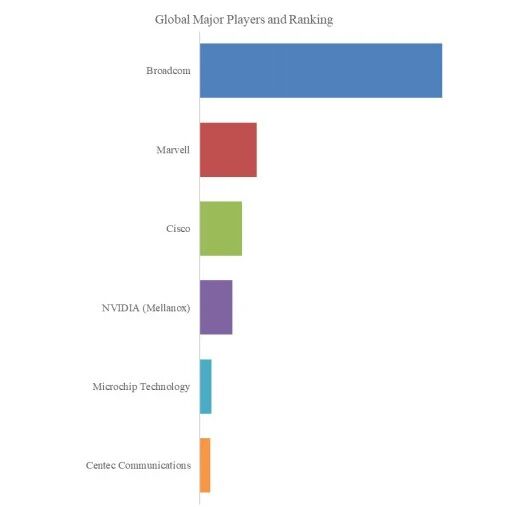
Core Viewpoint - The global Ethernet switch integrated circuit market is projected to grow from $4.86 billion in 2024 to $8.37 billion by 2031, with a compound annual growth rate (CAGR) of 7.26%, driven by the demand for higher-speed Ethernet and advancements in cloud computing, AI, and digital transformation [2][13]. Market Growth and Trends - The market is experiencing a significant shift towards higher-speed categories, particularly from 25G/100G to 200G/400G and even 800G switch architectures, reshaping revenue distribution and competitive dynamics [2][11]. - The revenue share of ≤ 25G chips is expected to decline from 25.63% in 2020 to approximately 9.34% by 2031, indicating a trend towards commoditization and integration into lower-end enterprise and industrial network devices [7][9]. - The 100G-400G segment remains a key revenue contributor, with its market share slightly decreasing from 47.31% in 2020 to 41.49% in 2024, while still experiencing revenue growth [8][11]. Competitive Landscape - Broadcom is the undisputed global leader with a market share of 54.59% in 2024, followed by Marvell at 12.95% and Cisco at 9.60%, which is expected to decline to 5.96% by 2030 due to a shift towards commercial chip adoption [4][9]. - The market is highly concentrated, with Broadcom and Marvell positioned as long-term winners due to their ability to invest heavily in R&D and innovation [11][13]. Product Type Evolution - The market is transitioning from traditional ≤ 25G and 25G-100G categories to higher-speed 100G-400G and 400G+ segments, driven by the expansion of cloud service providers and AI data centers [7][8]. - The 400G+ segment is the fastest-growing, expected to increase from $55 million in 2020 to $921 million in 2024, and projected to reach $3.24 billion by 2030, accounting for over 40% of total market revenue [8][11]. Application Trends - Commercial Ethernet switch integrated circuit solutions dominate the market, contributing 86.92% of total revenue in 2024, with expectations to exceed 92% by 2031, reflecting a trend of outsourcing hardware innovation to specialized semiconductor suppliers [9][11]. - The share of in-house developed integrated circuits is declining, from 18.37% in 2020 to an anticipated drop below 8% by 2031, due to the increasing complexity and costs associated with developing advanced switching chips [9][11]. Regional Insights - The Asia-Pacific region is the largest consumer market for Ethernet switch integrated circuits, driven by rapid cloud computing expansion in China, enterprise upgrades in Japan, and digital infrastructure development in India [11][13]. - North America remains at the technological forefront, primarily due to major cloud operators like Amazon, Google, Microsoft, and Meta adopting 400G/800G switch architectures [11][13].


Mizuho Sees Anthropic as Broadcom’s (AVGO) Fourth Hyperscale ASIC Partner, Raises Target
Yahoo Finance· 2025-10-23 18:51
Core Viewpoint - Broadcom Inc. is gaining attention as a leading player in the AI sector, with Mizuho reiterating an "Outperform" rating and raising the price target to $435 per share from $430, indicating confidence in its growth potential in the AI ASIC market [1][2]. Group 1: Customer Expansion and Revenue Potential - Mizuho identifies Anthropic as Broadcom's fourth customer, projecting it to generate $10 billion in revenue from "AI Racks" in the second half of 2026 [2][3]. - The company is also expected to benefit from a partnership with OAI, which is anticipated to ramp up to 10GW capacity by 2026, marking it as Broadcom's fifth customer [3]. Group 2: Product Innovations and Market Position - Broadcom has launched its third-generation CPO, Tomahawk 6-Davisson, which boasts approximately 70% lower power requirements and aims for over 5 million flap-free hours for reliability [3]. - The introduction of the Thor Ultra 800G NIC with advanced features such as telemetry and load-balancing RoCE, along with the expansion of the Jericho product line, positions Broadcom favorably in the competitive landscape [3]. Group 3: Market Dynamics and Competitive Landscape - The expansion of Broadcom's total addressable market (TAM) and market share in the AI ASIC sector is noted, with the company potentially having five hyperscale ASIC customers out of an estimated seven [2][3]. - Analysts suggest that the developments surrounding Anthropic may pose challenges for competitors like Marvell (MRVL), indicating a shifting competitive landscape in the AI chip market [2][3].
NVIDIA 的 InfiniBand 问题:Spectrum-X AI 架构、Tomahawk-5、Jericho-3AI 与 Quantum-2-Nvidia’s InfiniBand Problem - Spectrum-X AI Fabric, Tomahawk-5, Jericho-3AI, Quantum-2
2025-08-11 01:21
Summary of Key Points from the Conference Call Industry Overview - The discussion centers around the **semiconductor and networking industry**, particularly focusing on **Nvidia** and its competition with **Broadcom** in the context of AI infrastructure and networking technologies [1][4]. Core Insights and Arguments - **Nvidia's Position**: Nvidia is recognized for its visionary leadership under CEO Jensen Huang, with a strategic focus on accelerated computing and AI. The acquisition of **Mellanox** was aimed at enhancing its networking capabilities [2]. - **Networking Challenges**: Nvidia faces significant internal challenges with its **InfiniBand network stack**, which is complicated and has performance issues compared to Ethernet solutions [2][5]. - **Product Line Competition**: Nvidia has two competing product lines in networking: **Quantum InfiniBand** and **Spectrum Ethernet**. Broadcom similarly has **Tomahawk** and **Jericho** product lines, with increasing overlap due to new developments [4]. - **Market Demand Shift**: There is a clear market trend favoring Ethernet-based networks over InfiniBand, driven by hyperscaler demand. Ethernet networks, particularly those using **ConnectX-6/7 RoCE++**, show superior performance for AI applications compared to InfiniBand [5][24]. - **Cost and Deployment**: Ethernet is a larger market than InfiniBand, which helps reduce costs through economies of scale. The deployment costs for InfiniBand networks are significantly higher due to the need for more switches and cables [24][27]. Technical Challenges of InfiniBand - **Flow Control Issues**: InfiniBand's credit-based flow control can lead to resource exhaustion, backpressure propagation, and deadlock situations, particularly in large-scale deployments [16][17]. - **Scaling Problems**: As cluster sizes increase, the performance of InfiniBand networks degrades due to the aforementioned issues. The largest deployments face challenges that could hinder future scalability [19][21]. - **Latency and Performance**: InfiniBand is designed for low latency and high performance, but its management complexity can lead to unpredictable performance, especially in large AI model training scenarios [22][25]. Nvidia's Strategic Shift - **Pivot to Ethernet**: Nvidia is shifting focus from promoting InfiniBand to developing Ethernet-based solutions, recognizing the practical advantages of Ethernet in large-scale AI applications. This includes the introduction of **Spectrum-X AI fabrics** [44][45]. - **Integration of New Technologies**: Nvidia is exploring the integration of features like **SHARP** in InfiniBand switches to enhance performance for specific operations, although the overall strategy is leaning towards Ethernet solutions [47]. Additional Considerations - **Error Handling and Resilience**: The discussion highlights the importance of error handling in networking, with Ethernet solutions being more resilient and easier to manage in variable traffic conditions compared to InfiniBand [25][45]. - **Future of InfiniBand**: While InfiniBand has technical advantages, its relevance in the AI space may depend on Nvidia's ability to innovate and integrate compute capabilities within the network [47]. This summary encapsulates the key points discussed in the conference call, providing insights into the competitive landscape, technical challenges, and strategic directions of Nvidia and the broader networking industry.