MTIA 300芯片

Search documents
港股如何在地缘与估值优势间博弈?
Zhong Guo Yin He Zheng Quan· 2026-03-15 07:50
Market Performance - The Hang Seng Index fell by 1.13% to 25,465.6 points, while the Hang Seng Tech Index rose by 0.62% to 4,978.08 points, and the Hang Seng China Enterprises Index increased by 0.50% to 8,671.48 points during the week from March 9 to March 13, 2026[4]. - Among the sectors, Energy rose by 4.77%, Industrial by 3.87%, and Information Technology by 2.15%, while Real Estate fell by 3.79%, Materials by 3.17%, and Consumer Staples by 2.22%[6]. Liquidity and Fund Flows - The average daily trading volume on the Hong Kong Stock Exchange was HKD 2,934.26 billion, a decrease of HKD 481.59 billion from the previous week[12]. - Southbound capital saw a net inflow of HKD 524.40 billion, an increase of HKD 605.34 billion compared to the previous week[12]. - Over the past week, global active foreign funds experienced a net outflow of USD 4.59 million, while passive foreign funds saw a net outflow of USD 6.05 million[17]. Valuation and Risk Premium - As of March 13, 2026, the PE and PB ratios of the Hang Seng Index were 12.33 times and 1.27 times, respectively, placing them at the 80% and 64% percentile levels since 2010[27]. - The risk premium for the Hang Seng Index was calculated at 3.83%, which is at the 3% percentile level since 2010[29]. Geopolitical Impact - The ongoing conflict in the Middle East poses significant risks to the Hong Kong market, primarily due to potential disruptions in oil transport through the Strait of Hormuz, which could lead to increased inflation and operational costs for companies[48]. - A strong US dollar driven by market risk aversion may lead to reduced allocations to risk assets, further pressuring the Hong Kong market[48]. Investment Strategy - The report highlights that the greatest advantage for Hong Kong stocks is their valuation discount, but not all undervalued sectors are recommended for investment[49]. - Key sectors for potential investment include Consumer Discretionary, Financials, and Communication Services, which are expected to benefit from performance and valuation support[49].



Meta发布四颗芯片,疯狂堆料
半导体行业观察· 2026-03-12 01:39
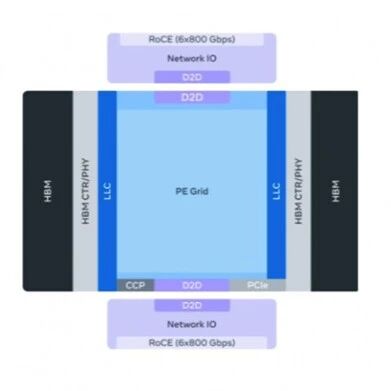
Core Viewpoint - Meta has introduced a new line of AI accelerators, the Meta Training and Inference Accelerator (MTIA), with a focus on high bandwidth memory (HBM) to enhance performance in AI workloads [2][3]. Group 1: Product Overview - Meta launched four new MTIA chips designed for specific tasks: MTIA 300 for R&R training, MTIA 400 for general workloads, and MTIA 450 and 500 for advanced AI workloads [3][4]. - The MTIA 500 chip is expected to have a performance of 30 petaflops and is set to be implemented in Meta's data centers by 2027 [4][5]. Group 2: Technical Specifications - MTIA 300 features 216 GB HBM with a bandwidth of 6.1 TB/s, while MTIA 400 has 288 GB HBM and 9.2 TB/s bandwidth [4]. - MTIA 450 doubles the memory bandwidth to 18.4 TB/s, and MTIA 500 offers a bandwidth of 27.6 TB/s with HBM capacity ranging from 384 GB to 512 GB [3][4]. Group 3: Competitive Landscape - Meta's MTIA 500 competes closely with NVIDIA's upcoming Rubin GPU, which offers 22 TB/s HBM4 bandwidth and 35 petaflops training capability [5]. - The MTIA 400 is noted as Meta's first fully in-house developed chip aimed at competing with the fastest AI accelerators on the market [5][6]. Group 4: Design Innovations - The MTIA 500 incorporates design innovations such as a 2×2 configuration and modular chip design, allowing for easier upgrades and cost efficiency [11]. - All MTIA models share the same chassis and network infrastructure, facilitating seamless upgrades across different chip generations [11].