
Microprocessor

Search documents
Microchip Technology(MCHP) - 2026 Q3 - Earnings Call Presentation
2026-02-05 22:00
Investor Presentation Fiscal Third Quarter 2026 A Leading Provider of Smart, Connected and Secure Embedded Solutions SAFE HARBOR Forward Looking Statement Safe Harbor: During the course of this presentation, we will make projections or other forward-looking statements regarding the future financial performance of the company (including our guidance) or future events, including our strategy, growth drivers, enhanced profitability, shareholder value creation, scalable bandwidth, enabling disaggregate compute, ...

【投融资视角】启示2025:中国集成电路行业投融资及兼并重组分析(附投融资汇总、兼并重组等)
Qian Zhan Wang· 2026-01-04 03:19
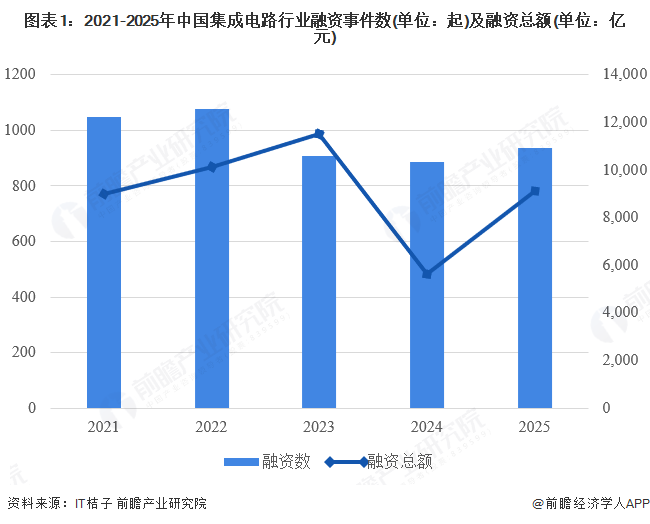
Industry Overview - The Chinese integrated circuit industry has seen a significant number of financing events, with over 1,000 events in both 2021 and 2022, indicating a peak period for investment [1] - In 2023, the number of financing events decreased, but the total financing amount increased to 1.15 trillion yuan, while in 2024, the number of events slightly declined, and the total financing amount halved to approximately 562.39 billion yuan [1] - By 2025, the number of financing events is expected to recover slightly to 938, with a total financing amount of approximately 911.05 billion yuan [1] Financing Events Summary - Major financing events in the Chinese integrated circuit industry for 2025 include various rounds of investment across different companies, with amounts often undisclosed [2][5][7] - Notable investments include 100 million yuan in Yanan Weiyan Technology and 1.43 billion yuan in Hongxing Zhixin, showcasing the active investment landscape [5][7] Financing Rounds Analysis - The most common financing round in the integrated circuit industry over the past five years has been the B round, with early-stage rounds like angel, Pre-A, and A rounds significantly outpacing later rounds [8] - Strategic investments have also been prevalent, indicating a strong interest in building long-term industry ecosystems [8] Regional Financing Distribution - Financing activities are heavily concentrated in eastern coastal provinces such as Guangdong, Jiangsu, and Zhejiang, with Jiangsu showing particularly high financing scales [9] - In contrast, provinces like Shandong and Henan have seen a significant decrease in financing events, while regions like Jilin and Tibet have almost no financing activity [9] Sector-Specific Financing Insights - The integrated circuit industry can be segmented into memory, logic chips, microprocessors, and analog chips, with memory leading with 374 financing events, significantly higher than logic chips (113 events), microprocessors (75 events), and analog chips (18 events) [13] - This reflects the strong demand for domestic alternatives in the memory sector and varying levels of investor interest across different segments [13] Representative Companies' Investment Activities - Key companies in the integrated circuit sector, such as Xinyuan Co., have made substantial investments in various startups to enhance their technological capabilities and strengthen their competitive edge [15][16][17][18] - For instance, Xinyuan Co. has invested 500 million yuan in Xinyuan Technology (Shanghai) and 100 million yuan in Xinyuan Microelectronics (Nanjing) [16] Mergers and Acquisitions - The competitive landscape among Chinese integrated circuit companies is characterized by numerous mergers and acquisitions, primarily focusing on horizontal integration to expand market share and achieve technological synergies [19][20] - Recent notable acquisitions include Huadian Co. acquiring 15% of Shengwei Ce Electronics and Xinyuan Co. acquiring 100% of Xinyuan Technology [20] Summary of Investment and M&A Trends - The investment activities in the Chinese integrated circuit industry are showing signs of recovery, with a notable increase in merger and acquisition events, indicating a dynamic market environment [22]




美国半导体行业_2025 年第三季度微处理器市场份额_AMD 和 ARM 在整体 CPU 市场强劲的情况下均抢占英特尔份额
2025-11-16 15:36
Summary of Microprocessor Market Share Conference Call Industry Overview - The conference call discusses the microprocessor market, specifically focusing on the performance of major players: AMD, Intel, and ARM in the 3Q25 period [1][8]. Key Points Market Performance - Total microprocessor unit shipments increased by 3.9% quarter-over-quarter (QoQ), surpassing the seasonal expectation of 2.4% QoQ, driven by strong server and notebook CPU shipments [1][5]. - Notebook MPU shipments rose by 3.0% QoQ, exceeding the seasonal decline of 1.5% QoQ, while desktop MPU shipments increased by 7.1% QoQ, which was below the seasonal increase of 18.1% QoQ [16]. - Server MPU shipments were up 1.8% QoQ, also above the seasonal expectation of a 5.8% decline, attributed to improved demand from cloud service providers (CSPs) [16]. Company-Specific Insights Intel (INTC) - Intel's overall MPU unit share decreased by 157 basis points QoQ from 65.8% in 2Q25 to 64.2% in 3Q25 [2][9]. - Specific declines in market share: - Notebook MPU share fell by 162 basis points QoQ from 66.9% to 65.3% - Desktop MPU share decreased by 131 basis points QoQ from 63.5% to 62.2% - Server MPU share dropped by 174 basis points QoQ from 63.3% to 61.5% [2][9]. AMD - AMD's overall MPU unit share increased by 108 basis points QoQ from 21.0% in 2Q25 to 22.1% in 3Q25 [3][11]. - Notable gains: - Notebook MPU share rose by 102 basis points QoQ from 17.3% to 18.3% - Desktop MPU share increased by 135 basis points QoQ from 30.2% to 31.5%, marking the highest share in the model's history since 2002 [3][11]. - AMD's server MPU share saw a slight decline of 8 basis points QoQ from 23.7% to 23.6% [3][11]. ARM - ARM's MPU unit share grew by 49 basis points QoQ from 13.2% in 2Q25 to 13.7% in 3Q25 [4][14]. - Gains included: - Notebook MPU share increased by 60 basis points QoQ from 15.7% to 16.3% - Server MPU share surged by 182 basis points QoQ from 13.0% to 14.8%, driven by Nvidia's GB200 strength and increased internal server adoption by CSPs [4][14]. - However, ARM's desktop MPU share slightly decreased by 4 basis points QoQ from 6.33% to 6.29% [4][14]. Analyst Ratings - The firm maintains a Neutral rating on AMD and a Sell rating on Intel [5][17]. Risks and Considerations - **Competition**: AMD faces direct competition from Intel in the microprocessor market and from NVIDIA in the graphics and AI GPU market, which could impact market share and estimates [20]. - **PC End Market**: AMD derives approximately 30% of its sales from the PC industry, making it sensitive to fluctuations in IT spending [21]. - **Customer Risk**: A significant portion of AMD's revenue comes from major clients like Sony and Microsoft, making it vulnerable to changes in their order volumes [21]. - **Macroeconomic Factors**: Intel's revenue is heavily reliant on the PC and server segments, which are also sensitive to IT spending trends [25]. Valuation - AMD's target price is set at $260.00, reflecting a 32x C27E EPS, aligned with historical averages due to high growth in the AI sector [19]. - Intel's target price is set at $29.00, based on its estimated book value, which is lower than the average for semiconductor companies due to reduced profitability [24]. Conclusion - The microprocessor market remains competitive, with AMD and ARM gaining ground at the expense of Intel. The overall market shows resilience with above-seasonal shipment growth, but risks related to competition and market dependency on IT spending persist. Analyst ratings reflect a cautious outlook for Intel while maintaining a neutral stance on AMD.
Microchip Technology(MCHP) - 2026 Q2 - Earnings Call Presentation
2025-11-06 22:00
Financial Performance - GAAP Revenue for Fiscal Second Quarter 2026 was $1,140.4 million, up 6.0% QoQ and down 2.0% YoY[17] - Gross Margin for Fiscal Second Quarter 2026 was 56.7%, increased by 236 basis points QoQ[17] - Operating Margin for Fiscal Second Quarter 2026 was 24.3%, increased by 364 basis points QoQ[17] - Diluted Earnings Per Share for Fiscal Second Quarter 2026 was $0.35, increased by 29.6% QoQ[17] - Adjusted Trailing Twelve Months (TTM) EBITDA was $1,102.9 million, representing 26.2% of TTM sales[17] - Adjusted Free Cash Flow was $38.3 million, representing 3.4% of net sales[17] Capital Allocation - The company paid $245.8 million in common dividends[17] - The company announced a common stock dividend of 45.5 cents per share for Q3FY26[17] - The company has reduced debt 24 out of the last 29 quarters[46] - The company has paid dividends for 92 consecutive quarters[46]
Microchip Technology(MCHP) - 2026 Q1 - Earnings Call Presentation
2025-08-07 21:00
Financial Performance - GAAP Revenue for Q1 FY2026 was $1,075.5 million, up 10.8% QoQ and down 13.4% YoY[18] - Gross Margin for Q1 FY2026 was 54.3%, an increase of approximately 240 basis points QoQ[18] - Operating Margin for Q1 FY2026 was 20.7%, an increase of approximately 670 basis points QoQ[18] - Adjusted Free Cash Flow was $244.4 million, representing 22.7% of net sales[18] - Adjusted TTM EBITDA was $1,166.8 million, or 27.5% of TTM sales[18] Capital Allocation - The company has paid approximately $4.4 billion in dividends[41] - The company has repurchased approximately $2.4 billion in shares[41] - The company has reduced debt by $7.3 billion over the last 28 quarters[41] - Total cash return in FY2025 was $1.07 billion[41] Company Overview - The company reported $4.4 billion in FY25 net sales[7]
花旗:美国半导体-4 月销售符合我们的预期,但低于季节性水平。维持半导体销售同比增长 8% 的预期
花旗· 2025-06-10 07:30
Investment Rating - The report maintains a positive investment rating for the semiconductor industry, forecasting a sales increase of 8% year-over-year (YoY) for 2025, amounting to $675.3 billion [5][20][12] Core Insights - April semiconductor sales were reported at $55.0 billion, reflecting an 11.1% month-over-month (MoM) decline, which is below the seasonal expectation of a 10.0% MoM decrease, but aligns with the report's estimate [1][2][8] - The report anticipates a below-seasonal growth in the second half of 2025 due to a tariff-induced correction, despite a strong start to the year [5][20] - The top picks for investment in the semiconductor sector are Analog Devices (ADI) and Texas Instruments (TXN), identified as the most defensive options during economic downturns [5][23][1] Sales Performance - April sales increased by 23.2% YoY, consistent with the report's expectations [2][8] - The three-month rolling average sales from February to April 2025 were $57.0 billion, showing a 20.9% YoY increase [9] Unit and Pricing Trends - Units excluding discretes decreased by 7.8% MoM, which is below the estimate of a 7.3% decline but better than the seasonal expectation of a 9.7% drop [3][14] - Average Selling Prices (ASPs) excluding discretes fell by 3.2% MoM, which is better than the estimated decline of 5.3% but below the seasonal increase of 0.2% [4][16] Future Projections - The report projects that units excluding discretes will grow by 4% YoY and ASPs will also increase by 4% YoY in 2025 [20][12] - The semiconductor industry is expected to experience seasonal growth in the first and second quarters of 2025, followed by below-seasonal growth in the third and fourth quarters [5][20]
美国半导体:2025 年第一季度微处理器市场份额 ——ARM 超越英特尔和 AMD,重申对 AMD 和英特尔的中性评级
2025-05-18 14:09
Summary of Microprocessor Market Share Conference Call Industry Overview - The conference call discusses the microprocessor market in the United States, focusing on the performance of major companies including ARM, AMD, and Intel during the first quarter of 2025 (1Q25) [1][7]. Key Points Market Performance - Total microprocessor unit shipments in 1Q25 decreased by 6.1% quarter-over-quarter (QoQ), which is better than the seasonal decline of 9.4% QoQ, primarily due to stronger-than-expected server CPU shipments [1][5]. - ARM gained market share, increasing its share by 281 basis points QoQ to 13.6% [1][4]. - AMD's overall market share decreased by 99 basis points QoQ to 21.1% [2][8]. - Intel's market share fell by 182 basis points QoQ to 65.3%, marking the lowest share recorded since 2002 [3][10]. Company-Specific Insights - **AMD**: - AMD's notebook MPU unit share dropped by 196 basis points QoQ to 18.8%, while its desktop share increased by 92 basis points to 26.2% [2][8]. - Server MPU share rose by 108 basis points to 24.4% [2][8]. - **Intel**: - Intel's desktop MPU share decreased by 66 basis points to 67.4%, and its notebook share fell by 219 basis points to 64.6% [3][10]. - Server MPU share declined by 210 basis points to 65.4% [3][10]. - **ARM**: - ARM's server MPU share increased by 102 basis points to 10.2%, driven by strong performance from Nvidia Grace CPUs [4][12]. - Notebook MPU share surged by 415 basis points to 16.6%, supported by Qualcomm and Google Chromebook CPUs [4][12]. - Desktop MPU share slightly decreased by 26 basis points to 6.4% [4][12]. Shipment Trends - Notebook MPU shipments fell by 6.9% QoQ, which is worse than the seasonal decline of 3.5% [5][14]. - Desktop MPU shipments decreased by 8.0% QoQ, significantly better than the seasonal decline of 21.8% [5][14]. - Server MPU shipments increased by 6.7% QoQ, contrasting with the expected seasonal decline of 11.5% [5][14]. Analyst Ratings - The analysts maintain a Neutral rating on both AMD and Intel, indicating a cautious outlook on their performance moving forward [1][15]. Additional Insights - The report highlights the competitive dynamics in the microprocessor market, with ARM making significant gains at the expense of both AMD and Intel [1][7]. - The data suggests a shift in market preferences, with ARM's growth in specific segments indicating potential long-term trends that could affect future market shares [4][12]. This summary encapsulates the key findings and insights from the conference call regarding the microprocessor market and the performance of major players within it.
Microchip (MCHP) FY Conference Transcript
2025-05-14 20:00
Summary of Microchip (MCHP) FY Conference Call - May 14, 2025 Company Overview - Microchip is a leading semiconductor company, ranked among the top five microcontroller suppliers globally, with a significant presence in the industrial market, holding the third-largest market share in industrial MCUs [2][41] - The company has a diverse portfolio, with 60% of its MCU offerings being 32-bit and higher architectures, alongside a solid analog and FPGA portfolio [2] Core Insights and Arguments Financial Performance and Outlook - Microchip has experienced a cyclical downturn but is optimistic about recovery, indicating a 7.7% sequential growth forecast for the June quarter [3][4] - The company is undergoing an inventory reduction program, expecting to decrease inventory by approximately $350 million in the current fiscal year [5] - Gross margins have bottomed out, with a long-term target of 65% non-GAAP gross margin and 40% non-GAAP operating margin [5] Market Dynamics - The company reported a book-to-bill ratio greater than one for the first time in nearly three years, indicating stronger order activity [7][10] - There is a distinction between demand pull-ins due to tariff expirations and genuine cyclical recovery, with the latter being more significant [7][12] - Inventory levels at distributors have decreased significantly, leading to increased reordering activity [11] Pricing Strategy - Microchip anticipates a mid-single-digit percentage decline in average pricing, which is more aggressive than some peers, driven by a strategy to gain market share [21][23] - The company is focusing on aggressive pricing for new designs to maintain competitiveness [23][24] Product Strategy and Innovation - Microchip is enhancing its total solution strategy (TSS) to increase attach rates of additional products per anchor product, with an average of four to five additional products per design [30][32] - The introduction of a new 64-bit microprocessor family based on RISC V architecture aims to provide more flexibility for customers, complementing existing ARM-based products [35][36] Competitive Landscape - The MCU market remains competitive, particularly in the 8-bit segment, where Microchip faces increased competition from Chinese vendors [41][43] - Microchip's strength lies in industrial and automotive sectors, where customers prefer comprehensive platforms over individual components [45] Megatrends and Growth Areas - Megatrend revenues have historically grown at twice the rate of Microchip's overall business, representing 47% of revenues in fiscal 2024 [46][48] - The company sees significant opportunities in AI and machine learning, particularly in robotics and predictive maintenance applications [49][50] Aerospace and Defense Segment - The aerospace and defense segment has shown resilience, growing from 11% to 18% of total revenue, driven by strong demand for radiation-hardened products [53][55] Manufacturing and Capacity - The closure of the Fab 2 facility is expected to streamline operations without significant capacity loss, as production will shift to other fabs [58][59] - Microchip maintains a balanced approach with 35% to 40% of wafer needs met internally, with plans for gradual capacity expansion [62][63] Other Important Insights - The company is closely monitoring inventory levels and expects to increase production as inventory falls below 200 days [66][67] - Significant inventory reserve charges are anticipated to decrease as inventory levels normalize, positively impacting gross margins [70][73] This summary encapsulates the key points discussed during the conference call, highlighting Microchip's strategic direction, market dynamics, and financial outlook.
Microchip Technology(MCHP) - 2025 Q4 - Earnings Call Presentation
2025-05-08 20:55
Financial Performance & Strategy - The company reported FY25 net sales of $4.4 billion[7] - The company's strategic shift to Megatrend business increased from 33% to 47% of total revenue[20] - The company's GAAP revenue for Fiscal Fourth Quarter 2025 was $970.5 million, a 5.4% QoQ decline and a 26.8% YoY decline[23] - The company's GAAP revenue for Fiscal Year 2025 was $4.402 billion[26] - The company's Adj Free Cash Flow for Fiscal Fourth Quarter 2025 was $182.6 million, representing 18.8% of net sales[23] - The company's Adj Free Cash Flow for Fiscal Year 2025 was $742.5 million, representing 16.9% of revenue[26] Capital Allocation - The company's total cash return in FY2025 was $1.07 billion[46] - The company's dividends paid was ~$4.2 billion[46] - The company's shares repurchased was ~$2.4 billion[46] Future Outlook - The company is targeting inventory reduction of >$350 million by March 31, 2026[32] - The company's Q1 FY26 GAAP Revenue guidance is $1,045.0 million at the mid-point[27]