
Flash

Search documents
未知机构:东吴电子陈海进存储春节一览卖方市场加剧产品导入价格股价全面加-20260224
未知机构· 2026-02-24 03:30
Summary of Conference Call Records Company and Industry Involved - **Company**: Kioxia (铠侠) - **Industry**: Semiconductor Storage Industry Key Points and Arguments 1. **Kioxia's Q3 FY2025 Performance**: - Revenue increased by 21% quarter-over-quarter and 20% year-over-year - Net profit surged by 114.9% quarter-over-quarter, with a net profit margin of 16.5% - Adjusted net profit forecasted at 340 billion yen, exceeding market expectations by more than double [1][2] 2. **NAND Supply Situation**: - Kioxia reported that NAND production capacity for the entire year of 2026 is already sold out - Inventory levels are low, indicating a continued tight supply-demand situation expected to last until 2027 [1][2] 3. **SK Hynix Investor Meeting Insights**: - The storage market has entered a definitive seller's market, with no customer demand fully satisfied for 2026 - DRAM/NAND inventory is only at 4 weeks, and the entire capacity for HBM is sold out for 2026 - Expansion bottlenecks for standard DRAM due to insufficient cleanroom space are evident [2] 4. **Apple's Supplier Strategy**: - Bloomberg reported that Apple is considering expanding its list of storage chip suppliers, planning to include Longsys and Changxin as new suppliers [2] 5. **Prepayment Trends in Flash Manufacturing**: - Phison indicated that some flash manufacturers are now requiring buyers to prepay for three years of goods (not just deposits) - An internal report from a manufacturer suggests that shortages will persist until 2030 [2] 6. **Stock Price Movements**: - During the holiday period (February 16-23), overseas storage manufacturers saw stock price increases: Samsung +8%, SK Hynix +7%, Micron +4%, GigaDevice +4%, Montage +6%, SanDisk +4% [2] Additional Important Insights 1. **Long-term Market Trends**: - The current cycle is characterized by strong sustainability and high certainty, indicating it is not a short-term pulse but a long-term industrial trend expected to span several years - Strategic allocation in the storage sector is recommended due to its significant value [3]
新一轮存储超级周期来了,一辈子只有一次
Hua Er Jie Jian Wen· 2026-02-17 08:21
Core Insights - The storage industry is entering a "once-in-a-lifetime" super cycle driven by the AI boom, with demand for storage chips skyrocketing due to the requirements of AI applications [1][16]. - Phison Electronics, a leader in NAND flash memory controllers, is at the center of this supply-demand battle, indicating that the market is not just facing shortages but a life-and-death struggle from cloud to endpoint [3][4]. Supply and Demand Dynamics - The demand for storage is quantitatively staggering; for instance, NVIDIA's new GPU, Vera Rubin, requires over 20 TB of SSD per unit, which could consume 200 EB of storage if 10 million units are sold, equating to 20% of last year's global NAND Flash production [4][22]. - The current supply-demand imbalance has led to unprecedented pricing and contract terms, including a requirement for buyers to prepay three years' worth of cash for flash memory, a first in the industry [5][29]. Market Impact on Consumer Electronics - The AI-driven demand for storage is severely impacting traditional consumer electronics, with predictions of a reduction in global smartphone production by 200 to 250 million units this year, alongside significant declines in PC and TV shipments [9][30]. - The cost of components has surged dramatically; for example, the price of an 8GB eMMC chip has skyrocketed from $1.5 to over $20, significantly affecting the bill of materials (BOM) for consumer products [10][31]. Long-term Shortages and Production Challenges - Major manufacturers like Samsung and SK Hynix are adopting a cautious approach to expansion due to past losses, with industry experts predicting that the current shortages could last until 2027 or even 2030 [12][36]. - The physical limitations of production capacity and equipment shortages are exacerbating the situation, as the semiconductor equipment supply is limited and the ramp-up time for new facilities is lengthy [13][43]. Future Opportunities in Space Computing - There is potential for space applications to alleviate some of the AI computing bottlenecks, as space environments can provide solutions for power and cooling challenges faced by terrestrial data centers [14][45]. - Successful developments in this area could lead to significant growth in the next 2-3 years, although the high reliability requirements for space applications present substantial challenges [15][48]. Strategic Positioning of Phison Electronics - Phison is focusing on high-value solutions and long-term investments in R&D, with a 50% increase in R&D spending this year, aiming to transition from a low-margin player to a provider of high-value solutions [16][52]. - The company is leveraging its expertise in AI and space applications to differentiate itself in a highly competitive market, emphasizing the importance of maintaining strong relationships with upstream suppliers [60][62].



一线厂商CEO:这一轮存储超级周期,一辈子只有一次,前无古人后无来者
Hua Er Jie Jian Wen· 2026-02-17 07:49
Core Insights - The storage industry is entering a "once-in-a-lifetime" super cycle driven by the AI boom, with demand for storage chips expected to surge dramatically [1][11]. - Phison Electronics, a leader in NAND flash memory controllers, highlights a critical supply-demand imbalance, indicating that the market is not just facing shortages but a life-and-death struggle across the supply chain [3][4]. Supply and Demand Dynamics - The demand for storage is quantitatively staggering; for instance, NVIDIA's new GPU, Vera Rubin, could consume 200 Exabytes of storage if 10 million units are sold, which is 20% of last year's total NAND Flash production [4][17]. - The AI-driven demand is validated by over $600 billion in capital expenditures from the four major U.S. cloud service providers this year, indicating a robust and ongoing need for storage solutions [4][14]. Market Conditions - The supply chain is experiencing unprecedented pressure, with upstream manufacturers demanding prepayment for three years of orders, a practice not seen before in the electronics industry [5][22]. - Phison Electronics is planning to raise $1 to $2 billion in operational funds to secure upstream supply sources amid these stringent market conditions [5][25]. Impact on Consumer Electronics - The consumer electronics sector is predicted to face a "collapse wave," with global smartphone production expected to decrease by 200 to 250 million units this year due to material shortages [6][7]. - The cost of components has skyrocketed; for example, the price of an 8GB eMMC chip has surged from $1.5 to over $20, significantly impacting the bill of materials for consumer products [7][26]. Long-term Supply Constraints - Major manufacturers like Samsung and Micron are adopting a cautious approach to capacity expansion due to past losses, leading to a belief that shortages could persist until at least 2027, with some reports suggesting as late as 2030 [8][31][32]. - The current shortages are primarily driven by cloud demand, and a potential surge in AI infrastructure development in China could exacerbate the situation further [8][34]. Emerging Opportunities - Space applications are seen as a potential solution to the AI computing bottleneck, as they can leverage solar power and natural cooling, although the reliability requirements are significantly higher [9][10]. - Phison Electronics aims to transition from a traditional memory supplier to a provider of high-value solutions, investing heavily in R&D to adapt to the evolving market landscape [11][47].

HUA HONG SEMI(01347) - 2025 Q4 - Earnings Call Transcript
2026-02-12 10:02
Financial Data and Key Metrics Changes - Fourth quarter 2025 sales revenue reached an all-time high of $659.9 million, a 22.4% increase compared to Q4 2024 and a 3.9% increase over Q3 2025 [3][7] - Gross margin for Q4 2025 was 13%, up 1.6 percentage points from Q4 2024, driven by improved average selling prices and cost reduction efforts [8] - For the full year 2025, revenue was $2.4 billion, a growth of 19.9% year-on-year, with a gross margin of 11.8% [17][18] - Net loss for Q4 2025 was $18.7 million, narrowed by 80.6% compared to Q4 2024 [9] Business Line Data and Key Metrics Changes - Revenue from embedded non-volatile memory was $180.2 million, a 31.3% increase compared to Q4 2024, driven by demand for MCU and smart car ICs [11] - Revenue from power discrete was $168.9 million, a 2.4% increase compared to Q4 2024, mainly due to demand for general MOSFET products [11] - Revenue from analog and power management IC was $173.8 million, a 40.7% increase over Q4 2024, driven by demand for power management IC products [12] Market Data and Key Metrics Changes - Revenue from China was $539.3 million, contributing 81.8% of total revenue, a 19.6% increase compared to Q4 2024 [10] - Revenue from North America was $72.8 million, a 51.3% increase compared to Q4 2024 [10] - Revenue from Europe was $19.3 million, a 35.6% increase compared to Q4 2024, driven by demand for MCU and IGBT products [10] Company Strategy and Development Direction - The company is focused on developing world-class specialty technology platforms and deepening collaborations with strategic customers [5] - The first phase of capacity construction for the second 12-inch production line in Wuxi exceeded expectations, and the acquisition of the Shanghai 12-inch manufacturing base progressed as planned [4] Management's Comments on Operating Environment and Future Outlook - Management expressed confidence in seizing growth opportunities amid changes in the global semiconductor industry, particularly driven by AI demand [5] - The company expects revenue for Q1 2026 to be in the range of $650 million to $660 million, with a projected gross margin of 13% to 15% [19] Other Important Information - Capital expenditures in Q4 2025 were $633.5 million, with significant investments in both 12-inch and 8-inch production lines [12] - Cash and cash equivalents increased to $4.196 billion by December 31, 2025, compared to $3.9047 billion at the end of Q3 2025 [14] Q&A Session Summary Question: Strategic results from the acquisition of Huali - The acquisition of Fab Five is expected to enhance long-term growth by increasing company scale and optimizing technology distribution across manufacturing capacities [22][23] Question: Supply-demand relation of 8-inch and 12-inch mature fab business - Management noted that changes in ownership of foundry capacities do not significantly alter supply-demand dynamics, and the overall trend is positive for the company [25][26] Question: Capacity utilization rate and its drivers - A slight decline in capacity utilization was attributed to the rapid ramp-up of Fab Nine, with management indicating that the change is minimal [30] Question: Future performance drivers related to AI products - AI-related products are expected to drive significant revenue growth, particularly in power management and automotive sectors [33][34] Question: Sustainability of current memory cycle - Management acknowledged the cyclical nature of the memory market but indicated that the current cycle driven by AI may last longer than previous cycles [37] Question: Price sustainability amid rising raw material costs - Management does not foresee significant increases in costs due to raw material prices, as domestic materials are becoming more competitive [45] Question: Equipment localization rate for Fab Nine B - The localization rate for equipment in Fab Nine B is expected to be higher than that of Fab Nine A, reflecting improvements in domestic equipment capabilities [71]
HUA HONG SEMI(01347) - 2025 Q4 - Earnings Call Transcript
2026-02-12 10:02
Financial Data and Key Metrics Changes - Fourth quarter 2025 sales revenue reached an all-time high of $659.9 million, a 22.4% increase compared to Q4 2024 and a 3.9% increase over Q3 2025 [3][7] - Gross margin for Q4 2025 was 13%, up 1.6 percentage points from Q4 2024, driven by improved average selling prices and cost reduction efforts [8] - Net loss for the period was $18.7 million, narrowed by 80.6% compared to Q4 2024, but widened by 159.9% from Q3 2025 [9] - For the full year 2025, revenue was $2.4 billion, a growth of 19.9% over the prior year, with a gross margin of 11.8% [17][18] Business Line Data and Key Metrics Changes - Revenue from embedded non-volatile memory was $180.2 million, an increase of 31.3% compared to Q4 2024 [11] - Revenue from standalone non-volatile memory was $56.6 million, up 22.9% compared to Q4 2024 [11] - Revenue from power discrete was $168.9 million, a 2.4% increase compared to Q4 2024 [11] - Revenue from analog and power management IC was $173.8 million, a 40.7% increase over Q4 2024 [12] Market Data and Key Metrics Changes - Revenue from China was $539.3 million, contributing 81.8% of total revenue, a 19.6% increase compared to Q4 2024 [10] - Revenue from North America was $72.8 million, a 51.3% increase compared to Q4 2024 [10] - Revenue from Europe was $19.3 million, a 35.6% increase compared to Q4 2024 [10] Company Strategy and Development Direction - The company is focused on developing world-class specialty technology platforms and deepening collaborations with strategic customers [5] - The first phase of capacity construction for the second 12-inch production line in Wuxi exceeded expectations, with plans for further expansion [4][5] - The company aims to optimize the distribution of specialty technologies across its manufacturing capacity to enhance efficiency and profitability [22][23] Management's Comments on Operating Environment and Future Outlook - Management expressed confidence in seizing growth opportunities amid changes in the global semiconductor industry, particularly driven by AI demand [5] - The company anticipates revenue for Q1 2026 to be in the range of $650 million to $660 million, with a projected gross margin of 13% to 15% [19] - Management noted that the current semiconductor market dynamics, particularly in logic and memory, present positive opportunities for pricing adjustments [26] Other Important Information - Capital expenditures in Q4 2025 were $633.5 million, with significant investments in both 12-inch and 8-inch production lines [12] - Cash and cash equivalents increased to $4.196 billion by December 31, 2025, compared to $3.9047 billion at the end of Q3 2025 [14] - Total assets increased to $14.4538 billion, with total liabilities rising to $5.2895 billion, resulting in a debt ratio of 36.6% [17] Q&A Session Summary Question: Strategic results from the acquisition of Huali - The acquisition of Fab Five is expected to enhance long-term growth by increasing company scale and optimizing technology distribution across manufacturing capacities [22][23] Question: Supply-demand relation of 8-inch and 12-inch mature fab business - Management noted that changes in ownership of foundry capacities do not significantly alter supply-demand dynamics, and the overall market conditions are viewed positively for logic foundries [25][26] Question: Capacity utilization rate and its drivers - A slight decline in capacity utilization was attributed to the ramp-up of Fab Nine, with expectations for quick reallocation of capacity across platforms [30] Question: Future performance drivers related to AI products - AI-related products are expected to drive significant growth, particularly in power management and automotive sectors [32][34] Question: Sustainability of current memory cycle - Management acknowledged the cyclical nature of the memory market but expressed optimism about sustained growth driven by AI demand in the near future [37] Question: Price sustainability amid rising raw material costs - Management indicated that while some raw material costs are rising, overall cost structure is not expected to be significantly impacted due to increased use of domestically produced materials [45] Question: Equipment localization rate for Fab Nine B - The localization rate for equipment in Fab Nine B is expected to be higher than that of Fab Nine A, reflecting improvements in domestic equipment capabilities [69]
HUA HONG SEMI(01347) - 2025 Q4 - Earnings Call Transcript
2026-02-12 10:00
Financial Data and Key Metrics Changes - Hua Hong Semiconductor reported Q4 2025 sales revenue of $659.9 million, a 22.4% increase compared to Q4 2024 and a 3.9% increase over Q3 2025, driven by increased wafer shipments and improved average selling prices [3][6] - The gross margin for Q4 2025 was 13%, up 1.6 percentage points from Q4 2024, primarily due to improved average selling prices and cost reduction efforts [7] - For the full year 2025, the company achieved sales revenue of $2.4 billion, a 19.9% growth year-on-year, with a gross margin of 11.8% [16][17] Business Line Data and Key Metrics Changes - Revenue from embedded non-volatile memory was $180.2 million, a 31.3% increase compared to Q4 2024, driven by demand for MCUs and smart car ICs [11] - Revenue from power discrete was $168.9 million, a 2.4% increase compared to Q4 2024, mainly due to demand for general MOSFET products [11] - Revenue from analog and power management IC was $173.8 million, a 40.7% increase over Q4 2024, driven by demand for power management IC products [12] Market Data and Key Metrics Changes - Revenue from China was $539.3 million, contributing 81.8% of total revenue, a 19.6% increase compared to Q4 2024 [10] - Revenue from North America was $72.8 million, a 51.3% increase compared to Q4 2024, driven by demand for power management ICs and MCUs [10] - Revenue from Europe was $19.3 million, a 35.6% increase compared to Q4 2024, mainly due to demand for MCUs and IGBT products [10] Company Strategy and Development Direction - The company plans to maintain a strong focus on developing world-class specialty technology platforms and deepen collaborations with strategic customers domestically and internationally [5] - The first phase of capacity construction for the second 12-inch production line in Wuxi exceeded expectations, and the acquisition of the Shanghai 12-inch manufacturing base progressed as planned [4] Management Comments on Operating Environment and Future Outlook - Management expressed confidence in seizing growth opportunities amid changes in the global semiconductor industry, particularly driven by AI demand [5] - The company expects revenue for Q1 2026 to be in the range of $650 million to $660 million, with a projected gross margin of 13% to 15% [18] Other Important Information - Net cash flows from operating activities were $246 million, a 29.5% decrease compared to Q4 2024, mainly due to increased payments to suppliers [12] - Capital expenditures in Q4 2025 were $633.5 million, including significant investments in 12-inch and 8-inch production lines [12] Q&A Session Summary Question: Strategic results from the acquisition of Huali - The acquisition of Fab Five is expected to enhance long-term growth by increasing company scale and optimizing the distribution of specialty technologies across manufacturing capacity [21][22] Question: Supply-demand relation of 8-inch and 12-inch mature fab business - Management noted that changes in ownership of foundry capacity do not significantly alter supply-demand dynamics, and the overall trend is positive for the company due to its focus on logic foundry business [24][25] Question: Capacity utilization rate and demand drivers - The slight decline in capacity utilization is attributed to the ramp-up of Fab Nine, with expectations for AI-related products to drive future revenue growth [30][32] Question: Sustainability of current memory cycle - Management acknowledged the cyclical nature of the memory market but indicated that the current cycle driven by AI may last longer than previous cycles [38] Question: Price sustainability amid rising raw material costs - Management does not foresee significant increases in costs from raw materials, as domestic materials are becoming more competitive [44][45] Question: Equipment localization rate for Fab Nine B - The localization rate for equipment in Fab Nine B is expected to be higher than that of Fab Nine A, reflecting improvements in domestic equipment capabilities [71]
只会写文档的产品经理没有未来,AI编程智能体正在终结“翻译官”时代
3 6 Ke· 2026-02-11 23:16
Core Insights - The role of Product Managers (PMs) is undergoing a significant transformation due to advancements in AI, shifting from a translation role to one focused on problem definition and product taste [1][3][15] - The traditional process of creating detailed requirement documents is being replaced by a more streamlined approach where clear problem statements are directly fed to AI agents, resulting in faster product iterations [5][11] Group 1: Changes in Product Management - The essence of a PM's job has shifted from translating customer needs into specifications to refining intentions so that AI can take action directly [4][11] - The time taken to move from "knowing what to do" to "having it done" has drastically reduced, with the entire cycle now potentially taking just hours instead of weeks [5][6] - The pace of product releases is accelerating, with companies launching products at a speed comparable to years of previous AI advancements [6] Group 2: New Skills for Product Managers - Problem shaping has become a core skill, requiring PMs to clearly articulate customer pain points for AI agents to act upon [7] - Context curation is essential, as the quality of AI outputs is directly proportional to the quality of the context provided by PMs [7][8] - Evaluating the quality of AI-generated outputs has become crucial, as PMs must discern between technically feasible solutions and those that genuinely address user needs [8][9] Group 3: Evolving Workflows - The traditional workflow of PMs is being replaced by a new model where they collaborate with AI to develop and iterate on products in real-time [11][12] - PMs are encouraged to embrace ambiguity and explore various solutions before locking in on a single approach, allowing for more innovative outcomes [12][14] - The focus is shifting from merely documenting requirements to deeply understanding problems, which enhances the value of PMs in the AI era [15][16]
猝不及防,Adobe关停2D动画软件Animate拥抱AI,最惨学生:一学期的课白上了
3 6 Ke· 2026-02-03 10:02
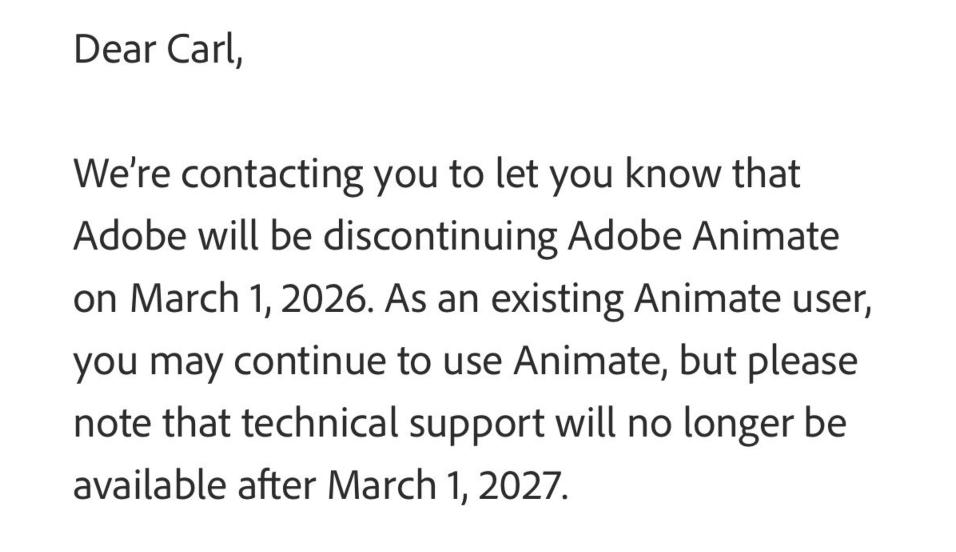
Core Viewpoint - Adobe has announced the discontinuation of Adobe Animate, a 2D animation software that has been in use for over 25 years, primarily due to a shift in focus towards AI technologies [8][19]. Group 1: Announcement and User Reactions - Adobe officially notified users that sales of Adobe Animate will cease on March 1, 2026, leading to widespread disbelief and anger among users, particularly those who have recently invested time in learning the software [3][8]. - Long-time users expressed frustration over Adobe's lack of communication and support for Animate, feeling betrayed by the sudden decision [5][17]. - The decision has significant implications for various professionals, including web animators, game developers, and independent creators who rely on Animate for their work [10][12]. Group 2: Reasons for Discontinuation - The primary reason cited for the discontinuation is Adobe's strategic pivot towards AI, with the company focusing on developing AI-driven tools across its product suite [19]. - Despite the software's historical significance and continued use, Adobe has not developed a suitable replacement that matches the capabilities of Animate, particularly in terms of frame-by-frame animation control [19][20]. Group 3: User Concerns and Alternatives - Users are concerned about the lack of a viable alternative, as transitioning to other software like Toon Boom involves high migration costs and a steep learning curve [11][12]. - Adobe's proposed solutions for users include using other Adobe applications to replicate some of Animate's functionalities, which many users find inadequate [14][19]. - The abrupt nature of the announcement and the absence of a clear transition plan have left users feeling unsupported and frustrated [17][19]. Group 4: Historical Context and Legacy - Adobe Animate, originally launched as FutureSplash Animator in 1996, played a crucial role in transforming the internet by enabling rich multimedia content [20][25]. - The software's legacy includes significant contributions to independent animation and web gaming, despite its decline in recent years [29].

晶圆代工厂,停止接单
半导体行业观察· 2026-01-30 02:43
公众号记得加星标⭐️,第一时间看推送不会错过。 晶相光在重讯中指出,力积电承接订单策略出现转变,主因在于其内部产能配置调整。不过,晶相光 目前已掌握的供应产能,仍可支应现阶段营运所需,并有能力达成公司对2026年度的销售目标。 晶相光进一步说明,力积电为公司主要晶圆供应商之一,最近一年度的进货金额占比高达58%。力积 电于29日下午正式通知,自今年第2季起将停止接单生产晶相光部分主要产品,公司随即启动相关因 应机制,以降低对营运的影响。 针对供应结构的变化,晶相光表示,已全面展开多项应变措施,包括与现有及潜在晶圆代工伙伴密切 洽谈,加速既有产品的制程转移与重新验证作业,同时推进中长期技术路线图布局。公司强调,将以 确保产品品质、交期稳定及客户权益为最高原则,并审慎评估供应链调整对整体营运可能带来的影 响。 DRAM需求强劲 力积电表示,为争取时效,董事会已于日前针对投资新设备提升DRAM 制程的规画通过增资案,配 合铜锣厂售予美光、双方策略合作的合约在第二季签订,待力积电今年度股东常会通过后,将根据经 营团队的规划尽速展开设备采购作业,将P3 厂现有月产逾三万片的DRAM 生产线升级。 力积电透露,根据双方已 ...


兆易创新港股上市首日收涨37.53%,清华物理系校友朱一明已打造两家千亿芯片巨头
Sou Hu Cai Jing· 2026-01-20 10:34
Core Viewpoint - The successful IPO of Zhaoyi Innovation marks a significant milestone for China's semiconductor industry, highlighting the company's growth and its founder's vision in the global chip market [1][2]. Company Overview - Zhaoyi Innovation, founded in 2005, has evolved from a startup to a key player in the global chip industry, offering a diverse range of products including Flash, niche DRAM, MCU, and analog sensors [3]. - The company is recognized as the only integrated circuit design firm globally that ranks in the top ten across four categories: NOR Flash, SLC NAND Flash, niche DRAM, and MCU [3][4]. Market Position - Zhaoyi Innovation's global rankings in product categories are as follows: - NOR Flash: 1st globally, 1st in China - SLC NAND Flash: 6th globally, 1st in China - Niche DRAM: 7th globally, 2nd in China - MCU: 8th globally, 1st in China [4]. Financial Performance - For the first three quarters of 2025, the company reported revenues of 6.832 billion yuan and a net profit of 1.083 billion yuan, reflecting year-on-year growth of 20.92% and 30.18%, respectively [6]. Future Plans - The company aims to capture at least one-third of the domestic niche DRAM market, valued between 3 billion to 4 billion USD, over the next five years [6]. - Zhaoyi Innovation is accelerating the mass production of chips for cutting-edge fields such as automotive cockpits, AIPC, and robotics to leverage the growth opportunities presented by AI [6]. IPO Details - The IPO raised approximately 4.610 billion HKD by issuing 28.916 million H-shares at an initial price of 162 HKD per share, with 40% of the funds allocated for R&D enhancement and 35% for strategic investments and acquisitions [2]. - The listing attracted significant interest from investors, with 18 cornerstone investors committing a total of 300 million USD [2]. Leadership and Vision - Founder Zhu Yiming, an alumnus of Tsinghua University, has played a pivotal role in establishing Zhaoyi Innovation and is also leading Changxin Technology, which is positioned to become a major player in DRAM manufacturing [5][6]. - Changxin Technology is currently pursuing an IPO on the Sci-Tech Innovation Board, aiming to raise 29.5 billion yuan with a pre-IPO valuation exceeding 150 billion yuan [6].
