
Mobile Phone

Search documents
最高1500元!河南2026年家电、数码产品补贴实施细则公布
Xin Lang Cai Jing· 2026-02-28 03:43
Core Viewpoint - The Henan Province has announced the implementation details for the 2026 subsidy program for replacing old household appliances and digital products, following the earlier vehicle trade-in subsidy policy [1][3]. Subsidy Scope - The subsidy covers six categories of household appliances: refrigerators (including freezers), washing machines (including washer-dryer combos), televisions (including laser TVs, excluding projectors), air conditioners (including home central air conditioning), computers (branded, excluding assembled machines), and water heaters (including wall-mounted boilers) [2][5]. - It also includes four categories of digital and smart products: mobile phones, tablets, smartwatches (bands), and smart glasses, with a single item sales price not exceeding 6,000 yuan [2][5]. Subsidy Standards - For household appliances, a subsidy of 15% of the final sales price is provided for energy-efficient or water-efficient products, with a maximum subsidy of 1,500 yuan per item for each consumer [6]. - For digital and smart products, a similar subsidy of 15% applies, with a maximum of 500 yuan per item for each consumer [6]. Participation Process - Consumers must log into the Yunshangfu APP for real-name registration and obtain subsidy vouchers [7]. - Upon purchasing eligible products, consumers will receive an immediate discount at the point of sale, and merchants must issue invoices reflecting the actual payment plus the government subsidy [7]. - Merchants are required to collect necessary information for subsidy verification, including product serial numbers and activation codes for certain devices [8]. Basic Conditions for Participants - Participants must be legally registered entities with independent accounting, primarily engaged in retail of household appliances and digital products, and must have the capability for after-sales services [9]. - They must have a good credit status, with no significant safety incidents or violations in the past two years [9]. - Participants must publicly disclose product pricing and ensure compliance with subsidy regulations [10]. Responsibilities and Requirements - The business department is responsible for determining and publishing the list of participating entities, overseeing compliance, and managing funds [12]. - The finance department will handle fund disbursement and monitoring, aiming for efficient subsidy payments [12]. - Market regulation departments will ensure product quality and price monitoring, protecting consumer rights [12]. - Participants must adhere to legal regulations and avoid fraudulent practices, with penalties for violations [14].
换新补贴+年味盛宴 兴安盟多场活动迎春接福
Xin Lang Cai Jing· 2026-02-14 09:16
Group 1 - The core theme of the consumption promotion in Xing'an League is "Warm Spring on the Ridge, Beneficial Purchase in Xing'an," featuring enhanced policy subsidies and integration of commerce, culture, and tourism [1] - A total of 8.5 million yuan in consumption vouchers will be distributed across the region, with trade-in subsidies for automobiles and home appliances reaching up to 20,000 yuan [1] - The new trade-in policy, effective from January 1, 2026, will cover 12 categories of home appliances and digital products, offering a 15% subsidy on the selling price for energy-efficient appliances and digital products [1] Group 2 - The new spring lantern festival at the Guiliuhe Ecological Park in Keyou Qianqi will run until March 4, featuring over 40 unique lantern displays and a variety of cultural performances [3] - The second annual New Year goods festival in Xing'an League, which started on February 4, attracted over 150 merchants and showcased more than 1,000 specialty products, achieving sales of 500,000 yuan on the first day [3] - Online live-streaming sales through platforms like Douyin and JD.com are promoting local agricultural products nationwide as part of the "Xing'an Cloud New Year Goods Festival" [3]


AI and Security in your Daily Life | Ashok Kanagala | TEDxLincoln Sudbury HS
TEDx Talks· 2026-02-09 17:14
[applause] Good afternoon everybody. Let me ask you a question. How many of you used mobile phone when you before coming here.Maybe you have used it for quick check on Instagram, Snapchat and or play a quick game. Well, there you go. Whether you realize it or not, you are already there with AI.It is trying to help you, trying to prompt you the right information or sometimes confusing you. Today we are going to explore how AI affects your daily life and why security matters and along with that how to be safe ...

2025 年中国手机:激活量 vs 出货量
程序员的那些事· 2026-01-22 05:15
Core Viewpoint - The article discusses the shipment data released by IDC, highlighting the performance of various smartphone manufacturers in terms of shipment volume and market share for 2024 and 2025, along with year-on-year growth rates [2][3]. Group 1: Shipment Data Overview - Huawei is projected to ship 46.7 million units in 2025, holding a market share of 16.4%, down from 47.6 million units and 16.6% market share in 2024, reflecting a year-on-year decline of 1.9% [3]. - Apple is expected to ship 46.2 million units in 2025, with a market share of 16.2%, an increase from 44.4 million units and 15.5% market share in 2024, showing a growth of 4.0% [3]. - Vivo's shipment is forecasted at 46.1 million units in 2025, maintaining a market share of 16.2%, down from 49.3 million units and 17.2% market share in 2024, indicating a decline of 6.6% [3]. - Xiaomi is anticipated to ship 43.8 million units in 2025, with a market share of 15.4%, up from 42.0 million units and 14.7% market share in 2024, reflecting a growth of 4.3% [3]. - OPPO is projected to ship 43.4 million units in 2025, holding a market share of 15.2%, slightly increasing from 42.5 million units and 14.8% market share in 2024, with a growth of 2.1% [3]. - The total shipment for all manufacturers is expected to be 284.6 million units in 2025, a slight decrease from 286.2 million units in 2024, resulting in a year-on-year decline of 0.6% [3].



最高补贴2万元!2026年青海省以旧换新补贴比例公布
Sou Hu Cai Jing· 2026-01-16 06:54
Core Insights - Qinghai Province is set to further optimize its consumer goods trade-in policy by 2026, aiming to boost consumption and economic development [1] Group 1: Investment and Economic Impact - In 2025, Qinghai Province invested a total of 1.69 billion yuan, benefiting over 1.52 million people and stimulating consumption worth 19.7 billion yuan [1] - The province achieved significant results in vehicle and appliance upgrades, with 92,000 new cars, 496,000 home appliances, 615,000 digital products, and 31,900 home decor items purchased through the trade-in program [1] Group 2: Policy Adjustments - The central government will continue to allocate long-term special treasury bond funds to support the trade-in policy, with local governments providing matching funds [1] - In 2026, Qinghai will implement further optimizations to the trade-in policies for automobiles, home appliances, and digital products [1] Group 3: Specific Subsidy Standards - The subsidy for old car trade-ins will be adjusted to a percentage of the vehicle price, with new energy vehicles receiving 12% of the price (up to 20,000 yuan) and fuel vehicles receiving 10% (up to 15,000 yuan) [2] - For home appliances, consumers will receive a 15% subsidy on qualifying products, with a maximum of 1,500 yuan [2] - The subsidy for digital products will also be set at 15% for items priced under 6,000 yuan, with a maximum of 500 yuan [2]
年轻人和老板们正在涌入广东
2 1 Shi Ji Jing Ji Bao Dao· 2026-01-16 00:08
Group 1: Economic Growth and Tourism - Guangdong has seen a significant increase in tourism, with 17.875 million visitors during the New Year holiday, representing a year-on-year growth of 34.8% [1] - The Guangzhou Metro set a new record for daily passenger volume on December 31, 2025, with 14.093 million trips, breaking the national record for subway ridership [1] Group 2: Employment Opportunities - Guangdong is a major employment hub, hosting all 31 manufacturing categories, with 15 of them being the largest in the country [2] - One in every twelve college graduates in China comes to Guangdong for employment [2] Group 3: Economic Output - Guangdong produces one-third of the world's mobile phones and 70% of drones, contributing to a quarter of the national express delivery and over one-third of cross-border e-commerce import and export volume [3] - On average, one in six residents in Guangdong is a business owner [3] Group 4: Technological Advancements - Guangdong leads the nation in artificial intelligence and robotics, with 40% of industrial robots and 80% of service robots being produced in the province [4] - The "Shenzhen-Hong Kong-Guangzhou" innovation cluster ranks globally at the top, with ten major national scientific infrastructure projects being developed [5] Group 5: Infrastructure and Connectivity - Guangdong is the first province in China to have four airports with a passenger capacity of over ten million, with airport passenger throughput exceeding 180 million in 2025 [6] - The Guangdong-Hong Kong-Macao Greater Bay Area is rapidly forming a one-hour living circle, enhancing regional connectivity [6]
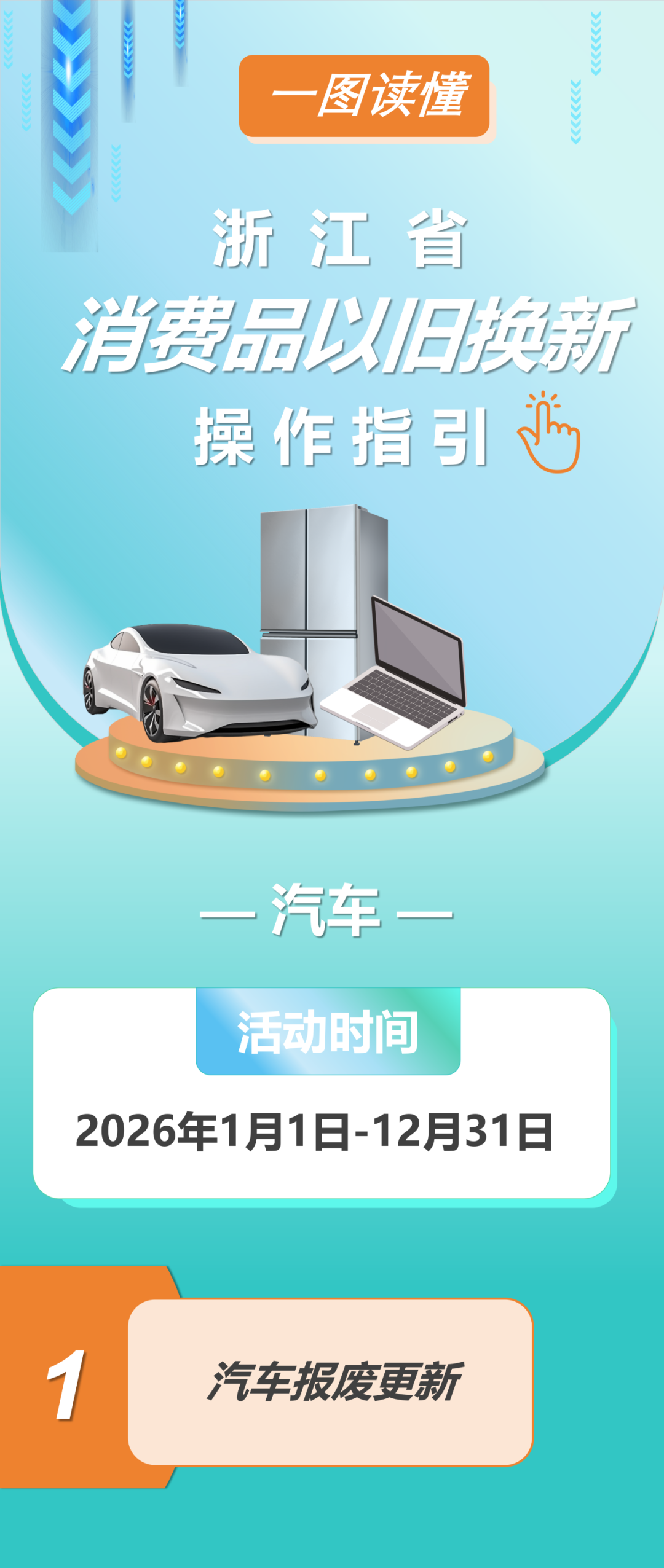
今起实施!2026年浙江消费品以旧换新,操作指引来了
Xin Lang Cai Jing· 2026-01-01 07:30
Group 1: Core Points - The Zhejiang province will implement a vehicle trade-in program from January 1, 2026, to December 31, 2026 [1][25] - The program aims to encourage consumers to replace old vehicles with new ones, providing subsidies for eligible purchases [3][18] Group 2: Subsidy Details - For scrapping and updating vehicles, personal consumers can receive a subsidy of 12% of the vehicle price, with a maximum subsidy of 20,000 yuan for new energy vehicles and 15,000 yuan for fuel vehicles [7][9][19] - The eligibility for the subsidy requires that the old vehicle must be registered in the applicant's name before January 8, 2025, and the new vehicle must be purchased within the program period [13][21] Group 3: Application Process - Consumers can apply for subsidies through platforms like Alipay and WeChat by searching for the "Zhejiang Auto Trade-in" mini-program [17][22] - Required documents for application include the scrapping certificate, vehicle deregistration certificate, sales invoice, and vehicle registration certificate, all of which must be obtained after January 1, 2026 [13][21] Group 4: Additional Consumer Products - The program also includes subsidies for household appliances such as televisions, refrigerators, washing machines, air conditioners, computers, and water heaters, with a subsidy of 15% of the actual sales price and a maximum of 1,500 yuan per item [30][31] - Consumers can participate in both online and offline activities to claim these subsidies, with specific guidelines for each method [32][43]
@北京消费者,家电、数码以旧换新补贴元旦开领
Xin Lang Cai Jing· 2025-12-31 13:47
Core Viewpoint - Beijing will implement a subsidy program for the replacement of old household appliances and digital products starting January 1, 2026, aimed at encouraging consumer spending in these sectors [1]. Subsidy Details - The subsidy will apply to six categories of household appliances (refrigerators, washing machines, televisions, air conditioners, water heaters, and computers) and four categories of digital products (mobile phones, tablets, smartwatches, and smart glasses) [1][10]. - The subsidy amount will be 15% of the final sales price after discounts, with a maximum of 1,500 yuan for household appliances and 500 yuan for digital products per item [1][10]. Qualification Process - Consumers can obtain subsidy qualifications through the "Jingtong" mini-program starting at 8 AM daily, with qualifications valid for the month of issuance [1][4]. - The program allows for both online and offline redemption, with specific platforms and stores designated for each [4][12][13]. Redemption Guidelines - For online purchases, consumers must complete the qualification process in the mini-program and then use the generated code on designated e-commerce platforms [6][7]. - For offline purchases, consumers must show the qualification QR code to participating retailers for verification [7]. Additional Information - The program includes a mechanism for reissuing qualifications if they expire without use, allowing consumers to reapply [1][4][16]. - The initiative is part of a broader effort to stimulate economic activity in the consumer electronics sector [1].

X @外汇交易员
外汇交易员· 2025-09-04 06:39
Growth Targets - The electronic information manufacturing industry aims for an average annual revenue growth of over 5% by 2026, factoring in sectors like lithium batteries, photovoltaics, and component manufacturing [1] - The industry targets an average growth rate of approximately 7% in the added value of scaled computer, communication, and other electronic equipment manufacturing from 2025 to 2026 [1] Industry Leadership - The electronic information manufacturing industry is expected to maintain its leading position in revenue scale and export proportion among 41 major industrial categories by 2026 [1] - Five provinces are projected to have electronic information manufacturing revenue exceeding 1 trillion RMB [1] Specific Product Goals - The server industry is projected to exceed a scale of 400 billion RMB [1] - The domestic market penetration rate of 75-inch and larger color TVs is expected to surpass 40% [1] - Personal computers and mobile phones are expected to advance towards intelligence and high-end features [1]
上半年冰箱等日用家电零售同比增长56.6%
Zhong Guo Xin Wen Wang· 2025-08-05 01:14
Group 1 - The core viewpoint of the article highlights that the sales revenue of enterprises in the country has maintained steady growth in the first half of the year, showcasing multiple positive aspects [1] - The "Two New" policy has shown significant effectiveness, with the amount of machinery and equipment purchased by enterprises increasing by 11.1% year-on-year, continuing the rapid growth trend from last year [1] - Consumer demand has accelerated due to the ongoing effects of the "old for new" series of policies, with retail sales of home audio-visual equipment such as televisions increasing by 45.3% and daily household appliances like refrigerators rising by 56.6% year-on-year [1] - Retail sales related to home decoration, such as furniture, have increased by 34% year-on-year, while retail sales of communication devices like mobile phones, which have been newly included in the "old for new" program, have grown by 25.4% [1]