
NVIDIA Vera CPU

Search documents
AI算力行业周报:英伟达GTC 2026正式开幕,OFC 2026见证“互连爆发”
Huaxin Securities· 2026-03-23 05:24
Investment Rating - The report maintains a recommendation for investment in the AI computing sector, particularly focusing on companies like NVIDIA and others involved in AI infrastructure [2]. Core Insights - NVIDIA has transitioned from a chip supplier to a full-stack AI infrastructure platform, with expectations that demand for its AI chips will reach at least $1 trillion by 2027, doubling previous forecasts [3]. - The OFC 2026 event highlighted the emergence of new multi-source protocol organizations to address interconnect needs for large-scale AI data centers, with significant participation from over 60 companies [4]. - The report emphasizes the importance of AI software and ecosystem development, particularly with the introduction of the NemoClaw software stack for secure AI operations [3]. Weekly Market Analysis - The communication sector saw a weekly increase of 2.10%, while the electronics sector experienced a decline of 2.84% from March 16 to March 20 [11]. - The AI computing sector showed varied performance, with communication network devices rising by 7.38%, while other power equipment saw a decline of 6.76% [17]. - The report indicates that the electronic sector had a net outflow of 20.4 billion yuan, while the communication sector had a net inflow of 20.55 billion yuan during the same period [22]. Company Focus and Earnings Forecast - Key companies highlighted include: - **Shannon Semiconductor (300475.SZ)**: Current stock price at 157.15, with an EPS forecast of 2.36 for 2026 and a "Buy" rating [5]. - **Guokai Micro (300672.SZ)**: Current stock price at 195.1, with an EPS forecast of 2.24 for 2026 and a "Buy" rating [5]. - **Luxshare Precision (002475.SZ)**: Current stock price at 48.22, with an EPS forecast of 3.00 for 2026, currently unrated [5]. - **Worley (002130.SZ)**: Current stock price at 24.61, with an EPS forecast of 1.39 for 2026, currently unrated [5]. Industry Dynamics - The report notes that the PCB industry is experiencing a shift towards high-frequency and high-speed boards due to the demands of 5G and AI technologies, with China becoming the largest PCB production base globally [27]. - The report highlights that the PCB industry is expected to recover from a downturn starting in 2024, with significant growth anticipated in 2025 [29]. - The demand for AI-related PCB is expected to rise sharply, driven by the increasing needs of AI computing [29].

英伟达GTC2026正式开幕,OFC2026见证“互连爆发”
Huaxin Securities· 2026-03-23 03:00
Investment Rating - The report maintains a recommendation for investment in the AI computing sector, particularly focusing on companies like NVIDIA and others involved in AI infrastructure [2]. Core Insights - NVIDIA has transitioned from a chip supplier to a full-stack AI infrastructure platform, with expectations that demand for its AI chips will reach at least $1 trillion by 2027, doubling previous forecasts [3]. - The OFC 2026 event highlighted the emergence of new multi-source protocol organizations focusing on interconnect needs for large-scale AI data centers, with significant innovations in optical modules [4]. - The report emphasizes the importance of AI software and ecosystem development, particularly with the introduction of the NemoClaw software stack for secure AI operations [3]. Market Performance Analysis - The communication sector saw a weekly increase of 2.10%, while the electronics sector experienced a decline of 2.84% from March 16 to March 20 [11]. - Among AI computing-related sectors, communication network devices and components had the highest weekly increase of 7.38%, while other power equipment saw a decline of 6.76% [17]. - The report indicates that the electronic sector had a net outflow of 20.4 billion yuan, while the communication sector had a net inflow of 20.55 billion yuan during the same period [22]. Company Focus and Earnings Forecast - Key companies highlighted include: - Shannon Semiconductor (300475.SZ) with a buy rating and projected EPS growth from 0.58 in 2024 to 2.36 in 2026 [5]. - Guokai Microelectronics (300672.SZ) also with a buy rating, showing a projected EPS turnaround from -0.88 in 2025 to 2.24 in 2026 [5]. - The report notes that the PCB industry is expected to recover from a downturn starting in 2024, with significant growth anticipated in 2025 [27][29]. Industry Dynamics - The report discusses the competitive landscape in the AI sector, with major investments from companies like Xiaomi, which plans to invest at least 60 billion yuan in AI over the next three years [41]. - It also highlights Google's development of a dedicated Gemini AI application for Mac, indicating ongoing competition in the AI space [43]. - The U.S. government is pushing for unified AI regulations to enhance innovation while ensuring consumer protection, reflecting the growing importance of AI in various sectors [45][46].


美股科技行业周报:英伟达GTC2026召开,推理时代正式来临,持续好看算力需求加速增长-20260322
Guolian Minsheng Securities· 2026-03-22 13:05
Investment Rating - The report suggests a positive outlook for the technology sector, particularly focusing on companies like NVIDIA, Micron, and others, indicating a recommendation for investment in these stocks [6][31]. Core Insights - NVIDIA has raised its revenue forecast for 2027 to $1 trillion, driven by the shift from "training-driven" to "inference-driven" AI, highlighting the increasing demand for computing power in the AI inference era [2][14]. - The Vera Rubin super AI platform has commenced mass production, featuring advanced hardware capabilities, including 60 exaflops of computing power and 10 PB/s of total bandwidth, with major clients such as Anthropic and OpenAI [2][16]. - Micron's FY26Q2 financial results show a significant increase in revenue to $23.9 billion, a year-on-year growth of 196%, driven by AI-related storage demand [29][30]. Summary by Sections Technology Industry Dynamics - The NVIDIA GTC 2026 conference emphasized the exponential growth in AI computing demand, with NVIDIA's optimistic long-term outlook for industry demand and company growth [14][31]. U.S. Technology Company Updates - Micron reported record high revenues and profits, with AI driving significant increases in DRAM and NAND demand, projecting that data center storage will exceed 50% of total industry demand by 2026 [29][30]. Weekly Insights - The report highlights NVIDIA's transition from chip sales to factory construction, expanding its core competencies to include system-level delivery capabilities in computing, storage, and networking [6][31].

Supermicro Advances Enterprises' Adoption of Accelerated Computing Across AI Factory, Data Center, and Edge with Expanded Portfolio Featuring NVIDIA RTX PRO Blackwell Server Edition GPUs
Prnewswire· 2026-03-18 13:05
Core Insights - Supermicro is expanding its portfolio of enterprise solutions to support the increasing demand for AI-enabled and graphical computing applications across various enterprise environments [1][2] - The new systems feature NVIDIA RTX PRO 4500 Blackwell Server Edition GPUs, optimized for data centers and edge environments, addressing space, power, and cooling limitations [1][4] Supermicro's Enterprise-Optimized Solutions - The company is introducing NVIDIA-Certified Systems that ensure compatibility with NVIDIA RTX PRO Blackwell GPUs and other NVIDIA technologies, enabling enterprises to accelerate workloads effectively [1][2] - Supermicro's modular Building Block Solutions® architecture supports NVIDIA RTX PRO Blackwell GPUs, allowing enterprises to reduce Time-to-Online and realize value from their infrastructure investments sooner [2][5] Expanded Portfolio Features - The new portfolio includes support for NVIDIA RTX PRO 4500 Blackwell GPUs and NVIDIA Vera CPU, providing customization options for various enterprise workloads such as LLM fine-tuning, AI inference, and data analytics [2][4] - Supermicro systems can replace standard 1U and 2U rackmount servers, offering significant acceleration improvements compared to CPU-only compute, with minimal modifications required for existing infrastructure [3][6] Specific Solutions Offered - Large-scale AI solutions are available in 4U and 5U systems, supporting up to 8 NVIDIA RTX PRO Blackwell GPUs per node, ideal for AI inference and media workloads [5] - Enterprise AI solutions are designed in 1U and 2U form factors, supporting up to 6 NVIDIA RTX PRO Blackwell GPUs, suitable for traditional data center environments [6] - Compact edge AI solutions are optimized for environments with thermal and power limitations, supporting up to 4 NVIDIA RTX PRO Blackwell GPUs while operating at low power levels [7]



英伟达连发7款“王炸”芯片,目标从芯片商转向AI工厂!黄仁勋的思路变了?业内:一句话总结就是“卖标准”
Mei Ri Jing Ji Xin Wen· 2026-03-18 09:26
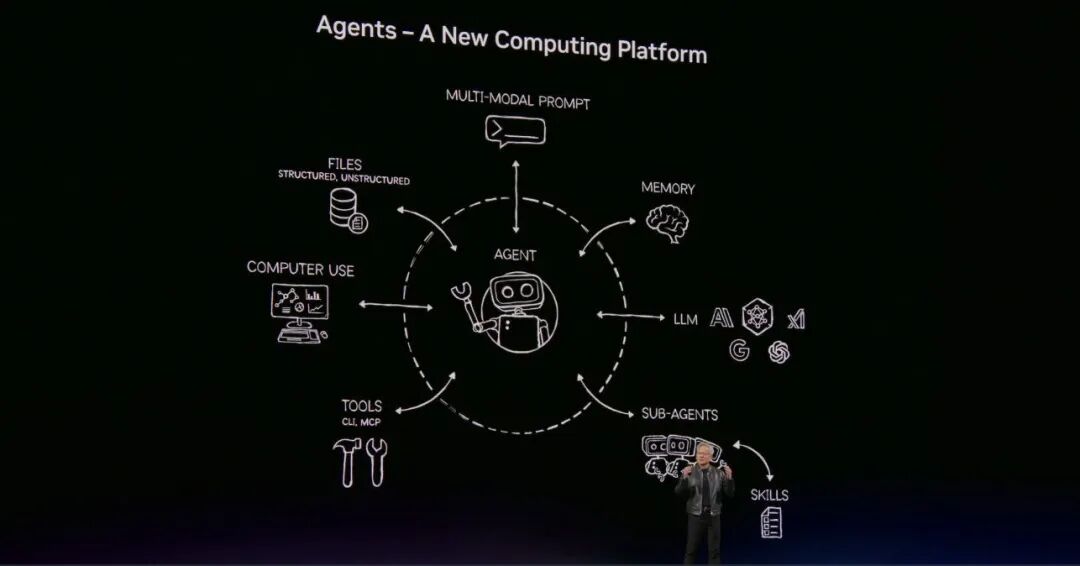
Core Insights - NVIDIA is transitioning from a chip company to an AI factory and AI infrastructure company, emphasizing the importance of its ecosystem and tools for AI development [2][13][17] - The introduction of OpenClaw is seen as a significant advancement, likened to the impact of Linux, and is expected to evolve traditional SaaS into "Agent as a Service" (AaaS) [3][4][12] - NVIDIA's CEO highlighted the company's goal of achieving $1 trillion in revenue from computing chips by 2027, doubling the previous year's forecast of $500 billion for 2026 [12] Product and Technology Developments - The GTC 2026 event showcased the Vera Rubin platform, which consists of seven chips and five racks, marking a pivotal moment for Agentic AI and infrastructure development [8][9] - Key components of the Vera Rubin platform include the Vera CPU, which is designed for agent-based AI and offers double the efficiency of traditional CPUs, and the Groq 3 LPU, which focuses on large language model inference [9][12] - The NemoClaw software stack was introduced to enhance data privacy and security for autonomous agents, providing a sandbox environment for development [7] Market Strategy and Positioning - NVIDIA's strategy is to create a high barrier to entry for competitors by building a comprehensive ecosystem and optimizing token costs to attract more users [2][12][16] - The company is focusing on the growing demand for AI applications and is positioning itself as a solutions provider rather than just a computing power supplier [13][16] - The emphasis on "burning more tokens" reflects the industry's need for efficient computing resources, with NVIDIA leading in the metric of "tokens per watt" [12][16]
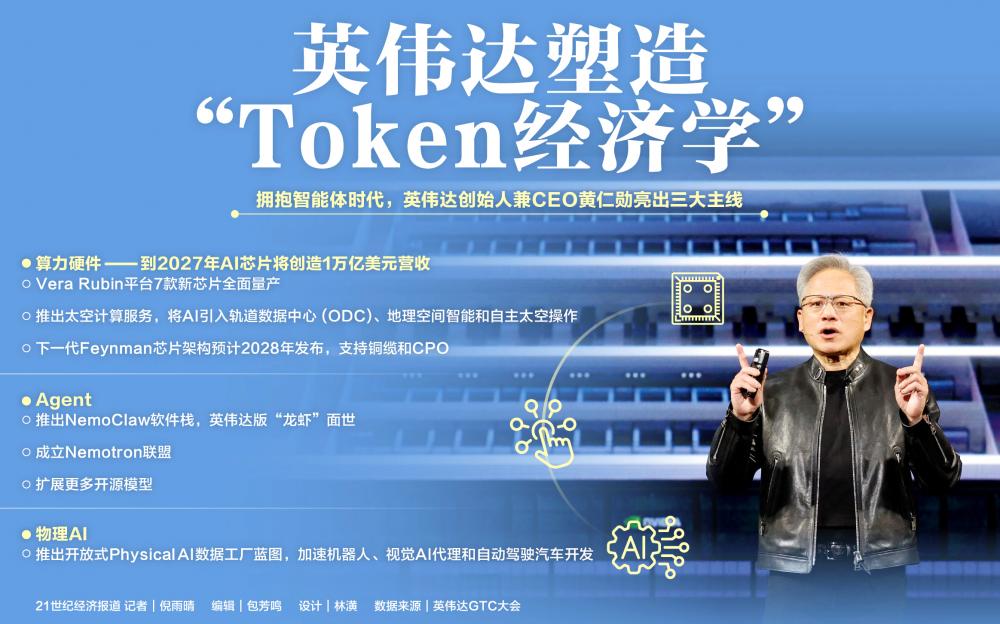
英伟达塑造“Token经济学”
2 1 Shi Ji Jing Ji Bao Dao· 2026-03-17 23:10
Core Insights - NVIDIA's GTC event showcased the launch of the Vera Rubin architecture, marking a significant leap in AI technology with seven new chips entering production, aimed at establishing the largest AI factory globally [1][14] - The introduction of Vera Rubin is expected to double the revenue forecast for AI chips from $500 billion to $1 trillion by the end of 2027 [2][16] - The event emphasized a shift from individual chip competition to a comprehensive system-level competition among tech giants, highlighting the importance of "Token" economics and the AI "five-layer cake" theory [2][16] Chip Architecture and Performance - The Vera Rubin architecture will utilize TSMC's 3nm process and features a tightly integrated design that enhances performance, achieving 50 PFlops for inference and 35 PFlops for training, with a fivefold increase in efficiency compared to the previous Blackwell architecture [4][18] - The architecture includes various chips such as NVIDIA Vera CPU, Rubin GPU, NVLink 6, and Groq 3 LPU, which can be configured into five different racks for data center operations [1][15] Application and Infrastructure - Vera Rubin is designed specifically for "Agentic AI" and long-context reasoning, featuring advanced components like the Transformer Engine 3.0 and Inference Context Memory, enabling AI agents to manage extensive token contexts and perform multi-step reasoning [5][19] - The infrastructure supports high-density liquid cooling and is built on NVIDIA's MGX framework, integrating 256 Vera CPUs to provide scalable and energy-efficient capacity [5][20] Collaborations and Market Impact - Key partners deploying the Vera CPU include Alibaba, ByteDance, Meta, and Oracle Cloud Infrastructure, with full production expected in the second half of the year [6][20] - NVIDIA is positioning itself as a leader in AI infrastructure, with the Vera Rubin DSX AI Factory reference design aimed at maximizing productivity and energy efficiency in AI token generation [6][20] Groq LPU and Real-Time Processing - The Groq LPU architecture, set to be integrated by the end of 2025, is designed for low-latency, real-time interactions, featuring 256 LPU processors with high bandwidth capabilities [21][22] - The LPU's deterministic pipeline architecture eliminates traditional GPU complexities, ensuring consistent execution times critical for applications like autonomous driving and high-frequency trading [22][23] AI Agent and Open Model Ecosystem - NVIDIA introduced the NemoClaw software stack for AI agents, which allows for continuous operation and complex task management, marking a significant development in the open-source AI landscape [11][24] - The company is also expanding its open model ecosystem, launching the Nemotron Coalition to foster collaboration among leading AI labs and model developers [12][24] Real-World Applications - New models for robotics and autonomous driving were unveiled, including the NVIDIA Isaac GR00T for humanoid robots and the NVIDIA Alpamayo for enhanced vehicle reasoning capabilities [13][25] - NVIDIA aims to create a comprehensive AI technology framework that bridges digital and physical worlds, promoting innovation and application across various sectors [13][25]
黄仁勋塑造“Token经济学” 英伟达拥抱智能体时代
2 1 Shi Ji Jing Ji Bao Dao· 2026-03-17 22:29
Core Insights - NVIDIA's GTC event showcased the launch of the Vera Rubin architecture, marking a significant leap in AI technology with seven new chips and the establishment of the largest AI factory globally [1][2] - The introduction of Vera Rubin is expected to double the revenue forecast for AI chips, reaching $1 trillion by the end of 2027, compared to the previous estimate of $500 billion [2] - The event emphasized a shift from individual chip competition to a comprehensive system-level competition among tech giants, highlighting the importance of integrated solutions [2] Chip Innovations - The Vera Rubin platform includes a diverse range of chips: NVIDIA Vera CPU, NVIDIA Rubin GPU, NVIDIA NVLink 6, NVIDIA ConnectX-9 SuperNIC, NVIDIA BlueField-4 DPU, and NVIDIA Spectrum-6, which together form a robust data center infrastructure [1] - The architecture utilizes TSMC's 3nm process and features a tightly coupled design that enhances performance, achieving 50 PFlops for inference and 35 PFlops for training [3][4] AI Infrastructure - The Vera CPU rack, built on NVIDIA MGX, integrates 256 Vera CPUs, providing scalable and energy-efficient capacity, with performance improvements over traditional CPUs [4] - The introduction of the Groq LPU architecture aims to enhance real-time interaction capabilities, with the LPX rack containing 256 LPU processors and a bandwidth of 640 TB/s [5][6] AI Agent Development - NVIDIA launched the NemoClaw software stack for AI agents, which allows for continuous operation and complex task execution, positioning it as a foundational tool for the next generation of AI applications [8][10] - The company is also forming the Nemotron Coalition to advance open model development, supporting various applications across industries [10][11] Real-World Applications - New models for robotics and autonomous driving, such as NVIDIA Isaac GR00T and NVIDIA Alpamayo, are designed to enhance decision-making capabilities in real-world environments [11]
到明年底,至少赚1万亿”!英伟达连发7款芯片,还推出自己的“龙虾
Guo Ji Jin Rong Bao· 2026-03-17 11:24
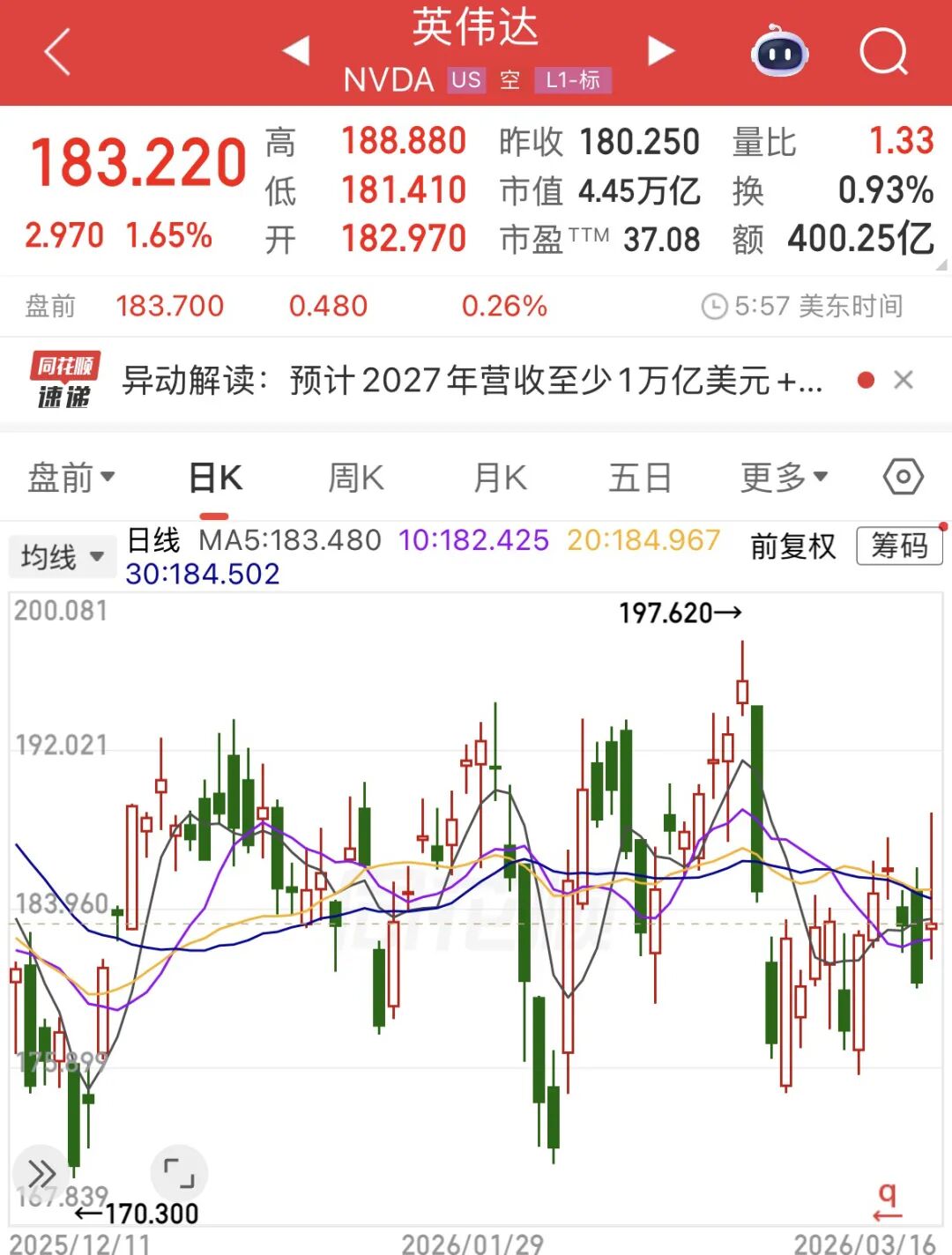
Core Viewpoint - Nvidia's CEO Jensen Huang predicts that AI chip revenue will reach at least $1 trillion by 2027, doubling previous forecasts, driven by explosive growth in computing demand [4][5]. Group 1: AI Chip Revenue Forecast - Huang's prediction of $1 trillion in AI chip revenue by 2027 is a significant increase from the $500 billion forecast made in October 2025 [4]. - The surge in revenue expectations is attributed to a million-fold increase in computing demand over the past two years [4]. - Goldman Sachs noted that this long-term revenue visibility greatly exceeds Wall Street's expectations, alleviating concerns about potential peaks in AI capital expenditures by 2026 [4]. Group 2: New AI Computing System - Nvidia introduced the Vera Rubin AI computing system, which consists of seven chips and five rack systems, marking a shift from being a GPU supplier to a full-stack AI infrastructure provider [5]. - The Vera CPU, designed specifically for agent AI and reinforcement learning, is claimed to be twice as efficient as traditional rack-level CPUs and 50% faster [5]. - Major cloud service providers like Alibaba, ByteDance, and Meta are confirmed to deploy the Vera CPU [5]. Group 3: Token Factory Economics - Huang introduced the concept of "Token Factory Economics," emphasizing the need for data centers to produce tokens continuously, which are the smallest semantic units for AI models [6][7]. - The efficiency of token throughput per watt will determine production costs, with a new valuation framework shifting focus from chip sales to AI factory production efficiency [7]. - The concept suggests that engineers will require an annual token budget, with companies allocating a portion of salaries for token distribution to enhance productivity [7]. Group 4: OpenClaw and NemoClaw - Huang highlighted the significance of the OpenClaw open-source project, comparing its impact on AI to that of Windows on personal computing [8][9]. - Nvidia launched the NemoClaw platform, a deployment tool optimized for OpenClaw, allowing easy integration of GPU servers into the OpenClaw ecosystem [9].
黄仁勋发表重磅演讲!称2027营收至少万亿美元,“龙虾”就是新操作系统!英伟达宣布:七款新芯片全面投产
Mei Ri Jing Ji Xin Wen· 2026-03-17 02:53
Core Insights - Nvidia's CEO Jensen Huang predicts that the new AI chip architectures, Blackwell and Rubin, will generate at least $1 trillion in revenue by the end of 2027, significantly surpassing the previous forecast of $500 billion made in October 2025, highlighting the rapid expansion of AI infrastructure investment [1][10][16] Chip Production and Architecture - Nvidia announced the production of seven new chips under the Vera Rubin architecture, marking the beginning of the Agentic AI era and establishing the largest AI factory globally [2][12] - The new chip lineup includes: - NVIDIA Vera CPU - NVIDIA Rubin GPU - NVIDIA NVLink 6 - NVIDIA ConnectX-9 SuperNIC - NVIDIA BlueField-4 DPU - NVIDIA Spectrum-6 - NVIDIA Groq 3 LPU [2][13][14] AI Supercomputer Capabilities - The Vera Rubin platform integrates these chips to form a powerful AI supercomputer capable of supporting large-scale pre-training, post-training, testing, and real-time intelligent inference [3][14] - Huang describes Vera Rubin as a generational leap, providing the necessary power for every stage of AI development and signaling the onset of the largest infrastructure buildout in history [3][14] Token Factory Concept - Huang introduced the concept of a "Token Factory," suggesting that future data centers will transition from mere storage facilities to factories producing intelligent tokens, which are fundamental units generated by AI [5][11][17] - He emphasized that the performance per watt will determine the economic viability of these factories, with the highest throughput translating to the lowest production costs [20] AI Service Levels - Future AI services will be categorized into different tiers based on token generation rates and costs: - Free tier (high throughput, low speed) - Mid-tier (~$3 per million tokens) - High-tier (~$6 per million tokens) - High-speed tier (~$45 per million tokens) - Ultra-high-speed tier (~$150 per million tokens) [20][21] - Huang noted that as models grow larger and context lengthens, AI will become smarter, but token generation rates may decline [20] OpenClaw and Future Developments - Huang praised the OpenClaw project as a significant advancement, likening it to an operating system for agent-based computing, and predicted that all SaaS companies will evolve into AaaS (Agent-as-a-Service) companies [9][23] - He also hinted at the next-generation computing architecture, Feynman, and the development of a space-based data center, Vera Rubin Space-1, which could extend AI computing capabilities beyond Earth [23]

燃爆!英伟达连发7款芯片,黄仁勋剑指万亿AI芯片收入
2 1 Shi Ji Jing Ji Bao Dao· 2026-03-17 01:17
Core Insights - NVIDIA's GTC event showcased the launch of the Vera Rubin platform, marking a significant advancement in AI infrastructure with seven new chips aimed at creating the world's largest AI factory [1][3] - The introduction of Vera Rubin is expected to double the revenue forecast for AI chips, projecting $1 trillion by the end of 2027, compared to the previous estimate of $500 billion [3] - NVIDIA is transitioning from a GPU-centric company to an AI infrastructure provider, aiming to become a foundational platform for the AI ecosystem [5] Chip Innovations - The new chip family includes NVIDIA Vera CPU, Rubin GPU, NVLink 6, ConnectX-9 SuperNIC, BlueField-4 DPU, Spectrum-6, and Groq 3 LPU, enabling a comprehensive AI computing solution [2] - The Vera Rubin architecture utilizes TSMC's 3nm process, featuring a tightly integrated design that significantly enhances performance metrics, including a 5x improvement in efficiency compared to the previous Blackwell architecture [6][7] System-Level Advancements - The Vera Rubin platform represents a shift from single-chip performance to a system-level evolution in AI infrastructure, emphasizing the need for integrated solutions in AI development [4][10] - The introduction of the DSX platform aims to optimize energy consumption and enhance the scalability of AI infrastructure, allowing for a 30% increase in AI deployment within existing data centers [9] AI Agent and Open Model Ecosystem - NVIDIA is advancing its AI agent capabilities with the launch of the NemoClaw software stack, which supports the development of autonomous AI agents capable of complex task execution [16][18] - The establishment of the Nemotron Coalition aims to foster collaboration among leading AI labs to develop open foundational models, enhancing the AI ecosystem's capabilities [19][21] Application in Real-World Scenarios - The new models introduced by NVIDIA, such as Isaac GR00T and Alpamayo, are designed for robotics and autonomous driving, showcasing the company's commitment to integrating AI into physical applications [20][21] - The focus on real-time interaction and low-latency processing through the Groq LPU architecture positions NVIDIA to lead in the emerging market for agentic AI and real-time decision-making systems [11][15]