
Neuralink脑机接口产品

Search documents
医飞冲天!港股通医疗9连阳创纪录
Xin Lang Cai Jing· 2026-01-14 12:09
Core Viewpoint - The Hong Kong Stock Connect medical sector has experienced a significant rally, with the Hong Kong Stock Connect Medical Theme Index achieving a record nine consecutive days of gains as of January 14, 2026, marking the longest winning streak in history [1]. Group 1: ETF Performance - The Huabao Hong Kong Stock Connect Medical ETF (159137) has seen substantial growth since its listing on January 12, 2026, with daily increases of 4.7%, 3.44%, and 2.49%, and a total trading volume reaching 259 million yuan today [1][3]. - The ETF covers 50 leading stocks across various medical fields, with notable performances from Alibaba Health, which surged by 18.96%, and other stocks like Yimai Sunshine and MicroPort Scientific, which rose by 9.98% and 8.62% respectively [3][4]. Group 2: Market Catalysts - Three main catalysts are driving the momentum in the Hong Kong Stock Connect medical sector: 1. The brain-computer interface (BCI) industry is entering a rapid industrialization phase, with companies like Neuralink and Brain Tiger Technology making significant advancements and investments [5][6]. 2. Major players are entering the AI medical field, with partnerships such as NVIDIA and Eli Lilly committing $1 billion to AI drug development, indicating a shift towards AI-driven healthcare solutions [6][7]. 3. The CXO (Contract Research Organization) sector is showing signs of recovery, with WuXi AppTec forecasting a net profit of 19.151 billion yuan for 2025, reflecting a year-on-year increase of approximately 102.65% [7][8]. Group 3: Industry Trends - The demand for CRO and CDMO services is gradually recovering, supported by a reduction in supply over the past three years, which may lead to simultaneous profit and valuation increases in the sector [8].

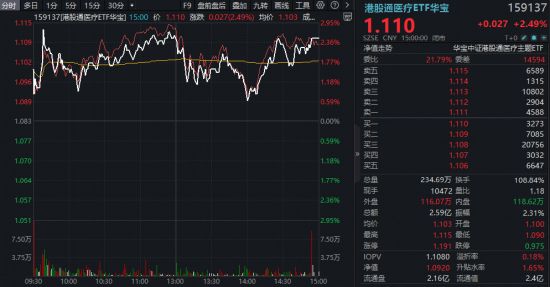
ETF盘中资讯|AI医疗涨势如虹!阿里健康暴拉10%,港股通医疗ETF(159137)冲击3%!美年健康4连板,A股最大医疗ETF阶段新高
Sou Hu Cai Jing· 2026-01-14 03:22
Core Viewpoint - The AI healthcare sector is experiencing significant growth, with both A-shares and Hong Kong stocks showing strong performance, particularly in AI medical ETFs and related stocks [1][2][3] Group 1: A-share Market Performance - The largest medical ETF in the A-share market (512170) surged by 3%, reaching a near three-month high, with active trading exceeding 1 billion CNY within the first hour of trading [1] - Key stocks such as Meiyuan Health and Weining Health saw substantial gains, with Meiyuan Health achieving a four-day consecutive rise and Weining Health spiking by 14% at one point [1] Group 2: Hong Kong Market Performance - The Hong Kong medical sector continues to strengthen, with the Hong Kong Stock Connect medical theme index rising consistently since the beginning of the year, led by Alibaba Health, which increased by nearly 10% [2] - The newly listed Hong Kong Stock Connect medical ETF (159137) has seen significant gains, with a trading volume exceeding 110 million CNY and a peak increase of nearly 3% within three days of its launch [2] Group 3: AI Healthcare Developments - Recent collaborations in the AI healthcare field include a partnership between NVIDIA and Eli Lilly to invest 1 billion USD over five years in an AI drug development lab in Silicon Valley [3] - In China, Tsinghua University's team has developed an AI-driven high-throughput drug virtual screening platform, DrugCLIP, with research results published in the journal Science [3] - The penetration rate of AI healthcare applications is rapidly increasing, with Ant Group's AI assistant, Antifufu, surpassing 30 million monthly active users, and OpenAI's ChatGPT Health reaching over 40 million daily users globally [3] Group 4: Brain-Computer Interface Developments - Elon Musk announced that Neuralink's brain-computer interface products are set to enter mass production by 2026, with nearly automated surgical procedures [3] - Strong Brain Technology, a leading domestic company in the brain-computer interface sector, has submitted an IPO application to the Hong Kong Stock Exchange [3] - The Ministry of Industry and Information Technology in China has indicated a focus on quantum technology and brain-computer interfaces during the 14th Five-Year Plan, emphasizing technological breakthroughs and enterprise cultivation [3]


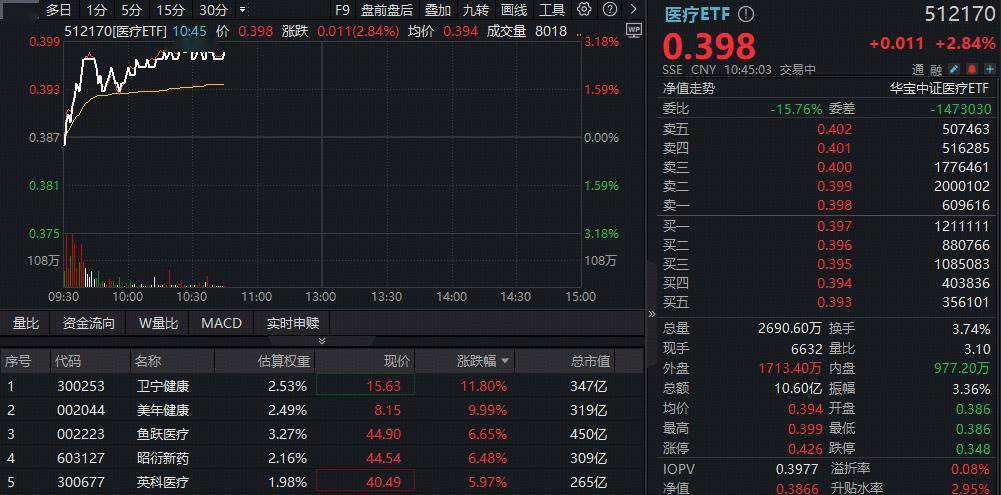
AI医疗涨势如虹!阿里健康暴拉10%,港股通医疗ETF(159137)冲击3%!美年健康4连板,A股最大医疗ETF阶段新高
Xin Lang Cai Jing· 2026-01-14 03:02
Group 1 - The A-share and Hong Kong stock markets are experiencing a surge in AI healthcare stocks, with the largest medical ETF (512170) reaching a 3% increase, marking a three-month high [1][7] - Major AI healthcare stocks such as Meinian Health have achieved four consecutive trading limits, while Weining Health saw a spike of 14% [1][7] - The trading volume for the medical ETF (512170) exceeded 1 billion CNY within the first hour of trading [1][7] Group 2 - The Hong Kong medical sector continues to strengthen, with the Hong Kong Stock Connect medical theme index rising consistently since the beginning of the year, led by Alibaba Health with nearly a 10% increase [1][9] - The newly listed Hong Kong Stock Connect medical ETF (159137) has seen significant gains, with a trading volume surpassing 110 million CNY within three days of its launch [1][9] Group 3 - Recent developments in AI healthcare include a partnership between NVIDIA and Eli Lilly to invest 1 billion USD over five years in an AI drug research lab in Silicon Valley [2][10] - Tsinghua University has developed an AI-driven high-throughput drug virtual screening platform, DrugCLIP, with results published in the journal Science [2][10] - The penetration rate of AI healthcare in the consumer sector is rapidly increasing, with Ant Group's AI assistant user base exceeding 30 million monthly active users [2][10] Group 4 - In the brain-computer interface sector, Elon Musk announced that Neuralink's products will enter mass production by 2026, with nearly automated surgical operations [3][10] - Strong Brain Technology, a leading domestic company in brain-computer interfaces, has reportedly submitted an IPO application to the Hong Kong Stock Exchange [3][10] - The Ministry of Industry and Information Technology has indicated a focus on quantum technology and brain-computer interfaces during the 14th Five-Year Plan, emphasizing technological advancements and enterprise cultivation [3][10]
科创生物医药ETF(588250)盘中大涨近5%,马斯克指出脑机接口产品将于2026年进入规模化量产阶段,早盘相关概念股集体爆发
Xin Lang Cai Jing· 2026-01-05 05:15
Core Insights - The market sentiment is positive, with the Shanghai Composite Index returning to 4000 points and strong performance in the Sci-Tech Innovation Board related indices [1] - The brain-computer interface (BCI) sector is experiencing a collective surge, with multiple stocks hitting the daily limit [1] - Elon Musk announced on social media that Neuralink's BCI products will enter mass production by January 1, 2026, with nearly automated surgical operations and enhanced safety features [1] Industry Developments - The first fully implanted, wireless, and fully functional BCI product developed by Brain Tiger Technology has achieved its first clinical implantation at Huashan Hospital affiliated with Fudan University [2] - On November 13, Ladder Medical announced that its self-developed "implantable wireless BCI system" entered the special review process of the National Medical Products Administration, becoming the first invasive BCI product to enter this "green channel" [2] - The 2025 BCI Conference showcased clinical progress of the NEO BCI system by Borui Kang, with 32 patients undergoing implantation across 11 hospitals, showing no adverse reactions and significant improvement in hand function [2] Technological Advancements - BCI technology is undergoing rapid iteration and upgrade, with breakthroughs in non-invasive devices improving signal quality and portability [3] - In the invasive field, the development of flexible electrodes is expected to enhance system safety, comfort, and long-term stability [3] - Multimodal integration of electromyography and electroencephalography signals is becoming a key trend for improving overall stability and reliability [3] Market Performance - As of January 5, the Sci-Tech Biomedicine ETF (588250.SH) rose by 4.93%, with its related index increasing by 5.01% [3] - Notable component stocks include BeiGene (up 11.46%), United Imaging (up 4.36%), and Eifang Bio (up 9.21%) [3] - Southwest Securities suggests focusing on three directions: overseas expansion, BCI, and AI healthcare, indicating that the 2026 market will revolve around R&D progress, commercialization, and internationalization [3]
脑机接口“上海方案”呼之欲出 瞄准至今无人攻克的难题 “2.0版”将于今年底或明年初发布
Jie Fang Ri Bao· 2025-06-15 01:58
Core Insights - The first invasive brain-computer interface (BCI) clinical trial in China is transforming the life of its subject, allowing him to control games using his thoughts, achieving efficiency comparable to that of a typical user with a touchpad [1] - China has become the second country globally, after the United States, to conduct invasive BCI clinical trials, with several metrics surpassing those of Neuralink, founded by Elon Musk [1][2] - The research is a collaboration between the Shanghai Institute of Neuroscience and Fudan University Huashan Hospital, contributing to Shanghai's goal of becoming a global technology innovation hub [1] Technology Comparison - The Shanghai BCI technology features ultra-thin and flexible electrodes, measuring only 1/5 to 1/7 the size of those used by Neuralink, significantly reducing damage to brain tissue [2] - The implanted device is the smallest globally, with a diameter of 26mm and a thickness of less than 6mm, which is half the size of Neuralink's product [2] Surgical Procedure - The surgical procedure for the invasive BCI is less invasive than Neuralink's, requiring only a small groove in the skull rather than penetrating it, making it more patient-friendly [3] Research and Development - The BCI research is led by young scientists who have returned to China, highlighting the importance of domestic talent in advancing this technology [4][5] - The Shanghai Institute has established a micro-nano electronic processing platform, enabling precise fabrication of BCI devices and accelerating research progress [6] Future Developments - The next version of the BCI system, expected by the end of this year or early next year, will feature 256 information transmission channels, four times the current capacity, and a smaller size [7] - Future applications aim to enhance motor control for paralyzed patients and potentially restore speech for those with language impairments [7] Industry Vision - The BCI technology is seen as a foundational technology for human enhancement and human-machine integration, with aspirations for consumer-level applications in the future [8] - Shanghai's "Future Industry Cultivation Action Plan" aims to establish a global innovation hub for BCI products by 2030, reflecting a clear vision for the industry's growth [8]