
OLED笔电面板

Search documents
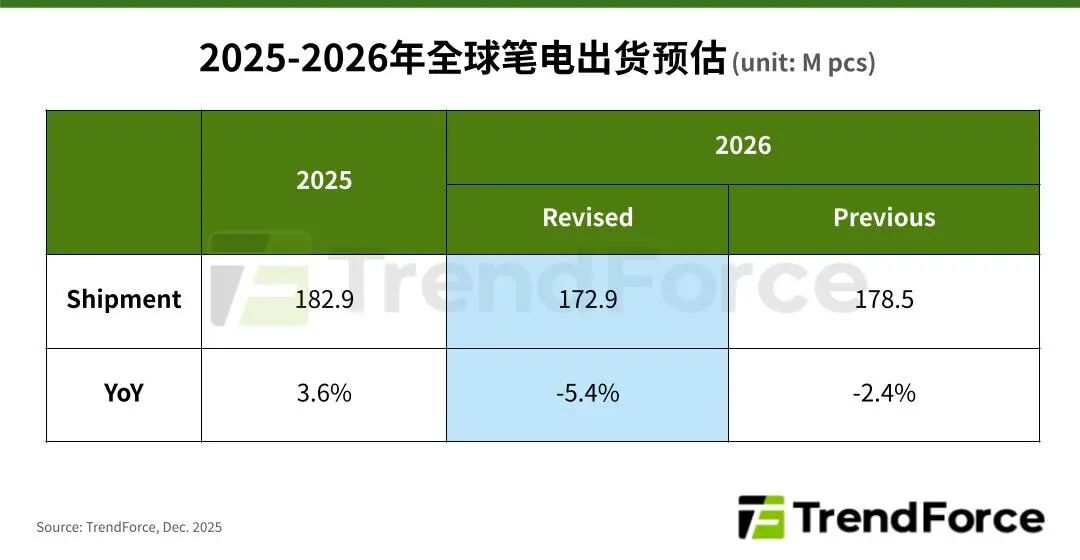
2026年全球笔电出货量预期降至近1.73亿台
WitsView睿智显示· 2025-12-31 09:25
Core Viewpoint - TrendForce has revised its global laptop shipment forecast for 2026 down by 5.4% to approximately 173 million units due to rising memory prices impacting brand profitability and pricing flexibility in a context of limited economic recovery and conservative consumer behavior [2][3]. Group 1: Market Dynamics - The increase in memory prices is significantly affecting laptop brands, leading to a conservative approach towards inventory, promotions, and product configurations [2]. - If memory price increases do not stabilize by Q2 2026, brands may face weakened demand for entry-level and consumer laptops, potentially resulting in a pessimistic scenario where total shipments could decline by 10.1% year-over-year [5]. Group 2: Brand Resilience - Brands that maintain stable long-term relationships with major memory suppliers and have a higher proportion of business and mid-to-high-end products will be better positioned to withstand the current memory price increases [5]. - Apple, for instance, despite facing rising memory costs, benefits from a highly integrated supply chain and strong pricing power, allowing for greater product line adjustment flexibility [5]. Group 3: Competitive Landscape - Lenovo, as a major player, is expected to face MSRP increases but can leverage its scale and mature supply chain to manage cost increases effectively, potentially even expanding its market share [6]. - The overall laptop market is projected to see a decline in panel shipments by approximately 7.9% in 2026 due to the impact of rising memory prices [6].


TrendForce集邦咨询:下调2026年全球笔电出货预估至年减5.4% 降至近1.73亿台
智通财经网· 2025-12-30 12:37
Core Viewpoint - The rising prices of memory chips are significantly impacting the profitability and pricing flexibility of laptop brands, leading to a downward revision of global laptop shipment forecasts for 2026 by TrendForce, projecting a 5.4% year-on-year decline to approximately 173 million units [1][2]. Group 1: Market Forecasts - TrendForce has revised the 2026 global laptop shipment forecast to 172.9 million units, down from a previous estimate of 178.5 million units, reflecting a year-on-year decline of 5.4% [2]. - If memory prices do not stabilize by the second quarter of 2026, there is a risk that the overall laptop shipments could decline by as much as 10.1% for the year [2]. Group 2: Brand Resilience - Brands that maintain long-term, stable relationships with major memory suppliers and have a higher proportion of business and mid-to-high-end products are better positioned to withstand the current memory price increases [2]. - Apple, for instance, is expected to leverage its integrated supply chain and pricing power to adjust its product line effectively despite rising memory costs [2][3]. Group 3: Product Launches and Market Dynamics - Apple plans to launch a 12.9-inch model in spring 2026, targeting the entry to mid-range price segment, which could attract consumers if supply chain efficiency and pricing remain favorable [3]. - Lenovo, as the largest laptop vendor, may face MSRP increases but can utilize its scale and mature supply chain to manage cost pressures and potentially gain market share [3]. Group 4: Impact on Display Panels - The increase in memory prices is expected to negatively affect the shipment momentum of laptop panels, with a projected decline of about 7.9% in 2026 [3]. - LCD panel shipments are anticipated to suffer due to reduced laptop demand and increased penetration of OLED panels, while OLED panel shipments may still grow but could face challenges in consumer purchasing willingness due to cost reflections [3].
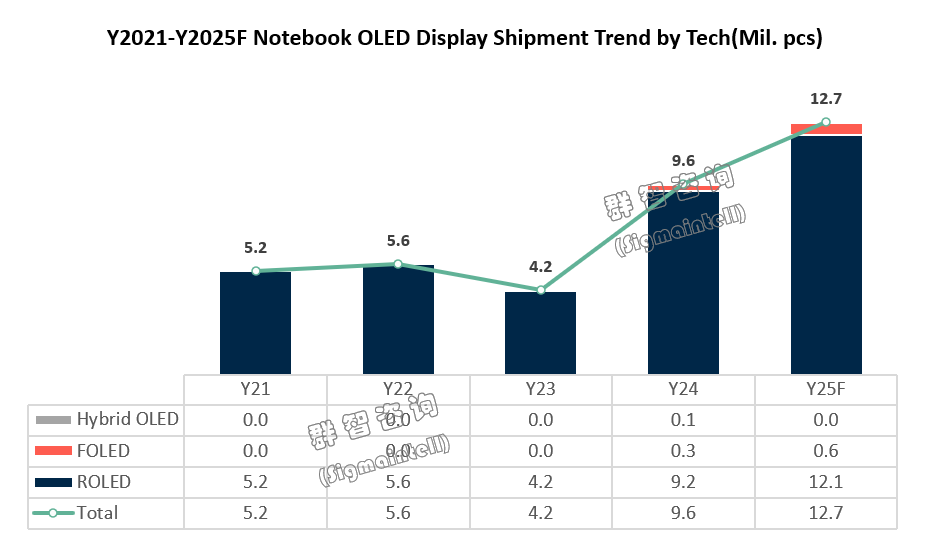
群智咨询:预计2025年OLED市场全球出货量达1270万片 市场渗透率进一步提升到6%
智通财经网· 2025-11-04 11:40
Core Insights - The global OLED laptop panel market is expected to reach a shipment volume of 12.7 million units by 2025, with a market penetration rate of 6% [1] - Rigid OLED (ROLED) will dominate the market with an estimated shipment of 12.1 million units, representing a 31% year-on-year growth [1][7] - Flexible OLED (FOLED) is projected to have a shipment of approximately 600,000 units, driven by flagship models like Huawei's 18-inch foldable PC [1] Market Trends - The OLED laptop market is witnessing rapid innovation, with new products being launched, such as Lenovo's Yoga Air X AI and Huawei's MateBook Fold [2] - The introduction of high-performance OLED screens is aligned with the trends in AI PC technology and the critical product iteration cycle in the PC market [2] Product Strategy - Samsung Display (SDC) is implementing a dual product strategy targeting both mainstream lightweight laptops and high-end gaming laptops, which is expected to enhance ROLED's market presence [6] - The mainstream FHD+ specifications for 14-inch and 16-inch laptops are being introduced to cater to traditional PC brands [6] Market Capacity and Production - The upcoming G8.6 OLED production lines are set to significantly impact the laptop panel market, with four new lines expected to come online in the next two years [10][11] - The G8.6 OLED production lines will focus on both Hybrid OLED and FOLED technologies, which offer advantages in display quality and thinness compared to traditional LCDs [11][15] Future Projections - By 2026, G8.6 OLED shipments are expected to reach around 1.7 million units, primarily driven by demand from Apple’s MacBook Pro [15] - The market for Hybrid OLED is anticipated to grow significantly by 2029, as it becomes the dominant technology in the high-end to mid-range laptop segments [18] Competitive Landscape - The competition between OLED and LCD technologies is expected to intensify, leading to a rapid upgrade in specifications across the laptop market [19] - The next five years are projected to be a revolutionary period for laptop display solutions, focusing on lighter, thinner, and smarter technologies [19]




全球四条8.6代OLED线投产时间预测出炉
WitsView睿智显示· 2025-10-28 07:51
Core Viewpoint - The global IT OLED panel market is entering a phase of diverse investment plans, with major players like Samsung Display, BOE, Visionox, and TCL Huaxing launching their 8.6-generation OLED production lines, indicating a competitive landscape ahead [2][5][6][7][9]. Group 1: Samsung Display - Samsung Display initiated its 8.6-generation line investment in 2023, utilizing traditional FMM evaporation technology and planning to incorporate Tandem OLED processes to enhance screen longevity. The equipment installation is complete, and products are expected to be introduced in the new MacBook Pro series by Apple in 2026, with mass production anticipated in Q2 2026 [5]. Group 2: BOE - Following Samsung, BOE announced its 8.6-generation OLED line investment by the end of 2023, also employing FMM evaporation technology and Tandem OLED configurations. Equipment installation is set to be completed gradually starting from Q2 2025, with production expected to commence in the first half of 2026 [6]. Group 3: Visionox - Visionox is entering the FMM-free camp with its self-developed ViP (Visionox Intelligent Pixelization) technology, which promises higher pixel density and aperture ratio compared to traditional FMM. The company plans to establish its 8.6-generation OLED line by Q2 2024, aiming for completion of the facility by Q4 2025 and volume production to start in Q1 2027 [7]. Group 4: TCL Huaxing - TCL Huaxing is adopting inkjet printing (IJP) technology, which simplifies the process compared to traditional FMM and theoretically reduces material waste by about 30%. Following the groundbreaking ceremony for its 8.6-generation OLED line, TCL Huaxing targets volume production by Q4 2027 [9]. Group 5: Market Dynamics - The investment plans for both FMM and non-FMM generation lines are proliferating, indicating a competitive environment in the IT OLED panel supply chain. The FMM camp benefits from established customer relationships and production experience, while the non-FMM camp, despite facing challenges like lower yield rates and material development, has the potential to catch up due to high market interest [9].

英伟达退出中国AI芯片市场,美光计划对华停供服务器芯片
Zhong Guo Neng Yuan Wang· 2025-10-20 07:52
Market Review - The overseas AI chip index increased by 2.90% this week, with all constituent stocks showing upward movement, particularly MPS which rose over 10% [1] - The domestic AI chip index fell by 6.1%, influenced by the tense China-U.S. trade relations, with only Cambricon showing a slight increase of less than 1% [1] - The Nvidia mapping index decreased by 8.7% due to U.S. export controls, resulting in Nvidia losing its market share in China's data-centric GPU market, leading to declines in related industry stocks [1] - The server ODM index rose by 1.1%, with significant performance differences among constituent stocks; Wiwynn increased by over 10%, while Wistron fell by nearly 10% [1] - The storage chip index declined by 2.1%, with short-term supply-demand dynamics causing varied stock performance among constituents [1] - The power semiconductor index dropped by 3.2%, and both the Guoyuan A-share and Hong Kong fruit chain indices fell by 10% and 10.1% respectively [1] Industry Data - Global wearable wristband device shipments grew by 13% year-on-year in Q2 2025, with Xiaomi (61% growth) and Huawei (47% growth) leading the market significantly [2] - Global smartphone shipments increased by 4% year-on-year in Q3 2025, with Samsung maintaining the top position due to its A series and foldable models, while Apple became the fastest-growing brand among the top five, driven by demand in emerging markets [2] - High-end PC panel and OLED laptop panel shipments are expected to grow by approximately 9% in 2025, with the OLED laptop market projected to enter a high growth phase in 2026, driven by Apple's launch of the OLED MacBook Pro, with an expected annual growth rate of 30% [2] Major Events - Micron plans to cease supplying server chips to Chinese data centers while retaining its automotive and mobile business, creating market opportunities for competitors like Samsung and SK Hynix, and accelerating the replacement process for local Chinese storage chip companies such as Yangtze Memory Technologies [3] - Due to U.S. export controls, Nvidia's CEO confirmed a complete exit from the advanced AI chip market in China, resulting in a market share drop from 95% to zero, which he believes will facilitate the rise of Chinese manufacturers like Huawei and lead to a split in the global AI ecosystem [3] - Apple plans to launch its first touchscreen MacBook Pro in 2026-2027, featuring the M6 chip and an OLED display [3]


英伟达退出中国AI芯片市场,美光计划对华停供服务器芯片 | 投研报告
Zhong Guo Neng Yuan Wang· 2025-10-20 06:48
Market Overview - The overseas AI chip index increased by 2.90% this week, with all constituent stocks showing upward movement, particularly MPS which rose over 10% [2] - The domestic AI chip index fell by 6.1%, influenced by the tense US-China trade relations, with only Cambricon showing a slight increase of less than 1% [2] - The Nvidia mapping index decreased by 8.7% due to US export controls, resulting in Nvidia losing its market share in China's data-centric GPU market [2] - The server ODM index rose by 1.1%, with significant performance differences among constituent stocks; Wiwynn increased by over 10%, while Wistron fell by nearly 10% [2] - The storage chip index declined by 2.1%, reflecting varied stock performance due to short-term supply-demand dynamics [2] - The power semiconductor index dropped by 3.2%, and both the Guoyuan A-share and Hong Kong fruit chain indices fell by 10% and 10.1% respectively [2] Industry Data - Global wearable wristband device shipments grew by 13% year-on-year in Q2 2025, with Xiaomi (61% growth) and Huawei (47% growth) leading the market [3] - Global smartphone shipments increased by 4% year-on-year in Q3 2025, with Samsung maintaining the top position and Apple being the fastest-growing brand, driven by demand in emerging markets [3] - High-end PC panel and OLED laptop panel shipments are expected to grow by approximately 9% in 2025, with a projected annual growth rate of 30% for OLED laptops starting in 2026 [3] Major Events - Micron plans to cease supplying server chips to Chinese data centers while retaining its automotive and mobile business, creating market opportunities for competitors like Samsung and SK Hynix, and accelerating the replacement process for local Chinese storage chip companies [4] - Due to US export controls, Nvidia's CEO confirmed a complete exit from the Chinese advanced AI chip market, reducing its market share from 95% to zero, which may facilitate the rise of Chinese manufacturers like Huawei and lead to a split in the global AI ecosystem [4] - Apple plans to launch its first touchscreen MacBook Pro in 2026-2027, featuring the M6 chip and an OLED display [5]