Office Agent

Search documents
认知偏差、落地断层、体验割裂是目前AI产品的三大痛点|百度王颖@MEET2026
量子位· 2025-12-19 01:01
Core Insights - The article discusses the evolution of AI from a conversational partner to an action assistant, highlighting the increasing complexity of tasks that users face despite advancements in AI capabilities. It identifies three main challenges: cognitive bias, implementation gaps, and fragmented experiences [1][5][14]. Group 1: AI Challenges - Cognitive bias, implementation gaps, and fragmented experiences are identified as the three major pain points for users of AI products [5][14]. - Users often experience a disconnect between AI's capabilities and their ability to execute complex tasks, leading to frustration [14]. Group 2: GenFlow and AI Development - GenFlow serves as the core scheduling hub for Baidu's super personal intelligent agent framework, achieving a monthly active user base in the tens of millions, making it the largest general-purpose intelligent agent globally [5][10]. - The recently updated GenFlow 3.0 integrates a memory system that allows it to retain user interactions and preferences, enhancing personalization [13][17]. Group 3: Product Innovations - Baidu Wenku launched the AI learning platform OREATE AI, which has surpassed 1.4 million monthly active users within a month of its launch and topped the ProductHunt global daily rankings [37]. - Baidu Wangpan has expanded its services to 175 countries, featuring multilingual subtitles and AI camera functionalities, receiving positive feedback globally [39]. Group 4: Future Vision - The vision is to create a super personal intelligent agent that empowers users to become super individuals, enhancing their capabilities in various tasks [8][9]. - The integration of Office Agent and GenX aims to facilitate seamless collaboration between users and AI, enhancing productivity and creativity [20][28].



OpenAI发布GPT-5.1模型 更具“温暖感” 并提供更多个性化选项
Feng Huang Wang· 2025-11-14 09:05
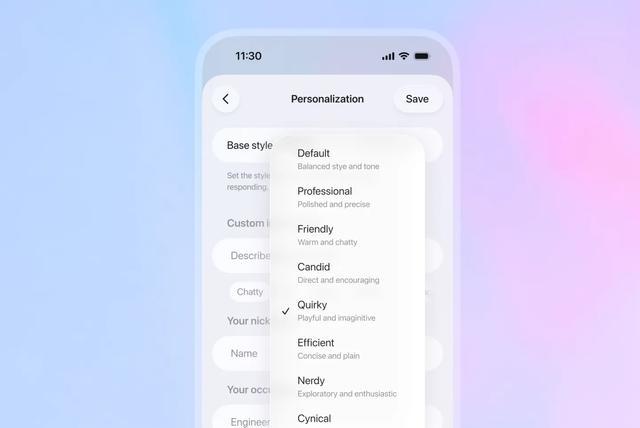
Core Insights - OpenAI has announced the upgrade of its flagship AI model to GPT-5.1, which will start rolling out to ChatGPT users this week, enhancing the model's intelligence and engagement compared to the previous version released in August [1][3] Group 1: Model Features - GPT-5.1 is divided into two versions: "Instant" and "Thinking," with the former excelling in temperature, intelligence, and instruction comprehension, while the latter is more efficient in handling complex problems and faster in simple tasks [3] - Users can now switch between various personality presets such as "default, professional, friendly, candid, quirky, efficient, nerdy, and cynical," allowing for a more tailored interaction experience [3] - The original GPT-5 model will remain available in ChatGPT as a "legacy model" for three months before being phased out [3] Group 2: User Base and Market Response - ChatGPT has surpassed 800 million users, indicating a demand that exceeds what a standard model can handle [3] - The initial release of GPT-5 did not meet user expectations, leading to dissatisfaction and the reintroduction of GPT-4o shortly after its launch [3] Group 3: Strategic Partnerships - Following the underwhelming performance of GPT-5, OpenAI's strategic partner Microsoft is exploring collaborations with other AI companies like Anthropic, integrating related models into various products such as Copilot Researcher and Office Agent [4] - OpenAI recently launched the AI-driven web browser ChatGPT Atlas, currently available only to premium subscribers, which allows the model to perform tasks directly in the browser [4]
Office Agent:新一代多智能体系统
Sou Hu Cai Jing· 2025-10-15 04:29
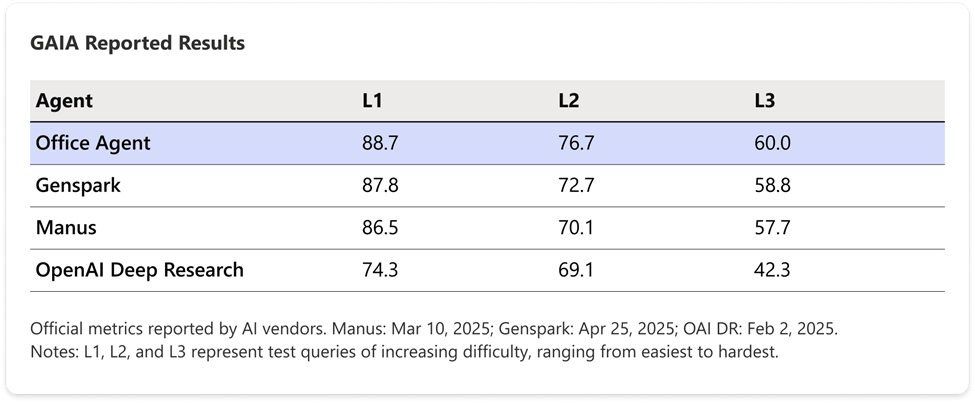
Core Insights - Microsoft has launched Office Agent, a multi-agent system built on an open-source technology stack and the Anthropic Claude model, aimed at enhancing content generation efficiency for users [1][6][22] - The system employs a new development paradigm called Taste-Driven Development (TDD), which focuses on aesthetic quality in content creation [1][6][12] Group 1: Office Agent Features - Office Agent automates the entire workflow from planning to writing and refining, significantly improving the efficiency of Office content production [1][3] - The system has achieved GAIA certification, demonstrating its superior performance in handling complex workflows [1][3] - It utilizes a collaborative workflow among specialized agents, including a central planning agent and various domain-specific agents [5][6] Group 2: Taste-Driven Development (TDD) - TDD enhances the aesthetic layout of AI-generated content by analyzing high-quality presentation samples to extract core design principles [6][12][14] - The workflow includes an iterative cycle where generated content undergoes quality and aesthetic evaluation through a content self-validation module [6][18] - TDD establishes a dual perspective framework for quality assessment, focusing on both content accuracy and aesthetic appeal [18][20] Group 3: Automation and User Experience - Office Agent introduces auto-theming, which generates designs that naturally fit the content rather than relying on preset templates [12][14] - The system incorporates expert-guided style rules to ensure that generated outputs are both aligned with core instructions and aesthetically refined [14][16] - Users can interact with Office Agent to review and adjust generated content, enhancing the collaborative aspect of the tool [21][22] Group 4: Performance Metrics - Microsoft has developed the TDDEval benchmark to assess TDD's performance across PowerPoint, Excel, and Word, ensuring a comprehensive evaluation of knowledge work [16][18] - The benchmark includes a variety of test tasks, ensuring the system's robustness in diverse scenarios [16][18] Group 5: Future Developments - Office Agent is currently available to Microsoft global personal and family subscription users, with business user support coming soon [22] - The system aims to integrate further within the Microsoft ecosystem, enhancing its capabilities in knowledge work creation and refinement [22][23]