PTC暖风机

Search documents
2026取暖电器行业简析报告
MCR嘉世咨询· 2026-03-16 01:40
Investment Rating - The report provides a positive investment outlook for the heating appliance industry, highlighting robust growth potential driven by policy support and consumer demand [4]. Core Insights - The heating appliance industry in China is projected to maintain steady growth from 2021 to 2025, with market size increasing from 328 billion to 770 billion yuan, reflecting a compound annual growth rate (CAGR) of approximately 29.1% [4][20]. - The industry has evolved through four stages: initial development, rapid growth, accelerated upgrading, and high-quality development, transitioning from basic heating functions to smart, energy-efficient, and scenario-based solutions [4][9]. - The market is increasingly driven by both policy initiatives promoting clean heating and rising consumer demand, particularly in non-central heating regions of southern China [4][21]. Market Overview - The heating appliance market is categorized into three main segments: electric heating, gas heating, and auxiliary integrated heating devices [4][8]. - Key product categories experiencing significant growth include baseboard/convection heaters, PTC heaters, and air-source heat pump heating machines, while traditional products like electric oil heaters are losing market share [4][20]. Industry Growth Drivers - Policy support for clean heating and energy efficiency standards, along with consumer demand awakening in southern regions, are key growth drivers [4][21]. - By 2025, smart heating products are expected to account for 47.6% of total sales, indicating a shift towards more advanced and user-friendly heating solutions [4][23]. Technological Innovations - The industry has seen a technological evolution from basic heating technologies to smart and green solutions, with AI control and IoT integration becoming mainstream [24][25]. - New materials like graphene and carbon fiber are being increasingly utilized, enhancing energy efficiency and reducing product weight [26][28]. Export Landscape - China is the largest exporter of heating appliances globally, with significant growth in exports to the EU, Japan, and ASEAN countries [32]. - In 2025, the export volume of electric heating appliances is expected to reach 10.615 million units, with a year-on-year growth of 6.18% [32]. Industry Structure - The industry value chain is characterized by a strong collaboration between upstream raw material suppliers, midstream manufacturers, and downstream sales channels, with profits skewed towards midstream brands and downstream channels [33][34]. - The market concentration is increasing, with the top five brands' market share rising from 58% in 2021 to 76% in 2025 [40]. Consumer Trends - Consumer preferences are shifting from basic heating needs to a demand for comfort, safety, and smart features, with a notable increase in the popularity of high-end and energy-efficient products [49]. - The market is witnessing a diversification of usage scenarios, with portable and waterproof products gaining traction in various environments [49].

山东省市场监管局发布2024年室内加热器产品质量省级专项监督抽查结果
Zhong Guo Zhi Liang Xin Wen Wang· 2025-06-20 09:00
Core Viewpoint - The Shandong Provincial Market Supervision Administration has released the results of the 2024 provincial special supervision and spot check on the quality of indoor heaters, indicating compliance and non-compliance issues among various products [4][5]. Group 1: Inspection Results - A total of 20 batches of indoor heater products were inspected in the 2024 seventh batch of provincial special supervision and spot checks [4]. - One batch from Shijiazhuang Century Hualian Supermarket Co., Ltd. was found non-compliant, specifically regarding power connection and external soft wire [5]. Group 2: Compliance Standards - The inspection was conducted based on standards such as GB4706.1-2005 and GB4706.23-2007, focusing on various safety and performance criteria including electrical strength, leakage current, and mechanical hazards [4]. Group 3: Consumer Guidance - Indoor heaters are popular for their quick heating, convenience, and safety, with various types available including liquid-filled, fan, radiant, convection, and panel heaters [6]. - Consumers are advised to check for the "CCC" certification mark, select appropriate types based on room conditions, and choose suitable specifications according to room size [6][7][8][9][10][11][12].

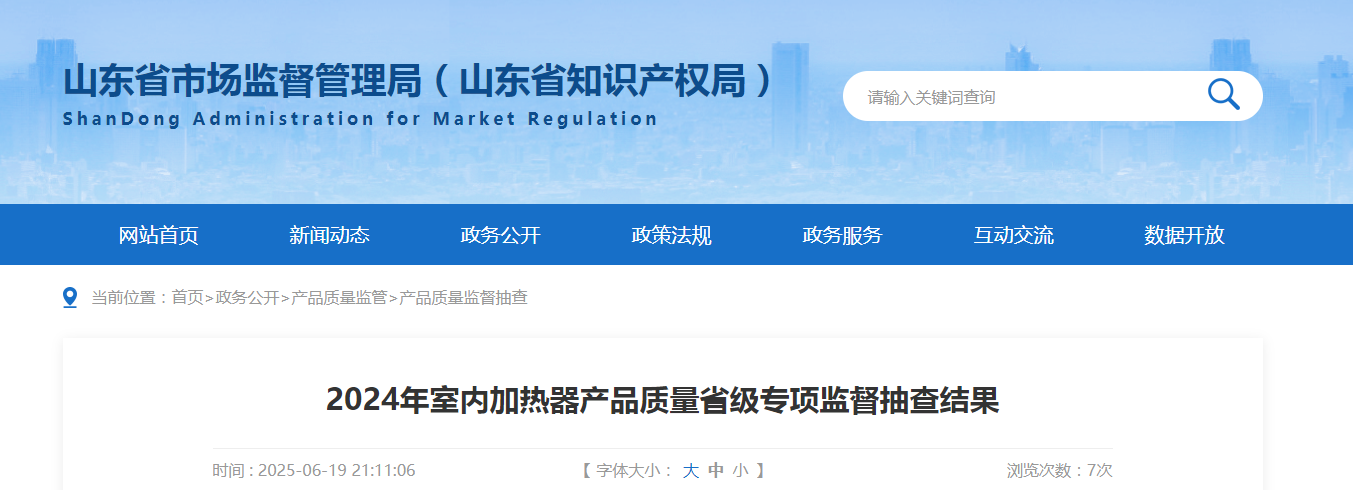
2024年江苏省苏州市室内加热器产品质量监督抽查情况发布(第103期)
Zhong Guo Zhi Liang Xin Wen Wang· 2025-06-10 09:04
Product Overview and Industry Distribution - Indoor heaters, commonly known as heating appliances, include types such as oil-filled heaters, far-infrared heaters, PTC warm air fans, and halogen tube heaters, all of which require CCC certification [3][4] - Oil-filled heaters typically cost between 400 to 500 yuan and are suitable for use in living rooms, bedrooms, and hallways, especially in homes with elderly or children [3] - Far-infrared heaters are less common in the market, priced around 100 yuan, and are used for localized heating [4] - PTC warm air fans range from 200 to 600 yuan and are ideal for portable home heating due to their quick heating and automatic temperature control features [4] - Halogen tube heaters are priced between 100 to 200 yuan and are effective for personal heating in small rooms [4] - Jiangsu province has about 40 indoor heater manufacturers, primarily small to medium-sized enterprises, with 8 certified companies in Suzhou, of which only 3 are currently operational [4] Inspection Basis and Key Projects - The quality supervision inspection is based on GB 4706.1-2005 and GB 4706.23-2007 standards, focusing on safety and specific requirements for indoor heaters [5] - Key inspection items include protection against electric shock, input power and current, heating performance, leakage current, moisture resistance, mechanical strength, and grounding measures [5][6] Supervision Inspection Results - A total of 15 batches of indoor heaters were inspected, with 2 batches found to be non-compliant, resulting in a non-compliance rate of 13.3% [5] - Specific non-compliance issues included inadequate protection against electric shock, discrepancies in input power and current, structural design flaws, unreliable power connections, and grounding issues [6][7][8][9][10]