Pinecone

Search documents
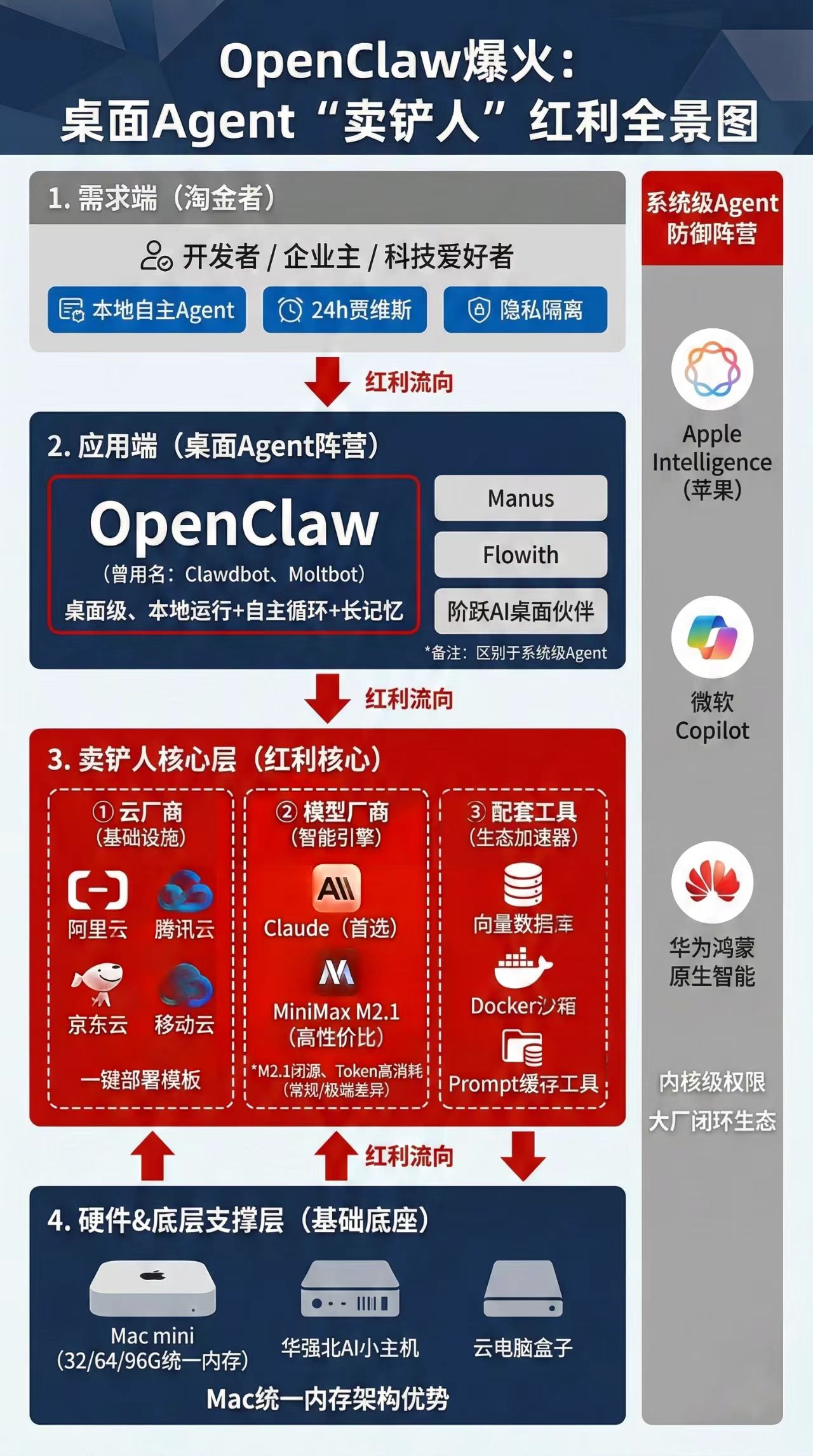
寻找桌面Agent红利下的卖铲人
Hua Er Jie Jian Wen· 2026-01-31 09:17
Core Insights - OpenClaw, a new desktop agent, has gained significant popularity in tech communities, enabling users to interact with AI in a natural chat interface and perform complex tasks [1][4] - The product's design allows for local operation, enhancing privacy and security, which has led to a surge in demand for MacMini as a dedicated device for running OpenClaw [4][17] - The rise of OpenClaw has sparked interest from cloud service providers, with companies like Alibaba Cloud and Tencent Cloud quickly launching dedicated services and templates for OpenClaw deployment [4][5] Group 1: Product Features and Market Response - OpenClaw can perform a variety of tasks, from comparing car dealership quotes to managing email subscriptions and flight bookings, showcasing its versatility [1] - The agent's ability to maintain long-term memory and context allows it to proactively send reminders and alerts, likened to a "24-hour standby Jarvis" [1] - The rapid adoption of OpenClaw has led to a proliferation of tutorials and guides, indicating strong community engagement and interest [1][4] Group 2: Financial Implications and Operational Costs - Users have reported high operational costs associated with OpenClaw, particularly due to its extensive use of API tokens, which can be quickly depleted [5][6] - Traditional chatbots consume fewer tokens per interaction compared to OpenClaw's autonomous operation, which can lead to significant expenses [6] - The need for efficient and cost-effective models is emphasized, as the performance of agents like OpenClaw heavily relies on underlying large models [6][7] Group 3: Competitive Landscape and Future Trends - The emergence of OpenClaw has intensified competition among desktop agents, with various players entering the market, including Manus and MiniMax [8] - The future of software is shifting towards a "thousand-end battle," where the focus will be on the capabilities of agents rather than just models [8] - Major tech companies like Apple and Microsoft are expected to evolve their AI offerings into comprehensive agents, leveraging their unique system-level access [10][11][12] Group 4: Hardware and Infrastructure Developments - The demand for dedicated hardware, such as MacMini, has surged due to its compatibility with OpenClaw, although it is not seen as a long-term solution [17][18] - New hardware solutions, including AI mini PCs and cloud-based "AI boxes," are emerging to provide cost-effective alternatives for users needing lightweight agents [20] - The competition for control over desktop agents is expected to intensify, with both software and hardware players vying for market share [20]

2026,进入AI记忆元年
3 6 Ke· 2026-01-27 10:28
Group 1 - The core finding indicates that the iteration cycle of SOTA models has been rapidly compressed to 35 days since mid-2023, with previous SOTA models potentially falling out of the Top 5 in just 5 months and out of the Top 10 in 7 months, suggesting a stagnation in breakthrough innovations despite ongoing technical advancements [1] - The emergence of vector database products like Milvus, Pinecone, and faiss in 2023 marks a significant shift in the AI memory landscape, leading to a proliferation of AI memory frameworks such as Letta (MemGPT), Mem0, MemU, and MemOS expected to emerge between 2024 and 2025 [2] - The integration of memory capabilities into models has sparked discussions in the industry, with Claude and Google announcing advancements in model memory, indicating a growing focus on memory-enhanced AI applications across various sectors [2] Group 2 - There are three common misconceptions about adding memory to large models, with the first being the belief that memory equates to RAG (Retrieval-Augmented Generation) and long context [3][4] - The overemphasis on RAG performance has led to a misunderstanding of its limitations, as it can only address about 60% of real user needs, highlighting the necessity for a comprehensive solution that includes dynamic memory capabilities [6][8] - The second misconception is that factual retrieval is paramount, while emotional intelligence is crucial for effectively addressing user needs, as demonstrated by a case where AI was required to handle emotional support in sensitive situations [11][13] Group 3 - The third misconception is the belief that the future of agents lies in standardization, while the reality is that non-standard solutions are essential for addressing the diverse needs of different industries [15][16] - Red Bear AI has developed a memory system that incorporates emotional weighting and collaborative capabilities among agents, allowing for tailored solutions that adapt to specific industry requirements [17][19] - As the industry transitions into 2026, memory capabilities are becoming the key differentiator among models and agents, marking a shift from a focus on scaling laws to a marathon-like approach centered on memory [22]