MacMini

Search documents
OpenClaw揭示AI智能体底层需求:人类的“拔线权”
虎嗅APP· 2026-02-05 00:53
Core Insights - OpenClaw, an AI Agent, is being hailed as a potential "super worker" that could transform human work patterns, with its native community MoltBook gaining popularity through user interactions [4][5]. Group 1: Market Impact and Winners - The first "winner" identified is the MacMini and VPS providers, as MacMini sales have surged since OpenClaw's launch due to its compatibility with MacOS, which facilitates easier deployment of OpenClaw [6]. - The demand for "sandbox" environments has increased, driven by user concerns over data and information security [7]. - OpenClaw's deployment on MacOS is seen as the most cost-effective option, despite its capability to run on other systems like Raspberry Pi, which may offer lower costs but reduced performance [6][9]. Group 2: Security Concerns - A security assessment by ZeroLeaks AI revealed OpenClaw's alarming security score of 2/100, indicating critical vulnerabilities, including a high success rate of data extraction attempts [9]. - Users, including high-profile figures like David Sacks, express reluctance to deploy OpenClaw due to these security concerns [8]. Group 3: Data and AI Interaction - The potential for AI Agents to serve as interaction gateways raises questions about data ownership and the competitive landscape among tech giants, with companies like ByteDance, Alibaba, and Tencent vying for control over user data [11]. - The emergence of open-source models like Kimi 2.5 could allow users to process tasks locally, potentially disrupting the subscription-based business models of closed-source AI [12][15]. Group 4: Future of AI Agents - The future of AI Agents hinges on establishing a secure framework that allows users to trust these systems, with the need for clear roles and responsibilities akin to traditional employment [16]. - The transition from AI Agents being seen as experimental tools to accepted workforce members will depend on the development of a digital governance system that ensures user data safety [16].



开源证券晨会纪要-20260201
KAIYUAN SECURITIES· 2026-02-01 15:19
Core Insights - The report emphasizes the importance of a strong domestic economic foundation for building a financial powerhouse in China, highlighting the need for comprehensive policies to boost domestic demand and optimize support for new industries [6][7][8] - The manufacturing sector is experiencing a decline in PMI, indicating weakening production and demand, with specific industries like food processing and aerospace remaining in a high prosperity zone while others face pressure [11][12][13] - The real estate sector is projected to hit a bottom in 2026, with historical patterns suggesting a cyclical rather than a trend-based issue, and the report discusses the implications of rental yields and mortgage rates on property prices [30][31][32][34] Macro Economic Analysis - The report outlines macroeconomic policies focusing on enhancing domestic circulation and expanding domestic demand, with specific measures including a 500 billion yuan investment guarantee plan for private investment [6][7] - It notes that the central bank will maintain a moderately loose monetary policy in 2026, with potential for further rate cuts and liquidity support [7][8] - Fiscal policies are aimed at stimulating consumption and investment, with a focus on service sectors and adjustments in real estate financing [8] Industry Insights - The automotive industry is highlighted with significant growth in FSD paid user penetration, reaching over 12%, and a fivefold increase in global humanoid robot shipments expected in 2025 [53][54] - The chemical industry is experiencing stable prices for refrigerants despite seasonal downturns, with companies like Juhua and Haohua Technology announcing performance increases for 2025 [4] - The food and beverage sector shows resilience in demand, particularly for brands like Moutai, indicating a clear trend of improvement at the bottom [4] Investment Strategy - The report suggests maintaining positions in the market despite volatility, advocating for a focus on theme-based investments that align with macroeconomic conditions [23][25] - It emphasizes the importance of sector rotation, recommending investments in steel, building materials, media, chemicals, and communication sectors [39][41] - The report also discusses the performance of "quantitative fixed income+" funds, noting their rapid growth and the strategies employed within this category [49][50][51]
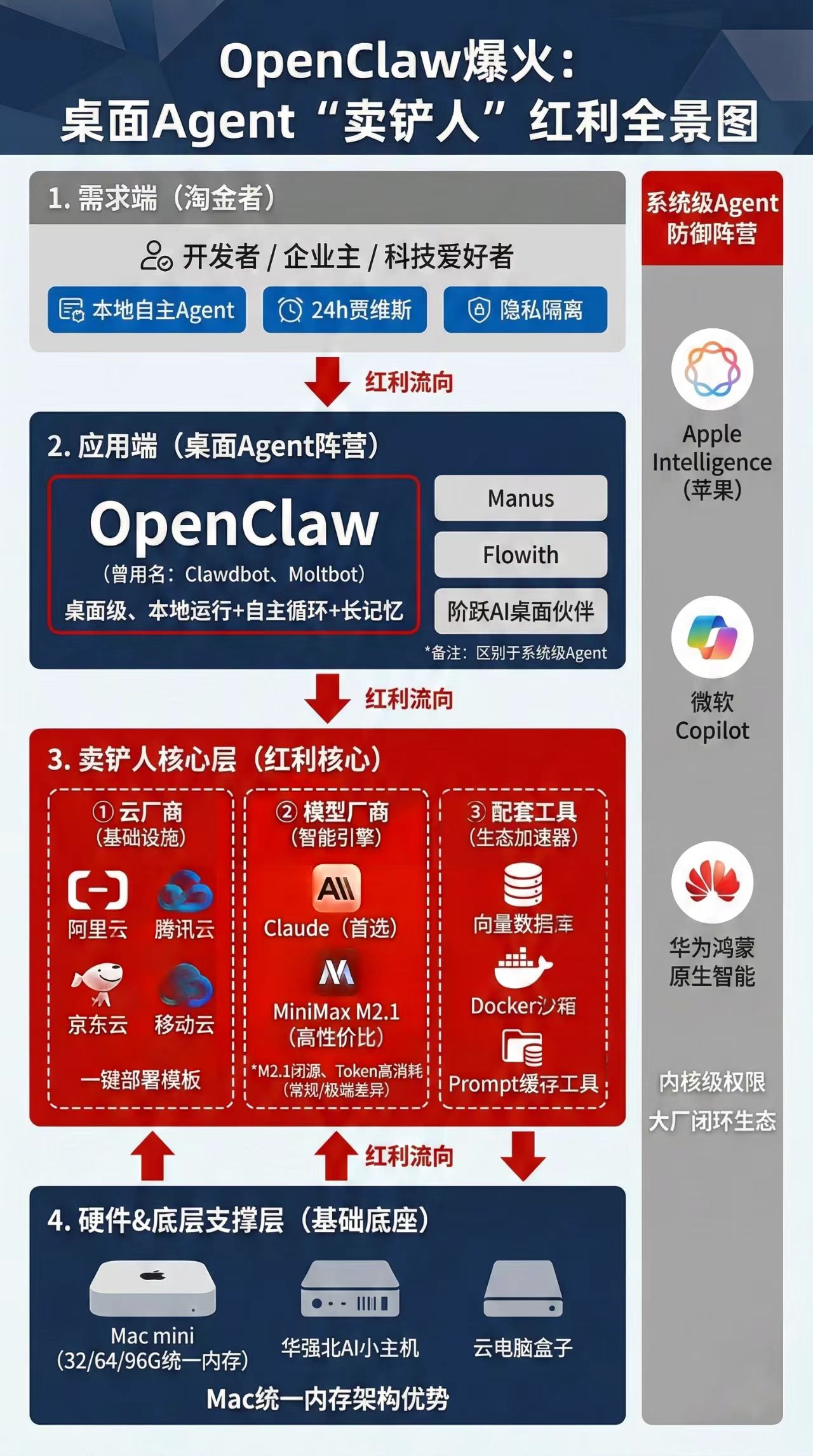
寻找桌面Agent红利下的卖铲人
Hua Er Jie Jian Wen· 2026-01-31 09:17
Core Insights - OpenClaw, a new desktop agent, has gained significant popularity in tech communities, enabling users to interact with AI in a natural chat interface and perform complex tasks [1][4] - The product's design allows for local operation, enhancing privacy and security, which has led to a surge in demand for MacMini as a dedicated device for running OpenClaw [4][17] - The rise of OpenClaw has sparked interest from cloud service providers, with companies like Alibaba Cloud and Tencent Cloud quickly launching dedicated services and templates for OpenClaw deployment [4][5] Group 1: Product Features and Market Response - OpenClaw can perform a variety of tasks, from comparing car dealership quotes to managing email subscriptions and flight bookings, showcasing its versatility [1] - The agent's ability to maintain long-term memory and context allows it to proactively send reminders and alerts, likened to a "24-hour standby Jarvis" [1] - The rapid adoption of OpenClaw has led to a proliferation of tutorials and guides, indicating strong community engagement and interest [1][4] Group 2: Financial Implications and Operational Costs - Users have reported high operational costs associated with OpenClaw, particularly due to its extensive use of API tokens, which can be quickly depleted [5][6] - Traditional chatbots consume fewer tokens per interaction compared to OpenClaw's autonomous operation, which can lead to significant expenses [6] - The need for efficient and cost-effective models is emphasized, as the performance of agents like OpenClaw heavily relies on underlying large models [6][7] Group 3: Competitive Landscape and Future Trends - The emergence of OpenClaw has intensified competition among desktop agents, with various players entering the market, including Manus and MiniMax [8] - The future of software is shifting towards a "thousand-end battle," where the focus will be on the capabilities of agents rather than just models [8] - Major tech companies like Apple and Microsoft are expected to evolve their AI offerings into comprehensive agents, leveraging their unique system-level access [10][11][12] Group 4: Hardware and Infrastructure Developments - The demand for dedicated hardware, such as MacMini, has surged due to its compatibility with OpenClaw, although it is not seen as a long-term solution [17][18] - New hardware solutions, including AI mini PCs and cloud-based "AI boxes," are emerging to provide cost-effective alternatives for users needing lightweight agents [20] - The competition for control over desktop agents is expected to intensify, with both software and hardware players vying for market share [20]