
Powerade Power Water

Search documents
BodyArmor减值拖累,可口可乐Q4 GAAP营业利润同比下滑32%,全年指引不及预期|财报见闻
Sou Hu Cai Jing· 2026-02-10 13:10
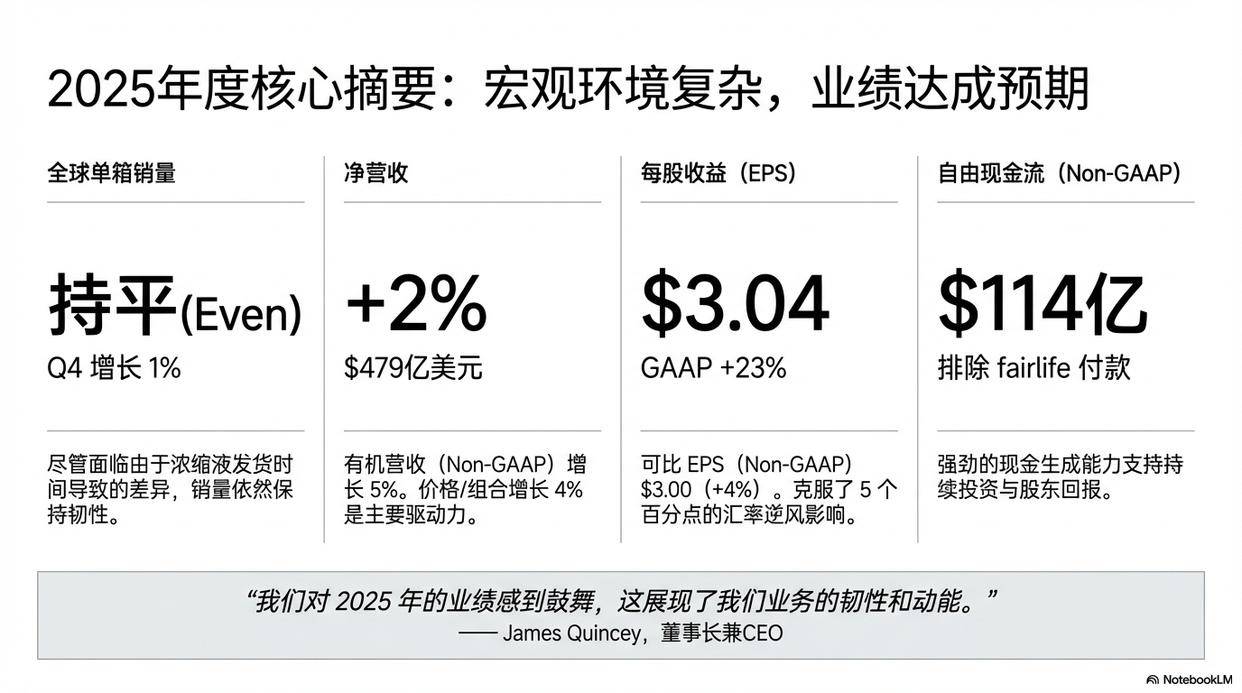
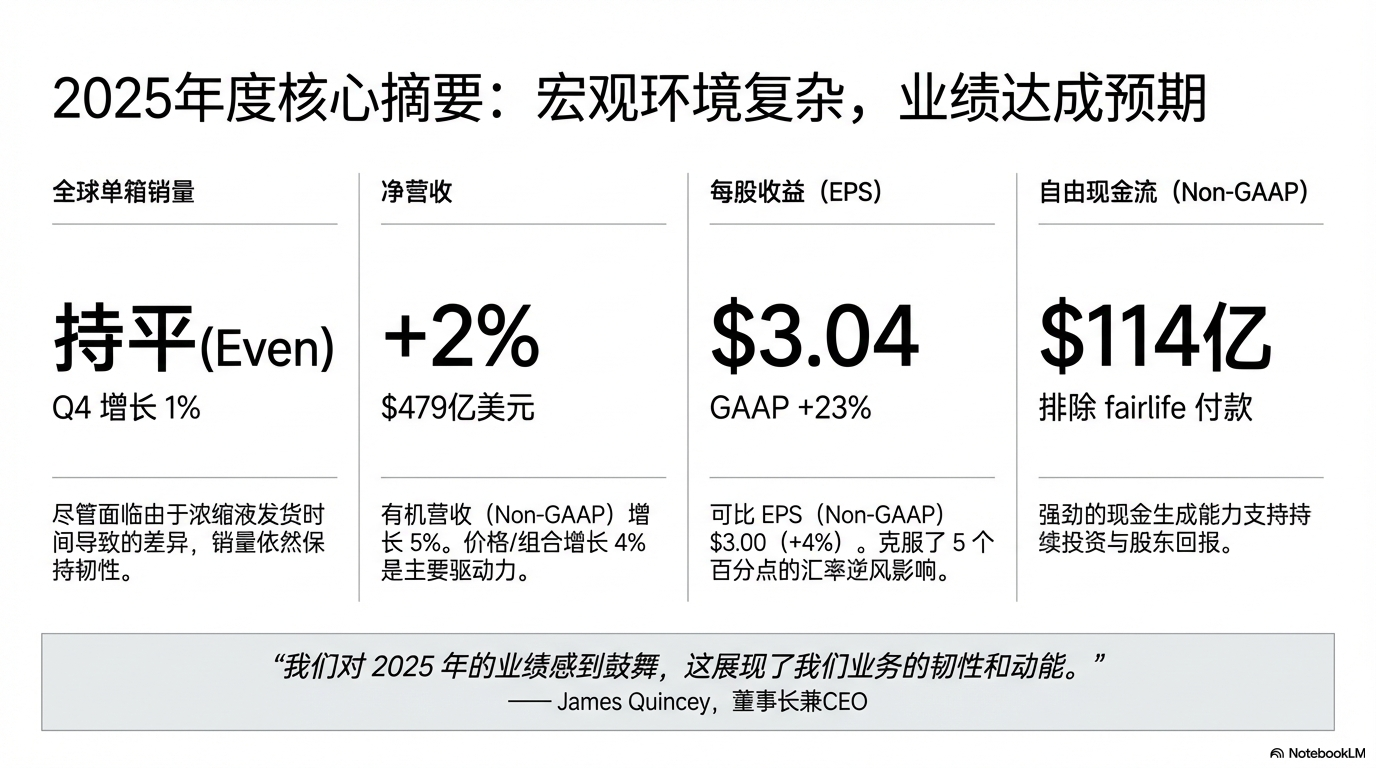
Core Viewpoint - Despite strong performance in the zero-sugar segment and slightly better-than-expected Q4 results, Coca-Cola's 2026 growth guidance appears weak, disappointing the market [1][3]. Financial Performance - Q4 revenue reached $11.82 billion, a 2% year-over-year increase, with organic revenue growth of 5% [1]. - Comparable EPS was $0.58, up 6% year-over-year, slightly exceeding analyst expectations [1]. - North America operating profit fell 65% year-over-year due to a $960 million non-cash impairment charge related to the BodyArmor brand acquisition [8]. Sales and Pricing - Global unit case volume grew by 1%, with price/mix growth of 1%, indicating maintained pricing power but at a reduced rate compared to previous years [9]. - Coca-Cola Zero Sugar was a standout product, with Q4 sales surging 13% and a 14% increase for the year [9]. - Traditional full-sugar soda sales faced pressure due to declining consumer demand, while Diet Coke remained flat for the year [9]. Future Outlook - Coca-Cola expects organic sales growth for 2026 to be between 4% and 5%, below Wall Street's average expectation of 5.01% [3][6]. - The company anticipates comparable EPS growth of 7% to 8% from a base of $3.00 in 2025, indicating a shift from the previous inflation-driven growth to a more moderate growth environment [6]. Market and Policy Challenges - The company faces increasing macroeconomic pressures, including health concerns regarding sugary drinks and state-level restrictions on soft drink purchases using food assistance benefits [5][11]. - Coca-Cola is diversifying its product portfolio to address these challenges, promoting healthier options and leveraging sports events for marketing [11].


BodyArmor减值拖累,可口可乐Q4 GAAP营业利润同比下滑32%,全年指引不及预期 | 财报见闻
Hua Er Jie Jian Wen· 2026-02-10 12:58
Core Viewpoint - Despite strong performance from the zero-sugar product line and slightly better-than-expected Q4 results, Coca-Cola's 2026 growth guidance appears weak, disappointing the market [1][4]. Financial Performance - In Q4, Coca-Cola reported revenue of $11.82 billion, a 2% year-over-year increase, with organic revenue growth of 5% [1]. - The comparable earnings per share (EPS) was $0.58, reflecting a 6% year-over-year growth, slightly above analyst expectations [1]. - However, GAAP operating profit fell by 32% year-over-year due to a $960 million non-cash impairment charge related to the acquisition of BodyArmor [4][11]. Future Outlook - Coca-Cola projects organic sales growth for 2026 to be between 4% and 5%, which is below Wall Street's average expectation of 5.01% [4][8]. - The company anticipates a 7% to 8% growth in comparable EPS from a base of $3.00 in 2025, indicating a shift from the previous high-inflation-driven growth to a more moderate growth environment [8]. Market Challenges - The company faces a complex macro policy environment, with signals from the Trump administration regarding the health implications of carbonated drinks and new state-level restrictions on soft drink purchases using food assistance benefits [7][14]. - As a result of the disappointing guidance and macroeconomic concerns, Coca-Cola's stock price dropped by 4.1% in pre-market trading [7]. Product Performance - Coca-Cola's core business showed resilience, particularly with its "no sugar" strategy, as Coca-Cola Zero Sugar saw a 13% increase in Q4 sales and a 14% increase for the year [9][12]. - In North America, despite a strong underlying performance, operating profit plummeted by 65% due to the impairment charge related to BodyArmor [11]. - Global unit case volume grew by 1%, with price/mix growth of 1%, indicating maintained pricing power but a narrowing increase compared to previous years [12]. Strategic Response - To address the challenges posed by changing consumer preferences and health trends, Coca-Cola is accelerating its diversification into non-sugar beverages, sports drinks, and water [8][14]. - The company is promoting innovative products like Powerade and Power Water and leveraging global sporting events for marketing to counteract the decline in traditional carbonated drink demand [14].
Coca-Cola takes Powerade into functional waters
Yahoo Finance· 2025-10-02 13:31
Core Insights - Coca-Cola Company is launching Powerade Power Water, a functional water product, marking the first innovation under the Powerade brand in over five years [1] - The new product is positioned as an electrolyte-enhanced flavored water with 50% more electrolytes compared to Gatorade Thirst Quencher [2] - Powerade Power Water will be available in 20oz bottles and 16.9oz six-pack formats, initially in regional retail stores in the US, with nationwide distribution planned for next year [3] Product Details - Powerade Power Water is sugar-free and comes in four flavors: mountain berry blast, strawberry kiwi, tropical pineapple, and watermelon [1] - The product aims to set a new standard for functional water with its enhanced electrolyte content and appealing taste [3] Market Strategy - The launch is part of a broader strategy to increase market share and sales within the competitive sports hydration category [4] - Marketing campaigns will include social media, digital promotions, retail activations, out-of-home advertising, and sampling events [4] - Future plans include establishing high-impact partnerships with influential figures in the fitness industry [4] Competitive Landscape - Coca-Cola's Bodyarmor brand already offers hydration products, including Bodyarmor Flash IV, launched in 2023 [5] - PepsiCo has also expanded its Gatorade range with a premium alkaline water product, indicating increased competition in the functional water segment [5]