无糖化

Search documents
BodyArmor减值拖累,可口可乐Q4 GAAP营业利润同比下滑32%,全年指引不及预期|财报见闻
Sou Hu Cai Jing· 2026-02-10 13:10
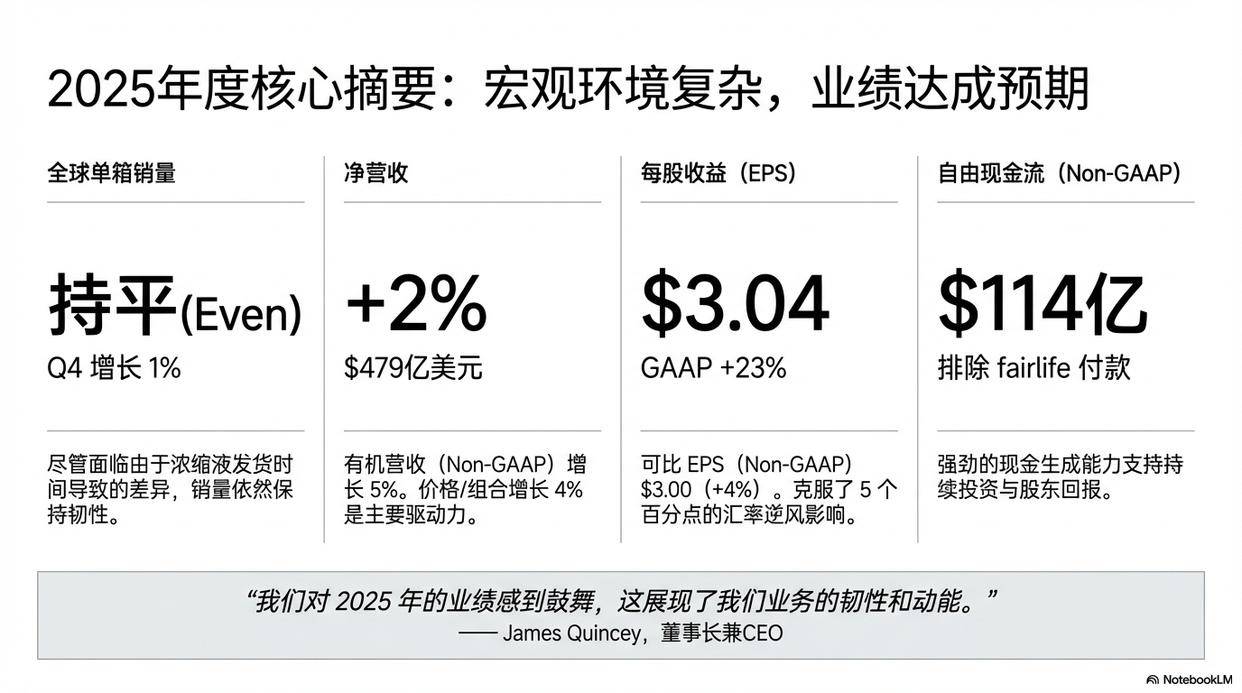
Core Viewpoint - Despite strong performance in the zero-sugar segment and slightly better-than-expected Q4 results, Coca-Cola's 2026 growth guidance appears weak, disappointing the market [1][3]. Financial Performance - Q4 revenue reached $11.82 billion, a 2% year-over-year increase, with organic revenue growth of 5% [1]. - Comparable EPS was $0.58, up 6% year-over-year, slightly exceeding analyst expectations [1]. - North America operating profit fell 65% year-over-year due to a $960 million non-cash impairment charge related to the BodyArmor brand acquisition [8]. Sales and Pricing - Global unit case volume grew by 1%, with price/mix growth of 1%, indicating maintained pricing power but at a reduced rate compared to previous years [9]. - Coca-Cola Zero Sugar was a standout product, with Q4 sales surging 13% and a 14% increase for the year [9]. - Traditional full-sugar soda sales faced pressure due to declining consumer demand, while Diet Coke remained flat for the year [9]. Future Outlook - Coca-Cola expects organic sales growth for 2026 to be between 4% and 5%, below Wall Street's average expectation of 5.01% [3][6]. - The company anticipates comparable EPS growth of 7% to 8% from a base of $3.00 in 2025, indicating a shift from the previous inflation-driven growth to a more moderate growth environment [6]. Market and Policy Challenges - The company faces increasing macroeconomic pressures, including health concerns regarding sugary drinks and state-level restrictions on soft drink purchases using food assistance benefits [5][11]. - Coca-Cola is diversifying its product portfolio to address these challenges, promoting healthier options and leveraging sports events for marketing [11].


能量饮料市场迎来巨变,无糖浪潮重塑品类格局
Sou Hu Cai Jing· 2026-02-03 21:24
Core Insights - The energy drink industry is undergoing a transformative change, with sugar-free products becoming a core growth driver, reshaping the competitive landscape [1] - The rise of the health-conscious younger consumer groups, particularly Generation Z and Millennials, is accelerating the industry's shift towards healthier options [1][4] - The global health and wellness economy has surpassed $6.3 trillion, with a projected annual growth rate of 7.3%, indicating a robust market for sugar-free energy drinks [4] Market Trends - The Chinese energy drink market's retail sales have exceeded 111.4 billion yuan in 2024, while the global functional beverage market is estimated to reach $149.75 billion, expected to grow to $248.51 billion by 2030, with sugar-free products contributing significantly [4] - In the U.S., Generation Z and Millennials, who represent only 36% of the adult population, account for over 41% of annual wellness spending [4] Regulatory Environment - Global regulatory measures are pushing the industry towards sugar-free products, with governments implementing taxes and guidelines to limit sugar intake [8] - The UK's 2018 Soft Drinks Industry Levy has led to a reduction of over 45,000 tons of added sugar in the beverage industry [8] - The World Health Organization's "3 by 35" initiative aims to halve the consumption of sugary beverages, alcohol, and tobacco by the end of 2025, emphasizing the urgency for innovation in sugar-free products [8] Strategic Implications - The rise of sugar-free energy drinks presents a significant opportunity for brands, as health considerations are deeply integrated into consumer decision-making [10] - Leading brands are accelerating their sugar-free strategies, focusing on formula and flavor innovations to capture the health-conscious consumer base [10] - Brands that respond quickly and invest strategically in sugar-free innovations are likely to gain a competitive edge and foster long-term loyalty among health-conscious consumers [10]
食品饮料深度研究:破局与重构:中国软饮行业的发展新纪元
HTSC· 2025-07-24 09:56
Investment Rating - The report maintains an "Overweight" rating for the food and beverage industry [3]. Core Insights - The Chinese soft drink industry is transitioning from a growth phase characterized by new product launches to a more competitive environment focused on existing products, making it challenging to cultivate new billion-dollar brands [16][39]. - The report highlights the emergence of health and functional trends in consumer preferences, which are expected to create new market opportunities for innovative products [5][17]. - The industry is witnessing a shift in growth logic from volume-driven to structural upgrades, emphasizing the need for companies to enhance product innovation and channel management capabilities to succeed [18][19]. Summary by Sections Industry Overview - The soft drink sector in China has a vast potential for nurturing billion-dollar products, with notable examples including Red Bull (23.4 billion), Dongpeng Special Drink (17.6 billion), and Wanglaoji (13.8 billion) [4][20]. - The market size for the soft drink industry reached 691.4 billion yuan in 2024, with a compound annual growth rate (CAGR) of 4.0% from 2014 to 2024 [21]. Market Trends - The report identifies a significant trend towards health and functionality in beverages, with a growing demand for low-sugar and functional drinks [5][17]. - The Japanese soft drink market's history of sugar reduction and functionalization serves as a reference for potential developments in China [17]. Competitive Landscape - The competitive dynamics have intensified, with a notable increase in product and channel homogeneity, making it harder to develop new billion-dollar products [41]. - Major players like Nongfu Spring, Uni-President China, and Master Kong are recommended for their strong market positions and innovative capabilities [8]. Future Outlook - Short-term projections indicate that the cost advantages in the industry will continue, benefiting leading companies [18]. - Long-term success will depend on companies' abilities to innovate products and refine channel strategies to capture emerging consumer demands [19].
破局与重构:中国软饮行业的发展新纪元
HTSC· 2025-07-24 04:08
Investment Rating - The report maintains an "Overweight" rating for the food and beverage sector [7] Core Insights - The Chinese soft drink industry is transitioning from a growth phase characterized by new product launches to a more competitive landscape focused on existing products, with significant challenges in cultivating new billion-dollar products [14][15] - Emerging trends in health and functionality are reshaping consumer preferences, creating opportunities for new product categories such as sugar-free beverages and functional drinks [3][16] - The report emphasizes the importance of product innovation and channel development as key factors for companies to succeed in the evolving market [17][18] Summary by Sections Industry Investment Rating - The food and beverage sector is rated as "Overweight" [7] Industry Overview - The soft drink market in China reached a scale of 6,914 billion yuan in 2024, with a CAGR of 4.0% from 2014 to 2024 [20] - Major billion-dollar products include Red Bull (23.4 billion), Dongpeng Special Drink (17.6 billion), and Wanglaoji (13.8 billion) [15][32] Market Trends - The report identifies a shift towards health and functionality in consumer preferences, with sugar-free and functional beverages gaining traction [3][16] - The health trend began with the introduction of sugar-free drinks in China in 1997, with significant growth noted since 2018 [3][16] Competitive Landscape - The report highlights that the competition in the soft drink industry has intensified, with a focus on product differentiation beyond taste to include packaging, marketing, and functional attributes [18][37] - The market is characterized by a high degree of product and channel homogeneity, making it challenging for new billion-dollar products to emerge [15][37] Investment Recommendations - The report recommends investing in leading companies with strong comprehensive capabilities, such as Nongfu Spring, Uni-President China, and Master Kong [5][9]
可口可乐:“快乐肥宅水” 依然是最稳避风港?
3 6 Ke· 2025-07-23 00:01
Core Viewpoint - Coca-Cola (KO.US) reported its Q2 2025 earnings, showing a slight miss in revenue expectations but maintaining a stable overall performance despite high base effects from the previous year [2][8]. Revenue Performance - Coca-Cola achieved a total revenue of $12.54 billion in Q2 2025, a year-on-year increase of 1.4%, which was slightly below market expectations [2][7]. - Organic revenue growth was 5%, with a decline in concentrate sales volume by 1% due to high base effects from the previous year [2][7]. - Concentrate prices increased by 6%, driven by a higher proportion of premium products in the mix [2]. Regional Insights - Emerging markets, including China, India, and Latin America, showed higher growth rates compared to mature markets like North America and Western Europe, although the Asia-Pacific region experienced a slowdown [3][4]. - The competitive landscape in China, with the rise of local brands, has impacted Coca-Cola's performance in that market [3]. Product Category Performance - The no-sugar cola segment continued to grow significantly, with a year-on-year increase of 14%, while classic cola saw a decline of 1% [4]. - Other product categories, except for ready-to-drink coffee, experienced declines due to high base effects from the previous year [4]. Profitability Metrics - Coca-Cola's gross profit margin improved by 1.3 percentage points to 62.6%, supported by effective cost management and a shift towards higher-margin products [5][7]. - Operating profit margin saw a substantial increase of 12.8%, indicating enhanced operational efficiency [8]. Future Guidance - The company expects to achieve organic growth of 5%-6% for the full year 2025, consistent with previous forecasts [6]. Strategic Initiatives - Coca-Cola is focusing on targeted strategies for different consumer segments, including increasing the availability of smaller packaging and family packs in discount channels for lower-income consumers, while emphasizing health-oriented products for higher-income groups [9]. - The company plans to expand its distribution network in emerging markets, particularly through non-retail channels, and will introduce localized product innovations to meet regional consumer preferences [9]. Investment Perspective - Coca-Cola's strong brand presence and localized operations provide it with a robust risk resilience, making it an attractive option for investors seeking stable returns [10].
可口可乐:关税越猛,“快乐肥宅水”越金贵?
美股研究社· 2025-04-30 10:16
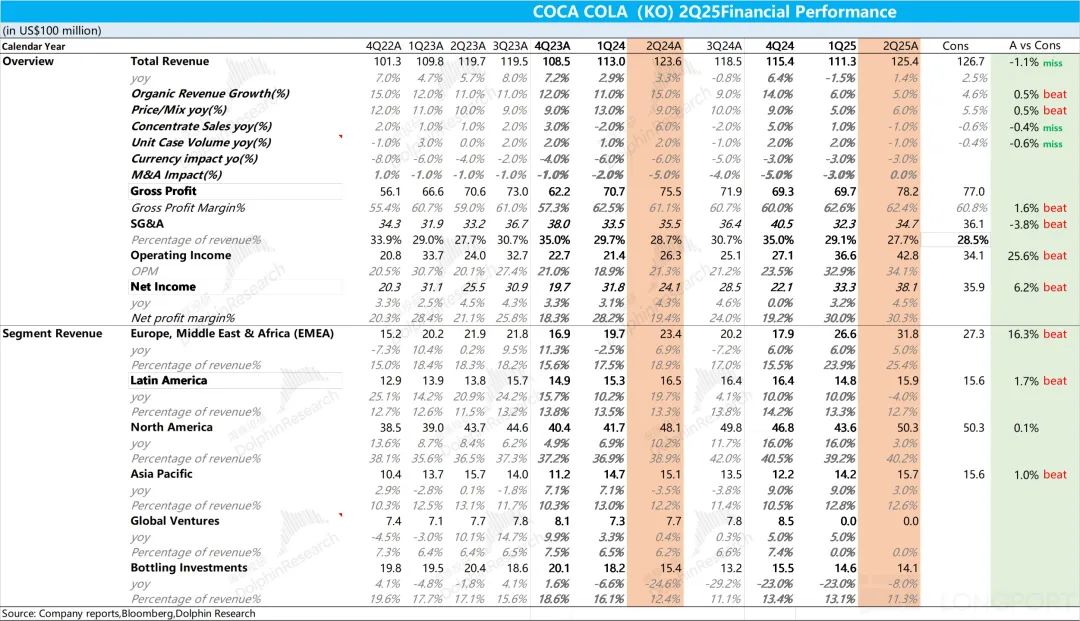
以下文章来源于海豚投研 ,作者海豚君 海豚投研 . 有灵魂的思考、有态度的研究。 来源 | 海豚投研 可口可乐(KO)于北京时间2025年4月29日晚间美股盘前发布了2025年第一季度财报(截止2025年3月),在川普的关税大棒下,宏观的高度 不确定性使得可口可乐再次成为了资金理想的避风港,从业绩上看,由于饮料行业一季度往往是全年的消费淡季,因此增速有所下降也在预期之 内,具体来看核心信息: 1、内 生增长有所降速: 1Q25 可 口 可乐 实 现 表 观营 收 111.3 亿 美元 , 同比 下 降2% , 和市场 预 期 基 本 一 致 , 其 中内 生营收 ( Organic revenue)同比增长6%,量价拆分看, 浓缩液销量增速和价格增速分别同比增加1%和5%。 由于发达国家健康意识不断提升加上去年可口可 乐在全球范围内大面积涨价,市场对可口可乐销量端的预期本就不高,因此这次销量端反而超出了市场一致预期。此外,受到关税大棒影响, 美元指数在Q1走弱,公司外汇 逆风的影响从-6%收窄至-3%。 2、亚太地区韧性更强。 分地区看,除了亚太地区外其他地区增速均有所回落, 亚太地区表现强劲一方面由于印度、 ...
可口可乐:关税越猛,“快乐肥宅水”越金贵?
海豚投研· 2025-04-29 14:56
可口可乐(KO)于北京时间2025年4月29日晚间美股盘前发布了2025年第一季度财报(截止2025年3月),在川普的关税大棒下,宏观的高度不确定性使得可口可 乐再次成为了资金理想的避风港,从业绩上看,由于饮料行业一季度往往是全年的消费淡季,因此增速有所下降也在预期之内,具体来看核心信息: 1、内 生增长有所降速: 1Q25可口可乐实现表观营收111.3亿美元,同比下降2%,和市场预期基本一致,其中内生营收(Organic revenue)同比增长6%,量价拆分 看, 浓缩液销量增速和价格增速分别同比增加1%和5%。 由于发达国家健康意识不断提升加上去年可口可乐在全球范围内大面积涨价,市场对可口可乐销量端的 预期本就不高,因此这次销量端反而超出了市场一致预期。此外,受到关税大棒影响,美元指数在Q1走弱,公司外汇 逆风的影响从-6%收窄至-3%。 2、亚太地区韧性更强。 分地区看,除了亚太地区外其他地区增速均有所回落, 亚太地区表现强劲一方面由于印度、菲律宾等发展中国家线下网点的加速铺货提 升了产品的市场覆盖率,另一方面,伴随更多低糖、低热量健康饮品在日本的推出,日本市场表现也有所回暖。 3、健康&营养品类表现 ...
中国饮料市场大变局
投中网· 2025-04-08 02:41
以下文章来源于大V商业 ,作者刘颖 大V商业 . 关注消费零售、财经科技、资本市场,关注信息背后的价值 将投中网设为"星标⭐",第一时间收获最新推送 中国市场终究还是抛弃碳酸饮料? 作者丨 刘颖 来源丨 大V商业 尼尔森对中国饮料市场的研究中,发现了这么一个有意思的趋势。 中国市场 7 大饮料品类中, 2020 年只有碳酸饮料是增长的,其余品类均为负增长。当时的一个合理的解释是,含糖的碳酸饮料具有成瘾性。 但是到了 2023 年,七大品类中却变成了只有碳酸饮料负增长,其余 6 类则大幅增长。 中国市场终究还是抛弃碳酸饮料。 2022 年之前,碳酸饮料还是七大品类中市场份额第一,到了 2023 年骤变,市场份额下降 3 个百分点首次被即饮茶超过。 (尼尔森中国饮料趋势,2023年碳酸饮料下滑7%) 市场份额格局发生变化,背后是参与其中的市场巨头们也正在被迫接受市场的调整。 作为中国市场最大的可乐品牌,可口可乐 2024 年的业绩并不理想,勉强维持的销售额背后,是可口可乐通过提高价格来冲销销售量的下滑。 与此同时,元气森林、东鹏特饮、农夫山泉、大窑等国产饮品在细分赛道里占据一席之地。 可口可乐负增长 可口可乐销量 ...