BodyArmor

Search documents
加价不加量,可口可乐“负重”前行
Bei Jing Shang Bao· 2026-02-12 14:03
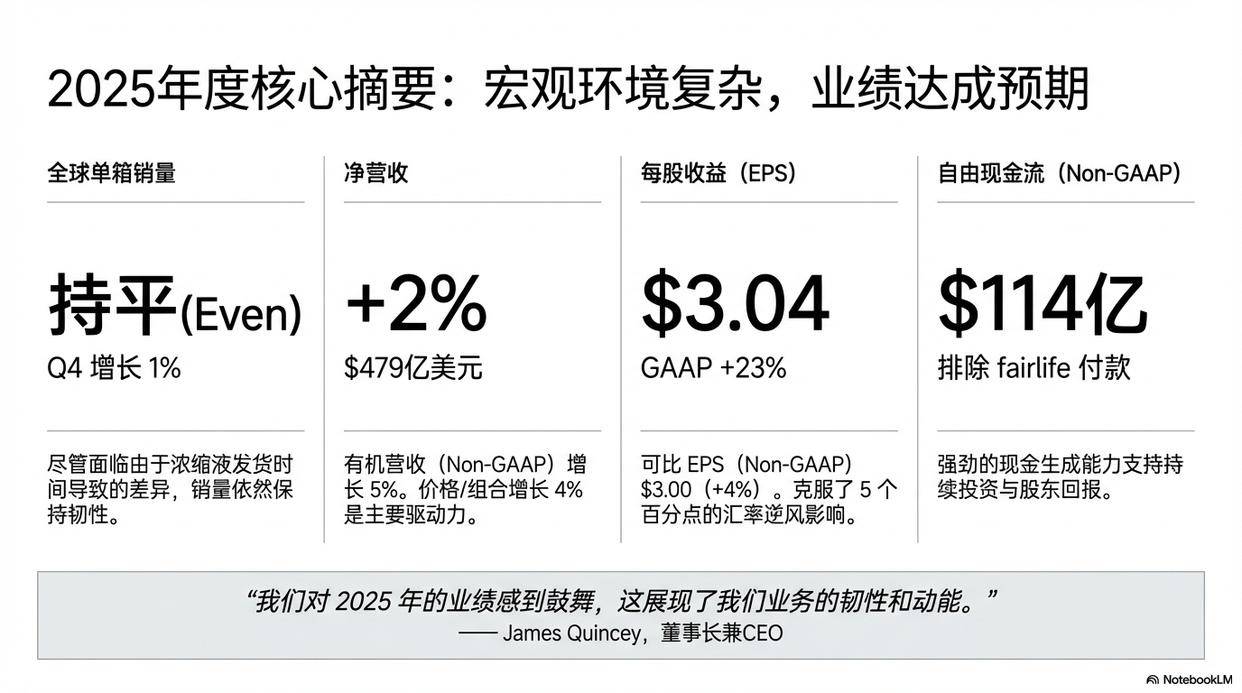
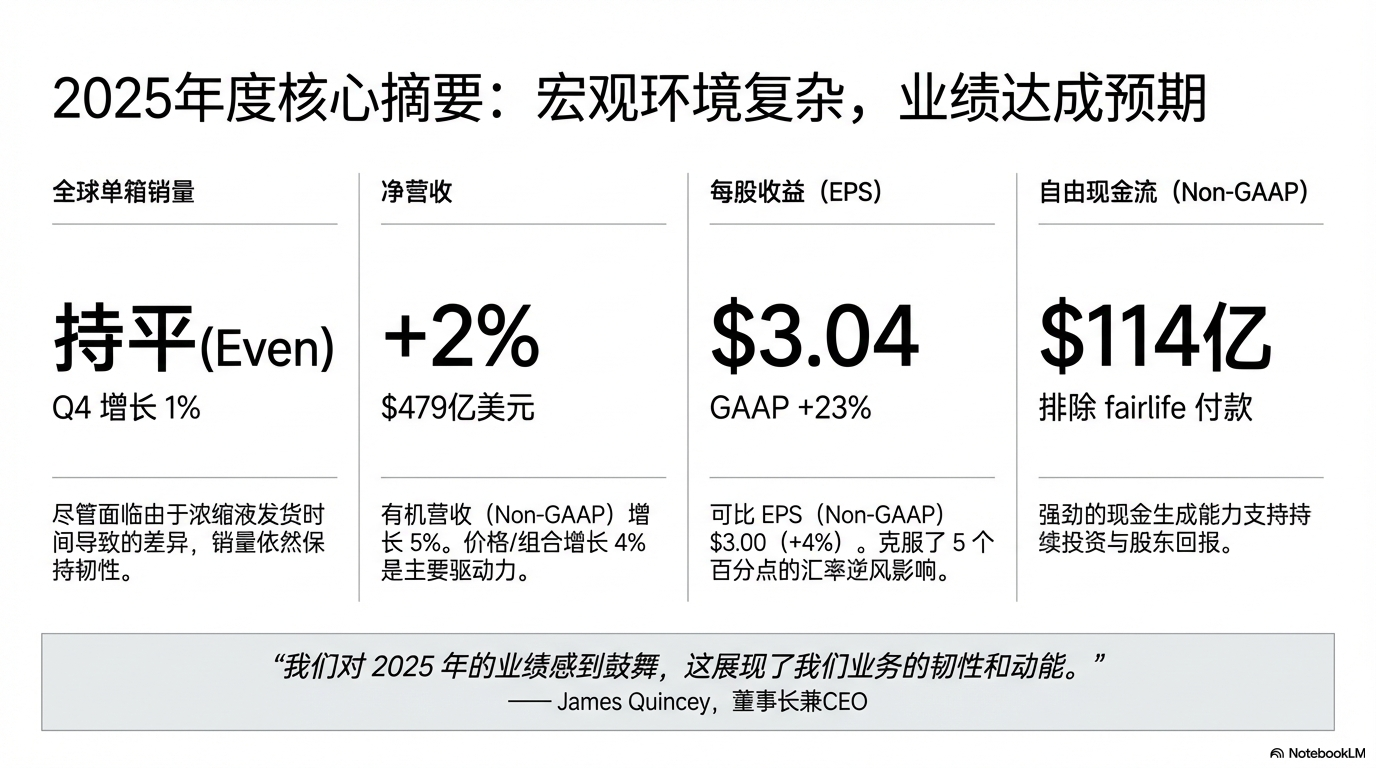
Core Insights - Coca-Cola's 2025 financial report reveals stagnant global unit case volume despite a 4% price increase, indicating a shift in market dynamics [2][4] - The company reported a revenue of $11.82 billion for Q4 2025, falling short of the $12.03 billion market expectation, primarily due to a 65% decline in North American operating income influenced by a $960 million impairment related to the BodyArmor acquisition [4] - The company's strategy of "volume and price growth" has failed, marking the first instance of zero volume growth in a decade [4][5] Financial Performance - Coca-Cola's total revenue for 2025 reached $47.9 billion, reflecting a 2% year-over-year increase, with organic revenue growth of 5% [4] - The global unit case volume growth rate was recorded at 0%, with all revenue growth attributed to price increases [4] - In the Asia-Pacific region, Q4 net revenue dropped by 7% and operating profit fell by 36%, highlighting core business weaknesses [5] Market Challenges - The rise of domestic brands like Nongfu Spring and Dongpeng Beverage poses significant external pressure on Coca-Cola [6] - Nongfu Spring reported a revenue of 25.62 billion yuan in H1 2025, a 15.6% increase, while Dongpeng Beverage achieved a revenue of 16.84 billion yuan in the first three quarters, growing by 34.13% [7] - The emergence of low-cost snack retail stores is disrupting traditional pricing strategies, complicating Coca-Cola's market positioning [7] Industry Context - The overall fast-moving consumer goods (FMCG) sector is experiencing collective anxiety, with the Chinese carbonated beverage market size declining by 2.6% in 2025 [8] - Coca-Cola has invested in upgrading five production bases in China over the past three years, which may support future growth opportunities [8]


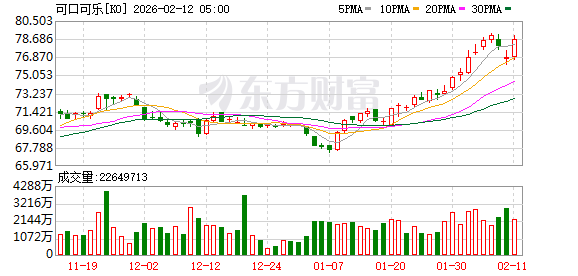
Coca-Cola stock sinks on disappointing outlook as Coke Zero, water power surprise sales increase
Yahoo Finance· 2026-02-10 14:11
Core Insights - Coca-Cola's stock experienced a decline of up to 4% following a cautious outlook for 2026, as CEO James Quincey highlighted the need for improvement in several international markets [1] - The company reported a 5% organic revenue growth in the fourth quarter, surpassing Wall Street's expectation of 4.8%, but anticipates organic sales growth of 4%-5% for 2026, which is below the 5% forecasted by analysts [2] - Adjusted earnings are projected to grow by 7%-8% this year, following a 9% increase in 2025 [2] Regional Performance - Coca-Cola is facing challenges in markets such as China, India, and Mexico, particularly due to the implementation of a soft drink tax, with flat sales reported in the Asia Pacific region during the fourth quarter [3] - In North America, the company saw a 1% increase in volumes and a 4% rise in prices in the fourth quarter, as consumers shifted towards less sugary options [3] Product Performance - Coca-Cola Zero Sugar volumes increased by 13% in the fourth quarter and 14% for the full year, while Diet Coke and Coca-Cola Light saw a 2% volume increase for the quarter and remained flat for the year [4] - The company is also experiencing growth in its protein products, such as Fairlife and Core Power, as well as hydration products like BodyArmor [4] Consumer Trends - The company is testing a new Simply Pop prebiotic soda to compete with PepsiCo's Poppi acquisition, although progress has been slow [5] - Quincey noted that while total consumer spending remains stable, purchasing habits are changing, with lower-income consumers engaging in value-based shopping [6] - Coca-Cola has implemented an affordability strategy over the past few years, which the company believes is effective in addressing these changing consumer behaviors [6]
可口可乐 2025 年为 BodyArmor 商标计入9.6 亿美元减值支出。
Xin Lang Cai Jing· 2026-02-10 13:33
Core Insights - Coca-Cola plans to record a $960 million impairment charge for the BodyArmor brand in 2025 [1] Group 1 - The impairment charge reflects the company's assessment of the brand's value and future performance [1] - This decision may impact Coca-Cola's financial statements and investor perceptions [1]
BodyArmor减值拖累,可口可乐Q4 GAAP营业利润同比下滑32%,全年指引不及预期|财报见闻
Sou Hu Cai Jing· 2026-02-10 13:10
Core Viewpoint - Despite strong performance in the zero-sugar segment and slightly better-than-expected Q4 results, Coca-Cola's 2026 growth guidance appears weak, disappointing the market [1][3]. Financial Performance - Q4 revenue reached $11.82 billion, a 2% year-over-year increase, with organic revenue growth of 5% [1]. - Comparable EPS was $0.58, up 6% year-over-year, slightly exceeding analyst expectations [1]. - North America operating profit fell 65% year-over-year due to a $960 million non-cash impairment charge related to the BodyArmor brand acquisition [8]. Sales and Pricing - Global unit case volume grew by 1%, with price/mix growth of 1%, indicating maintained pricing power but at a reduced rate compared to previous years [9]. - Coca-Cola Zero Sugar was a standout product, with Q4 sales surging 13% and a 14% increase for the year [9]. - Traditional full-sugar soda sales faced pressure due to declining consumer demand, while Diet Coke remained flat for the year [9]. Future Outlook - Coca-Cola expects organic sales growth for 2026 to be between 4% and 5%, below Wall Street's average expectation of 5.01% [3][6]. - The company anticipates comparable EPS growth of 7% to 8% from a base of $3.00 in 2025, indicating a shift from the previous inflation-driven growth to a more moderate growth environment [6]. Market and Policy Challenges - The company faces increasing macroeconomic pressures, including health concerns regarding sugary drinks and state-level restrictions on soft drink purchases using food assistance benefits [5][11]. - Coca-Cola is diversifying its product portfolio to address these challenges, promoting healthier options and leveraging sports events for marketing [11].
BodyArmor减值拖累,可口可乐Q4 GAAP营业利润同比下滑32%,全年指引不及预期 | 财报见闻
Hua Er Jie Jian Wen· 2026-02-10 12:58
Core Viewpoint - Despite strong performance from the zero-sugar product line and slightly better-than-expected Q4 results, Coca-Cola's 2026 growth guidance appears weak, disappointing the market [1][4]. Financial Performance - In Q4, Coca-Cola reported revenue of $11.82 billion, a 2% year-over-year increase, with organic revenue growth of 5% [1]. - The comparable earnings per share (EPS) was $0.58, reflecting a 6% year-over-year growth, slightly above analyst expectations [1]. - However, GAAP operating profit fell by 32% year-over-year due to a $960 million non-cash impairment charge related to the acquisition of BodyArmor [4][11]. Future Outlook - Coca-Cola projects organic sales growth for 2026 to be between 4% and 5%, which is below Wall Street's average expectation of 5.01% [4][8]. - The company anticipates a 7% to 8% growth in comparable EPS from a base of $3.00 in 2025, indicating a shift from the previous high-inflation-driven growth to a more moderate growth environment [8]. Market Challenges - The company faces a complex macro policy environment, with signals from the Trump administration regarding the health implications of carbonated drinks and new state-level restrictions on soft drink purchases using food assistance benefits [7][14]. - As a result of the disappointing guidance and macroeconomic concerns, Coca-Cola's stock price dropped by 4.1% in pre-market trading [7]. Product Performance - Coca-Cola's core business showed resilience, particularly with its "no sugar" strategy, as Coca-Cola Zero Sugar saw a 13% increase in Q4 sales and a 14% increase for the year [9][12]. - In North America, despite a strong underlying performance, operating profit plummeted by 65% due to the impairment charge related to BodyArmor [11]. - Global unit case volume grew by 1%, with price/mix growth of 1%, indicating maintained pricing power but a narrowing increase compared to previous years [12]. Strategic Response - To address the challenges posed by changing consumer preferences and health trends, Coca-Cola is accelerating its diversification into non-sugar beverages, sports drinks, and water [8][14]. - The company is promoting innovative products like Powerade and Power Water and leveraging global sporting events for marketing to counteract the decline in traditional carbonated drink demand [14].
I Predicted Coca-Cola Was a Better Buy Than Procter & Gamble in 2025, and I Was Right. Here Is My New Prediction for 2026.
The Motley Fool· 2026-01-21 03:15
Core Insights - Coca-Cola outperformed Procter & Gamble in 2025, with a gain of 12.3% compared to a 14.5% decline for P&G, despite the consumer staples sector being the worst-performing sector that year [1][2] - Both companies are recognized for their long histories of dividend increases, with Coca-Cola having 63 consecutive years and Procter & Gamble 69 years [3] Company Performance - Coca-Cola's strong performance is attributed to its robust supply chain and high margins, supported by a network of bottling partners that enhance operational flexibility [4] - Procter & Gamble also maintains high margins due to its size and brand portfolio, allowing both companies to convert more revenue into operating income than their peers [5] Capital Allocation Strategies - Coca-Cola has focused on mergers and acquisitions to diversify its brand portfolio, acquiring brands like BodyArmor and Costa Coffee, while Procter & Gamble has concentrated on innovation within its existing brands [7][8] - Despite Coca-Cola's diversification, it still heavily relies on its flagship brand, which accounted for 42% of U.S. unit case volume in 2024 [8] Revenue Growth Projections - For 2025, Coca-Cola is guiding for non-GAAP organic revenue growth of 5% to 6%, while Procter & Gamble's organic sales growth was only 2% for fiscal 2025, with a guidance of 0% to 4% for fiscal 2026 [9] Valuation and Investment Outlook - Heading into 2025, Coca-Cola was considered a better value due to its high margins and ability to maintain volume, while the narrative has shifted for 2026, making Procter & Gamble the better value [11][12] - Both stocks are trading below their historical valuations, making them attractive options for income investors looking to enhance passive income streams [13]

Coca-Cola announces its new CEO, company veteran Henrique Braun
Fastcompany· 2025-12-12 12:11
Core Insights - The article discusses the leadership transition at Coca-Cola as CEO James Quincey steps down, highlighting his transformative impact on the company and the challenges it faces moving forward [1][3]. Group 1: Leadership and Achievements - James Quincey, who served as CEO for nine years, is recognized for adding over 10 billion-dollar brands to Coca-Cola, including BodyArmor and Fairlife [1]. - Quincey also expanded Coca-Cola's portfolio into the alcoholic beverage market with the launch of Topo Chico Hard Seltzer in 2021 [1]. - In 2020, Quincey led a significant restructuring that halved the number of brands and resulted in thousands of layoffs, aiming to streamline operations and focus on fast-growing products like Simply and Minute Maid juices [2]. Group 2: Challenges Ahead - As Quincey departs, Coca-Cola is confronted with challenges such as weak demand for its products in the U.S. and Europe, along with increasing scrutiny from customers regarding its ingredients [3]. - Following a suggestion from President Donald Trump, Coca-Cola announced plans to release a version of its classic Cola made with cane sugar instead of high-fructose corn syrup [3]. - The board expresses confidence in Henrique Braun, Quincey's successor, to leverage the company's strengths and pursue global growth opportunities [3].
Coca-Cola names a company veteran as its new CEO
Yahoo Finance· 2025-12-11 02:01
Core Viewpoint - Coca-Cola has announced that its Chief Operating Officer, Henrique Braun, will become the next CEO effective March 31, 2026, as James Quincey transitions to the role of executive chairman [1] Group 1: Leadership Transition - Henrique Braun, 57, has been with Coca-Cola for three decades and has held various leadership roles, including overseeing operations in Brazil, Latin America, Greater China, and South Korea [2] - James Quincey, 60, has been recognized as a "transformative leader" during his nine years as CEO, during which Coca-Cola added over 10 billion-dollar brands and entered the alcoholic beverage market [3][4] Group 2: Company Performance and Challenges - Under Quincey's leadership, Coca-Cola underwent a significant restructuring in 2020, reducing its brands by half and laying off thousands of employees to streamline operations [4] - The company is currently facing challenges such as weak demand for its products in the U.S. and Europe, along with increased scrutiny of its ingredients [5] - Coca-Cola plans to release a version of its trademark Cola with cane sugar instead of high-fructose corn syrup in response to consumer demand [5] Group 3: Future Outlook - The board is confident that Braun will leverage the company's strengths and pursue global growth opportunities [5]
Coca-Cola CEO James Quincey to leave top post after 9 years
Yahoo Finance· 2025-12-10 17:26
Core Insights - Coca-Cola is transitioning leadership from CEO James Quincey to COO Henrique Braun, effective March 31, as Quincey moves to the role of executive chairman [7] - Quincey has focused on transforming Coca-Cola into a "total beverage company," emphasizing healthier options and reducing the drink portfolio to prioritize larger, more profitable brands [3][4][5] - Under Quincey's leadership, Coca-Cola added over 10 billion-dollar brands, including BodyArmor, Topo Chico, and Fairlife, while also entering the alcohol category through partnerships [4][7] Leadership Transition - Henrique Braun, who has extensive experience across Coca-Cola's global operations, will take over as CEO, with a focus on identifying growth opportunities and leveraging technology for business improvement [6][7] - The leadership change comes amid shifting consumer preferences, with a decline in sugary drink consumption and an increase in demand for waters, sports drinks, and energy beverages [7]
Can This Dividend King Outlast A Recession And Grow Its Payout For 7 More Years?
The Motley Fool· 2025-12-02 08:07
Core Viewpoint - Coca-Cola is well-positioned to continue its dividend growth, having increased its dividend for 63 consecutive years, qualifying it as a Dividend King [1][3][12] Company Performance - Coca-Cola has a diverse portfolio with approximately 200 brands sold in over 200 countries, including 30 brands that generate over $1 billion in annual sales [3] - The company has achieved an average organic revenue growth rate of 9% over the past five years, driven by volume growth, price increases, and new product launches [4][10] Financial Strength - Coca-Cola maintains a strong balance sheet with an A+/A1 bond rating, providing significant financial flexibility [7] - The company's leverage ratio is at the low end of its target range of 2.0-2.5 times, allowing for an additional $12.6 billion in debt capacity [8] - Recent transactions, including a $2.4 billion cash infusion from Coca-Cola Consolidated and a $3.4 billion deal involving Coca-Cola Beverage Africa, are expected to enhance its financial position [9] Growth Strategy - Coca-Cola invests over $2 billion annually in capital expenditures to support high-growth areas, aiming for organic revenue growth of 4% to 6% and earnings-per-share growth of 7% to 9% [10][11] - The company plans to continue making acquisitions to supplement its organic growth, leveraging its strong balance sheet for future opportunities [11]