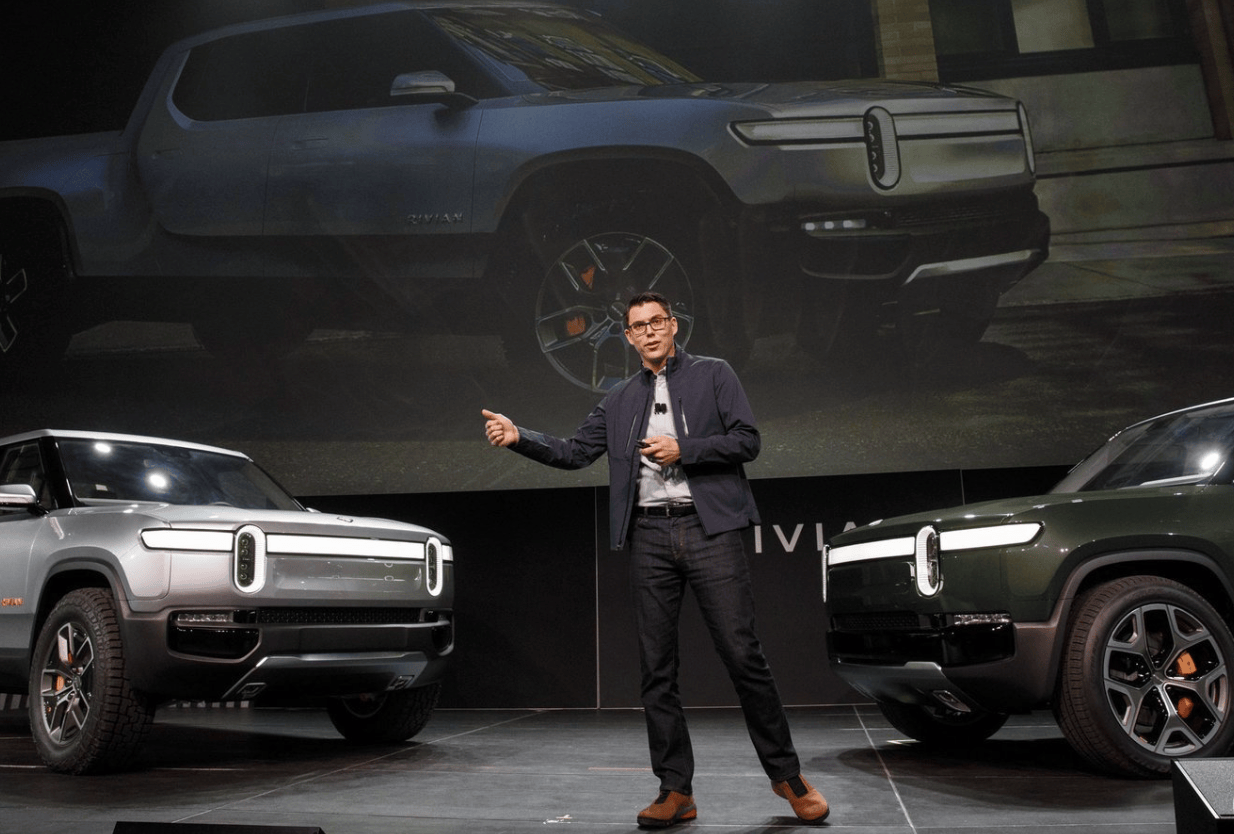
R2车型

Search documents
巨亏252亿,“特斯拉杀手”Rivian跌下神坛
阿尔法工场研究院· 2026-02-25 00:03
Core Viewpoint - The article highlights the inflated valuations of AI companies, drawing parallels with the electric vehicle company Rivian, which experienced a significant drop in market value after failing to meet performance expectations [3][4][11]. Group 1: Rivian's Journey - Rivian raised $2.85 billion through four rounds of financing in 2019 before going public in November 2021, achieving a valuation of $120 billion, making it one of the largest IPOs in U.S. history [6]. - After its IPO, Rivian's market value soared to over $150 billion, surpassing established automakers like Daimler and Volkswagen, but subsequently plummeted by 80% within four months [6][10]. - As of now, Rivian's market value has decreased by over 90%, resulting in a loss of more than $130 billion in total market capitalization [3][10]. Group 2: Financial Performance - In Q4 2025, Rivian reported revenues of $1.286 billion, a year-over-year decline of 25.84%, with automotive revenue dropping 45% to $839 million [13]. - For the full year 2025, Rivian achieved total revenues of $5.387 billion, an 8.39% increase from $4.97 billion in the previous year, but incurred a net loss of $3.646 billion, a 23.19% increase from the prior year's loss [15]. - The software and services segment showed significant growth, with revenues increasing by 222% to $1.557 billion in 2025 [15]. Group 3: Strategic Partnerships and Future Plans - Rivian received a total investment of $5.8 billion from Volkswagen, which included the establishment of a joint venture to develop next-generation electric vehicles [8]. - The company plans to launch the R2 model in Q2 2026, which is expected to be a critical turning point for demonstrating long-term profitability [16]. - Rivian anticipates quarterly deliveries to rise significantly in the second half of 2026, with expected cash inflows of $2 billion from the joint venture with Volkswagen [16]. Group 4: Market Context and Implications - The article emphasizes that the current AI wave has generated even larger capital inflows compared to the previous electric vehicle boom, with major tech companies like Google, Meta, Microsoft, and Amazon collectively spending $650 billion this year [12]. - The narrative surrounding AI companies is compared to that of Rivian, suggesting that without solid products and technology, companies may struggle to sustain their inflated valuations [11][17]. - The conclusion drawn is that while Rivian's losses are decreasing, the timeline for achieving profitability remains uncertain, and the company must reach a break-even point to ensure its survival [17].

亏损252亿!“特斯拉杀手”Rivian,跌下神坛
Sou Hu Cai Jing· 2026-02-24 01:19
Core Insights - The article discusses the valuation bubble surrounding AI companies, particularly those with large models that have yet to turn a profit, highlighting the risks of unsustainable valuations in the tech sector [1][6][12] Group 1: AI Valuation and Market Dynamics - The AI sector has seen companies with revenues under 500 million being valued at over 300 billion, indicating a market frenzy [1] - The narrative surrounding AI is larger than previous tech bubbles, with major companies like Google, Meta, Microsoft, and Amazon collectively spending 650 billion this year, surpassing previous investment levels [11] - The article compares the current AI boom to the electric vehicle surge led by Tesla, noting that while Tesla managed to justify its valuation through performance, other companies like Rivian have struggled [7][11] Group 2: Rivian's Journey and Financial Performance - Rivian raised 28.5 billion in funding before producing any vehicles and achieved a significant IPO, becoming one of the largest in U.S. history [3][4] - After a brief surge, Rivian's market value plummeted by over 90%, losing more than 130 billion in total market capitalization [6][12] - Rivian's Q4 2025 revenue was 1.286 billion, down 25.84% year-over-year, with automotive revenue dropping 45% [13] - The company reported a total revenue of 5.387 billion for 2025, an 8.39% increase from the previous year, but still faced a net loss of 3.646 billion [19][20] - Rivian's software and services segment saw a significant increase, with revenue growing 222% year-over-year, indicating a potential area for future growth [19][20] Group 3: Strategic Partnerships and Future Outlook - Rivian received a total investment of 5.8 billion from Volkswagen, which has helped the company reduce production costs by over 35% [8][20] - The company plans to launch the R2 model in Q2 of this year, which is seen as a critical point for demonstrating long-term profitability [19][20] - Rivian anticipates receiving an additional 2 billion from its partnership with Volkswagen, although capital expenditures are expected to rise [20]
Robotaxi进入“千辆时代”:规模扩张加速 盈利路径渐现端倪
Zhong Guo Jing Ying Bao· 2026-01-30 19:59
Core Insights - The Chinese autonomous driving industry is transitioning from technical feasibility to commercial viability, with significant advancements in Robotaxi operations and fleet sizes [1][6] - Major players like Xiaoma Zhixing and Didi Chuxing are expanding their fleets and partnerships, indicating a shift towards large-scale operations and deeper collaborations across the industry [2][4] Fleet Expansion - Xiaoma Zhixing's fully autonomous Robotaxi fleet has surpassed 1,159 vehicles, marking a significant milestone in the industry [2] - The platform of Ruoqi Chuxing has over 300 Robotaxi vehicles in operation, with a cumulative safe mileage of nearly 6 million kilometers, covering multiple cities in Guangdong [1][2] Partnerships and Collaborations - Didi Chuxing and GAC Aion's R2 model delivery showcases a closed-loop acceleration from R&D to mass production, highlighting the deepening division of labor within the industry [3][4] - Xiaoma Zhixing has signed significant agreements with partners like BAIC New Energy and Aitebo, focusing on co-creating products and exploring efficient monetization paths for Robotaxi services [4] Regional Advantages - Guangdong has emerged as a hub for the Robotaxi industry, with leading companies like Xiaoma Zhixing and Ruoqi Chuxing establishing a strong presence [5] - The region's policies have lowered the barriers for companies to enter new cities, facilitating quicker expansion and operational efficiency [5] Cost and Regulatory Challenges - High operational costs are identified as the primary constraint to commercial viability, overshadowing technical maturity and liability definitions [6][7] - The current regulatory framework is lagging, with unclear standards for commercial operation capabilities and liability definitions, complicating the industry's growth [7] Future Recommendations - Industry experts suggest standardizing vehicle models and expanding pilot areas to enhance operational efficiency and reduce costs [8] - Implementing a mixed scheduling model and promoting standardized mass-produced vehicles are recommended to lower per-vehicle costs and improve service delivery [8]
Rivian宣布裁员4.5%
Xin Lang Cai Jing· 2025-10-24 14:24
Group 1 - Rivian Automotive (RIVN) stock price increased by 0.5% in early trading on Friday [1] - The company has agreed to a $250 million settlement to resolve a class-action lawsuit from investors regarding price increases, without admitting wrongdoing [1] - The settlement will be paid through insurance and cash reserves, pending court approval [1] Group 2 - Rivian announced a 4.5% workforce reduction as the company focuses on launching the R2 model aimed at the mass market in 2026 [1]

Rivian(RIVN.US)再度裁员之际支付2.5亿美元了结投资者诉讼 坚称无不当行为
智通财经网· 2025-10-24 11:00
Core Viewpoint - Rivian has agreed to pay $250 million to settle an investor lawsuit while denying any wrongdoing, aiming to resolve the legal dispute without admitting fault [1] Group 1: Legal Settlement - The lawsuit was filed in 2022, accusing Rivian of failing to disclose critical information regarding plans to raise the price of its first mass-produced vehicle prior to its IPO, misleading investors who purchased Class A common stock in November 2021 [1] - The proposed settlement, which requires court approval, will be funded through $67 million from directors and officers liability insurance and $183 million from the company's own cash [1] - Rivian maintains that the settlement does not imply any admission of guilt or wrongdoing [1] Group 2: Workforce Reduction - On the same day as the settlement announcement, Rivian announced a 4.5% reduction in its workforce, marking the second round of layoffs since September of the previous year [1] Group 3: Stock Performance - Following the news, Rivian's stock price increased by 1.3%, closing at $13.09, significantly lower than its post-IPO peak of $172 [1] Group 4: Future Plans - Rivian stated that reaching a settlement will allow the company to focus its resources on the upcoming R2 model, which is scheduled for launch in the first half of 2026 [1]
大摩拉古纳会议前瞻汽车板块:北美汽车市场整体强韧 AI与自动化成增效共识
智通财经网· 2025-09-16 08:22
Industry Overview - The North American automotive and shared mobility industry remains resilient, with no signs of deterioration except for electric vehicles. Investors are debating whether the strong SAAR (Seasonally Adjusted Annual Rate) from 2025 onwards is driven by tariffs and its sustainability in 2026, with current Q4 and 2026 positioning being conservative and requiring data validation [1] - Investors hold a pessimistic view on the electric vehicle sector for Q4 2025 and FY 2026, questioning whether R2 models can bridge profitability for electric vehicles. Traditional automakers are expected to reduce high incentives for clearing electric vehicle inventory before September 30, benefiting profitability [1][2] Company Dynamics - Carvana and Carmax are experiencing competitive differentiation, with Carvana showing optimism despite facing potential challenges from ABS market fluctuations and changing consumer demand. Carmax focuses on a multi-channel model and operational efficiency amid concerns over Triclor's bankruptcy affecting subprime ABS [2] - Several companies are leveraging AI and automation as key drivers for enhancing production efficiency and customer value. Lear plans to enhance competitiveness in the Chinese market through automation and AI, while Avis is applying AI in pricing algorithms and supply-demand management [2] Company Strategies - Avis is focusing on travel demand and autonomous driving, planning to expand partnerships in autonomous vehicle cities while strengthening its financial position and stock buybacks [3] - Carmax is driving sales through multi-channel capabilities and adjusting inventory to meet consumer purchasing power challenges, implementing a three-pillar capital allocation strategy [3] - Ford's Pro division is promoting growth through a diversified customer base, enhancing aftermarket profit contributions via software, and advancing BlueCruise autonomous driving [3] - Group 1 Automotive is flexibly allocating capital and disposing of underperforming stores, supported by parts and used car businesses, with strong consumer market performance and minimal tariff cost transfer [3] - Lear has exceeded performance expectations from 2025 onwards, with revenue nearing guidance limits, and is collaborating with Palantir to enhance automation while deepening partnerships with local Chinese automakers [3] - Lucid is clarifying its profitability path with the Gravity model as a key market expansion tool, positioning itself as a luxury brand to avoid competition from Chinese automakers while advancing autonomous driving technology [3] - Phinia is diversifying into aerospace, focusing on free cash flow generation and shareholder returns starting Q4 2025 [3] - Quantumscape is collaborating with Volkswagen's PowerCo to advance battery technology commercialization and plans to transition into a technology licensing company [3] - Rivian is set to host an autonomous driving and AI day, with Gen2 hardware and platform debuting soon, leveraging the R2 model to address demand fluctuations and deepening partnerships with Volkswagen while exploring collaborations with other automakers [3]
全球第四斩获20GWh电池大单!
起点锂电· 2025-05-01 06:58
Core Viewpoint - Korean battery companies are expanding their presence in the U.S. electric vehicle market, with SK On being selected as a battery supplier for the startup Slate, backed by Jeff Bezos [1][2][3]. Group 1: SK On and Slate Partnership - SK On will supply 20 GWh of batteries to Slate from 2026 to 2031, with a potential for increased supply as production scales up [2]. - The estimated value of the contract is approximately 4 trillion KRW (about 202.8 billion RMB), sufficient to power around 300,000 mid-sized electric vehicles [2]. Group 2: Slate's Background and Product Offering - Slate Auto, based in Michigan, aims to produce an electric pickup truck priced under $20,000 (approximately 146,000 RMB) and plans to start production next year [4]. - The company is developing an affordable two-seat electric pickup inspired by classic models like the Ford Model T and Volkswagen Beetle [4]. - Slate's vehicle can transform into a five-seat SUV and offers customization options with various accessories [5]. Group 3: U.S. Electric Vehicle Market Dynamics - The U.S. electric vehicle market is seeing a surge in startups like Slate, but Tesla remains the only company with significant market share [6]. - American electric vehicle companies heavily rely on battery supplies from South Korea and Japan due to the underdeveloped local battery industry [6][8]. Group 4: Competition and Market Share - Korean battery manufacturers, including LG Energy Solution and Samsung SDI, are also securing contracts with U.S. startups, indicating a trend of collaboration [8]. - In early 2025, global electric vehicle battery installations reached 129.9 GWh, with Chinese companies holding a 67.5% market share, while Korean companies' market share declined to 21.6% [11][12]. Group 5: Strategic Shifts in Korean Battery Companies - Korean battery firms are adapting by increasing their procurement from Chinese suppliers and shifting their focus to lithium iron phosphate batteries and different battery formats [12][13]. - The long-term outlook suggests that China will maintain its leadership in the global lithium battery industry, driving energy transition worldwide [14].
软件部门占据主导地位,Rivian正在实现悄然转型
美股研究社· 2025-03-31 11:04
Core Viewpoint - Rivian has been minimally affected by the recent announcement of a 25% tariff on all imported vehicles and parts in the U.S. [1] Group 1: Financial Performance and Guidance - Rivian's stock price has rebounded to pre-announcement levels since last Wednesday [3] - The tariffs will impact the company's gross margin to some extent, as some parts may come from secondary and tertiary suppliers outside the U.S. [4] - Management has incorporated these factors into their guidance for 2025, which includes a projected revenue of $1 billion with a gross margin of 30% [4] - The software and services sector is expected to improve, with Q4 2024 revenue of $214 million, a 114% increase from Q3 2023 [4] - Rivian's joint venture with Volkswagen is expected to generate approximately $2 billion in revenue over the next four years [5] - The company reported a positive gross margin of 28% in Q4 2024, achieving $170 million in gross profit, which is double Wall Street's expectations [7] Group 2: Market Position and Valuation - Rivian's EV/Sales ratio is currently at 2.4, which is attractive despite being nearly double the industry median [7] - The company's price-to-book ratio is only 10% higher than the industry median, trading at 2.3 [8] - Institutional positions increased by 66% quarter-over-quarter in Q4 2024, with a 5.8% increase in holdings from 13F filers [8] Group 3: Risks and Uncertainties - A significant risk is the potential cancellation of regulatory credits that Rivian sells to other manufacturers, which generated nearly $300 million in revenue in 2024 [10] - There is uncertainty regarding the $7,500 green vehicle tax credit, which may be eliminated, impacting the company's financial outlook [11] - Management has accounted for these risks in their 2025 guidance, which reflects potential adjustments due to incentives, regulations, and tariffs [12][17] Group 4: Investment Outlook - Rivian is considered a speculative buy at current price levels, primarily due to the high-margin potential of its software and services sector [16] - The Volkswagen joint venture has improved the company's cash reserves and is expected to yield high-profit revenue in the coming years [16] - Despite uncertainties regarding regulatory credits and tariffs, management has incorporated most adverse factors into the 2025 guidance, making Rivian an attractive investment opportunity [17]