RoboBallet

Search documents
快讯|宇树科技将发布身高1.8米的人形机器人,中国工业机器人年安装量全球居首,谷歌DeepMind推出RoboBallet
机器人大讲堂· 2025-09-28 13:33
Group 1: Industrial Robotics in China - China is rapidly increasing its production and installation of industrial robots, with over 2 million operational robots and nearly 300,000 new installations last year, surpassing the total of other regions combined, while the US installed only 34,000 robots [2] - Since 2017, China's annual installation of robots has exceeded 150,000 units, capturing 33% of the global market share [2] - The Chinese government is actively encouraging enterprises to become leaders in the robotics sector, particularly in industrial robots [2] Group 2: Developments in Humanoid Robotics - Yushutech plans to release a 1.8-meter tall humanoid robot, with significant algorithm upgrades enhancing stability and performance, allowing it to perform various movements [3][5] - The domestic robotics industry has seen an average growth rate of 50% to 100% in the first half of the year [5] - The newly launched Unitree R1 humanoid robot is lightweight and priced starting at 39,990 yuan, with some orders already received [5] Group 3: Innovations in Robotics Coordination - Google DeepMind has introduced the AI system RoboBallet, which enables manufacturing robots to coordinate autonomously, addressing task allocation, scheduling, and motion planning challenges [6][8] - RoboBallet utilizes graph neural networks for efficient collaboration among robots, with a slower increase in computational complexity compared to traditional methods [8] Group 4: Expansion of Surgical Robotics - Tumi Robotics has made significant strides in the international market by commercializing its single-port and multi-port surgical robots at the Cleveland Clinic Abu Dhabi, marking a first for Chinese surgical robots in a top global medical institution [9][11] - Tumi has accumulated over 50 overseas orders, covering more than 30 countries and regions, accelerating its global commercialization process [11] Group 5: Patent and Collaboration Developments - Gangzi Robotics has received exclusive authorization for over 2,000 embodied intelligence patents from Datar Robotics, enhancing local manufacturing capabilities for humanoid robots [12][14] - The collaboration aims to integrate both companies' strengths, with Gangzi's XR-OS operating system achieving full-link intelligence [14] - Gangzi Robotics has seen a remarkable stock increase of 420% this year, with a market capitalization of 2.72 billion HKD, indicating strong commercial outcomes from various partnerships [14]


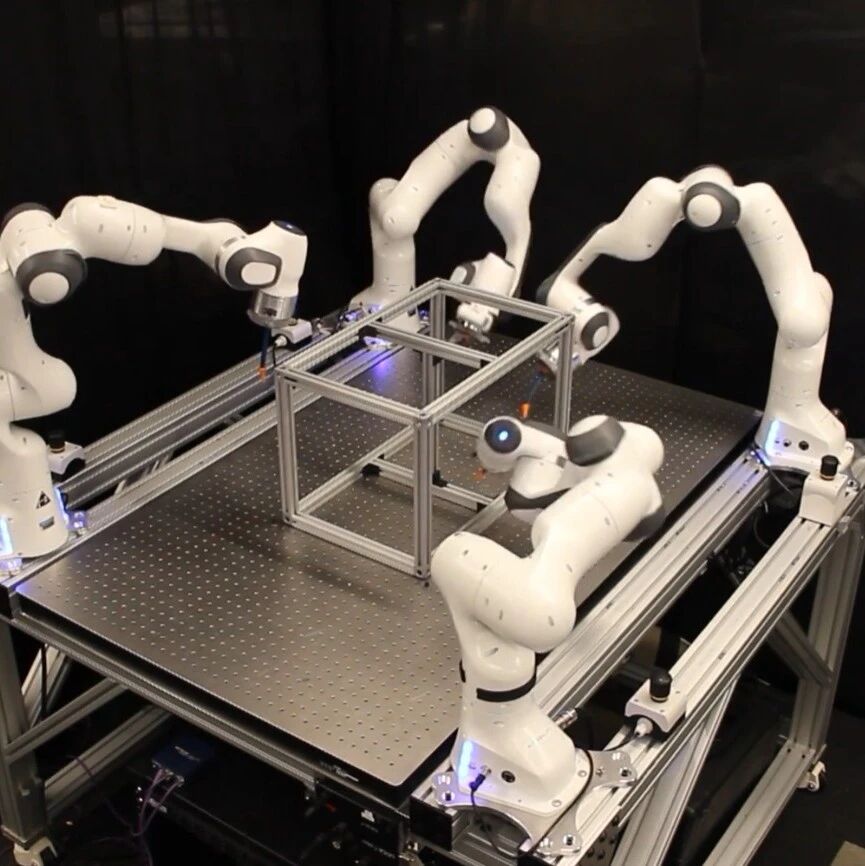
《Science Robotics》封面:DeepMind发布RoboBallet,重新定义多机器人协同规划
机器人大讲堂· 2025-09-17 11:13
Core Viewpoint - Multi-robot systems are becoming a key technology for improving production efficiency in modern industrial manufacturing, but face significant challenges in coordinating multiple robots in shared environments [1][4]. Group 1: Challenges in Multi-Robot Coordination - Three core sub-problems must be solved for effective multi-robot coordination: motion planning, task scheduling, and task assignment, each presenting significant computational challenges [3][4]. - Motion planning requires collision-free path planning for each robot, which becomes exponentially complex as the number of robots and obstacles increases [3]. - Task scheduling is akin to the classic Traveling Salesman Problem, with computational complexity that escalates with the number of tasks [3]. - Task assignment involves determining which robot performs which task, with costs dependent on other tasks' assignments, creating a coupled relationship among the three sub-problems [3][4]. Group 2: RoboBallet Framework - RoboBallet is a novel framework developed by engineers from University College London and Google DeepMind, combining Graph Neural Networks (GNN) and Reinforcement Learning (RL) to automate the resolution of multi-robot coordination issues [4][5]. - The framework represents the collaborative scene as a dynamic graph, where nodes represent individual robots and edges denote their interactions based on spatial proximity [5]. - GNN efficiently processes structured information, allowing the model to generalize well to unseen configurations of obstacles and tasks [5]. Group 3: Training and Performance - RoboBallet employs a fine-tuned TD3 algorithm for training the policy network, enabling the generation of multi-robot trajectories while addressing task assignment, scheduling, and motion planning [7]. - The reward mechanism includes task completion rewards and collision penalties, promoting efficient task execution while avoiding collisions [7]. - The model is trained in randomly generated environments, allowing it to learn effective coordination strategies through millions of interactions [7][9]. Group 4: Computational Efficiency and Scalability - RoboBallet demonstrates impressive computational efficiency, achieving planning steps in approximately 0.3 milliseconds even with a maximum configuration of 8 robots, 40 tasks, and 30 obstacles [8]. - The framework's inference time scales linearly with the number of robots, tasks, and obstacles, making it feasible for real-time applications [11]. - Increasing the number of robots significantly enhances task execution efficiency, with average execution time dropping from 7.5 seconds to 4.5 seconds (a 40% reduction) when the number of robots is increased from 4 to 8 [12].