S30

Search documents
三季度国内手机市场排名出炉:vivo份额居首位,荣耀销量降幅最大
Xin Lang Cai Jing· 2025-11-06 10:03
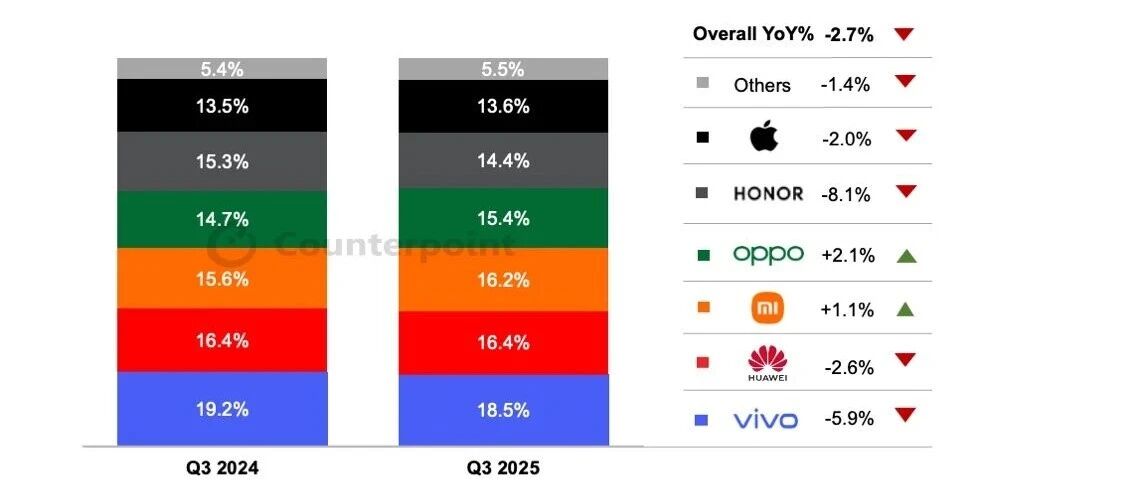
Core Insights - The overall smartphone sales in China declined by 2.7% year-on-year in Q3 2025, attributed to weak consumer demand influenced by the summer vacation and back-to-school season [1] - Vivo leads the market with an 18.5% share despite a 5.9% drop in sales, while Honor experienced the largest decline, with its market share falling to 14.4% [1] - Huawei maintained a stable market share of 16.4% with a slight sales decrease of 2.6%, supported by the Nova 14 series despite challenges with its HarmonyOS [2] - OPPO showed a recovery with a 2.1% year-on-year growth, driven by the stable performance of the Reno 14 series and its sub-brand OnePlus [4] - Xiaomi achieved a 1.1% increase in sales, bolstered by the REDMI Note 15 and K80 series, and its new Xiaomi 17 series has gained traction in the high-end market [4] - Apple’s market share rose to 13.6% with a 2% sales decline, maintaining strong competitiveness in the high-end segment due to the iPhone 17 series [5] - Despite the overall market downturn, smartphone sales in China grew by 11% year-on-year in the first two weeks of October, indicating a positive start to Q4 [7] Company Summaries - **Vivo**: Holds the top market share at 18.5%, with a 5.9% decline in sales; successful in mid-range and entry-level segments with models like S30 and Y500 [1] - **Honor**: Experienced the largest sales drop of 8.1%, with challenges in product innovation and brand positioning, despite some success in the entry-level market with the X70 series [4][2] - **Huawei**: Maintained a stable market share of 16.4% with a 2.6% sales decline; the Nova 14 series performed well, but the HarmonyOS's development is still ongoing [2] - **OPPO**: Achieved a 2.1% growth in sales, with the Reno 14 series contributing to its recovery [4] - **Xiaomi**: Recorded a 1.1% increase in sales, with the new Xiaomi 17 series enhancing its presence in the high-end market [4] - **Apple**: Increased market share to 13.6% with a 2% sales decline; the iPhone 17 series continues to perform well in the high-end market [5]



2025 年 Q3 中国智能手机销量同比下滑 2.7%;在 iPhone 17 需求推动下 Q4 销量增长势头向好
Counterpoint Research· 2025-11-06 07:03
Core Insights - The Chinese smartphone market experienced a year-on-year decline of 2.7% in Q3 2025 due to economic slowdown and reduced demand [5][4] - OPPO achieved the highest year-on-year growth rate among major OEMs, driven by strong demand for its sub-brand OnePlus [6][5] Market Performance - The overall smartphone sales in China decreased by 2.7% in Q3 2025, influenced by ongoing economic factors such as the summer vacation and back-to-school season [5][4] - Vivo's market share fell to 18.5% amid intensified competition, yet it maintained a leading position with a diverse product line [5][6] - Huawei's high-end Mate 70 and Pura 80 series saw lower sales compared to previous models, while the Nova 14 series continued to perform well [5][6] Brand Analysis - OPPO's growth of 2.1% was attributed to stable sales of the Reno 14 series and strong performance from OnePlus, particularly the Ace 5 and 13 series [6][5] - Xiaomi recorded a year-on-year growth of 1.1%, supported by the Redmi Note 15 and K80 series, with the recently launched Xiaomi 17 series receiving positive market feedback [6][9] - Honor's X70 series stood out in the entry-level market, but the brand's overall sales declined by 8.1% [6][5] Apple Performance - The iPhone 17 series outperformed the iPhone 16 series in initial sales, with the base model being particularly popular due to its competitive pricing [7][11] - Apple's pricing strategy has increased pressure on high-end Android brands, with expectations of intensified competition in Q4 [7][11] - The iPhone 17's sales in September were nearly double that of the iPhone 16 during the same period last year, indicating strong market demand [11][9]
机构:第三季度前八周中国智能手机销量vivo位居第一
Zheng Quan Shi Bao Wang· 2025-09-18 03:14
Core Insights - Vivo leads the Chinese smartphone market with a 19% market share in the first eight weeks of Q3, driven by strong performance of S30 and X200s series products [1] - Huawei, OPPO, and Xiaomi are tied for second, third, and fourth places with a market share of 16% each [1] - The overall Chinese smartphone market is expected to see a slight decline in Q3, while the annual performance is projected to remain stable [1]
稳坐两轮锂电 "顶流" 宝座 星恒破局内卷式竞争
高工锂电· 2025-05-27 12:54
Core Viewpoint - The article discusses the competitive landscape in the lithium battery industry, highlighting the challenges of "involution" and the need for companies to establish strong competitive barriers to thrive in a saturated market [2][3][24]. Group 1: Industry Overview - The competition in the new energy sector has escalated to a national level, with leading companies maintaining growth while many others face stagnation or losses due to established competitive advantages [2]. - The electric two-wheeler lithium battery industry is undergoing significant transformation driven by new national standards, increased demand for lead-acid battery replacements, and a rationalization of lithium battery costs [3]. Group 2: Market Performance - In Q1 of this year, domestic sales of electric two-wheeled vehicles surged by 58% year-on-year, indicating a robust growth trend in the lithium battery sector for this market [4]. - Leading company Xingheng Power has solidified its market position with over 70% sales growth in Q1, despite facing production capacity constraints [4][5]. Group 3: Competitive Strategy - Xingheng Power has focused on refining its operations within the electric two-wheeler lithium battery sector since its establishment in 2003, forming strategic partnerships with major manufacturers [7]. - The company has achieved a supply rate of over 70% with leading vehicle manufacturers, demonstrating its deep understanding of market needs and robust supply chain management [7][9]. Group 4: Technological Innovation - Xingheng Power has developed a unique "golden dual-core" material system that enhances battery cycle life to 3000 times while ensuring safety and performance [11]. - The company has pioneered the manganese-based battery technology, which now holds over 80% market share in the electric two-wheeler sector, and has introduced patented safety features to mitigate fire risks [11][13]. Group 5: Market Positioning - Xingheng Power has strategically positioned itself in the Southeast Asian electric motorcycle market, capturing significant market share and responding quickly to local demands [17][18]. - The company has adopted a strategy of "technology embedded + market positioning," making it difficult for competitors to replicate its advantages [18]. Group 6: Resilience and Growth - During the lithium carbonate price surge in 2022, Xingheng Power did not simply pass on cost pressures but instead focused on technological breakthroughs to stabilize supply chains and market balance [20][21]. - The company has played a pivotal role in setting industry standards and has been a key player in the compliance transition for electric two-wheeled vehicles [21][22].