SPV(应急流动性金融工具)

Search documents
非银流动性支持工具引热议 宏观审慎监管创新破题
Sou Hu Cai Jing· 2026-02-05 16:44
Group 1 - The core viewpoint of the articles is that the implementation probability of "similar ONRRP" tools in China is low due to significant mismatches with the domestic financial market structure and liquidity framework [1][4][5] - The macro-prudential management in China has officially entered a new paradigm of "comprehensive coverage" and "preventive measures," with a focus on building liquidity support mechanisms for non-bank financial institutions [1][2] - Experts believe that the liquidity support mechanism for non-bank institutions is an "emergency arrangement under specific scenarios" rather than a routine tool, reflecting a proactive approach to preventing systemic financial risks [1][6] Group 2 - The People's Bank of China has outlined the core direction for macro-prudential management, emphasizing the need to expand the coverage of macro-prudential policies and innovate policy tools [2][3] - Non-bank financial institutions are now included in the core regulatory framework due to their significant role in managing assets worth trillions of yuan and their impact on the bond, stock, and derivatives markets [2][3] - The risks in the bond market, such as interest rate, credit, and liquidity risks, are more pronounced for non-bank financial sectors compared to banks, necessitating a mechanism for providing liquidity to non-bank institutions in specific scenarios [3][4] Group 3 - The discussion around the potential creation of "similar ONRRP" tools has gained traction, but experts argue that the necessity for such tools in China is low due to the lack of urgency in creating liquidity absorption tools [4][5] - The current macroeconomic environment in China, characterized by a stable lower bound for interest rates, does not present a pressing need for tools similar to the ONRRP used by the Federal Reserve [4][5] - The liquidity support mechanisms for non-bank institutions are being explored, with the central bank indicating a willingness to provide liquidity under specific conditions, such as significant deviations in market liquidity indicators [6][7] Group 4 - Future innovations in liquidity support tools may include specialized liquidity facilities for systemically important non-bank institutions and temporary liquidity support tools during systemic market pressures [7] - The design of these tools aims to comprehensively address various risk scenarios, allowing for flexibility in providing support to individual institutions or entire markets [6][7]
非银流动性支持工具引热议,宏观审慎监管创新破题
Di Yi Cai Jing· 2026-02-05 12:04
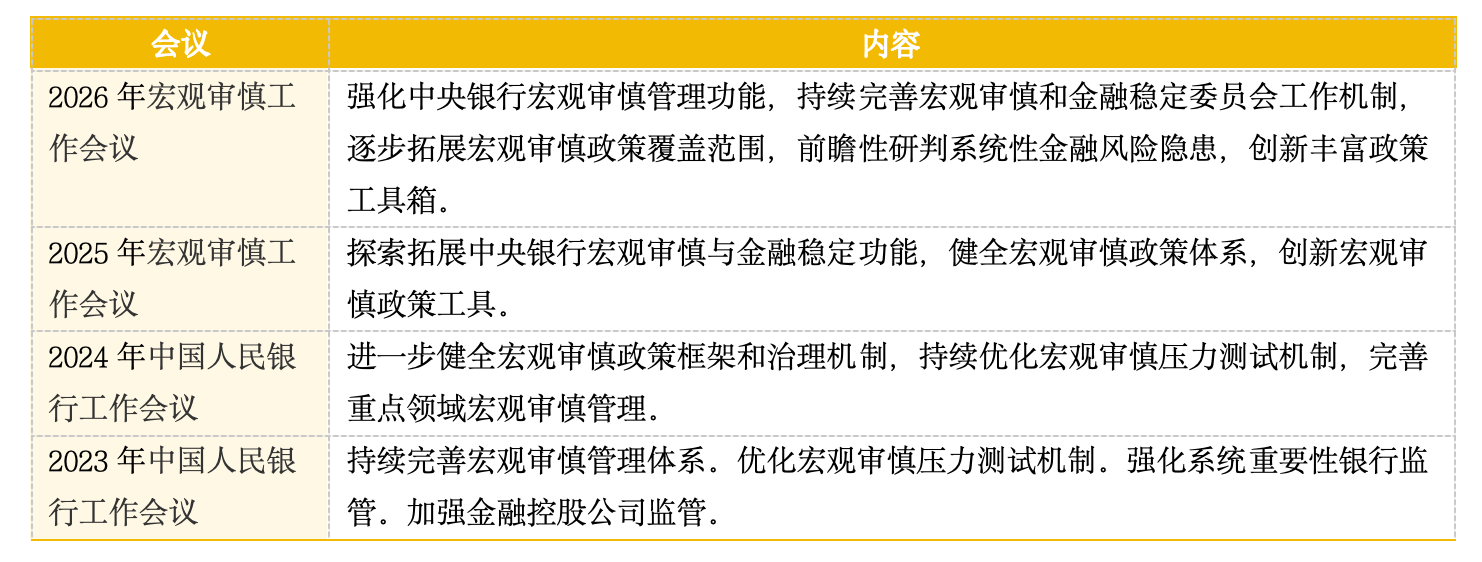
Core Viewpoint - The People's Bank of China (PBOC) is enhancing its macro-prudential management framework, focusing on the establishment of liquidity support mechanisms for non-bank financial institutions as a proactive measure to prevent systemic financial risks [1][2]. Group 1: Macro-Prudential Management Developments - The PBOC's macro-prudential management is transitioning to a "comprehensive coverage" and "prevention-first" paradigm, with a focus on liquidity support mechanisms for non-bank financial institutions [2][3]. - The PBOC's policy focus from 2023 to 2024 is on defensive regulation and risk prevention in key areas, while 2025 marked a shift towards enhancing mechanisms and expanding functions within the regulatory framework [3][4]. Group 2: Liquidity Support Mechanisms - The liquidity support mechanism for non-bank financial institutions is designed as an emergency arrangement for specific scenarios, reflecting a forward-looking approach to macro-prudential management [1][8]. - Experts suggest that the PBOC may explore liquidity support tools similar to the Federal Reserve's ONRRP, but the likelihood of such tools being implemented in China is low due to structural differences in the financial market [6][7]. Group 3: Regulatory Focus on Non-Bank Financial Institutions - Non-bank financial institutions manage trillions of yuan in assets and play a significant role in the bond, stock, and derivatives markets, making their regulation crucial [5]. - The PBOC aims to gradually expand its regulatory coverage to include more systemically important financial institutions, enhancing monitoring of non-bank institutions and cross-border capital flows [5][6]. Group 4: Future Directions for Policy Tools - Future innovations in liquidity support tools may include specialized liquidity facilities for systemically important non-bank institutions, temporary liquidity support during systemic pressures, and expanded collateral options for non-bank institutions [9].