SiC MOS G2

Search documents
三代半产业运作模式演进方向
Xin Lang Cai Jing· 2025-12-12 14:19
Core Viewpoint - The article discusses the diversified operational models of domestic listed companies in the third-generation semiconductor materials, silicon carbide (SiC) and gallium nitride (GaN), as they are widely applied in electric vehicles, data centers, and consumer electronics [1][9]. Group 1: Main Operational Models - The IDM (Integrated Device Manufacturer) model dominates the core competition, covering the entire industry chain from chip design to wafer manufacturing and packaging testing, becoming the preferred model for leading companies [2][10]. - Eight companies primarily operate under the IDM model, with Huazhong Microelectronics and Wentai Technology being notable examples, focusing on applications in electric vehicles and data centers [2][10]. - Huazhong Microelectronics has achieved mass production of SiC JBS G3 and SiC MOS G2 products, while Wentai Technology has established a global capacity layout with its 1200V automotive-grade SiC MOSFET [2][10]. Group 2: Company-Specific Developments - InnoLux is the world's first GaN IDM company to achieve large-scale production of 8-inch wafers, with a product voltage range from 15V to 1200V, and has seen a 128% growth in automotive-grade chip deliveries [3][11]. - Sanan Optoelectronics has built a complete SiC industry chain, with a monthly capacity of 16,000 pieces for 6-inch SiC and is accelerating its 8-inch SiC project in partnership with STMicroelectronics [3][11]. - Jiejie Microelectronics focuses on SiC Schottky diodes for electric vehicles and renewable energy, achieving mass production while maintaining flexibility through outsourcing [3][11]. Group 3: Operational Model Variations - Companies like Yangjie Technology adopt a hybrid model of IDM and Fabless, balancing production capacity and R&D, while also collaborating with foundries to ensure capacity [4][13]. - Sinda Semiconductor is transitioning from a Fabless to an IDM model, establishing its own 6-inch SiC chip production line with an annual capacity of 60,000 automotive-grade SiC MOSFETs [5][14]. - The hybrid model allows companies to respond quickly to market demands while gradually mastering core processes, suitable for medium-sized enterprises aiming for high-end markets [6][14]. Group 4: Industry Trends and Future Directions - The current landscape of the third-generation semiconductor industry in China shows a trend of "IDM as the mainstream, with hybrid models as a supplement," driven by the explosive demand from electric vehicles and AI data centers [8][15]. - IDM companies are expanding their 12-inch SiC/GaN production lines, while hybrid model companies are increasing their self-production ratios to reduce reliance on external foundries [8][15]. - Future success in the industry will depend on technological R&D capabilities, production scale, and supply chain stability, pushing the industry towards high-quality development [8][15].


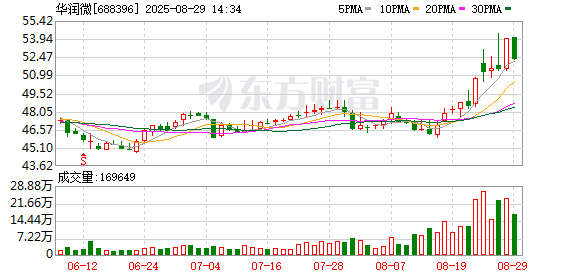
华润微上半年净利润3.39亿元 同比增长20.85%
Xin Hua Cai Jing· 2025-08-29 06:33
Financial Performance - The company reported a revenue of 5.218 billion yuan for the first half of 2025, representing a year-on-year increase of 9.62% [2] - The net profit attributable to shareholders was 339 million yuan, up 20.85% year-on-year, while the net profit excluding non-recurring items decreased by 3.95% to 273 million yuan [2] - The gross margin for the first half of 2025 was 25.65%, a decrease of 0.75 percentage points year-on-year, while the net profit margin increased by 0.62 percentage points to 5.35% [2] R&D and Innovation - The company invested 548 million yuan in R&D during the first half of 2025, accounting for 10.50% of its revenue [3] - Significant technological breakthroughs include the completion of the first-generation automotive-grade planar gate high-performance SiC MOSFET products and the successful development of MEMS high-end three-layer structure silicon microphone sensors [3] - The company's self-developed "Buck LED Constant Current Driver QPT4115" won the "2025 Automotive Electronics Golden Chip Award" [3] Market Position and Strategy - The global power semiconductor market is experiencing steady growth, with China holding a 38.6% market share valued at 29.1 billion USD [3] - The company is deepening its AI full-scenario layout, focusing on consumer electronics and automotive smart transformation, as well as cloud AI solutions [4] - The company is accelerating its layout in automotive-grade chips, achieving full-scene coverage in cockpit, body, and autonomous driving applications [4] Production Capacity and Product Development - The company’s 12-inch power device wafer production line in Chongqing has reached full production capacity of 30,000 wafers per month [5] - The Shenzhen 12-inch specialty analog integrated circuit production line is ramping up, with multiple products in mass production on the 90nm platform [5] - Sales revenue from third-generation semiconductor SiC and GaN products has seen rapid growth, with a focus on applications in new energy vehicles, charging piles, and data center power supplies [5]