TL721x

Search documents
泰凌微(688591):端侧AI与物联网双翼驱动,成长路径清晰
Guotou Securities· 2025-10-28 07:06
Investment Rating - The investment rating for the company is "Buy-A" with a target price of 66.96 CNY, maintaining the rating [4]. Core Insights - The company reported a revenue of 263 million CNY for Q3 2025, representing an 18.57% year-on-year growth, and a net profit of 38.61 million CNY, which is a 3.56% increase year-on-year [1]. - The company is focusing on low-power hardware development for edge AI, with R&D investment reaching 69 million CNY in Q3 2025, a 38.96% increase year-on-year [2]. - The company is a leading player in the IoT wireless communication chip sector, with a net profit margin of 18.23% in Q3 2025, up from 10.94% in the same period last year [3]. Financial Performance - The company is projected to achieve revenues of 1.165 billion CNY, 1.526 billion CNY, and 1.958 billion CNY for the years 2025, 2026, and 2027 respectively, with net profits of 224 million CNY, 314 million CNY, and 429 million CNY for the same years [9]. - The company’s gross profit margin is expected to improve from 43.5% in 2023 to 55.8% in 2027 [11]. - The projected earnings per share (EPS) for 2025 is 0.93 CNY, with a price-to-earnings (PE) ratio of 55.3 [10]. Market Position - The company is well-positioned in the edge AI market, which is expected to grow at a compound annual growth rate (CAGR) of 58% from 2023 to 2028, potentially exceeding 1.9 trillion CNY by 2028 [2]. - The company has successfully launched multiple AI chips and is expanding its product matrix through acquisitions, enhancing its competitive edge in the IoT market [3].

泰凌微(688591)深度报告:无线物联网连接芯片龙头 端侧AI开启增长新纪元
Xin Lang Cai Jing· 2025-10-17 00:34
Core Insights - The company specializes in low-power wireless IoT chip development, design, and sales, focusing on short-range wireless communication chips, and has transitioned through single-mode, multi-mode, and AI integration phases since its establishment [1][2] Group 1: IoT Chip Business - The company achieved a revenue of 844 million yuan in 2024, with a CAGR of 12.58% from 2019 to 2024, where IoT wireless connection chips accounted for 90.6% of total revenue [1] - The company ranks first in domestic shipments of BLE and ZigBee chips, and is a leading supplier of multi-mode chips in China, with product competitiveness on par with Nordic and Silicon Labs [2] - The revenue and profit from IoT chip products are expected to continue increasing due to market expansion and a higher proportion of high-margin products [2] Group 2: Audio Chip Business - The audio SoC supports classic Bluetooth, low-power Bluetooth, and 2.4G private protocols, with significant clients including Harman and Sony, and is entering a rapid growth phase starting in 2024 [2] - In the first half of 2025, audio chip revenue reached 61.17 million yuan, reflecting a year-on-year increase of 98.82% [2] Group 3: Edge AI Market - The company launched two edge AI chips, TL721x and TL751x, along with the TLEdgeAI-DK platform, addressing real-time, privacy, and bandwidth issues in AIoT [3] - The ultra-low power advantage of the edge AI chips allows the company to penetrate battery-powered AIoT scenarios effectively, enhancing customer development ease and accelerating product introduction [3] - The "hardware + platform" model is expected to strengthen customer binding and increase market penetration in smart home and industrial systems, driving revenue growth [3] Group 4: Financial Projections - The company forecasts net profits of 224 million, 314 million, and 429 million yuan for 2025, 2026, and 2027, respectively, with year-on-year growth rates of 130%, 40%, and 37% [4] - The IoT business is anticipated to benefit from ongoing market expansion and an increase in high-margin product sales, while the audio business is entering a growth phase [4]
2025年中国物联网芯片代表性企业分析 泰凌微:无线物联网芯片引领者
Qian Zhan Wang· 2025-07-24 08:28
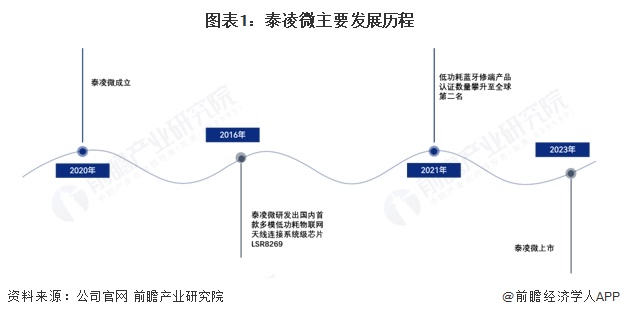
Core Insights - The article highlights that 泰凌微 (TaiLing Micro) is one of the most comprehensive companies in the global wireless IoT chip market, focusing on the research, design, and sales of low-power wireless IoT chips [1][2]. Company Overview - 泰凌微 was established in June 2010 and specializes in integrated circuit design, particularly in wireless IoT system-level chips [1]. - The company has a diverse product range supporting various applications, including smart retail, consumer electronics, smart home, smart healthcare, logistics, and audio entertainment [1]. Business Focus - The primary business of 泰凌微 is the development, design, and sales of low-power wireless IoT chips, focusing on technologies such as low-power Bluetooth, dual-mode Bluetooth, Zigbee, Matter, and WiFi [2]. - The company plans to embrace AI trends in 2024 by integrating edge AI with low-power wireless IoT chips, launching multiple series of chips and software development tools [2]. Product Adoption - 泰凌微's products are adopted by numerous leading domestic and international brands, including Google, Amazon, Xiaomi, Logitech, Lenovo, and Sony [5]. Production and Sales Data - In 2024, 泰凌微's IoT chip production is expected to reach 442 million units, a year-on-year increase of 51.84%, while sales are projected to be 425 million units, up 36.85% [7]. Technological Advancements - 泰凌微 has achieved several domestic firsts in technology, including the launch of a multi-mode low-power IoT chip with a peak current of 1mA and the first company to pass Bluetooth 6.0 high-precision positioning standard certification [10]. - The company is a leading supplier of Zigbee chips in China and has a strong competitive position in both local and international markets [8]. Core Technologies - The company has developed a comprehensive technology and product series for Zigbee communication protocols, supporting various standards [11]. - 泰凌微's latest generation of RF transceivers can support multiple communication modes, which is significant for the coexistence of Zigbee and Thread networks [11]. Future Directions - 泰凌微 is set to launch a machine learning and AI development platform, TLEdgeAI-DK, which will support mainstream local AI models, paving the way for future AI edge applications [11].