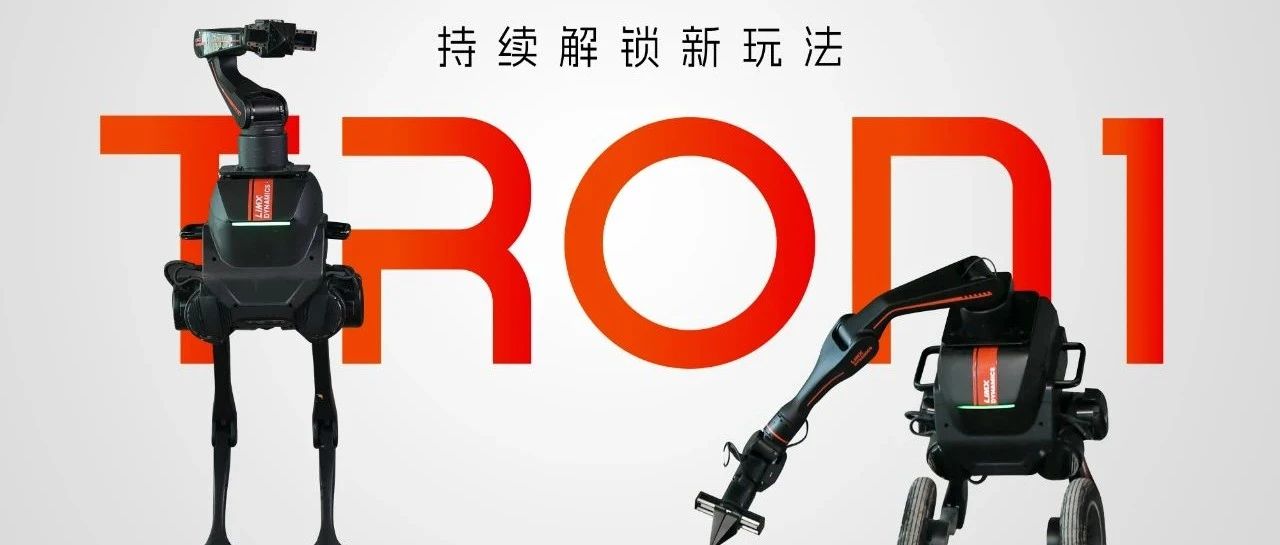
TRON 1多形态双足机器人

Search documents
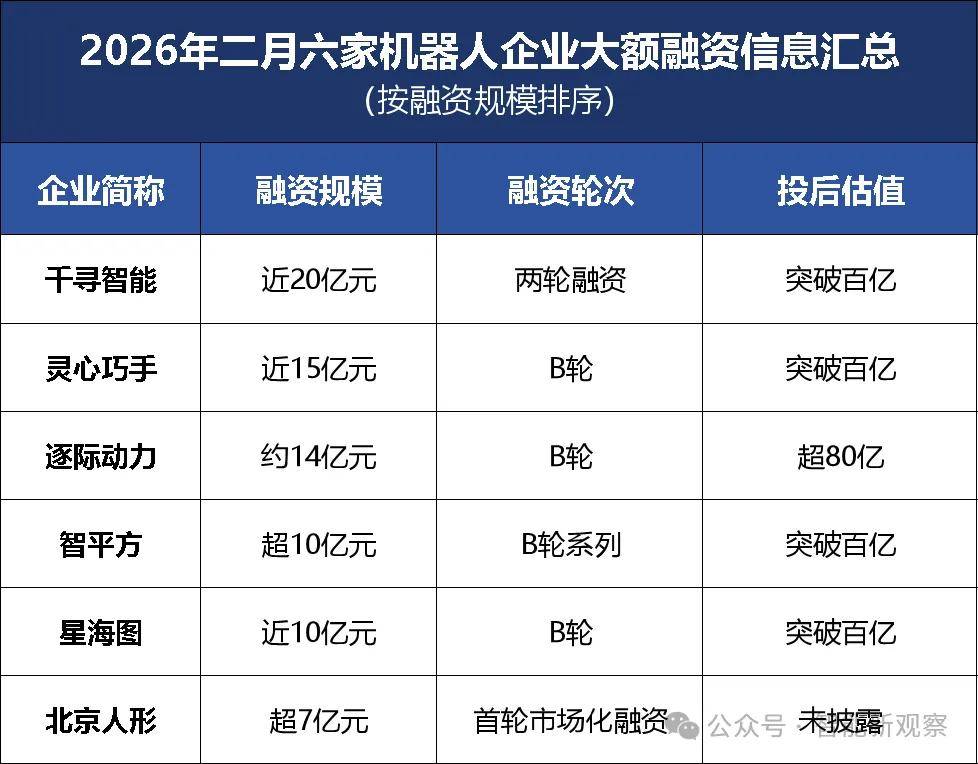
大额融资再度爆发:2月六家机器人企业狂氪资本近80亿!
Sou Hu Cai Jing· 2026-02-26 03:56
Core Insights - The domestic robotics sector continues to attract significant investment, with six companies raising a total of 7.6 billion yuan in February 2026, marking a strong trend in financing within the industry [1][31] - Four of these companies have achieved post-financing valuations exceeding 10 billion yuan, entering the "unicorn club" of robotics [1] Company Financing Summaries - **Qianxun Intelligent**: Raised nearly 2 billion yuan in two rounds of financing, achieving a post-financing valuation exceeding 10 billion yuan. The funding was led by top-tier institutions, and the company plans to enhance its investment in embodied foundational models and real data systems [2][5] - **Lingxin Qiaoshou**: Completed nearly 1.5 billion yuan in B-round financing, with a total financing amount exceeding 2 billion yuan since its establishment. The company focuses on dexterous robotic hands and aims to deliver 50,000 to 100,000 units in 2026 [8][10] - **Zhujidi Power**: Announced approximately 1.4 billion yuan in B-round financing, led by JD.com. The company has established a strong capital base and aims to enhance R&D and market investment for product commercialization [11][13] - **Zhi Ping Fang**: Secured over 1 billion yuan in B-round financing, becoming Shenzhen's first unicorn in embodied intelligence. The company has completed 12 rounds of financing and focuses on end-to-end large model technology [18][20] - **Xinghai Tu**: Raised nearly 1 billion yuan in B-round financing, becoming the first unicorn in its region. The company has launched a "plug-and-play" VLA integrated platform and aims to serve a wide range of industries [23][25] - **Beijing Humanoid Robot Innovation Center**: Completed over 700 million yuan in its first round of market financing, focusing on the development of core platforms for embodied intelligence and promoting the industrial application of humanoid robots [26][30] Industry Trends - The recent wave of financing reflects a collective industry shift towards making robots practical tools for real-world applications, moving beyond laboratory settings [31] - Companies are increasingly adopting platform and ecosystem strategies, aiming to create foundational infrastructures that support the intelligent transformation of various industries [31]


新科研神器!多形态双足机器人带来移动操作和具身智能新玩法!
机器人大讲堂· 2025-05-19 13:12
Core Viewpoint - The article highlights the advancements in embodied intelligence research, particularly focusing on the TRON 1 robot, which integrates multiple mobility forms and a robotic arm, enabling it to operate in complex environments and perform precise tasks [5][19]. Group 1: Technological Breakthroughs - TRON 1 features a unique combination of wheel-legged, bipedal, and robotic arm capabilities, allowing it to perform tasks in three-dimensional spaces, breaking the limitations of traditional flat-surface operations [6][7]. - The robot's design simplifies the complexity of robotic movement and operation, making it an accessible platform for researchers, especially beginners [6][11]. - The integration of the robotic arm with multi-modal mobility allows TRON 1 to handle tasks across various terrains and environments, enhancing its applicability in real-world scenarios [9][10]. Group 2: Research Applications - TRON 1 supports both independent control of the robotic arm and coordinated full-body movement, facilitating research into collaborative strategies and complex task execution [11][13]. - The robot's adaptability to different environments makes it an ideal platform for studying household service robots and search-and-rescue operations, where unpredictability is a significant factor [9][10]. - Researchers can utilize TRON 1 to simulate realistic applications, such as navigating through multiple rooms to locate and manipulate specific objects [9][10]. Group 3: Market Potential and Future Directions - The global embodied intelligence market is projected to grow from $1.8 billion in 2023 to $13.8 billion by 2028, with a compound annual growth rate of 50.2%, indicating a strong demand for platforms like TRON 1 [19]. - TRON 1's modular design and open SDK facilitate cross-disciplinary research, allowing researchers to customize their setups according to specific needs [14][17]. - The robot's evolution reflects a shift from a mobility platform to a comprehensive research tool, addressing the dual needs of movement and manipulation in embodied intelligence [19].