
UniScene

Search documents
为什么世界模型对行业产生了这么大的影响?
自动驾驶之心· 2025-12-29 09:17
Core Insights - The article emphasizes the vision of world models in understanding and transforming the physical world, focusing on the continuous technological breakthroughs that lead to generative AI in autonomous driving [2] Group 1: World Model Exploration - Various companies are building their cloud and vehicle-based world models using open-source algorithms for long-tail data generation and closed-loop simulation/evaluation [4] - The exploration of world models in autonomous driving includes video generation, OCC generation, and LiDAR point cloud generation, with notable works from Wayve, OccWorld, and others [3][4] Group 2: Challenges in Understanding World Models - The definition of world models remains ambiguous, leading to confusion among newcomers in the field [5] - Many beginners struggle to grasp the concepts of data generation and closed-loop simulation, often feeling lost despite extensive efforts [6] Group 3: Course Offering - The article introduces a course on world models in autonomous driving, developed in collaboration with industry algorithm experts, aimed at helping learners understand the field from theory to practice [6][8] - The course covers various chapters, including an introduction to world models, background knowledge, discussions on general world models, and practical applications in video and OCC generation [11][12][13][14] Group 4: Course Structure and Content - The course is structured into six chapters, each focusing on different aspects of world models, including their historical development, technical stacks, and industry applications [11][12][13][14][15] - The course aims to equip participants with the necessary skills to understand and implement world models in autonomous driving, preparing them for job interviews and practical applications [16][19]

东方理工金鑫:如何找到自动驾驶与机器人统一的「空间语言」丨GAIR 2025
雷峰网· 2025-12-14 06:27
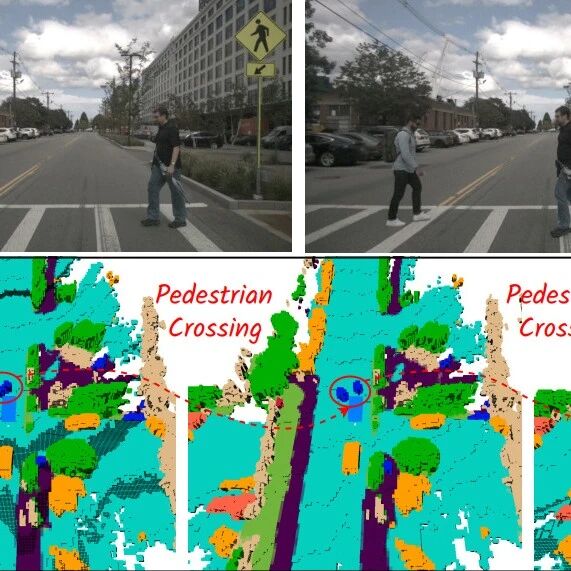
Core Viewpoint - The article discusses the emerging paradigm of "world models" in AI, emphasizing the importance of integrating physical rules and data-driven methods to enhance machine intelligence and its applications in industries like manufacturing and autonomous driving [2][4][5]. Group 1: Researcher and Team Insights - Researcher Jin Xin from Ningbo Oriental Institute of Technology is focusing on "embodied world models" for decision-making, collaborating with institutions like Shanghai Jiao Tong University and Tsinghua University [3]. - Jin's team is exploring a "hybrid" approach to building world models, combining explicit physical rules with data-driven methods to address complex phenomena [4]. Group 2: Applications and Industry Collaboration - The team is applying their methods in industrial manufacturing, collaborating with leading companies in Ningbo to validate their "factory world model" [5]. - The advancements in world models are seen as a significant leap in technology, with applications in autonomous driving, robotics, AIGC, AR, and VR [9]. Group 3: Space Intelligence Framework - The framework for space intelligence is divided into three parts: spatial perception, spatial interactivity, and spatial understanding, generalization, and generation [10][12][13][14]. - The process involves a "modeling-training" loop where AI agents are trained in simulated environments, leading to continuous optimization [18]. Group 4: Specific Projects and Innovations - The project "UniScene" focuses on generating driving scenarios, addressing the limitations of traditional data collection methods in the automotive industry [20][22]. - The "OmniNWM" project introduces a closed-loop mechanism for planning and generating future states based on trajectory inputs [42][44]. - The "InterVLA" dataset aims to provide first-person perspective data for robots, enhancing their interaction capabilities [46][57]. Group 5: Challenges and Future Directions - The article highlights the challenges in creating realistic world models, particularly in embedding complex physical rules and ensuring data quality [98][104]. - The research emphasizes a mixed approach, combining knowledge-based constraints with data-driven learning to improve the understanding of physical laws in AI models [106].
