VR/MR头显

Search documents
总投资20亿元,宏禧科技12英寸硅基OLED项目封顶
WitsView睿智显示· 2025-12-04 08:38
Core Viewpoint - The article highlights the significant advancements in the production of 12-inch silicon-based OLED (OLEDoS) technology in China, with multiple companies investing heavily in expanding their production capabilities and addressing the growing demand for micro-displays in AR and VR applications [1][4][5]. Group 1: Company Developments - Hongxi Technology announced the completion of its 12-inch silicon-based OLED project in Chuzhou, Anhui, with an investment of 2 billion yuan, aiming for an annual output of 72,000 wafers and an annual revenue of 3 billion yuan once fully operational [1]. - The company has already established a production line for OLEDoS and has launched products in various sizes, including 0.6-inch, 0.7-inch, and 1.33-inch, with a new 1.4-inch model under development [4]. - In February, Hongxi Technology successfully completed nearly 500 million yuan in Series A financing [4]. Group 2: Industry Trends - Domestic OLEDoS companies are actively pushing for mass production of 12-inch products, which is expected to lower production costs [5]. - TrendForce analysts noted that over ten Chinese manufacturers, including Sony and BOE, are now establishing 12-inch OLEDoS production lines [5]. - The demand for OLEDoS technology is particularly strong in AR glasses, with projections indicating that the technology's penetration rate will reach 53% by 2025 before declining [6]. - In the VR/MR headset market, OLEDoS is anticipated to see a rapid increase in penetration, reaching 58% by 2030 due to breakthroughs in both supply chain and application [6].


全球化再均衡之下AI + 元宇宙仍是锚点,歌尔股份(002241.SZ)引领生态重构
Ge Long Hui· 2025-04-09 01:14
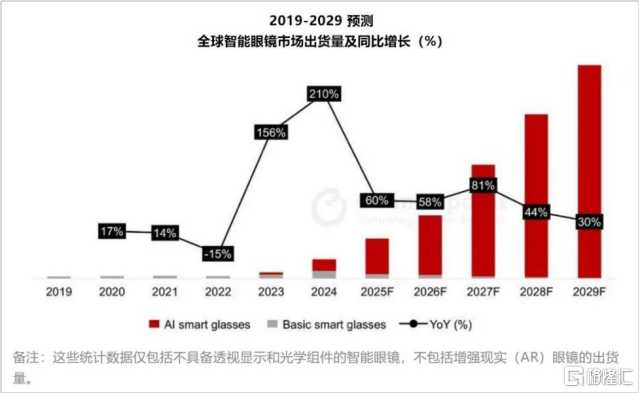
Group 1: Industry Overview - The global consumer electronics industry is experiencing a multi-dimensional recovery driven by the AI hardware revolution, with VR/MR headset shipments expected to reach 9.6 million units in 2024, a year-on-year increase of 8.8% [1] - The integration of AI large models with display technologies like waveguides and MicroLED is accelerating the evolution of smart glasses from entertainment tools to productivity tools, marking the beginning of a "battle of hundreds of glasses" [1] - The smartphone remains a crucial hardware product for AI technology implementation, with global smartphone shipments projected to reach 1.26 billion units in 2025, reflecting a 2.3% year-on-year growth [1] Group 2: AI and Metaverse Synergy - The collaborative evolution of AI and the metaverse has created a symbiotic relationship, where generative AI supports digital identity creation and virtual environment construction [2] - AI is expanding the boundaries of the metaverse, exemplified by AI agents like Luna, which autonomously operate multiple social media accounts and evolve through social interactions [2] - The metaverse provides a dynamic ecosystem for AI growth, offering a rich training sample library through user behavior data and interaction information [3] Group 3: Market Dynamics and Competition - Traditional smartphone manufacturers, internet giants, VR/AR companies, AI startups, and cross-industry players are competing in the "battle of hundreds of glasses" [4] - Major companies like Huawei, Xiaomi, and ByteDance are entering the AI glasses market, with Xiaomi targeting a production of 300,000 units by Q2 2025 [4] - The competition is expected to mature by 2025, with mainstream manufacturers completing product scenario validation and entering a phase of scaled production [4] Group 4: Company Spotlight - GoerTek - GoerTek is positioned as a key player in the AI and metaverse industry, providing essential technical and ecological support for the development and application of AI glasses and VR/AR technologies [5][8] - GoerTek holds a 70% market share in the high-end VR headset segment, serving as the exclusive manufacturer for top products like Meta Quest Pro and Sony PS VR2 [5] - The company is collaborating with major manufacturers like Xiaomi to develop AI glasses, with internal sales expectations set at 300,000 units [5] Group 5: Technological Advancements - GoerTek is building a strong technological moat through advancements in SiP packaging, acoustic technology, optical micro-displays, and smart sensing technologies [8][9] - The SiP module technology allows for the integration of high-performance processors and sensors in limited spaces, crucial for VR/AR devices [9] - GoerTek's acoustic technology enhances immersive experiences in the metaverse, while its optical micro-display innovations support lightweight and high-performance VR/AR devices [9][10] Group 6: Financial Performance - GoerTek reported a revenue of 100.95 billion yuan in 2024, a year-on-year increase of 2.41%, with a net profit of 2.665 billion yuan, reflecting a significant growth of 144.93% [11] - The company is expected to reach a critical point in its technology compounding curve, leveraging its technological reserves and ecological partnerships for future growth [11] - The ongoing advancements in AI and the metaverse are anticipated to provide GoerTek with new growth opportunities and potential valuation reassessment [11]