
WebOS

Search documents
LG电子预计第三季度营收和营业利润双双下滑
Huan Qiu Wang· 2025-10-13 05:35
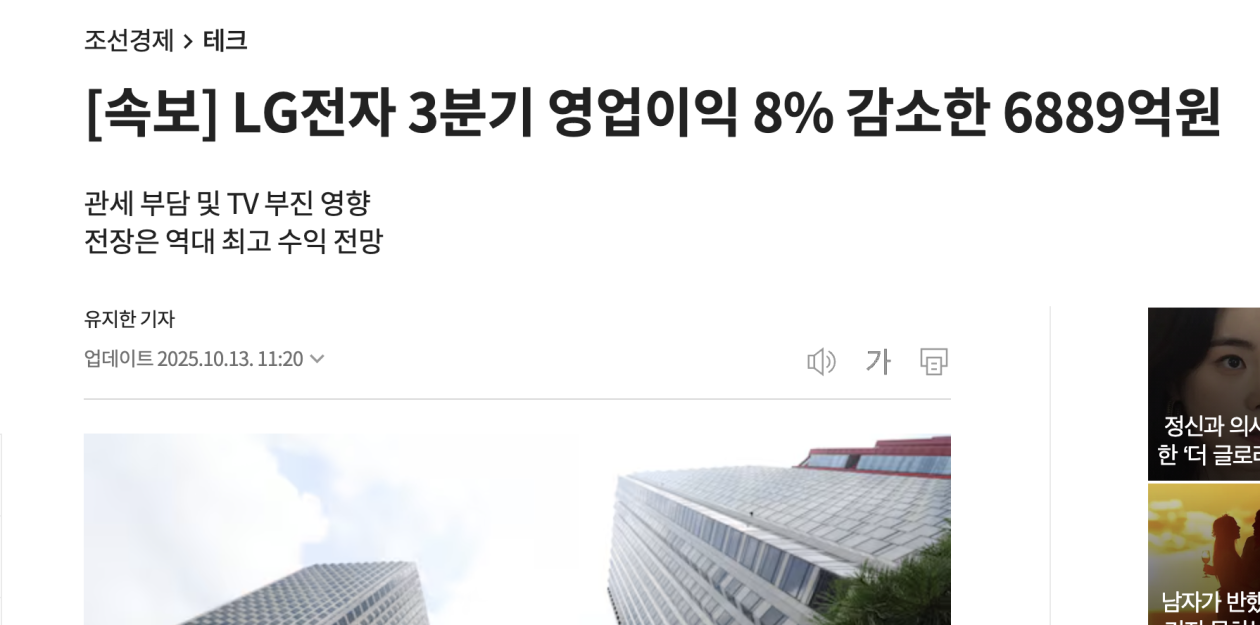
Core Insights - LG Electronics reported third-quarter earnings with revenue of 21.8751 trillion KRW and operating profit of 688.9 billion KRW, reflecting a year-over-year revenue decline of 1.4% and an operating profit decrease of 8.4% [1][3]. Group 1: Financial Performance - The decline in performance was primarily attributed to the burden of tariffs on the television business and weak overall performance [3]. - The home appliance sector faced high export tariff costs and sluggish global demand recovery [3]. Group 2: Business Challenges - The media entertainment division responsible for the television business experienced increased marketing expenses due to intensified market competition [3]. - A voluntary retirement program for employees aged 50 and above or with low performance resulted in one-time costs impacting profitability [3]. Group 3: Strategic Initiatives - The company is actively working to mitigate the negative impact of tariffs through optimized production operations and resource allocation [4]. - LG Electronics is seeing steady growth in its subscription business that combines products and services [4]. Group 4: Business Segments - The automotive parts business is expected to achieve record profitability in the third quarter, driven by significant sales growth in high-end in-car infotainment products [4]. - The HVAC business has secured large-scale orders globally, including AI data center cooling solutions [4]. Group 5: Future Focus - LG Electronics plans to emphasize "qualitative growth" in areas such as automotive parts, HVAC B2B business, and non-hardware operations like appliance subscriptions and WebOS [4]. - The company anticipates significant financing from its upcoming IPO in India, which will accelerate business restructuring and future growth [4][5].

49天毁掉12亿美元,前HP CTO揭秘HP当年错失移动时代的真相
3 6 Ke· 2025-06-18 07:44
Core Insights - The article discusses the failure of HP's WebOS project, which was acquired from Palm for $1.2 billion, and how it was abruptly terminated just 49 days after the launch of the TouchPad tablet [1][2][3] Group 1: Acquisition and Initial Optimism - HP acquired Palm in 2010, believing that WebOS had the potential to be a leading mobile platform due to its advanced multitasking capabilities and elegant UI design [4][5] - The acquisition was seen as a strategic move to secure a foothold in the mobile computing market, which was shifting away from traditional PCs [4][5] Group 2: Leadership Changes and Strategic Shift - Following the acquisition, HP's CEO Mark Hurd resigned, and Leo Apotheker took over, who had a radically different vision for the company, focusing on software and services rather than hardware [7][8] - Apotheker viewed WebOS as a burden and aimed to pivot HP away from its traditional hardware business, which included the TouchPad [7][8] Group 3: Project Collapse and Decision-Making Failures - The TouchPad was launched on July 1, 2011, but failed to gain traction, selling only 25,000 units out of 270,000 shipped, while Apple sold 9 million iPads in the same period [10][11] - Just 49 days after the launch, HP announced the cessation of all WebOS device development, a decision made without adequate time to address the product's issues or build a developer ecosystem [11][12] Group 4: Aftermath and Reflection - The abrupt termination of the WebOS project led to significant internal backlash, with team members blaming leadership for the failure [12][13] - The article emphasizes the importance of having the right leadership and decision-making frameworks in place to avoid similar failures in the future [18][20][21] - Despite the failure of WebOS, the underlying technology was later repurposed by LG for smart TVs, indicating its potential value if managed correctly [23]
