
WorkIQ

Search documents
Microsoft (NasdaqGS:MSFT) 2026 Conference Transcript
2026-03-04 18:17
Summary of Microsoft 2026 Conference Call Company Overview - **Company**: Microsoft (NasdaqGS: MSFT) - **Date**: March 04, 2026 - **Key Speaker**: Satya Nadella, Chairman and CEO Industry Insights - **Software Industry Dynamics**: The software industry is experiencing significant innovation and uncertainty, particularly regarding how software will be built, delivered, and priced in the coming years [3][4] - **AI Integration**: AI is transforming knowledge work by enhancing productivity and enabling sophisticated task management through tools like Excel and GitHub [4][6][7] Key Points and Arguments - **AI's Role in Software**: AI is increasingly capable of predicting trajectories in knowledge work, leading to higher productivity and the creation of sophisticated artifacts [4][6] - **Growth in Microsoft 365**: Microsoft 365 has seen a 20% increase in subscriptions, indicating strong user engagement and the potential for further growth in the agentic future of software [12][27] - **CIO Perspectives**: 80% of CIOs are either using or expect to use Microsoft Copilot, highlighting a disconnect between investor concerns and CIO confidence in the product [27][28] - **Network Effects of Intelligence**: The integration of AI with existing databases like WorkIQ enhances the value proposition for CIOs, as it compounds the benefits of prior investments in data infrastructure [29][31] - **Model Layer Strategy**: The industry is likely to see a multi-model approach rather than consolidation into a few frontier models, emphasizing the need for flexibility and optimization in model usage [32][34] Additional Important Insights - **Capital Intensity**: The shift towards AI and advanced computing is increasing capital intensity, but Microsoft views this as a knowledge-intensive business that can leverage software to manage costs effectively [56][58] - **Long-term Strategy**: Microsoft aims to maintain a long-term focus on R&D and product development, balancing immediate investor expectations with strategic growth initiatives [66][69] - **OpenAI Partnership**: The relationship with OpenAI is foundational for Microsoft, providing access to advanced models while allowing for flexibility and mutual growth [44][47] - **User Interface Evolution**: The future of user interfaces may involve more natural language processing and agentic loops, enhancing user interaction with software systems [19][24] Conclusion - Microsoft is well-positioned to capitalize on the evolving software landscape, driven by AI integration and a strong focus on user needs and long-term strategic growth. The company is navigating challenges related to capital intensity and market competition while maintaining a commitment to innovation and customer trust.

1480亿美元的赌注:为何高盛认为市场误读了微软的资本开支?
Hua Er Jie Jian Wen· 2026-02-13 13:19
Core Viewpoint - Microsoft has seen a 15% decline in stock price since the earnings report on January 28, primarily due to concerns over increased capital expenditures without a corresponding rise in Azure growth guidance and competition from new AI tools in the Office 365 business [1] Group 1: Capital Expenditure and Azure Growth - Microsoft is adjusting its computing power allocation, increasing the share for internal research and Copilot from approximately 10% to 20% [3][5] - For fiscal year 2026, capital expenditures are projected to reach $148 billion, a 400% increase from fiscal year 2022 [3] - Current computing power allocation is about 70% for Azure and 30% for Copilot and internal research, with new GPU allocations approaching a more balanced 60/40 split [6] Group 2: Iceberg Model of Computing Investment - Goldman Sachs introduced an "iceberg analogy" to explain Microsoft's computing capital expenditure strategy, distinguishing between visible investments that directly impact Azure and Office 365 and invisible investments crucial for long-term strategy [4] - If all new computing capacity is allocated to Azure, its growth rate could exceed 40%, indicating a strategic postponement of some growth potential for long-term investments [4][10] Group 3: Drivers of Increased Internal Allocation - Four structural factors are driving the increased demand for Microsoft's computing power, leading to a significant evolution in capital expenditure structure [7] - Azure AI computing power accounts for the largest share, with a multiplier of 4-5 times for "computing power/quarterly new revenue," translating to $0.20 to $0.25 in revenue for every $1 of capital expenditure [8] Group 4: Copilot Investment Strategy - Microsoft is positioning Copilot as a cost-effective enterprise-level LLM solution, priced at approximately $30 per user per month, compared to ChatGPT Enterprise at $60 [12] - Copilot is beginning to make a substantial contribution to M365 commercial cloud revenue, projected to reach $89 billion in fiscal year 2026 [13] - The adoption rate of Copilot is increasing among both internal employees and external customers, driving up computing power consumption [9]

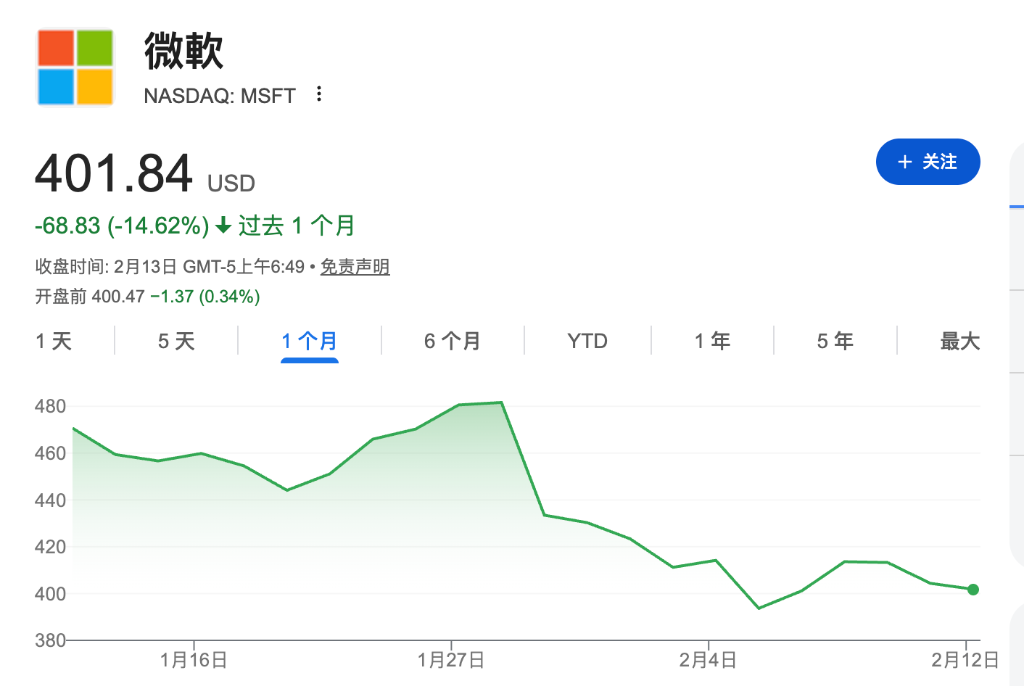
Microsoft (MSFT) Earns Fresh Analyst Support After Ignite and Investor Meetings
Yahoo Finance· 2025-11-25 10:48
Group 1: Microsoft Corporation's AI Position - Microsoft is recognized as a leading AI stock, with Evercore ISI reiterating an Outperform rating and a price target of $640, viewing the recent pullback as a buying opportunity into CY26 [1] - The discussions with Microsoft President Charles Lamanna revealed the company's expanding scope in agents, business applications, the Power Platform, and Agent 365 offerings [2] - Agent 365 is positioned as a core 'registry of registries,' providing Microsoft with a structural advantage in managing agent growth, security, and interoperability [3] Group 2: Business Applications and Agent Governance - Business applications are expected to be fundamentally reshaped by agents, WorkIQ, and Copilot, leading to a decline in traditional app UI value as enterprises shift towards agent-driven experiences [4] - The importance of agent governance is increasing as enterprises face rapid agent proliferation and rising AI-generated data, presenting opportunities for companies like AvePoint to lead in compliance and visibility [5] - Microsoft remains optimistic about its AI position, emphasizing its focus on efficiency, security, and AI advancements in its cloud and business solutions [6]