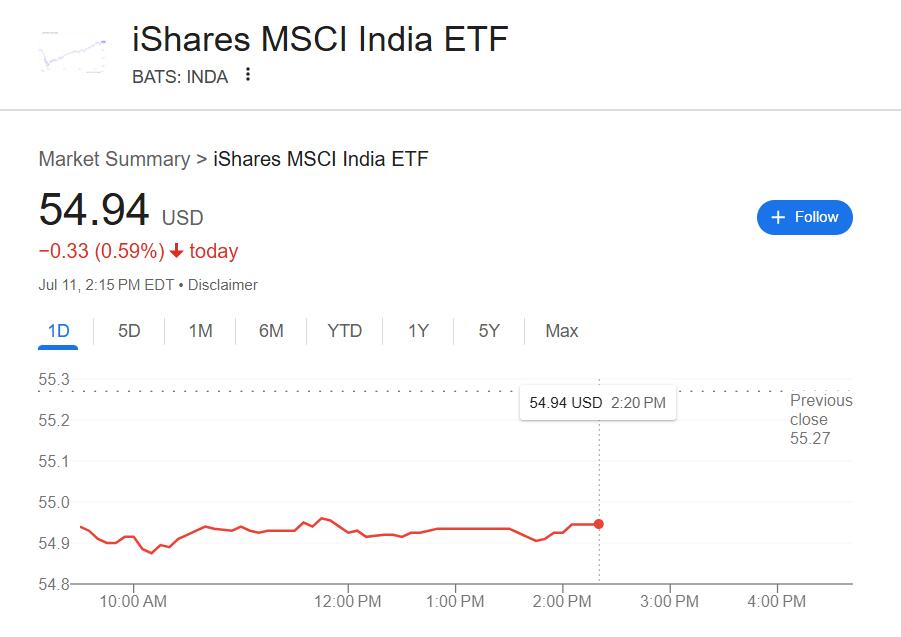
iShares MSCI India ETF

Search documents
X @Bitget Wallet 🩵
Bitget Wallet 🩵· 2026-03-19 11:53
We just added 50+ new onchain assets to our Stock Zone:ALBon AlbemarleAPLDon Applied DigitalASTSon AST SpaceMobileBNOon US Brent Oil FundCAPRon Capricor TherapeuticsCIBRon First Trust NASDAQ Cybersecurity ETFCOHRon CoherentCRWVon CoreWeaveECHon iShares MSCI Chile ETFENLVon Enlivex TherapeuticsENPHon Enphase EnergyETHAon iShares Ethereum TrustETNon EatonEWJon iShares MSCI Japan ETFEWYon iShares MSCI South Korea ETFEWZon iShares MSCI Brazil ETFEXODon Exodus MovementFCXon Freeport-McMoRanFSOLon Fidelity Solana ...
Looking For A Rebound? China Tech and Emerging Markets Top Oversold List
Benzinga· 2026-03-04 17:41
Core Insights - A new group of stocks and funds, particularly those focused on China and growth sectors, have entered deeply oversold territory, indicating potential for a rebound if market sentiment improves [1][2] Group 1: Oversold Stocks and ETFs - KraneShares CSI China Internet ETF (KWEB) has the lowest RSI at 18.32, trading around $29.85, suggesting some dip-buying interest despite being oversold [4] - JD.com Inc. (JD) has an RSI of 24.42, trading at $25.21, reflecting significant selling pressure in the Chinese consumer and internet sectors [4] - iShares China Large-Cap ETF (FXI) shows an RSI of 24.99, with shares at $35.89, indicating broad selling pressure affecting major China benchmarks [4] - Sea Ltd. (SE) has an RSI of 27.32, trading at $88.26, suggesting early bargain hunting in the Southeast Asia e-commerce and gaming sector [4] - SPDR Blackstone Senior Loan ETF (SRLN) has an RSI of 28.42, trading near $39.82, indicating that selling pressure has also impacted the credit and floating-rate loan market [4] - Avantor Inc. (AVTR) carries an RSI of 28.44, with shares at $8.74, indicating potential for a bounce if fundamentals stabilize [4] - Novo Nordisk A/S (NVO) has an RSI of 29.09, trading at $38.05, suggesting traders may be returning after profit-taking [4] - Tencent Music Entertainment Group (TME) shows an RSI of 29.74, trading around $14.05, reflecting a sharp retreat from recent highs [4] - iShares MSCI India ETF (INDA) has an RSI of 29.75, trading near $50.03, indicating that selling pressure has extended beyond China into broader Asian markets [4]


EXCLUSIVE: US–India Trade Deal To 'Tilt The Spreadsheet' As Firms Rethink China Exposure, Says Strategist - Boeing (NYSE:BA), iShares MSCI India ETF (BATS:INDA)
Benzinga· 2026-02-12 17:01
Core Insights - The new U.S.-India trade deal represents a significant shift in bilateral relations, with India expected to play a larger role in U.S. supply chains, although it will not lead to an immediate overhaul [1][4] - The agreement is seen as a gradual shift rather than a sudden change, influencing how U.S. multinationals evaluate costs and risks associated with sourcing alternatives to China [2][7] Trade Dynamics - U.S. imports from India reached $95.4 billion between January and November 2025, marking a 19.2% increase from the same period in 2024, while U.S. exports to India rose by 9.6% [3] - Under the new deal, U.S. tariffs on Indian goods will decrease from 50% to 18%, contingent upon India's commitment to halt Russian oil purchases [4] - India plans to import at least $500 billion worth of U.S. goods over the next five years, with significant demand expected for energy, aircraft, and ICT products [5] Tariff Implications - India will reduce tariffs on U.S. industrial and agricultural goods, while the U.S. will reciprocate by removing tariffs on pharmaceuticals, gems, and aircraft parts [6] - The tariff cuts are expected to reinforce existing trends of U.S. companies reducing reliance on China, with India being a viable alternative [7] Sourcing Decisions - Multinational companies' sourcing decisions are influenced by long-term contracts and compliance checks, which can take years to adjust [8] - The shift in sourcing will occur in stages, starting with pilot sourcing and contract renegotiations, followed by capacity expansion and supplier consolidation [8] Reliability and Costs - The move away from Russian oil by India is seen as reducing geopolitical ambiguity, which is increasingly important for U.S. investors [11] - Higher energy prices may pressure margins for Indian manufacturers, but reliability is becoming a premium factor for U.S. multinationals, who prefer stable partners over the cheapest options [12]

India ETF Bucks Emerging-Market Stock Selloff On US Trade Deal
Www.Ndtvprofit.Com· 2026-02-03 02:08
Group 1: Market Reactions - An index fund tracking Indian shares, the $9.4 billion iShares MSCI India ETF, experienced its largest gain since May, attributed to a trade deal with the US that will lower tariffs on Indian goods from 25% to 18% [1] - MSCI's gauge for developing-nation equities fell by as much as 2.9%, marking the most significant decline since April, while South Korean stocks saw a notable drop with the Kospi index down 5.3% [2] - The overall market selloff was influenced by a dramatic decline in various asset classes, including global equities and precious metals, following President Trump's nomination of Kevin Warsh to lead the Federal Reserve, which strengthened the dollar [3] Group 2: Currency and Bond Markets - MSCI's gauge for currencies decreased by approximately 0.4%, with the South Korean won underperforming, while Latin American currencies, particularly the Colombian peso, outperformed after a 100-basis point rate hike by the Colombian central bank [4] - Morgan Stanley strategists indicated that Trump's nomination of Warsh does not signify the end of the rally in emerging-market currencies and local bond markets, suggesting that investors should consider buying dips due to solid fundamentals [6] - Poland is planning a return to the Japanese bond market with a multi-tranche Samurai issue to meet its increasing borrowing needs, while Argentina is opting not to sell bonds in global markets due to access to alternative funding sources at lower interest rates [8]

Modi Momentum: Finding Stability in India’s Goldilocks Economy
Yahoo Finance· 2026-01-14 22:19
Economic Overview - The Reserve Bank of India has cut the repo rate to 5.25%, indicating a supportive monetary policy environment [1] - India's GDP is projected to grow by approximately 6.7% for Fiscal Year 2026, reflecting strong economic expansion alongside stable prices [1] - The Consumer Price Index (CPI) for December 2025 was reported at 1.33%, significantly below the RBI's target of 4%, which is favorable for maintaining purchasing power [2] Investment Landscape - India is seen as a primary destination for investment due to its favorable economic conditions, characterized as a "Goldilocks phase" with high growth and low inflation [4] - Investors are shifting capital towards markets like India that offer political stability and controlled prices amidst volatility in Western markets [5] - Lower interest rates are expected to catalyze corporate expansion and profitability, particularly benefiting the financial sector [6][7] Market Strategy - U.S.-based investors can access Indian market growth through the iShares MSCI India ETF (BATS: INDA), which is heavily weighted towards the financial sector [8] - The ETF's performance is expected to benefit from increased loan demand as the economy grows and interest rates fall [9] - The "China Plus One" strategy is driving foreign direct investment into India, providing a long-term support for the ETF's price [10] Company Focus: HDFC Bank - HDFC Bank is a critical holding in the INDA ETF, accounting for over 8% of the fund, and its performance is vital for the ETF's overall success [11] - The bank has returned to an aggressive growth phase, with a recent Credit-Deposit (CD) ratio normalizing to 98.5%, indicating a healthier balance sheet [14] - HDFC Bank reported a 13% year-over-year increase in loan growth and an 11.5% increase in deposits, signaling a recovery from previous merger integration issues [21] Valuation Insights - HDFC Bank's recent IPO of its subsidiary, HDB Financial Services, adds tangible value to the parent company's books, enhancing its market capitalization [16][17] - This structural valuation support may be underappreciated by the market, providing a margin of safety for investors [15] Strategic Diversification - The divergence between India's stable growth narrative and the uncertainty in Western markets presents a compelling investment opportunity [18] - The combination of the INDA ETF and HDFC Bank's growth potential offers a data-backed strategy for investors looking to diversify away from U.S. political risks [20]

India ETFs Offer Compelling Growth Upside: Is the Risk Worth Taking?
ZACKS· 2026-01-09 16:50
Core Insights - The Nifty 50 Index has declined approximately 1.87% in early 2026 due to tariff concerns and foreign equity outflows [1] - Despite short-term volatility, India ETFs present a strong long-term growth opportunity, with the index up about 1.63% over the past six months and nearly 8.41% over the past year [2] Economic Outlook - India's economic outlook is optimistic, supported by favorable demographics, a growing base of young investors, increasing AI investments, advancements in chip design and digital infrastructure, and rapid digital transformation [3] - The OECD projects India's real GDP growth at 6.7% in 2025 and 6.2% in 2026, driven by resilient domestic demand and digitalization [6] Market Pressures - Uncertainty regarding U.S. tariffs poses a significant challenge, with tariffs on Indian goods reaching up to 50% and potential increases for nations purchasing Russian oil [4] - Foreign investors have sold $900 million in Indian shares in January 2026, following a record $19 billion in sales the previous year [5] Growth Projections - India's economy is expected to grow by 7.4% in the fiscal year ending in March, surpassing initial estimates of 6.3%–6.8% [7] - Private consumption, accounting for nearly 60% of GDP, is projected to grow by 7% year-on-year, while government spending is expected to increase by 5.2% [8] Investment Opportunities - Short-term challenges may increase market volatility, but India's long-term economic fundamentals remain strong, presenting investment opportunities [14] - Recommended India ETFs include iShares MSCI India ETF (INDA), WisdomTree India Earnings Fund (EPI), and Franklin FTSE India ETF (FLIN), with INDA being the largest at $9.58 billion in assets [15][16]

Goldman Sachs' Upgrade: A Signal to Invest in Indian ETFs?
ZACKS· 2025-11-12 13:15
Core Viewpoint - The Indian equity market has experienced significant underperformance in 2023, with the Nifty 50 index only increasing by approximately 5% year to date, contrasting sharply with a 22% gain in the previous year and lagging behind many Asian markets that have surged over 30% [1][2] Group 1: Causes of Underperformance - Disappointing corporate earnings growth, subdued domestic consumption, and adverse tariff disputes, including new U.S. tariffs, have negatively impacted export-sensitive sectors and contributed to rupee depreciation [4] - Domestic political uncertainty, a slowdown in capital expenditure (capex), and a shift of global capital to safer markets have pressured Indian equities, with foreign investors estimated to have sold over $30 billion in Indian equities over the past year [5] - The Indian equity market's valuation remains high, trading at approximately 22.3 times forward earnings, about 20% above its long-term norm, which has raised concerns [5][6] Group 2: Positive Outlook - Goldman Sachs has upgraded the Indian equity market to "overweight" after 13 months of a "neutral" rating, citing supportive policy changes such as anticipated RBI rate cuts, liquidity easing, and reductions in the Goods and Services Tax (GST) [7] - Record equity purchases by Domestic Institutional Investors (DIIs) and steady retail Systematic Investment Plan (SIP) inflows have stabilized the market amid foreign portfolio investor (FPI) selling [8] - The end of a year-long cycle of earnings downgrades suggests a clear earnings rebound is expected, contributing to a bullish outlook [9] Group 3: Investment Opportunities - Several Indian ETFs are highlighted as potential investment opportunities, including: - **iShares MSCI India ETF (INDA)**: Net assets of $9.57 billion, top holdings include HDFC Bank (8.12%), Reliance Industries (6.59%), and ICICI Bank (5.18%), with a year-to-date gain of 4% [11][12] - **WisdomTree India Earnings Fund (EPI)**: Total assets of $2.85 million, top holdings include Reliance Industries (7.49%), HDFC Bank (6.17%), and ICICI Bank (5.26%), with a year-to-date gain of 3.1% [13] - **iShares India 50 ETF (INDY)**: Total assets of $690.23 million, top holdings include HDFC Bank (12.73%), Reliance Industries (8.53%), and ICICI Bank (8.14%), with a year-to-date gain of 5.2% [14] - **Franklin FTSE India ETF (FLIN)**: Total assets of $2.59 billion, top holdings include HDFC Bank (7.13%), Reliance Industries (6.45%), and ICICI Bank (4.54%), with a year-to-date gain of 3.6% [15]

The Geopolitical Windfall for Indian ETFs as Trump Hints at Tariff Cut
ZACKS· 2025-10-22 13:41
Core Insights - The U.S. is reportedly preparing to reduce tariffs on Indian imports from 50% to between 15% and 16%, contingent on India's commitment to decrease Russian oil purchases, which is generating optimism in the markets, particularly for India-focused ETFs [1][4] - The anticipated bilateral trade agreement is expected to be formalized at the upcoming ASEAN Summit, potentially alleviating trade tensions and significantly benefiting large-cap Indian equities and related ETFs [2][6] - The geopolitical dynamics, including the U.S. strategy to economically isolate Russia, are influencing the trade negotiations, which could lead to a positive impact on global trade and financial markets [3][5] Trade Agreement Implications - The trade deal is expected to enhance India's export sectors by providing tariff relief, particularly benefiting industries such as textiles, engineering goods, and pharmaceuticals [4][7] - The agreement is also part of the U.S. strategy to diversify energy alliances, especially in light of reduced agricultural imports from China, with India positioned as a potential new market for U.S. agricultural products [5][6] Investment Opportunities - The impending trade deal presents a significant opportunity for investors to increase their exposure to Indian markets through ETFs before prices rise post-announcement [7][8] - A shift in sentiment from trade conflict to strategic partnership is likely to attract Foreign Institutional Investor (FII) capital into India, making it an opportune time for long-term investors to accumulate India ETFs [8] India-focused ETFs Overview - iShares MSCI India ETF (INDA) has net assets of $9.58 billion and has gained 3.5% year to date, with fees of 62 basis points [10] - WisdomTree India Earnings Fund (EPI) has total assets of $2.9 million, up 2.1% year to date, with fees of 84 basis points [11][12] - Franklin FTSE India ETF (FLIN) has total assets of $2.53 billion, with a year-to-date increase of 3.3% and fees of 19 basis points [13] - The India Internet ETF (INQQ) has net assets of $63.4 million, also up 3.3% year to date, with fees of 86 basis points [14]
International ETFs Are Up 30% This Year
Yahoo Finance· 2025-10-08 10:00
Core Insights - The iShares MSCI Brazil ETF experienced a significant inflow of $285 million in the week leading up to a call between President Trump and Brazilian President Lula da Silva, discussing potential tariff reductions [2] - The ETF has shown a year-to-date increase of over 37%, indicating strong performance despite previous tariff announcements [2] - In contrast, the iShares MSCI India ETF has only returned 0.23% year to date, highlighting India's underperformance in the ETF category amid similar tariff challenges [3] Brazil's Performance - Brazil's exports to countries other than the US have increased, mitigating the impact of the 50% tariffs imposed on Brazilian goods [2] - The inflow into the Brazil ETF marks the first net inflows since the tariffs were announced in July [2] India's Situation - The Nifty-50 index in India has seen a marginal increase of 2% since the implementation of the tariffs, driven by domestic sectors like financials and consumer discretionary [3] - Key export-oriented sectors such as IT and pharmaceuticals are not affected by the tariffs, contributing to the muted market reaction [3] China's Performance - The KraneShares CSI China Internet ETF and the iShares MSCI China ETF have returned nearly 46% and 43% respectively, indicating strong performance despite some institutional divestment from China [3] Caution in Emerging Markets - Investors in single-country funds, particularly in emerging markets, are advised to exercise caution and monitor their investments more frequently compared to the US market [4]
美印协议又有戏了?据称美征印度关税或低于20%,印度ETF和卢比跌幅收窄
Hua Er Jie Jian Wen· 2025-07-11 20:34
Core Points - The article discusses the potential for a temporary trade agreement between the United States and India, which may lower the planned tariff rates on India to below 20% [1] - There are indications that India is seeking a more favorable trade agreement compared to the recent U.S.-Vietnam agreement, which has faced complications [6] - Following recent trade negotiations, India has indicated plans to impose retaliatory tariffs on U.S. products in response to U.S. tariffs on Indian automotive imports [7] Group 1 - The U.S. is reportedly working towards a temporary trade agreement with India, which could ease tensions and allow for further negotiations [1] - The Indian government is looking for a trade deal that is more advantageous than the one recently proposed to Vietnam, which has been criticized for its unfavorable terms [6] - After a recent round of negotiations, India has communicated its intention to the WTO regarding retaliatory tariffs on certain U.S. products [7] Group 2 - India is expected to send a delegation to the U.S. for further trade discussions, focusing on resolving disputes over tariffs on automotive parts, steel, and agricultural products [8] - The U.S. has requested India to open its agricultural market, particularly for genetically modified crops, but India has rejected this due to concerns over food security [9] - Key issues remain unresolved, including non-tariff barriers in agriculture and regulatory processes in the pharmaceutical sector [9]