CNBC

Search documents
Spirit Airlines sells more planes, calls back 500 flight attendants from furlough ahead of spring break
CNBC· 2026-02-12 16:43
Core Insights - Spirit Airlines is attempting to recover from its second bankruptcy in less than a year by selling 20 Airbus planes and recalling flight attendants from furlough [1][2] - The sale of the aircraft, which are mostly not in service, is part of Spirit's strategy to stabilize its operations after years of financial difficulties [1] - Spirit's fleet will be reduced to 94 aircraft, aligning with the company's focus on its strongest routes and most efficient fleet [2] Staffing and Operations - The company is utilizing natural attrition and voluntary actions to adjust staffing levels for pilots and flight attendants [2] - The phased-out aircraft sales will begin in April, indicating a structured approach to fleet management [2] Strategic Partnerships - Ongoing deal discussions with investment firm Castlelake and budget carrier Frontier Airlines have not resulted in an agreement, leaving Spirit to consider independent strategies for future operations [3]



FTC tells Tim Cook to look into reports Apple News is censoring conservatives
CNBC· 2026-02-12 16:39
Core Viewpoint - The FTC Chair Andrew Ferguson has raised concerns about potential political bias in Apple News, suggesting that the platform may be favoring left-wing news outlets while suppressing conservative ones [2][3]. Group 1: Allegations of Bias - Reports indicate that Apple News has been systematically promoting articles from left-wing outlets and suppressing those from conservative publications [2]. - Ferguson's letter references a study by the Media Research Center, which analyzed featured stories on Apple News during morning time slots in January [3]. Group 2: Legal and Regulatory Context - Apple has the legal right to promote any content it chooses on Apple News, a point acknowledged by Ferguson [2]. - Ferguson clarified that the FTC does not have the authority to mandate Apple or any other company to adopt specific political stances or curate news offerings based on ideology [3].


We're locking in some profits in 2 rallying stocks that we still love long term
CNBC· 2026-02-12 16:24
Core Viewpoint - The company is making strategic trades by selling shares of Eaton and Procter & Gamble to lock in profits as the stock market approaches overbought conditions, while maintaining a focus on potential growth in technology stocks [1] Eaton - The company is selling 20 shares of Eaton at approximately $403 each, reducing its weighting in the portfolio from 2.75% to 2.55% and decreasing the share count to 250 [1] - Eaton's shares have increased by 27% year to date, prompting the company to raise its price target to $425 due to strong momentum in data center orders [1] - The decision to trim the position is aimed at securing gains from the recent performance over the past month and a half [1] Procter & Gamble - The company is selling 50 shares of Procter & Gamble at around $162, decreasing its weighting in the portfolio from about 1.9% to 1.7% and reducing the share count to 425 [1] - Procter & Gamble shares have risen 13% year to date, and the company downgraded its rating to a hold equivalent after the stock reached a new high for 2026 [1] - The initial investment in Procter & Gamble was made in anticipation of a rebound in the consumer staples sector, which has proven successful as the sector gains popularity [1] Market Conditions - The S&P Short Range Oscillator indicates that the stock market is nearing overbought conditions, leading to the decision to book profits in the aforementioned stocks [1] - Despite the overall market conditions, technology stocks, particularly the Magnificent Seven, are perceived to have room for growth, prompting the company to maintain a focus on selectively increasing positions in these areas, especially in Alphabet [1]



Waymo begins deploying next-gen Ojai robotaxis to extend its U.S. lead
CNBC· 2026-02-12 16:00
Core Insights - Waymo has launched its sixth-generation driverless system for robotaxi rides, initially for employees in the San Francisco Bay Area and Los Angeles, with plans for public access later this year [2][3] Group 1: Technology and Fleet Expansion - The sixth-generation Waymo Driver utilizes more cost-effective parts and is designed to handle harsher weather conditions compared to previous versions, marking a significant upgrade in technology [2] - Waymo aims to extend its lead in the U.S. market by upgrading its driverless technology and expanding its fleet [2][3] - The new system will serve as the primary engine for Waymo's next phase of expansion [2] Group 2: Market Position and Competition - Waymo currently offers fully autonomous robotaxi services in six U.S. markets and plans to begin operations in London later this year [4] - Competitors such as Amazon-owned Zoox and Tesla are testing their driverless systems but have not yet launched widespread driverless ride-hailing services [4] - Chinese companies like Baidu-owned Apollo Go and WeRide are expanding internationally at a faster pace than Waymo [5] Group 3: Strategic Partnerships and Concerns - Waymo's decision to use vehicles from Chinese automaker Geely has raised concerns among GOP lawmakers regarding national security [5][6] - Waymo has assured that it will not share its autonomous driving technology or rider information with Geely's subsidiary, Zeekr, which provides the base vehicles [6] Group 4: Vehicle Specifications - The Ojai vehicle, which is part of Waymo's fleet, features a boxier design with a lower step and higher ceiling compared to existing models, while maintaining a similar footprint to the Jaguar I-PACE [8]


Electricity prices are rising by double the rate of inflation. Data center demand means no relief ahead
CNBC· 2026-02-12 15:45
Core Insights - Rising electricity prices are driven by increased demand from artificial intelligence data centers, with prices jumping 6.9% year-over-year in 2025, significantly outpacing the headline inflation rate of 2.9% [1] Group 1: Electricity Price Trends - Electricity prices are projected to continue rising through the end of the decade, with data centers accounting for 40% of electricity demand growth [2] - Households are expected to see electricity prices rise another 6% through 2027, with inflation slowing to 3% in 2028 due to lower natural gas prices [3] Group 2: Economic Impact - The increase in electricity prices will lead to a decline in disposable income and consumer spending growth, which is expected to fall by 0.2% through 2027, while economic growth will slow by 0.1% [2][3] - Higher electricity prices will contribute to core inflation, increasing it by 0.1% through 2027 and by 0.05% in 2028 as businesses pass on costs to consumers [4] Group 3: Demographic and Regional Disparities - Lower-income households will experience a larger impact from rising electricity prices, as electricity constitutes a greater share of their spending [4] - The impact of rising electricity prices will vary significantly across different regions in the U.S., influenced by regional market structures and regulatory choices [3]

January homes sales tank more than 8%, as Realtors say potential buyers are 'struggling'
CNBC· 2026-02-12 15:00
Core Insights - The U.S. housing market is facing challenges due to high home prices, declining supply, and weakened consumer confidence [1] Sales Performance - Sales of previously owned homes in January fell by 8.4% from December to an annualized rate of 3.91 million, marking a 4.4% decrease compared to January 2025, the slowest pace since December 2023 [2] - The decline in sales was most pronounced in the South and West regions of the U.S. [3] Affordability and Supply - The National Association of Realtors (NAR) reported that affordability conditions are improving, with the Housing Affordability Index indicating the most affordable housing since March 2022, driven by wage gains outpacing home price growth and lower mortgage rates [4] - Despite improvements in affordability, housing supply remains low, with 1.22 million homes for sale at the end of January, representing a 3.7-month supply, below the balanced market threshold of six months [4] Home Prices and Market Dynamics - Tighter supply has kept home prices positive, with the median home price in January at $396,800, a 0.9% increase year-over-year and the highest January price on record [5] - Homes are taking longer to sell, averaging 46 days in January compared to 41 days in January of the previous year [5] - The market is seeing stronger sales in the higher-end segment, particularly for homes priced over $1 million, while sales for homes priced below $250,000 have dropped significantly [6]

American Airlines flight attendants picket as CEO tries to calm frustrated employees
CNBC· 2026-02-12 14:00
Core Viewpoint - American Airlines is facing significant pressure from its flight attendants' union, which is advocating for new leadership due to the airline's underperformance in profitability and punctuality compared to competitors like Delta Air Lines and United Airlines [1][3]. Group 1: Union Actions and Leadership Pressure - The Association of Professional Flight Attendants, representing 28,000 cabin crew members, has issued a vote of no confidence in CEO Robert Isom, marking the first such action by the union [3]. - The pilots' union has also expressed dissatisfaction, seeking a meeting with the airline's board to address ongoing issues [3]. - The upcoming picket outside the company's headquarters is an unusual action outside of contract negotiations, indicating heightened tensions between labor groups and management [4]. Group 2: Financial Performance and Projections - American Airlines forecasts stronger revenue and profits for 2026, projecting adjusted earnings per share of up to $2.70, a significant increase from the adjusted 36 cents reported last year [4]. - For the first 11 months of the year, American Airlines ranked eighth in punctuality with a 73.7% on-time rate, indicating a need for operational improvements [6]. - In 2025, American Airlines reported a net income of $111 million, significantly lower than Delta's $5 billion and United's over $3.3 billion, leading to employee dissatisfaction regarding profit-sharing [7]. Group 3: Operational Improvements - The airline is undergoing a revamp aimed at enhancing profitability through modern airplane cabins that can command higher fares, especially as coach-class fares have decreased [5]. - Investments are being made in larger airport lounges and the addition of free Wi-Fi for customers, which are part of the strategy to improve customer experience and financial performance [5].

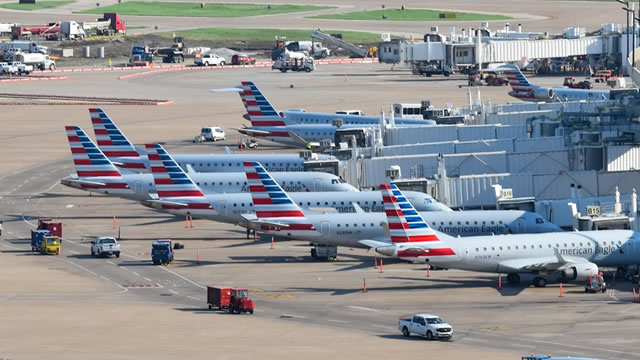
Canada tariffs, McDonald's value push, El Paso airport and more in Morning Squawk
CNBC· 2026-02-12 13:07
Performance Review - The U.S. labor market added 130,000 nonfarm payrolls in January, exceeding the Dow Jones consensus estimate of 55,000 jobs, with the unemployment rate decreasing to 4.3%, the lowest since August [2][6] - Job growth was primarily concentrated in health care-related fields, but annual revisions indicated payroll gains from April 2024 to March 2025 were 898,000 lower than initially reported [6] Tariff Turnover - The House of Representatives voted to overturn President Trump's tariffs on Canada, with a vote of 219-211, reflecting a symbolic rebuke of Trump's economic policy [3][4] - The U.S. generated $30 billion from tariffs in January, marking a more than 300% year-over-year increase, which helped reduce the federal budget deficit [5] Company Performance - McDonald's reported a nearly 7% increase in domestic same-store sales for the fourth quarter, attributed to successful promotions and a focus on value [7][8] - Restaurant Brands International, the parent company of Burger King, also reported better-than-expected fourth-quarter results, with same-store sales outside the U.S. rising 6.1%, surpassing analysts' estimate of 3.7% [9] IPO vs. IOU - Wall Street is currently focused on debt issuance in the tech sector, with a UBS report estimating global tech and AI-related debt issuance could reach $990 billion in 2026, up from $710 billion in 2025 [11][12] - Major companies like Oracle and Alphabet have led corporate debt sales, with Amazon, Meta, and Tesla expected to follow suit [12]

Tech IPO hype gets drowned out on Wall Street by prospect of $1 trillion in debt sales
CNBC· 2026-02-12 13:00
Core Viewpoint - The current focus in tech capital markets is on debt financing rather than equity, driven by significant capital expenditures for AI development among major tech companies [1][3]. Group 1: Debt Financing Trends - The four major tech companies—Alphabet, Amazon, Meta, and Microsoft—are expected to spend nearly $700 billion in 2023 on capital expenditures and finance leases to support AI initiatives [2]. - UBS projects that global tech and AI-related debt issuance, which more than doubled to $710 billion last year, could rise to $990 billion by 2026 [4]. - Morgan Stanley anticipates a $1.5 trillion financing gap for AI development, primarily to be filled by debt as companies move away from self-funding [4]. Group 2: Major Corporate Debt Issuances - Oracle plans to raise between $45 billion and $50 billion in 2023, having already sold $25 billion in high-grade debt [6]. - Alphabet has increased its bond offering to over $30 billion, following a previous $25 billion debt sale [6]. - Amazon has filed for a mixed shelf registration to potentially raise both debt and equity, while Meta is exploring external financing options to enhance cash flow [7]. Group 3: Market Dynamics and Investor Sentiment - The corporate debt market has seen a "monumental" increase, with significant sales from companies like Oracle and Alphabet [5]. - Despite the high demand for tech bonds, there are concerns about the sustainability of this debt influx, as it may lead to higher yields and costs for other borrowers [21][22]. - The concentration of tech companies in corporate bond indexes raises concerns about market stability, with tech now comprising about 9% of investment-grade corporate debt indexes [19]. Group 4: IPO Market Outlook - There have been no notable IPO filings from U.S. tech companies in 2023, with attention focused on potential public offerings from SpaceX, OpenAI, and Anthropic [9][11]. - Analysts expect around 120 IPOs this year, raising approximately $160 billion, a significant increase from the previous year [11]. - The current market conditions are not favorable for venture-backed startups, with volatility and geopolitical concerns keeping many on the sidelines [12].

Restaurant Brands earnings top estimates as international Burger King restaurants fuel sales growth
CNBC· 2026-02-12 11:32
Core Insights - Restaurant Brands International reported strong quarterly earnings and revenue, exceeding expectations due to robust international growth [1][2] Financial Performance - The company reported a fourth-quarter net income of $113 million, or 34 cents per share, down from $259 million, or 79 cents per share, a year earlier [1] - Adjusted earnings were 96 cents per share, slightly above the expected 95 cents [7] - Net sales increased by 7.4% to $2.47 billion, with organic revenue growth of 6.5% after excluding currency fluctuations and refranchising sales [2] Same-Store Sales - Same-store sales rose by 3.1%, driven by strong international performance [2] - Outside the U.S. and Canada, same-store sales increased by 6.1%, with international Burger King restaurants achieving 5.8% growth, surpassing analyst expectations of 3.7% [3] Segment Performance - Tim Hortons reported a same-store sales growth of 2.9%, below the projected 3.8%, contributing 46% to overall revenue [5] - Burger King achieved a same-store sales growth of 2.7%, exceeding the expected 2.4% [5] - Popeyes experienced a decline in same-store sales of 4.8%, worse than the anticipated 2.4% decrease [5] Strategic Initiatives - The company plans to expand its international presence, including a joint venture for Burger King China, where CPE owns approximately 83% and Restaurant Brands retains a 17% stake [4] - To address challenges at Popeyes, the company appointed Burger King veteran Peter Perdue to lead the U.S. and Canadian business and named Matt Rubin as the new chief marketing officer [6] - Further growth strategies will be discussed at the investor day in Miami on February 26 [6]