
Forbes

Search documents
Oscar Telecast Heads To YouTube In 2029, Leaving Broadcast Behind
Forbes· 2025-12-17 20:45
Core Insights - The Oscars will transition to YouTube and YouTube TV starting in 2029, marking a significant shift for the traditional Hollywood awards ceremony [3][4] - This partnership with YouTube is seen as a response to declining viewership and changing media consumption habits, particularly among younger audiences [8][11] - The Academy has expanded its international membership by approximately 40% since the "Oscars So White" protests, reflecting a more diverse and global focus [14] Industry Impact - The move to YouTube is expected to alter the Oscars' direct U.S. reach initially, but YouTube's vast user base of 2.5 to 2.7 billion monthly active users may compensate for this by 2029 [11] - YouTube generated an estimated $36.1 billion in ad revenue last year, indicating its strong position in the advertising market, which could benefit the Oscars [7] - The Academy's decision aligns with its goal to reach international audiences, as Hollywood films increasingly feature global elements [12][13] Viewership Trends - Broadcast viewership has been declining, with the Oscars drawing around 20 million viewers in the most recent ceremony, which is still below pre-pandemic levels [10] - The Golden Globes experienced a significant drop in viewership, attracting only about half of the Oscars' audience, highlighting the challenges faced by traditional award shows [10] - YouTube TV, with approximately 10 million subscribers, is adapting to market demands by offering smaller, cheaper themed bundles, which may attract more viewers to the Oscars [14]



Samsung Expands Its Micro RGB TV Range—All The Way Down To 55 Inches
Forbes· 2025-12-17 20:26
Core Viewpoint - The 2026 CES will prominently feature RGB mini-LED technology, with LG and Samsung leading the charge in launching new Micro RGB TV models, including mainstream sizes like 55 and 65 inches [1][3]. Company Developments - Samsung has expanded its Micro RGB TV range to include five additional screen sizes, making it more accessible to mainstream consumers [1][3]. - The first Micro RGB TV, a 115-inch model, was launched by Samsung in September 2025, priced at $29,999, indicating a premium positioning initially [3][7]. - Samsung representatives expressed confidence that the new mainstream Micro RGB models will be priced similarly to current premium LCD TVs, although specific pricing has not yet been announced [5]. Technology Advancements - Samsung's Micro RGB technology utilizes smaller LEDs (under 100 micrometers), which increases backlight unit density for improved color accuracy and vibrancy compared to competitors [8]. - The Micro RGB light source is paired with enhanced RGB color dimming, claiming to achieve 100% coverage of the BT.2020 color gamut, validated by the VDE Testing and Certification Institute [9]. - The new Micro RGB AI Engine Pro processor enhances frame-by-frame clarity and realism through advanced AI tools [10]. Visual and Audio Features - Samsung's proprietary Glare Free screen technology aims to reduce onscreen reflections, enhancing the viewing experience by preserving color and contrast [11]. - Audio features include Dolby Atmos playback, an Adaptive Sound Pro system, support for the Eclipsa audio spatial sound system, and the Q Symphony feature for synchronized sound with Samsung soundbars [12]. Upcoming Events - Samsung's new Micro RGB TVs will be showcased at CES from January 6-9, with further updates expected as more details are released [13].


Wells Fargo Stock 2026 Outlook
Forbes· 2025-12-17 19:45
Core Insights - Wells Fargo has experienced a significant stock increase of approximately 32% in 2025, indicating a shift from a defensive recovery to a growth phase following the removal of the asset cap and strong earnings performance in Q3 [2][5]. Asset Cap Removal - The Federal Reserve lifted the $1.95 trillion asset cap in June 2025, which had restricted Wells Fargo's balance-sheet growth since 2018 [5]. - With the cap removed, Wells Fargo has adjusted its medium-term Return on Tangible Common Equity (ROCE) target to 17%-18%, up from 15%, reflecting increased confidence in growth potential [5]. Changing Rate Environment - The Federal Open Market Committee cut the federal funds rate by 25 basis points to a range of 3.50%-3.75% in December 2025, marking a shift from a hawkish stance [6]. - Treasury yields have decreased, with the 10-year yield dropping to approximately 4.16% from over 4.40% in June, creating a mixed scenario for banks like Wells Fargo [6]. Impact on Net Interest Income - Wells Fargo is asset-sensitive, meaning declining rates could reduce net interest income by compressing the margin between loan yields and deposit costs [7]. - However, the removal of the asset cap allows Wells Fargo to pursue balance-sheet growth, providing a competitive advantage over peers like JPMorgan [7]. Growth Strategies - The bank is focusing on onboarding substantial commercial operating deposits, which are cheaper and more reliable than wholesale funding, enhancing its funding profile [8]. - Wells Fargo is expanding into higher-yielding loan sectors, such as credit cards and corporate lending, to counterbalance margin pressure from declining rates [8]. Capital Markets and Investment Banking - Lower interest rates and a more predictable economic outlook favor capital markets activity, stimulating mergers and acquisitions, as well as debt and equity issuance [9]. - The removal of the asset cap allows Wells Fargo to rebuild its Investment Banking division and offer financing commitments necessary for competing in significant corporate transactions [9]. Business Focus Areas - The bank aims to re-engage with new and existing commercial clients to expand its low-cost deposit base [11]. - It is also focused on growing its balance sheet to compete effectively in global markets and capital-intensive investment banking activities [11]. - Additionally, Wells Fargo plans to increase loans in critical sectors, including residential mortgages [11].


Comcast Stock (+5.4%): Activist Buzz, Spinoff Fuel Rally
Forbes· 2025-12-17 19:45
Core Insights - Comcast (CMCSA) saw a stock increase of +5.4%, closing at $29.73, driven by significant trading activity in swaps and over-the-counter options, often linked to activist investors [1] - The upcoming spinoff of Comcast's cable networks in early January 2026 is contributing to positive sentiment around the stock [1] - The stock's current valuation is considered depressed, raising questions about whether the recent price movement is due to genuine strategic re-rating or speculative trading [1] Trading Activity - There is a notable institutional presence in the trading dynamics, indicating participation from both long-term investors and event-driven funds [4] - The trading profile suggests accumulation by 'Smart Money', with ongoing buying pressure and sophisticated options activity [6] - Relative Volume (RVOL) reached 89.7 million shares, 178% above the three-month average, with call options making up 86.59% of the overall volume [13] Financial Management - Comcast has declared the redemption of $2.75 billion in notes, showcasing its financial strength and proactive capital management [3] - The company is strategically adjusting its portfolio, indicating a deliberate approach to value creation [3] Future Outlook - The combination of potential activist involvement, strategic portfolio adjustments through the spinoff, and strong institutional backing suggests a robust movement in the stock [8] - The stock is trading at 5 times EBITDA, presenting an attractive risk/reward ratio, with a key resistance level at the $30 mark [8] - A decisive breach above this psychological threshold could lead to further upward movement as short sellers cover their positions [8]


Can SMCI Stock Recover If It Falls Another 30%?
Forbes· 2025-12-17 19:45
Core Insights - Super Micro Computer (SMCI) shares have decreased by 13.1% over the last 21 trading days, indicating a shift in investor interest away from AI-related stocks and highlighting execution risks and margin pressures faced by the company [1] - The stock's recent decline raises questions about whether this weakness is temporary or indicative of deeper issues within the company [1] Company Overview - Super Micro Computer is valued at $19 billion with a revenue of $21 billion, currently priced at $31.66 per share [3] - The company has experienced a revenue growth of 11.9% over the last 12 months, with an operating margin of 4.4% [3] - The liquidity position shows a Debt to Equity ratio of 0.17 and a Cash to Assets ratio of 0.29 [3] Valuation Metrics - The stock is currently trading at a P/E ratio of 36.0 and a P/EBIT ratio of 28.9, indicating a moderate valuation [8] - Historically, the stock has offered a median return of 30.9% within a year following sharp declines since 2010 [8] Downturn Resilience - If SMCI stock were to dip another 20-30% to $22, it has been noted that the stock has experienced a slightly worse impact than the S&P 500 index during various economic downturns [5] - The stock fell 34.5% from a peak of $35.33 on August 7, 2023, to $23.15 on September 21, 2023, compared to a peak-to-trough drop of 25.4% for the S&P 500 [9] - Historical performance shows that the stock has fully regained its pre-Crisis peak after significant declines, including a 45.8% drop during the 2020 Covid Pandemic and a 59.6% drop from 2017 to 2018 [10][11] Investment Strategy - A well-diversified portfolio is recommended to mitigate risks and seize growth opportunities, as individual stock choices can be unpredictable [12] - The Trefis High Quality (HQ) Portfolio, which includes 30 different stocks, has consistently outperformed its benchmark indices, delivering superior returns with reduced risk [13]


Should You Be Cautious About Intel Stock?
Forbes· 2025-12-17 19:45
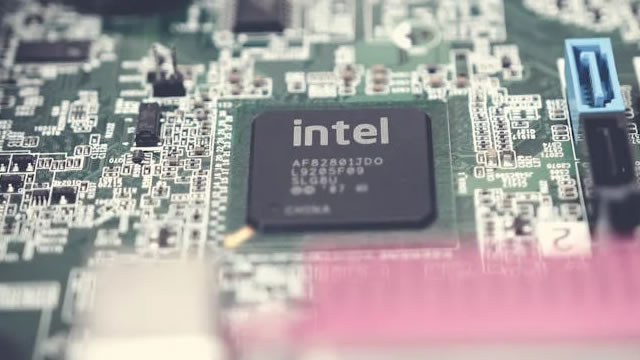
Core Viewpoint - The overall outlook on Intel Corporation (INTC) stock is negative, with a recommendation to sell, as operational performance and financial standings are weak, despite a moderate valuation [1][3]. Valuation - Intel's valuation appears moderate compared to the broader market, indicating that the stock may not be accurately priced given its underlying performance issues [6]. Growth - Intel's top line has contracted at an average rate of -7.6% over the past three years, with revenues decreasing by 1.5% from $54 billion to $53 billion in the last 12 months [8]. - Quarterly revenues increased by 2.8% to $14 billion in the most recent quarter compared to $13 billion a year ago [8]. Profitability - The operating income for Intel over the last 12 months was -$104 million, resulting in an operating margin of -0.2% [9]. - The company generated nearly $8.6 billion in operating cash flow during this timeframe, with a cash flow margin of 16.0% [9]. - Intel produced approximately $198 million in net income, indicating a net margin of about 0.4% [9]. Financial Stability - As of the latest quarter, Intel's debt stood at $47 billion, with a market cap of $168 billion, resulting in a debt-to-equity ratio of 30.7% [10]. - Intel's cash (including equivalents) constitutes $31 billion of $205 billion in total assets, yielding a cash-to-assets ratio of 15.1% [10]. Downturn Resilience - Intel has underperformed compared to the S&P 500 index during various economic downturns, indicating vulnerability to market fluctuations [11]. - The stock has experienced significant declines during past crises, including a 63.3% drop from a peak of $68.26 on April 9, 2021, to $25.04 on October 11, 2022 [13].

ServiceNow: Buy The Dip In NOW Stock?
Forbes· 2025-12-17 19:45
Core Viewpoint - ServiceNow's stock dropped 11% following the announcement of a $7 billion acquisition of Armis, leading to analyst downgrades and investor concerns [2][3] Valuation and Performance - ServiceNow's current stock price of approximately $780 is considered appealing, but its high valuation makes it sensitive to negative surprises, presenting a challenging entry point [3] - The company's price-to-sales (P/S) ratio is 15.2 compared to 3.2 for the S&P 500, and its price-to-earnings (P/E) ratio stands at 111.4 versus 23.5 for the benchmark [11] - ServiceNow's revenues have grown significantly, with a 21.1% increase from $10 billion to $13 billion over the last 12 months, compared to 6.0% growth for the S&P 500 [11] - The operating income for the last four quarters totaled $1.8 billion, resulting in an operating margin of 13.9%, which is lower than the S&P 500's 18.8% [11] Financial Strength - ServiceNow's balance sheet is strong, with a debt of $2.4 billion and a market capitalization of $162 billion, leading to a low debt-to-equity ratio of 1.2% compared to 21.2% for the S&P 500 [11] - The company has a cash-to-assets ratio of 24.8%, significantly higher than the S&P 500's 6.9%, indicating strong liquidity [11] Growth and Profitability - ServiceNow's average revenue growth rate over the past three years is 22.3%, outperforming the S&P 500's 5.5% [11] - The company's profit margins are above most companies in the Trefis coverage universe, reflecting strong profitability [8] Resilience During Downturns - ServiceNow's stock has shown slightly better performance than the S&P 500 during recent downturns, indicating moderate resilience [10] - The overall assessment of ServiceNow's performance across key metrics is categorized as "Very Strong" for growth and financial stability, and "Strong" for profitability [15]


Buy PG Stock Over Colgate-Palmolive?
Forbes· 2025-12-17 19:45
Core Viewpoint - Procter & Gamble (P&G) stock is currently viewed favorably, especially in comparison to its competitor Colgate-Palmolive (CL), despite both companies experiencing a decline of approximately 12% year-to-date, while the S&P 500 has increased by 16% [2][3]. Financial Performance Comparison - P&G's recent quarterly revenue growth was 3.0%, significantly higher than CL's 1.0% [4]. - On a trailing twelve-month basis, P&G's revenue growth stands at 1.2%, compared to CL's 0.1% [4]. - P&G demonstrates superior profitability with a last twelve-month operating margin of 24.1% and a three-year average margin of 23.6%, both of which exceed CL's corresponding figures [4]. Investment Strategy Insights - For investors seeking potential gains with reduced volatility, a High Quality Portfolio is recommended, which has consistently outperformed its benchmark, yielding returns exceeding 105% since its launch [5]. - The performance metrics of the High Quality Portfolio illustrate that it has generated better returns with less risk compared to the benchmark index [5].



The Case For Buying Visa Stock Today
Forbes· 2025-12-17 19:45
Core Viewpoint - Visa (V) stock is considered a strong buying opportunity due to high margins and cash generation ability at a discounted price, indicating consistent and predictable profits which lower risk and allow for capital reinvestment [1] Company Performance - Visa's stock has increased by 10% year-to-date but is 35% cheaper based on its Price-to-Sales (P/S) ratio compared to one year ago [3] - Visa's Q4 2025 results showed steady global transaction growth, with cross-border volumes up 12% and processed transactions increasing by 10% [4] - A 25% increase in value-added services supports Visa's fee-based revenue model, and partnerships like Orange Money and USDC stablecoin settlement are expanding its network [5] - Management anticipates continued low double-digit revenue growth for fiscal year 2026 [5] Financial Fundamentals - Visa has strong fundamentals, with an operating cash flow margin of nearly 57.6% and an operating margin of 66.4% for the last twelve months [11] - Long-term profitability averages show approximately 58.9% operating cash flow margin and 66.8% operating margin over the last three years [11] - Revenue growth for Visa was 11.3% for the last twelve months and 10.9% over the last three years, although it is not classified as a growth story [11] - The stock is currently available at a P/S multiple of 11.0, representing a 35% discount compared to one year ago [11] Investment Criteria - Visa meets several investment criteria, including a market cap exceeding $10 billion, high cash flow from operations margins, and a significant decline in valuation over the past year [12] - The average 12-month forward returns for stocks meeting these criteria are nearly 19%, with a win rate of about 72% [12]


Can Coinbase Stock Rally From 250?
Forbes· 2025-12-17 19:45
Core Insights - Coinbase stock is currently trading within a support zone of $237.90 to $262.94, where it has historically rebounded, achieving an average peak return of 38.7% after four instances of buying interest at this level [2] Financial Performance - Coinbase's Q3 2025 results showed strong revenue and profits, enhancing its financial position [4] - The company reported a revenue growth of 48.6% over the last twelve months (LTM) and an average growth of 23.3% over the past three years [10] - The free cash flow margin is approximately 25.8%, and the operating margin is 27.0% LTM [10] Market Conditions and Strategic Moves - The strategic entry into tokenized stocks and prediction markets starting December 17 aims to diversify revenue beyond volatile spot trading [4] - Analyst consensus leans towards a "Buy" rating, indicating considerable upside potential despite recent downgrades and revenue concerns for Q4 [4] Valuation and Risks - Coinbase stock trades at a price-to-earnings (PE) multiple of 30.1, reflecting varied valuation indicators [10] - The stock is susceptible to sharp sell-offs, having previously declined 91% during the Inflation Shock, highlighting its vulnerability during market upheavals [6]

