a16z

Search documents
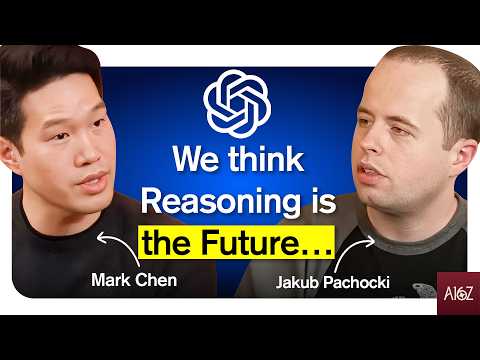
From Vibe Coding to Vibe Researching: OpenAI’s Mark Chen and Jakub Pachocki
a16z· 2025-09-25 13:00
Research & Development Focus - OpenAI is targeting the production of an automated researcher to automate the discovery of new ideas, with a focus on economically relevant advancements [1][3] - The company is extending the reasoning horizon of models, aiming for them to autonomously operate for longer periods, measured by performance in math and programming competitions [3] - OpenAI is working on improving the ability of models to handle more difficult and messy real-world coding environments, focusing on style, proactivity, and latency [12][13] Model Capabilities & Advancements - GPT-5 aims to bring reasoning into the mainstream, improving upon previous models like O3 by delivering reasoning and more agentic behavior by default [1] - The company observed significant progress in models' ability to solve hard science problems, with instances of discovering non-trivial new mathematics [1] - Reinforcement Learning (RL) continues to be a versatile method for continuous improvements, especially when combined with natural language modeling [4][5] Talent & Culture - OpenAI emphasizes fundamental research and innovation, discouraging copying and fostering a culture where researchers are inspired to discover new things [35][36] - The company looks for individuals who have solved hard problems in any field, possessing strong technical fundamentals and the intent to work on ambitious challenges [40] - OpenAI protects fundamental research by delineating researchers focused on algorithmic advances from those focused on product, ensuring space for long-term research questions [46][57] Resource Allocation & Strategy - OpenAI prioritizes core algorithmic advances over product research in compute allocation, but remains flexible to adapt to changing needs [59] - The company believes compute remains a critical resource for advancing AI, not expecting to be data-constrained anytime soon [62][63] - OpenAI acts from a place of strong belief in its long-term research program, not tying it too closely to short-term product reception [70]

Ben Horowitz on Passion: "Don't follow your passion, follow your contribution.
a16z· 2025-09-24 22:03
Don't follow your passion. What you take out of the world over time is much less important than what you put into the world. And so my recommendation would be follow your contribution.Find the thing that you're great at. Put that into the world. Contribute to others.Help the world be better. Think for yourself. And that is the thing to. ...

Mark Cuban on AI
a16z· 2025-09-22 16:49
AI Talent & Business Acumen - AI native individuals are in high demand [1] - A business background combined with AI skills is highly valuable for small companies [1] - Individuals with both business knowledge and AI expertise can offer significant assistance to companies [1]

Write Things Down
a16z· 2025-09-18 18:29
The person who writes down the thing has tremendous power independent of their actual formal role in an organization or in the world. There are so few people who will write down the thing. We see this at companies all the time which is one of the ways you find like the upandcomers at a tech company.It's like, okay, who wrote down the. ...
The Little Tech Agenda for AI
a16z· 2025-09-08 13:01
There have been these big institutional players in DC in the state capitals for a very long time. There wasn't anyone who was actually advocating on behalf of the startups and entrepreneurs, the smaller builders in the space. They're trying to build models that might compete with Microsoft or OpenAI or Meta or Google for those companies.What are the regulatory frameworks that would actually work for them as opposed to making that competition even more difficult than it already is. Regulate use, do not regul ...

The Top 100 Most Used AI Apps in 2025
a16z· 2025-08-27 13:00
Consumer AI Trends - The consumer AI list tracks real-world AI usage by analyzing website traffic (monthly visits globally) and mobile app usage (monthly active users) [1] - Companionship continues to dominate the consumer AI space, with new names like Juicy Chat, Joy, and Rream joining established players [1] - Vibe coding is a rising trend, with companies like Lovable and Replit gaining traction and showing strong revenue retention (100% or above in the first 3 months for many leading platforms) [1][2] - Chinese AI companies are making a significant impact, both with products for the domestic market (e.g., Cork, Dow Bow, Kimmy) and those built for international users (e.g., Deepseek, Hyo, Cling, Cart) [2] - Some Chinese companies are distributing their models through US properties like Crea or Hedra [2] Google's Performance - Google had a strong six months, with four unique properties making the web list: Gemini (number two with about 10% of ChatGPT's web traffic, but closer on mobile at half of ChatGPT's traffic), AI Studio (top 10), Notebook LM (number 13), and Google Labs (number 39) [1] - Google's AI Studio, a developer-facing sandbox, surprisingly hit the top 10 [1] - Google Labs includes V3, a new video model, and other products like Doppel and Project Mariner [1] All-Star Companies - 14 companies have made the list every time over the past 2 years, including ChatGPT, Perplexity, PO (general LLM assistants); Character AI (companionship); Midjourney, Photo Room, Leonardo Cutout Pro, V, 11 Labs (creative tools); Quillbot, Gamma (productivity); and Hugging Face, Civid AI (model hosting) [3] - Over half of the "all-star" companies host or use other people's models or are model aggregators, highlighting the importance of UI and product experience [3] Future Predictions - The industry expects verticalization of AI products, with users choosing different tools for specific tasks [10] - Productivity-focused "prosumer" tools are expected to explode in usage as model reliability and UI improve [14][15] - Emerging categories to watch include edtech, personal finance, and AI-native social platforms [18][19][20]

Can AI Fix Housing and Healthcare Affordability?
a16z· 2025-08-21 13:00
Housing Market & Affordability - The US is short approximately 5 million housing units, requiring an additional 18% to 2 million units per year to prevent the shortage from worsening [1][12] - Technology can counter cost inflation in the housing sector, which historically has underinvested in tech compared to other industries [28] - AI-driven automation can significantly reduce labor costs, a major controllable expense for housing operators [29] - AI is helping to increase housing supply in areas that have relaxed zoning regulations [19][20] Elise AI's Solutions & Impact - Elise AI aims to enable fully autonomous buildings, where core operations run without human intervention [1][31] - Buildings using Elise AI have demonstrated 2% higher occupancy rates compared to the market average [15] - Elise AI's technology has helped customers like Equity Residential achieve up to 200 units per employee through centralized staff and AI communication [30] - Elise AI is expanding its AI solutions from housing to healthcare, focusing on automating administrative tasks and improving patient engagement [74][76] Future Vision - The ultimate vision is to reduce the percentage of household income spent on housing and healthcare from 42% to around 20% [3][96] - AI can facilitate greater mobility in the housing market by enabling shorter-term leases and reducing the labor required for apartment turnover [55][57]

Dylan Patel on GPT-5’s Router Moment, GPUs vs TPUs, Monetization
a16z· 2025-08-18 18:26
AI Chip Market & Competition - NVIDIA maintains a significant lead in the AI hardware race, making it difficult for competitors to simply copy their approach [1] - Custom silicon development by companies like Google, Amazon, and Meta has the potential to reshape the AI chip market [1] - The rise of AI silicon startups presents both opportunities and challenges in the competitive landscape [1] AI Model Economics & Infrastructure - The economics of launching AI models are shifting towards cost efficiency [1] - Infrastructure bottlenecks, including power and cooling, pose significant challenges for data centers [1] Geopolitics & Policy - Export controls and China's AI ambitions play a crucial role in the geopolitics of the chip race [1] Strategic Advice for Tech Leaders - The discussion provides advice for leaders at NVIDIA, Google, Meta, Apple, Microsoft, and OpenAI regarding their next moves in the AI landscape [1]


Google DeepMind Lead Researchers on Genie 3 & the Future of World-Building
a16z· 2025-08-16 17:19
All of the applications basically stem from the ability to generate a world that that just just from a few words. You look at it and like there's a world, you know, that's generated in front of your eyes and it's amazing that it's happening. I was very excited about how far can can can we push that and it's at the point where like a human who is not an expert like will watch it and think it looks real, right.And I think that's pretty incredible. Jack Schlomi, uh, GD3 has taken over the internet. Uh, we're h ...

The State of American AI Policy: From ‘Pause AI’ to ‘Build’
a16z· 2025-08-15 13:00
AI 监管与政策 - 行业共识转变:整个行业逐渐意识到需要对 AI 进行合理监管,保持行业健康发展 [1] - 政策制定需谨慎:政策制定者应充分了解技术,避免仓促立法,对创新造成阻碍 [1] - 监管应适度:在 AI 技术发展初期就进行严格监管可能会扼杀创新,应在技术成熟后再决定如何监管 [1] - 行动计划的意义:美国政府的 AI 行动计划标志着一种转变,即在 AI 发展中纳入技术专家的意见 [4] 开源 AI 的讨论与转变 - 开源 AI 的争议:早期对开源 AI 的批评主要集中在潜在风险上,例如可能被用于制造生物武器 [2] - 行业态度的转变:随着中国在 AI 模型方面的快速发展,行业对开源 AI 的态度发生了转变,意识到限制开源可能会阻碍创新 [1] - 开源 AI 的商业模式:开源 AI 逐渐被视为一种可行的商业策略,尤其是在满足政府和传统行业对安全和控制的需求方面 [5] AI 风险与机遇 - AI 发展需平衡风险与机遇:在关注 AI 潜在风险的同时,也应充分认识到 AI 在科学发现和解决全球性问题方面的巨大潜力 [7][8] - 评估 AI 风险需谨慎:在评估 AI 风险时,应基于科学依据,避免夸大风险,并借鉴以往技术发展的经验 [3] - 避免过度监管:不应因对 AI 系统缺乏完全理解而阻止其部署,而应通过教育、测试等方式来管理风险,充分利用 AI 的价值 [12]