a16z

Search documents
He Built a $3B+ Company. This is his next BIG IDEA.
a16z· 2025-12-10 15:57
Company Overview & Strategy - Jonathan Swanson built Thumbtack, a home-services marketplace, and Athena, a fast-growing platform that pairs ambitious people with world-class personal assistants [1] - Jonathan Swanson runs a 4,000-person company, invests, and raises four kids by designing his life around leverage [1] - The discussion revolves around work, life, and systems that enable people to operate at scale [1] Delegation & Productivity - The conversation explores how elite assistant culture shaped Jonathan Swanson's philosophy and why delegation is a skill most founders never truly learn [1] - The report highlights the combination of humans and AI in redefining personal productivity [1] - Jonathan Swanson believes ambition grows with leverage and delegates everything from scheduling to search processes to entire life systems [1] - The report touches on the future of work, the rise of machine-generated delegation, and the expanding role of chiefs of staff [1] Talent & Team Management - The discussion includes global talent and scaling teams [1] - The report covers hiring and managing executives [1] - The report also covers co-founder dynamics and taking the leap [1] Future Trends - The future of Athena is discussed, along with final advice [1]

The Chip That Could Unlock AGI
a16z· 2025-12-08 15:05
Unconventional AI's Vision - Unconventional AI aims to revolutionize computing by drawing inspiration from the brain's efficiency, targeting AI ubiquity [1, 40, 41] - The company is focusing on analog computing to achieve greater efficiency compared to digital systems, especially for AI workloads [4, 9, 15] - The company's goal is to find a paradigm analogous to intelligence within five years and build a scalable solution for manufacturing [34, 35] Technological Approach - Unconventional AI is exploring energy-based models, diffusion models, and flow models due to their inherent dynamics [26] - The company is building a mixed-signal chip, potentially one of the largest analog chips ever built, for its first prototype [48, 50] - The company plans to release open-source resources to encourage experimentation and collaboration [27] Industry Perspective - The increasing energy consumption of data centers, currently using 4% of the US energy grid, is a major concern, potentially rising to 8%-10% [16] - The industry faces a potential shortfall of 400 gigawatts of additional capacity over the next 10 years to meet AI demand [17] - TSMC is considered a key partner, while collaboration with Nvidia and Google remains a possibility [36, 37, 38] Company Strategy - Unconventional AI is building a practical research lab environment, encouraging exploration and innovation without premature manufacturing constraints [56, 57] - The company seeks individuals skilled in mapping algorithms to physical substrates, energy-based models, dynamical systems, and analog/digital circuit design [47, 48] - The company emphasizes agency and empowerment for its team members, fostering a culture of ownership and learning from both successes and failures [59, 60]

Ben Horowitz on a Founding Team
a16z· 2025-12-06 15:00
An ideal founding team is usually two people and the two people are of two different types. So one you need an inventor and it's the inventor's job to build the product that's 10 times better than any other product available to solve that problem and then you need an entrepreneur and the entrepreneur's [music] job is to take the market. And so the best thing to do is have two people who know how to do both, but at least one person who's world class in each. ...

Marc Andreessen on Timing
a16z· 2025-12-04 23:26
The great founders almost always feel like you're too late and you're almost always too early. [music] For you, it's become obvious. As far as you're concerned, the world should already work this way, which is why you're pursuing it.The reality is you're almost always too early. We almost never see a qualified founder fail cuz they're too late to market. It's almost always cuz they're too early to market.The iPad is like this breakthrough product in 2009 and every, you know, Apple, oh my god, they invent al ...


Why AI Moats Still Matter (And How They've Changed)
a16z· 2025-12-03 14:01
Moats and Defensibility in the AI Era - Moats still matter, and largely remain the same, focusing on differentiation and defensibility [3][5] - AI is an incredible tool for differentiation, but the AI itself is not necessarily a source of defensibility [4][6] - Defensibility resides in owning the end workflow, becoming the system of record, having a network effect, and deeply embedding within the customer [7] - Data network effects become apparent at large scale, requiring mega-scale to be evident [8] Software and Market Dynamics - The market opportunity for software is shifting from IT spend to labor, as software can now perform tasks previously done by humans [1][7] - The barrier to creating software has decreased dramatically, leading to more supply [3][22] - Incumbents overshoot the market with excessive features, creating opportunities for new entrants [18][19] - Per-seat pricing models are being challenged as AI reduces the need for as many seats, potentially shifting to per-outcome pricing [14][15][16] Green Field Opportunities and New Company Creation - Green field opportunities require patient entrepreneurs and a high rate of new company creation [27][34][35] - Companies in the "Goldilock zone" of irrelevance, like payroll companies, are hard to displace [26][28][29] - The messy inbox problem, where AI extracts data from unstructured sources, creates a wedge for new companies to disrupt existing workflows [102][103] OpenAI and the Future of AI - It is unrealistic to believe that OpenAI will build applications for every market [59] - Part of the product value is orchestrating work across different model companies [60] - OpenAI should focus on being the backend platform for developers and building large consumer brands [74][79][80]

The $700 Billion AI Productivity Problem No One's Talking About
a16z· 2025-12-01 18:35
Russ Fradin sold his first company for $300M. He’s back in the arena with Larridin, helping companies measure just how successful their AI actually is. In this episode, Russ sits down with a16z General Partner Alex Rampell to reveal why the measurement infrastructure that unlocked internet advertising's trillion-dollar boom is exactly what's missing from AI, why your most productive employees are hiding their AI usage from management, and the uncomfortable truth that companies desperately buying AI tools ha ...
The Secret Marketing Strategy That Built a16z: From Zero to Legendary VC Firm
a16z· 2025-11-26 14:01
I cause a lot of antagonism between us and the other firms in those days. >> Your filter is like you're going to get the deal or I'm going to get the deal. You die or I die. >> And they're not exactly shrinking ballots themselves. >> They hated that cover story. Look at him on the cover of the magazine. That's not supposed to be him. Not supposed to be the entrepreneur. What the hell? D. I mean, they just like we didn't have any entrepreneurs at the time. >> VC was like a big secret. And then actually build ...
Marc Andreessen on "the clip"
a16z· 2025-11-18 01:37
Content Consumption Trends - Clips are the primary method for content consumption [1] - Sports games generate approximately 5 to 8 clips that often go viral [1] - Clips commonly achieve distribution that is 1000 times greater than the original content [1]

Sam Altman on Sora 2
a16z· 2025-11-14 18:46
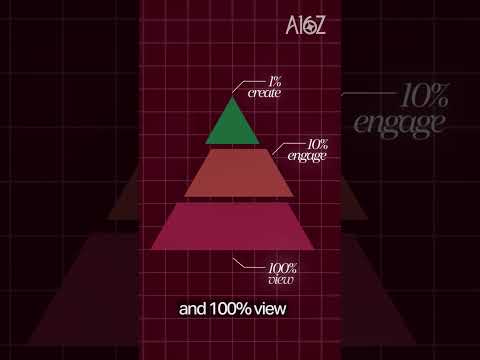
Cuz videos are expensive to me. For people that are doing that like hundreds of times a day, the traditional naive thing that it's like 1% of users create content, 10% leave comments, and 100% view. Maybe a lot more want to create content, but it's just been harder to do.I think that's a very cool. ...
The Brutal Truth About Biotech: Why $2B Per Drug Is Killing Innovation
a16z· 2025-11-14 16:08
Industry Challenges & Opportunities - Biotech industry faces record lows and structural challenges [1] - Technology progress is disconnected from market reality [1] - Drug development costs are exploding, reaching $25 亿 (2.5 billion) per approval [1] - The industry needs to invent medicines impossible to make with current tools [1] Competitive Landscape - China's investigator-initiated trials offer speed and cost advantages [1] - Geographic arbitrage in China is rewriting the competitive playbook [1] - The industry is exploring how to compete with China by inventing new technologies [1] Innovation & Future Trends - AI in drug development aims to reduce the cost of a $25 亿 (2.5 billion) drug to $5 亿 (500 million) [1] - The industry is focusing on treating aging before fully understanding it [1] - The next iconic biotechs will likely rebundle the stack [1]