LENOVO GROUP(00992)

Search documents
联想集团宣布“中小企业生态朋友圈”再次“扩列”
Huan Qiu Wang· 2026-02-06 08:45
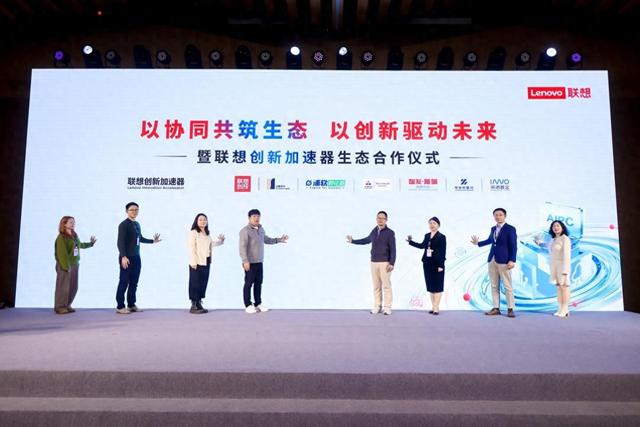
Core Viewpoint - Lenovo Group has expanded its "SME Ecosystem Circle" through a collaboration with various investment and innovation partners to support small and medium enterprises (SMEs) in transitioning from "laboratory workbenches" to "billion-level markets" [1][3] Group 1 - The Lenovo Innovation Accelerator, originally launched in 2022, has grown its ecosystem to over 2,500 members and established strategic partnerships with local governments, large enterprises, and investment institutions [3] - In the previous fiscal year, Lenovo and its member companies generated a collaborative revenue of 1.5 billion yuan [3] - Lenovo has engaged in business collaborations with nearly 100 member companies, resulting in the delivery of over 60 Proof of Concept (PoC) projects [3] Group 2 - The recent event featured a theme of "Building Ecosystems through Collaboration and Driving the Future with Innovation," highlighting the commitment to support SMEs [1] - Lenovo has signed a memorandum of industrial ecological cooperation with Hangzhou's Shangcheng District to explore mechanisms for policy and industry collaboration [3] - The partnership with Pusong Incubator aims to enhance support for SMEs along the industrial chain, accelerating the implementation of Lenovo's dual empowerment system [3]

联想举办首届创新加速器开放日 “中小企业朋友圈”再次扩容
Zheng Quan Ri Bao Wang· 2026-02-05 13:18
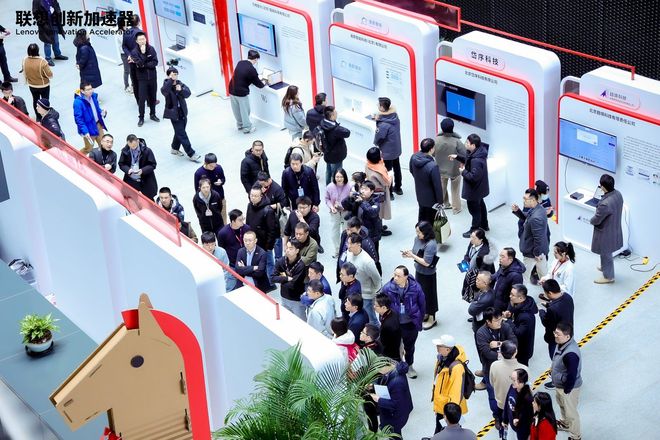
Group 1 - Lenovo Group held its first Innovation Accelerator Open Day and "New Business Innovation Ecosystem Roadshow," attracting over 100 innovative projects and showcasing 23 representative companies in AI computing power, core components, and software-hardware applications [1] - Over the past three years, the Innovation Accelerator has attracted more than 400 innovative projects, facilitated nearly 100 ecosystem connections, and helped over 60 projects complete Proof of Concept (PoC) validation, with nearly 20 projects achieving commercialization and capital connection [1] Group 2 - The Innovation Accelerator responds to national policies by addressing the pain points of technology-driven SMEs in areas such as technology iteration, market access, and resource integration, promoting AI industry integration and inclusivity [2] - Lenovo has established an ecosystem membership system covering over 2,500 enterprises, with collaborative revenue exceeding 1.5 billion yuan, and aims to connect more internal resources and external partners to accelerate the growth of SMEs [2][3] Group 3 - Lenovo Venture Capital has recommended over 30 invested companies to participate in the Innovation Accelerator, aiming to increase this proportion to 50% in the future, thereby providing more excellent enterprises with support from Lenovo's capital and industry [3] - A roundtable forum discussed the deep integration of business, capital, technology, and supply chains, emphasizing the need for collaboration to build an open and resilient "innovation community" [3] Group 4 - SMEs play a crucial role in technological innovation in China, but face obstacles in their growth, particularly in the current phase where AI technology is transitioning from laboratories to real-world applications [4] - Lenovo aims to empower SMEs by assisting in early exploratory research and facilitating the transformation of laboratory technologies into market-ready products through its flexible production lines [4][5] Group 5 - The Innovation Accelerator has produced notable collaboration cases, such as the development of a three-in-one pressure touchpad solution with Titanium Technology and the introduction of a directional sound technology into Lenovo's PC hardware ecosystem [5] - The Open Day event gathered various stakeholders to inject new momentum into the sustainable development of the industrial ecosystem, helping SMEs transition from "laboratory workbenches" to "hundred billion markets" [5]
联想中小企业朋友圈再次“扩列”
3 6 Ke· 2026-02-05 13:02
Core Insights - Lenovo Group hosted its first Innovation Accelerator Open Day on February 5, showcasing over 100 innovative projects and 23 representative companies in AI computing, core components, and software-hardware applications [1][3] - The Innovation Accelerator has achieved significant results over the past three years, attracting over 400 innovative projects, facilitating nearly 100 ecosystem connections, and helping around 20 projects achieve commercialization [3][6] - The event highlighted nine top companies that will receive opportunities for million-level PoC projects and priority cooperation with Lenovo's factories [3][5] Group 1: Event Overview - The Innovation Accelerator Open Day featured discussions on hard technology investment, AI industry integration, and the importance of open collaborative ecosystems for sustainable growth [5][6] - Lenovo's Innovation Accelerator has built an ecosystem membership system covering over 2,500 companies and established strategic partnerships with various governments and leading enterprises [6][19] - The event included a collaboration ceremony with multiple institutions to inject new momentum into the sustainable development of the industrial ecosystem [19][21] Group 2: Strategic Goals and Achievements - Lenovo aims to empower small and medium-sized enterprises (SMEs) by addressing their pain points in technology iteration, market access, and resource integration [6][16] - The Innovation Accelerator has evolved from the "Star Plan for Startups" initiated in 2022, expanding its services to create a comprehensive empowerment system for SMEs [16][17] - Lenovo's collaboration with various partners has led to the development of innovative products, such as a three-in-one pressure touchpad and a directional sound technology for PCs [17][19] Group 3: Future Outlook - Lenovo plans to leverage its innovative product matrix, technological advantages, and global supply chain to support the resilient growth of its partners [21] - The company emphasizes the importance of open integration and mutual empowerment in building a robust innovation community [21]
AI是否存在泡沫、成本压力挑战几何?联想业绩将是重要风向标
Ge Long Hui· 2026-02-05 09:07
Core Insights - The global AI industry is undergoing a critical transition, with generative AI technology creating a complete value chain from upstream computing power to downstream applications, leading to a market capitalization exceeding one trillion for nine companies by February 4, 2026 [1] - Investors are increasingly focused on the commercial viability of AI, shifting from "technological possibilities" to "business certainties," as evidenced by recent earnings reports from major companies like Nvidia, AMD, Microsoft, Meta, and Google [2] - Lenovo is positioned as a key player in the AI value chain, serving as a critical link between computing power, models, and physical AI applications, making its performance a barometer for AI investment sustainability [3][5] Industry Dynamics - The AI industry is evolving from a training-driven phase to one focused on inference and deployment, with terminal devices, edge computing, and solution services becoming the forefront of value realization [3][12] - The importance of the entry and deployment layer has increased significantly, as it addresses the practical questions of who is using AI and whether they are willing to pay for it [5][11] - The shift in focus from cloud data centers to on-site enterprise and edge nodes indicates a change in business logic, emphasizing the need for cost-effective AI delivery closer to users [5][11] Lenovo's Strategic Importance - Lenovo's role as a "physical world AI integrator" distinguishes it from other AI companies, as it does not compete directly in model capabilities but instead focuses on delivering scalable products and solutions that make AI accessible [6][11] - The company's mixed AI strategy, which spans both consumer and enterprise segments, is seen as a critical indicator of AI's transition from concept to large-scale implementation [6][9] - Investors are particularly interested in whether Lenovo's financial results can validate its long-term strategy and whether its AI initiatives are translating into sustainable revenue streams [8][9] Market Expectations - Investors are looking for Lenovo's Q3 FY25/26 results to provide insights into the company's ability to convert its AI strategy into verifiable financial outcomes, beyond just seasonal revenue fluctuations [8][9] - Key areas of focus include the scalability of edge AI and hybrid AI revenue sources, the profitability of server and infrastructure business, and the company's ability to maintain margins amid rising component costs [9][12] - The performance of Lenovo's earnings report is expected to serve as a significant benchmark for assessing the maturity of AI commercialization within the broader industry [12]
联想申请数据处理方法及系统专利,确定满足物料齐套问题对应生产目标的目标解
Jin Rong Jie· 2026-02-05 05:42
Core Insights - Lenovo (Beijing) Co., Ltd. has applied for a patent titled "Data Processing Method and System," with publication number CN121457698A, filed on October 2025 [1] - The patent describes a method for addressing material availability issues through a bipartite graph, involving the segmentation of variable and constraint nodes to derive global feature information [1] Company Overview - Lenovo (Beijing) Co., Ltd. was established in 1992 and is located in Beijing, primarily engaged in the manufacturing of computers, communications, and other electronic devices [1] - The company has a registered capital of 565 million HKD and has invested in 108 enterprises, participated in 5,000 bidding projects, and holds 1,743 trademark records and 5,000 patent records [1]
联想集团获摩根大通增持5,477.26万股普通股股份 价值约4.94亿港元
Ge Long Hui· 2026-02-05 04:13
Core Viewpoint - JPMorgan Chase & Co. has increased its stake in Lenovo Group by acquiring 54.77 million shares, raising its ownership percentage from 6.90% to 7.35% [1] Group 1: Share Acquisition Details - The acquisition occurred on January 29, with JPMorgan purchasing shares at an average price of HKD 9.0212 per share in the market and HKD 9.036 per share off-market [1] - The total value of the shares acquired amounts to approximately HKD 494 million [1] - Following the acquisition, JPMorgan's total shareholding in Lenovo Group now stands at 912 million shares [1]
2025年全球平板市场继续复苏:联想增速最快高达36.2%
Ge Long Hui· 2026-02-05 04:06
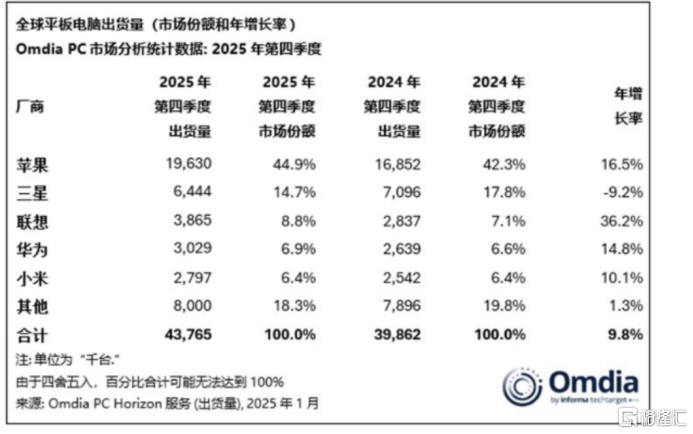
Core Viewpoint - The global tablet market is expected to see a year-on-year shipment growth of 9.8% in 2025, reaching 162 million units, with Apple and Samsung maintaining the top two positions, collectively holding about 55% market share [1]. Group 1: Market Performance - In Q4 2025, global tablet shipments reached 43.765 million units, supported by strong performance from Apple's iPad Air and iPad Pro series, which saw shipments of 19.63 million units, a year-on-year increase of 16.5%, capturing a market share of 42.3% [2]. - Samsung's shipments amounted to 6.44 million units in Q4 2025, reflecting a year-on-year decline of 9.2%, yet it maintained a market share of 17.8%, leading over Huawei, Xiaomi, and Lenovo [3]. - Lenovo exhibited the fastest growth among major manufacturers, with shipments of 3.865 million units, a year-on-year increase of 36.2%, achieving a market share of 7.1% [5]. Group 2: Market Dynamics - Lenovo's rapid growth is attributed to proactive inventory strategies implemented before price increases in memory components [6]. - The tablet market in 2025 achieved its highest annual shipment volume since the pandemic-driven demand peak in 2020, bolstered by seasonal holiday demand and preemptive stocking by manufacturers in anticipation of memory supply constraints [6]. - Manufacturers are advised to carefully balance competitiveness and profitability, as potential disruptions in the memory market could affect supply availability and increase prices, with growth opportunities becoming more limited, primarily focused on high-end models in developed markets and education demand in emerging markets [6].

联想集团(00992.HK)获摩根大通增持5477.26万股
Ge Long Hui· 2026-02-04 13:56
Group 1 - JPMorgan Chase & Co. increased its stake in Lenovo Group (00992.HK) by acquiring 54.77 million shares at an average price of HKD 9.0212 per share, totaling approximately HKD 494 million [1] - Following the acquisition, JPMorgan's total holdings in Lenovo rose to 911,794,651 shares, increasing its ownership percentage from 6.90% to 7.35% [1]

联想申请信息处理方法专利,实现不同维度特征向语言模型的有效输入
Jin Rong Jie· 2026-02-04 11:38
Group 1 - Lenovo (Beijing) Co., Ltd. has applied for a patent titled "An Information Processing Method, Module Determination Method, and Information Processing Device," with publication number CN121457525A, and the application date is October 2025 [1] - The patent abstract reveals a method that includes obtaining a first input feature, which can be one of text, image, video, or audio features, with dimensions differing from the first language model [1] - The method involves converting the first input feature into first probability information, which represents the probability distribution of vectors in a predefined vector set, and then determining a second input feature based on this probability information [1] Group 2 - Lenovo (Beijing) Co., Ltd. was established in 1992 and is located in Beijing, primarily engaged in the manufacturing of computers, communications, and other electronic devices [2] - The company has a registered capital of 565 million HKD and has invested in 108 enterprises, participated in 5,000 bidding projects, and holds 1,743 trademark records and 5,000 patent records [2] - Additionally, the company possesses 238 administrative licenses [2]
Omdia:2025年,全球平板出货量增长10%,市场增速接近放缓
Canalys· 2026-02-04 10:25
Core Insights - The global tablet market is expected to recover in 2025, with a year-on-year shipment growth of 9.8%, reaching 162 million units [2] - The strongest performance is anticipated in the fourth quarter of 2025, with shipments reaching 44 million units, also reflecting a 9.8% year-on-year increase [2] - The Central and Eastern Europe region is projected to be the fastest-growing market in 2025, followed by the Asia-Pacific region [2] Market Performance - In Q4 2025, the global tablet market is expected to grow by 10% year-on-year [7] - Apple is projected to lead the market with shipments of 19.6 million iPads, a 16.5% increase driven by strong demand for the iPad Air and M5 chip-equipped iPad Pro series [7] - Samsung, despite being second, is expected to see a 9.2% decline in shipments to 6.4 million units due to overall market slowdown [7] - Lenovo is anticipated to have the fastest growth among major manufacturers, with shipments of 3.9 million units, a 36% increase [7] - Huawei and Xiaomi are also expected to show growth, with shipments of 3 million and 2.8 million units, reflecting increases of 14.8% and 10.1% respectively [7] Manufacturer Strategies - Manufacturers are advised to balance competitiveness and profitability, as potential disruptions in the memory market could affect supply availability and increase prices [4] - Growth opportunities are expected to be limited, focusing on high-end and flagship model refresh cycles in developed markets, as well as education demand supported by public sectors in emerging markets [4] - Product positioning and marketing strategies are anticipated to evolve, with manufacturers aiming to position tablets as central devices in ecosystems, incorporating cross-operating system functionalities and AI-driven experiences [4]