
PING AN OF CHINA(02318)

Search documents
预定利率降至20年最低,险企产品结构重心转向分红险
券商中国· 2025-11-13 12:40
Core Viewpoint - Major insurance companies are shifting towards "guaranteed returns + floating dividends" products, indicating a transformation in product design towards dividend insurance, which relies on the actual operating surplus of the insurance companies, thus testing their investment and operational capabilities [1][2][4]. Product Structure Shift - The insurance predetermined interest rate has entered a single-digit era, with a continuous decline over three years, reaching the lowest level in 20 years. Ordinary products have dropped from 3.5% to 2%, while dividend products have decreased from 3.0% to 1.75% [3][4]. - The dynamic adjustment mechanism for predetermined interest rates was officially launched this year, with rates being adjusted quarterly based on various market indicators [3]. - To adapt to the low-interest-rate environment, insurance companies are focusing on dividend insurance products, which provide guaranteed returns and potential growth, thus enhancing their sales strategies [3][4]. Investment Capability Challenges - The shift towards dividend insurance is influenced by multiple factors, including declining interest rates and the need for better asset-liability matching to mitigate interest rate risk [4][5]. - Dividend insurance consists of guaranteed returns and non-guaranteed bonuses, with the latter being subject to fluctuations based on investment performance, claims, and expenses, placing higher demands on the investment and operational capabilities of insurance companies [6]. Ensuring Dividend Realization Rates - To prevent misleading clients with overly optimistic projected dividend rates, regulatory measures have been implemented, requiring insurance companies to disclose actual dividend realization rates and allocate at least 70% of distributable surplus to clients [7]. - Major insurance companies are increasingly investing in high-dividend assets to ensure stable cash flow and long-term matching, employing a combination management framework to balance short, medium, and long-term investment goals [7][8]. - Companies must possess advanced product design capabilities, professional dividend policy formulation skills, systematic risk management abilities, and innovative asset-liability linkage capabilities to ensure sustainable dividend levels and financial stability [8].


港交所:中国平安资产管理公司在中国中车H股的持股比例升至6.47%。
Xin Lang Cai Jing· 2025-11-13 09:20
Core Viewpoint - Ping An Asset Management Company has increased its stake in CRRC Corporation Limited's H-shares to 6.47% [1] Group 1 - Ping An Asset Management Company is a significant investor in CRRC Corporation Limited, reflecting confidence in the company's performance and prospects [1] - The increase in stake indicates a strategic move by Ping An to enhance its investment portfolio in the transportation and rail industry [1]
中国平安:已开展分红型重疾险产品研究与开发
Zheng Quan Shi Bao Wang· 2025-11-13 09:17
Core Viewpoint - China Ping An (601318) is poised to capitalize on new opportunities in the health insurance sector following the release of guidelines that allow for the development of participating long-term health insurance products, enhancing product competitiveness through a dual focus on protection and investment [1] Group 1 - The new guidelines, titled "Guiding Opinions on Promoting High-Quality Development of Health Insurance," permit the launch of participating long-term health insurance products [1] - The introduction of these products is expected to create new growth opportunities for critical illness insurance [1] - China Ping An has already initiated research and development for participating critical illness insurance products and aims to launch them as soon as the relevant details are finalized [1]
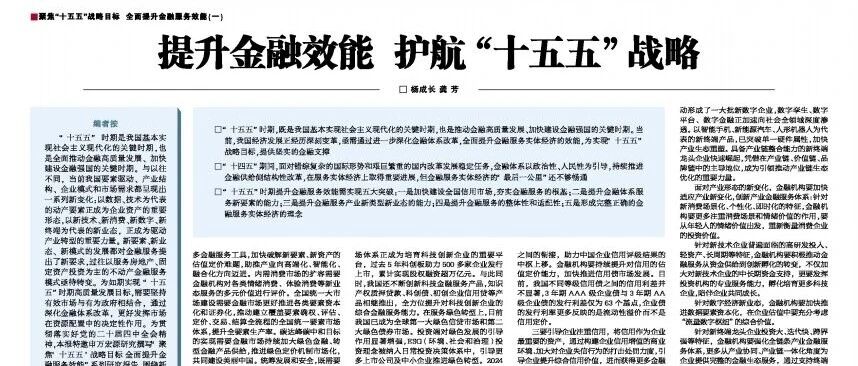
提升金融效能 护航“十五五”战略
申万宏源研究· 2025-11-13 06:52
Core Viewpoint - The article emphasizes the importance of enhancing financial service efficiency to achieve the "15th Five-Year Plan" strategic goals, highlighting the need for deepening financial system reforms and improving support for the real economy [3][5][7]. Group 1: Financial Role in Economic Development - The "15th Five-Year Plan" is a critical period for achieving socialist modernization and promoting high-quality financial development [5][6]. - Financial services must play a key role in supporting technological innovation and the development of new productive forces, requiring better resource allocation in capital markets [7][8]. - The financial system needs to continue reforms to address structural contradictions in funding and project financing, ensuring effective capital conversion [4][8]. Group 2: Achievements During the "14th Five-Year Plan" - Significant progress was made in the financial system, including improvements in the financial institutional framework and market scale, with China becoming the world's largest credit market by September 2025 [9][10]. - The direct financing ratio increased to 31.6%, and the asset management scale of various institutions grew by 35% compared to the end of 2020 [9][10]. - Financial institutions have enhanced their service capabilities, particularly in supporting technological innovation and green transformation [11][12]. Group 3: Five Breakthroughs for the "15th Five-Year Plan" - The article outlines five key breakthroughs needed to enhance financial service efficiency: building a national credit market, improving service capabilities for new factors, enhancing services for new industries and business models, increasing overall service adaptability, and forming a correct understanding of financial services for the real economy [13][14][17]. Group 4: Building a National Credit Market - A national credit market is essential for the financial system and the unified market, requiring improvements in credit data collection and sharing [14][15]. - Financial institutions need to enhance their credit rating and assessment capabilities to better support small and medium-sized enterprises [16][17]. Group 5: Enhancing Services for New Factors - Financial institutions must adapt to the shift towards new asset forms, such as data and technology, and improve their service capabilities accordingly [17][18]. - There is a need for a comprehensive valuation system for new asset types, focusing on technology and data-driven industries [19][20]. Group 6: Adapting to New Industries and Business Models - The financial sector must innovate its service offerings to meet the demands of new consumption patterns and technological advancements [20][21]. - Financial institutions should focus on providing integrated financial services that align with the characteristics of new industries and business models [22][23]. Group 7: Overall Service Integration and Adaptability - Financial products need to be more integrated and adaptable to meet the diverse needs of enterprises, particularly in terms of financing options [22][23]. - Collaboration among financial institutions is essential to create a more cohesive service environment that supports various financing needs [23][24]. Group 8: Correct Understanding of Financial Services - There is a need for a correct understanding of the relationship between finance and the real economy, emphasizing that finance should serve the real economy effectively [24][25]. - Financial institutions must balance profitability with their role in supporting national strategic goals and local economic needs [24].



甘肃监管局同意平安产险永登支公司营业场所变更
Jin Tou Wang· 2025-11-13 04:09
Core Points - The Gansu Regulatory Bureau of the National Financial Supervision Administration approved the request from China Ping An Property & Casualty Insurance Company to change the business location of its Yongdeng branch [1] Group 1 - The business location of China Ping An's Yongdeng branch is changed from "No. 2, North-South Commercial Shop, Zhaoyuan Community, Binhai Road, Chengguan Town, Yongdeng County, Lanzhou City, Gansu Province" to "No. 786, Binhai Avenue, Chengguan Town, Yongdeng County, Lanzhou City, Gansu Province" [1] - China Ping An is required to handle the change and obtain new permits in accordance with relevant regulations [1]
德宏金融监管分局同意平安产险陇川支公司变更营业场所
Jin Tou Wang· 2025-11-13 04:09
Core Viewpoint - The Dehong Financial Regulatory Bureau has approved the relocation of China Ping An Property & Casualty Insurance Co., Ltd.'s Longchuan branch to a new address in Yunnan Province, indicating the company's ongoing operational adjustments and compliance with regulatory requirements [1]. Group 1 - The approval was granted for the relocation of the Longchuan branch to a specific new address in Dehong Dai and Jingpo Autonomous Prefecture, Yunnan Province [1]. - The new business location is specified as C区4-07, 08, 09, 10, 11, located east of the intersection of Tongxin Road and Mengwan Road in Zhangfeng Town [1]. - The company is required to handle the necessary changes and obtain new permits in accordance with relevant regulations [1].
智通港股沽空统计|11月13日
智通财经网· 2025-11-13 00:21
Core Insights - The article highlights the top short-selling ratios and amounts for various companies, indicating significant market sentiment against these stocks [1][2]. Short-Selling Ratios - The top three companies with the highest short-selling ratios are Hang Seng Bank-R (80011) and BYD Company-R (81211), both at 100.00%, followed by Kuaishou-WR (81024) at 90.79% [1][2]. - The short-selling ratio for Shengjing Bank (02066) is 83.46%, while Meituan-WR (83690) has a ratio of 77.62% [2]. Short-Selling Amounts - The companies with the highest short-selling amounts are Xiaomi Group-W (01810) at 2.038 billion, Tencent Holdings (00700) at 1.705 billion, and Pop Mart (09992) at 1.689 billion [1][2]. - Other notable companies include Alibaba-SW (09988) with 1.451 billion and Ping An Insurance (02318) with 1.368 billion [2]. Short-Selling Deviation Values - The top three companies with the highest deviation values are Shengjing Bank (02066) at 71.47%, Hang Seng Bank-R (80011) at 60.71%, and BYD Company-R (81211) at 49.79% [1][2]. - Kuaishou-WR (81024) has a deviation value of 40.46%, indicating a significant difference from its historical short-selling average [2].



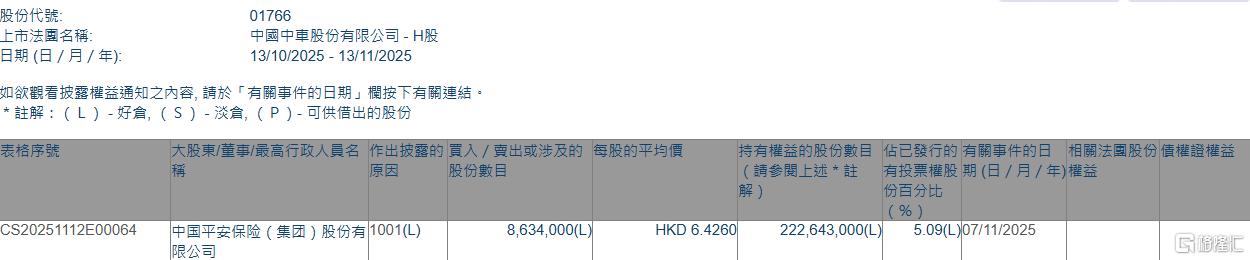
中国中车(01766.HK)获中国平安增持863.4万股
Ge Long Hui· 2025-11-12 23:24
Group 1 - China CNR Corporation Limited (01766.HK) has been increased in shareholding by Ping An Insurance (Group) Company of China, Ltd. on November 7, 2025, with an average purchase price of HKD 6.426 per share [1] - The total number of shares acquired by Ping An Insurance amounts to 8.634 million shares, with a total investment of approximately HKD 55.4821 million [1] - Following this transaction, Ping An Insurance's total shareholding in China CNR has risen to 222,643,000 shares, increasing its ownership percentage from 4.89% to 5.09% [1]
提升金融效能 护航“十五五”战略
Shang Hai Zheng Quan Bao· 2025-11-12 17:51
Core Viewpoint - The "15th Five-Year Plan" period is crucial for achieving socialist modernization and promoting high-quality financial development in China, necessitating a transformation in financial services to meet new demands from emerging factors, industries, and business models [1][2][3] Financial System Reform - The financial system must deepen reforms to enhance its effectiveness in serving the real economy, addressing structural contradictions such as excess funds but difficulty in investment and financing [2][5] - Five breakthroughs are needed to improve financial service efficiency: building a national credit market, enhancing service capabilities for new factors, adapting to new industry types, improving overall service integration, and forming a correct financial service concept [2][3][4] Achievements During the "14th Five-Year Plan" - Significant progress was made in financial service to the real economy, with improvements in the financial institutional framework and market scale [5][6] - By September 2025, China became the world's largest credit market with a credit balance exceeding 270 trillion yuan, and the bond market's scale surpassed 190 trillion yuan [6][7] Financial Institutions Development - Major state-owned financial institutions have strengthened, with the asset scale of the banking sector nearing 470 trillion yuan, and the securities industry rapidly developing [7][8] - Public funds have become the largest public investment product, with assets under management exceeding 36 trillion yuan, generating significant returns for investors [7][8] Financial Services for Innovation and Green Transition - Financial institutions are increasingly supporting technological innovation, with venture capital funds reaching 14.4 trillion yuan and supporting over 36,000 tech startups [8][9] - China has become the largest green credit market globally, with a significant increase in ESG investment practices among listed companies [8][9] Financial Market Opening - The financial system is expanding its openness, with over 160 licensed foreign financial institutions and significant foreign investment in domestic bonds and stocks [9][10] - Financial institutions are enhancing services for Chinese companies going abroad, facilitating cross-border transactions and listings [9][10] Enhancing Financial Service Capabilities - Financial institutions need to adapt to new economic dynamics by improving their service capabilities for new factors like data and technology, transitioning from real estate-focused services to those that support intangible assets [12][13] - There is a need for better valuation and pricing mechanisms for new asset types, with a focus on technology and data-driven investments [12][13] Addressing New Industry Types and Business Models - The shift towards new consumption and technology-driven industries requires financial institutions to innovate their service offerings, focusing on consumer experience and emotional value [15][16] - Financial services must evolve to support the unique characteristics of new technology firms, including high R&D costs and long development cycles [15][16] Improving Overall Financial Service Integration - Financial products need to be more integrated and adaptable to meet the diverse needs of enterprises, particularly in terms of flexible financing options [17][18] - There is a challenge in aligning financial services with the operational realities of businesses, especially for SMEs facing high entry barriers [17][18] Forming a Correct Financial Service Concept - A clear understanding of the relationship between finance and the real economy is essential, emphasizing that finance should serve as a tool for value creation [20][21] - The financial sector must balance profitability with its role in supporting national strategic goals and local economic needs [20][21]
分红险站上C位!险企抢跑2026年“开门红”
Guo Ji Jin Rong Bao· 2025-11-12 14:38
Core Viewpoint - The insurance industry is shifting towards dividend insurance products in response to a low interest rate environment, with major companies launching their 2026 "opening red" products focused on these offerings [1][2][4]. Product Trends - Major life insurance companies like China Life, Ping An Life, and Xinhua Insurance are prominently featuring dividend insurance in their new product launches for 2026 [2][3]. - From October 1, 2025, to November 12, 2025, 45 out of 98 new life insurance products were dividend-based, accounting for 45.9%, while 28 out of 57 new annuity products were also dividend-based, making up 49.1% [2]. Market Dynamics - The shift to dividend insurance is seen as a necessary response to the current low interest rate market and regulatory guidance aimed at reducing liabilities and restructuring the industry [2][4]. - Dividend insurance offers a combination of guaranteed returns and potential higher yields, making it more attractive than traditional fixed-income products in the current "asset scarcity" environment [3]. Challenges Ahead - The industry faces challenges in rebuilding trust due to past discrepancies between projected and actual dividend rates, necessitating greater transparency and stable operations from insurance companies [4]. - There is a need to enhance the professional capabilities of sales teams, as the complexity of dividend insurance requires a deeper understanding of asset allocation and risk disclosure [4]. - Balancing short-term performance pressures with the long-term nature of dividend insurance is crucial for success [4]. Investment Performance - Analysts predict that the investment capabilities of insurance companies will be a decisive factor in the competitive landscape of dividend insurance, with a projected investment return of over 6% for listed companies [5]. - The ability to manage asset-liability duration gaps remains a key focus for insurance asset management in a low interest rate environment [5]. Future Directions - The "opening red" marketing strategy needs to evolve from a product-driven approach to a customer-centric value creation model, emphasizing long-term relationships and comprehensive service offerings [6][7]. - Companies should leverage technology and data analytics for precise marketing and improved customer service, while also focusing on brand building and social responsibility to enhance competitiveness [7].

