PING AN OF CHINA(02318)

Search documents
中国平安郭晓涛:要在周期风浪里“寻找确定性”
Xin Lang Cai Jing· 2026-03-30 09:17
Core Viewpoint - China Ping An's 2025 performance report highlights a resilient financial performance despite market uncertainties, with a focus on strategic investments in emerging industries and a commitment to enhancing service offerings [1][4][12]. Financial Performance - In 2025, China Ping An achieved an operating profit of CNY 134.41 billion, a year-on-year increase of 10.3%, and a net profit attributable to shareholders of CNY 143.77 billion, up 22.5% [7][10]. - The company's net asset scale surpassed CNY 1 trillion for the first time, reaching CNY 1,000.42 billion [7]. - The company plans to distribute a cash dividend of CNY 1.75 per share for 2025, totaling CNY 48.89 billion, marking 14 consecutive years of steady growth in dividends [9][11]. Investment Strategy - The core investment strategy for 2025 is to "find certainty in uncertainty," focusing on sectors like infrastructure, healthcare, and high-dividend assets [4][6]. - The company aims to deepen its investment in emerging industries such as GPUs, robotics, semiconductors, and brain-machine interfaces [1][12]. - Over CNY 900 billion in floating profits are not included in current profits, providing a solid foundation for the company's financial health [9]. Business Segments - The life and health insurance business showed robust growth, with new business value increasing by 29.3%, becoming a key driver of performance [9][11]. - The property insurance and banking sectors experienced slight declines in net profit, down 2.82% and 4.2% respectively [11]. - The company’s solvency ratio has been declining, with figures of 208%, 204.1%, and 193.3% for 2023 to 2025 [9][11]. Customer Growth and Service Focus - By the end of 2025, the number of customers in protection, asset, and service categories grew by 3.9%, 2.5%, and 4.0% respectively, indicating a shift towards integrated financial and service offerings [12][13]. - 2026 has been designated as the "Service Year," emphasizing the integration of financial services with enhanced customer service capabilities [13][14]. Technological Advancements - The company is committed to AI and technology investments, viewing them as essential for strategic implementation [14]. - A significant technology platform upgrade, the "Nine to One" project, aims to unify various customer accounts and services into a single platform, enhancing user experience [14].


万亿家底、5亿客户!中国平安咋还跑不过同行?
Xin Lang Cai Jing· 2026-03-30 07:00
Core Viewpoint - China Ping An's 2025 financial results show a revenue exceeding 1 trillion RMB, with net assets also surpassing 1 trillion RMB, and a 22% increase in net profit excluding non-recurring items, but the growth rate lags behind competitors [2][17]. Financial Performance - Revenue for 2025 reached 1,050.5 billion RMB, a year-on-year increase of 2.1% [3][18]. - Net profit attributable to shareholders was 134.8 billion RMB, up 6.5% year-on-year, while net profit excluding non-recurring items increased by 22.5% to 143.8 billion RMB [11][26]. - Total assets grew to 13,898.5 billion RMB, a 7.3% increase from the previous year [3][18]. - The weighted average return on equity (ROE) rose to 14.0%, an increase of 0.2 percentage points [3][18]. Business Segments - The life and health insurance segment generated an operating profit of 103.3 billion RMB, contributing over 65% of the group's operating profit, with a new business value (NBV) of 36.9 billion RMB, up 29.3% [4][19]. - The property insurance segment reported an operating profit of 17.0 billion RMB, a 13.2% increase, despite a 2.8% decline in net profit due to one-time losses from asset sales [6][21]. - Banking operations saw a decline in both revenue and profit, with net profit at 42.6 billion RMB, down 4.2%, and operating income at 131.4 billion RMB, down 10.4% [8][24]. Investment Performance - The total investment income for 2025 was 234.3 billion RMB, a 13.5% increase, with a comprehensive investment return rate of 6.3%, up 0.5 percentage points [11][26]. - The company achieved a significant increase in investment service performance, with a 55.5% rise in related profits [20][25]. Strategic Insights - China Ping An aims to leverage its comprehensive financial services and healthcare strategy to become a leading international service group, although challenges in scaling and profitability remain [13][28]. - The company faces contradictions in its growth strategy, including the inability of scale expansion to support profit growth and the insufficient conversion of competitive advantages into profit [29][30].

对话中国平安路昊阳:过滤短期波动坚定配置权益资产,未来加大“硬科技”领域投资
Xin Lang Cai Jing· 2026-03-30 04:09
Core Viewpoint - The insurance industry is increasingly focusing on "hard technology" as a key investment area, with major companies like China Ping An and China Life actively allocating resources to this sector [1][2][3]. Investment Trends - By the end of 2025, China Ping An's equity investment proportion rose from 11% in 2024 to 20%, indicating a significant increase in equity investments, particularly in high-dividend stocks and technology growth stocks [1]. - Other insurance companies, including China Life and China Pacific Insurance, have also expressed intentions to invest in new productive forces [1]. Strategic Focus Areas - The insurance sector is aligning its investments with national policies that encourage emerging industries, particularly in hard technology and new productive forces [2][3]. - Key emerging industries identified include integrated circuits, aerospace, biomedicine, low-altitude economy, new energy storage, and intelligent robotics, along with future industries like quantum technology and 6G [2]. Investment Scale and Support - China Ping An has invested over 11.5 billion yuan in the national major semiconductor industry to support domestic chip development, with total investments in AI, semiconductors, robotics, and biomedicine exceeding 10 billion yuan [3]. - The company is actively participating in strategic emerging industries and supporting technological innovation through both equity and debt investments [3]. Challenges and Regulatory Environment - While investment in hard technology is generally smooth under current policies, challenges remain, particularly regarding equity investments in non-listed companies, which carry higher solvency risk factors [4][5]. - Recent regulatory adjustments have optimized solvency capital requirements for investments in listed companies, but the risk factor for investments in non-listed strategic emerging industries remains unchanged at 0.4 [4][5]. Future Outlook - The insurance sector is expected to continue increasing its focus on hard technology investments, with companies like Ping An committed to enhancing their investment capabilities and risk management in this area [5].
中国平安(601318):多元渠道助推价值高增 资管减亏夯实基础
Xin Lang Cai Jing· 2026-03-30 00:32
Core Viewpoint - The company reported stable growth in its annual performance, with a net profit attributable to shareholders increasing by 6.5% year-on-year, while the new business value (NBV) saw a significant rise of 29.3% [1][2]. Group 1: Financial Performance - The net profit attributable to shareholders increased by 6.5% year-on-year, aligning with expectations, although it showed a decline from 11.5% in the first three quarters, primarily due to a Q4 profit of 1.92 billion, which was down 74% year-on-year [1]. - The operating profit after tax (OPAT) grew by 10.3% year-on-year, an improvement from 7.2% in the previous three quarters, with life insurance and property insurance OPAT growth rates of 6.5% and 13.2%, respectively [1]. - The company declared a dividend of 2.7 yuan per share, representing a year-on-year increase of 5.9%, maintaining stable growth over the years [1]. Group 2: New Business Value (NBV) and Value Metrics - The NBV increased by 29.3% year-on-year, with individual insurance and bank insurance NBV growth rates of 10.4% and 137.9%, respectively. New single premiums rose by 1.5%, with bank insurance first-year premiums (FYP) increasing by 92.2% to offset a slight decline in individual insurance channels [2]. - The NBV margin (NBVM) improved to 23.4%, up 4.9 percentage points year-on-year, despite adjustments to non-economic assumptions. The bank insurance and individual insurance NBVM increased by 6.4 and 4.4 percentage points, respectively, with bank insurance achieving the highest value rate in the industry at 24.5% [2]. - The embedded value (EV) rose by 5.7% year-on-year, with life insurance EV increasing by 11.2%, showing significant improvement compared to the previous year's growth rates of 2.3% and 0.5% [2]. Group 3: Cost of Risk (COR) and Profitability - The property insurance combined ratio (COR) improved by 1.5 percentage points to 96.8%, outperforming industry peers, with the auto insurance COR decreasing by 2.3% [3]. - Earnings per share (EPS) forecasts for 2026-2028 are projected at 7.75, 8.15, and 9.18 yuan per share, with an estimated valuation of 0.9 times the embedded value for A-shares and 0.8 times for H-shares, corresponding to a fair value of 80.14 yuan per share for A-shares and 80.76 Hong Kong dollars per share for H-shares, maintaining a "buy" rating for both A and H shares [3].
金融行业周报(2026、03、29):投资驱动保险券商利润高增,息差企稳助推银行业绩改善-20260329
Western Securities· 2026-03-29 12:57
Investment Rating - The report does not explicitly state an overall investment rating for the financial industry but provides specific recommendations for various sectors and companies within the industry [4]. Core Insights - The financial industry experienced a decline this week, with the non-bank financial index down by 3.98%, underperforming the CSI 300 index by 2.57 percentage points. The banking sector, however, showed resilience with a decline of only 0.71%, outperforming the CSI 300 index by 0.7 percentage points [10][1]. - The insurance sector reported significant profit growth driven by investments, although Q4 results were impacted by stock market volatility. The long-term fundamentals of the insurance industry remain intact, suggesting potential for valuation and performance recovery [1][17]. - The brokerage sector saw a 3.61% decline, with 14 listed brokerages reporting a combined revenue of 271.68 billion yuan and a net profit of 109.02 billion yuan, reflecting year-on-year increases of 37.7% and 54.8%, respectively [2][18]. - The banking sector's performance showed marginal improvement, with 13 listed banks reporting revenue and net profit growth of 0.85% and 1.08%, respectively. The net interest income is expected to stabilize, contributing to a more favorable outlook for 2026 [3][21]. Summary by Sections Insurance Sector - The insurance sector index fell by 5.52%, underperforming the CSI 300 index by 4.11 percentage points. The annual reports of listed insurance companies showed significant profit growth driven by investments, with notable Q4 declines due to market fluctuations [1][14]. - The net profit growth for major insurers was led by China Taiping (+221%), followed by China Life (+44%) and New China Life (+38%). The new business value (NBV) also saw substantial increases across the board [14][17]. - Recommendations include China Ping An, China Taiping, and New China Life, with a focus on long-term value recovery in the sector [4][17]. Brokerage Sector - The brokerage sector index decreased by 3.61%, with a reported combined revenue of 271.68 billion yuan and a net profit of 109.02 billion yuan from 14 listed brokerages, indicating strong recovery driven by market conditions [2][18]. - The return on equity (ROE) for these brokerages improved by 1.56 percentage points to 7.5%. The report suggests that the brokerage sector is experiencing a significant recovery in profitability [18][19]. - Recommended stocks include Guotai Junan, Huatai Securities, and Xingye Securities, focusing on firms with strong fundamentals and potential for mergers and acquisitions [4][19]. Banking Sector - The banking sector index fell by 0.71%, with 13 listed banks reporting revenue and net profit growth of 0.85% and 1.08%, respectively. The net interest margin is expected to stabilize, contributing to a positive outlook for 2026 [3][21]. - The report highlights that the asset quality remains stable, with a slight decrease in the non-performing loan ratio to 1.21% and an average provision coverage ratio of 232% [22][24]. - Recommended banks include Hangzhou Bank and Bank of China (H), with a focus on banks with high dividend yields and strong earnings potential [4][24].



非银金融行业投资策略周报:资本市场改革深化,行业基本面趋势向好-20260329
GF SECURITIES· 2026-03-29 12:48
Core Viewpoints - The non-bank financial industry is experiencing a positive trend in its fundamentals due to deepening capital market reforms, with a projected 30% profit growth over the next 25 years [5][10] - The average daily trading volume in the Shanghai and Shenzhen markets is 21.1 trillion CNY, reflecting a 4.5% decrease week-on-week [5] - The net profit of 150 securities companies is expected to reach 219.439 billion CNY in 2025, representing a year-on-year increase of 31.2% [5] Group 1: Industry Performance - As of March 28, 2026, the Shanghai Composite Index is at 3913.72 points, down 1.09%, while the Shenzhen Component Index is at 13760.37, down 0.76% [10] - The non-bank financial sector indices have seen declines of 3.55% and 5.72% for securities and insurance, respectively [10] Group 2: Insurance Sector Insights - The insurance sector's annual reports show a slowdown in growth due to changes in the market environment in Q4, but the long-term trend remains positive [16] - The net profit growth for insurance companies is expected to be in double digits for the year, despite a high base in 2024 [16] - Key stocks to watch in the insurance sector include China Pacific Insurance, Ping An Insurance, and China Life Insurance [16] Group 3: Securities Sector Developments - The introduction of a "light asset, high R&D" recognition standard has been expanded to the main board, enhancing the inclusivity of the capital market [17][18] - The new standards aim to improve the flexibility of refinancing rules and guide funds towards key technology sectors [18] - The adjustments to the standards include raising the R&D investment ratio for the ChiNext board from 3% to 5%, reinforcing the board's positioning [21] Group 4: Investment Recommendations - The report suggests focusing on companies with strong quarterly performance catalysts, including CITIC Securities, Huatai Securities, and China Merchants Securities [5] - In the insurance sector, recommended stocks include China Taiping, New China Life, and AIA Group [16] - For Hong Kong stocks, quality dividend stocks such as China Shipbuilding Leasing and Hong Kong Exchanges are highlighted [5]

韧性生长,价值重估 中国平安年报:在变局中重估平安的增长逻辑
Cai Jing Wang· 2026-03-29 10:32
Core Insights - The article highlights that China Ping An has delivered a substantial annual report amidst industry fluctuations and structural adjustments, showcasing high growth, resilience, and sustainable value under the dual drivers of "comprehensive finance + healthcare and elderly care" [1] - The annual report indicates that Ping An has not only achieved robust profit growth but has also explored new productive forces in the transformation of comprehensive finance through AI empowerment and deep engagement in the healthcare and elderly care ecosystem [1] - A positive signal is conveyed that Ping An is transitioning from a "financial institution" to a "provider of comprehensive life solutions centered on services" [1] Summary by Categories Financial Performance - Ping An has demonstrated steady profit growth, indicating a strong financial performance despite industry challenges [1] Strategic Transformation - The company is leveraging AI and exploring new productive forces in its transformation towards comprehensive finance [1] - The focus is shifting towards providing comprehensive life solutions, moving beyond traditional financial services [1] Industry Context - The report reflects the ongoing adjustments and cyclical fluctuations within the industry, positioning Ping An as a resilient player adapting to these changes [1]
中国平安(601318):多元渠道助推价值高增,资管减亏夯实基础
GF SECURITIES· 2026-03-29 10:28
Investment Rating - The investment rating for the company is "Buy-A/Buy-H" [2] Core Views - The company reported a year-on-year increase of 6.5% in net profit attributable to shareholders, which aligns with expectations, although it shows a decline from the previous quarter's growth of 11.5%. The fourth quarter saw a significant drop in profit, down 74% year-on-year, primarily due to the company's efforts to increase equity investments [8] - The new business value (NBV) increased by 29.3% year-on-year, driven by strong growth in both individual and bancassurance channels, with the latter showing a remarkable growth rate of 137.9% [8] - The embedded value (EV) rose by 5.7% year-on-year, with the life insurance segment contributing a 11.2% increase, indicating improved asset quality and profitability [8] Financial Forecasts - The forecasted earnings per share (EPS) for 2026 is 7.75 CNY, with expected growth rates of 7.59% and 5.10% for 2027 and 2028 respectively [7] - The company's reasonable value is estimated at 80.14 CNY per share for A-shares and 80.76 HKD for H-shares, maintaining a "Buy" rating for both [8] Performance Metrics - The company’s return on equity (ROE) is projected to be 13.63% in 2026, slightly improving from previous years [7] - The new business value margin (NBVM) increased to 23.4%, up 4.9 percentage points year-on-year, indicating enhanced profitability in new business [8]
银行业周报:基本面改善逻辑强化-20260329
ZHESHANG SECURITIES· 2026-03-29 10:28
Investment Rating - The industry rating is maintained as "Positive" [5] Core Views - The banking sector's performance is relatively stable compared to the market, with the banking index down by 0.71% this week, ranking 13th among 31 primary industries [1] - State-owned banks experienced a larger decline, with respective drops of -1.17% for state-owned banks, -0.30% for joint-stock banks, -0.88% for city commercial banks, and -0.57% for rural commercial banks [1] - The financial reports of 22 listed banks show a recovery in profitability, with average revenue and net profit growth of 2.1% and 4.9%, respectively, indicating a positive trend in earnings [3] - The average non-performing loan (NPL) ratio for these banks is 1.05%, down by 2 basis points, reflecting stable asset quality [3] Summary by Sections Industry Performance - The banking sector's index decreased by 0.71%, while the overall market index fell by 0.73%, indicating a slight underperformance [1] - The top three gainers in the banking sector were CITIC Bank (+4.39%), Ping An Bank (+2.32%), and Shanghai Rural Commercial Bank (+1.25%), while the largest decliners included Chongqing Bank (-6.55%), Xiamen Bank (-4.26%), and Agricultural Bank (-4.14%) [1][10] Financial Reports - The financial reports indicate a clear recovery trend, with 22 listed banks showing an average revenue growth of 2.1% and net profit growth of 4.9% [3] - The average net interest margin for the banks is 1.50%, with a slight decrease of 1 basis point, while some banks like Bank of Communications and China Construction Bank reported an increase in their margins [3] - The asset scale of these banks grew by 10.1% year-on-year, with a slight acceleration in growth rates [3] Investment Recommendations - The report suggests focusing on state-owned banks and certain high-dividend small and medium-sized banks, recommending major banks like Bank of Communications, Industrial and Commercial Bank, and China Construction Bank [7] - The report highlights the potential for a recovery in earnings growth for the banking sector in 2026, with an expected core revenue growth of 5% [6][7] - The average dividend yield for the banking sector is projected at 4.4%, making it an attractive investment option [6][12]



【华西非银】中国平安2025年报点评:OPAT实现双位数增长,资负两端表现稳健
Xin Lang Cai Jing· 2026-03-29 09:29
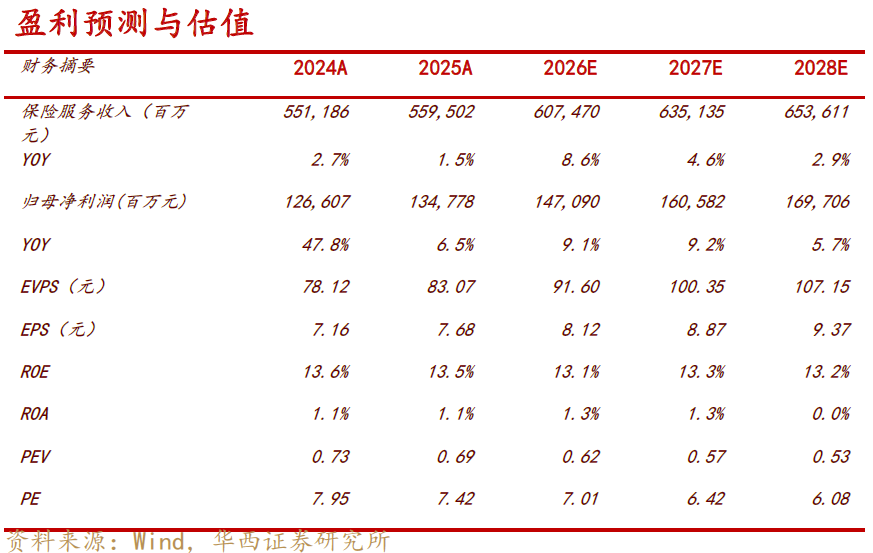
Summary of Key Points Core Viewpoint - Ping An Insurance reported a solid performance in 2025, with a notable increase in operating profit and new business value, despite challenges in the fourth quarter due to market volatility and one-time project impacts [1][2]. Financial Performance - The group achieved a parent operating profit (OPAT) of CNY 134.415 billion, up 10.3% year-on-year, with a Q4 increase of 35.3% [1]. - The net profit attributable to the parent company was CNY 134.778 billion, reflecting a year-on-year growth of 6.5%, but a significant decline of 74.1% in Q4 [1]. - The new business value (NBV) for life and health insurance reached CNY 36.897 billion, up 29.3% year-on-year [1][3]. - The combined ratio (COR) for property insurance improved to 96.8%, a 1.5 percentage point enhancement year-on-year [1][4]. Business Segments - Life and Health Insurance: - Operating profit was CNY 99.752 billion, a 2.9% increase year-on-year, driven by a 55.5% rise in investment service performance [3]. - The NBV growth was attributed to a significant increase in value rate, with the NBVM rising by 4.9 percentage points to 23.4% [3]. - The agent channel's NBV grew by 10.4%, while the bank insurance channel saw a remarkable increase of 138.0% [3]. - Property Insurance: - Operating profit reached CNY 16.923 billion, up 13.2% year-on-year, with stable growth in insurance service revenue of CNY 338.912 billion, a 3.3% increase [4]. - The overall cost ratio improved due to optimized expenses and profitability in the auto insurance segment [4]. Investment Performance - The total investment income increased by 13.5%, with a comprehensive investment return of 6.3%, up 0.5 percentage points year-on-year [5]. - The investment portfolio exceeded CNY 6.49 trillion, reflecting a 13.2% increase from the beginning of the year [5]. Dividend Distribution - The company proposed a cash dividend of CNY 1.75 per share at the end of 2025, leading to a total annual cash dividend of CNY 2.70 per share, a 5.9% increase year-on-year [1]. Future Projections - The company maintains its revenue forecasts for 2026-2027 at CNY 607.47 billion and CNY 635.135 billion, respectively, with an additional forecast for 2028 at CNY 653.611 billion [6]. - The net profit projections for 2026-2027 are set at CNY 147.09 billion and CNY 160.582 billion, with a new forecast for 2028 at CNY 169.706 billion [6].