
BANK OF CHINA(03988)

Search documents
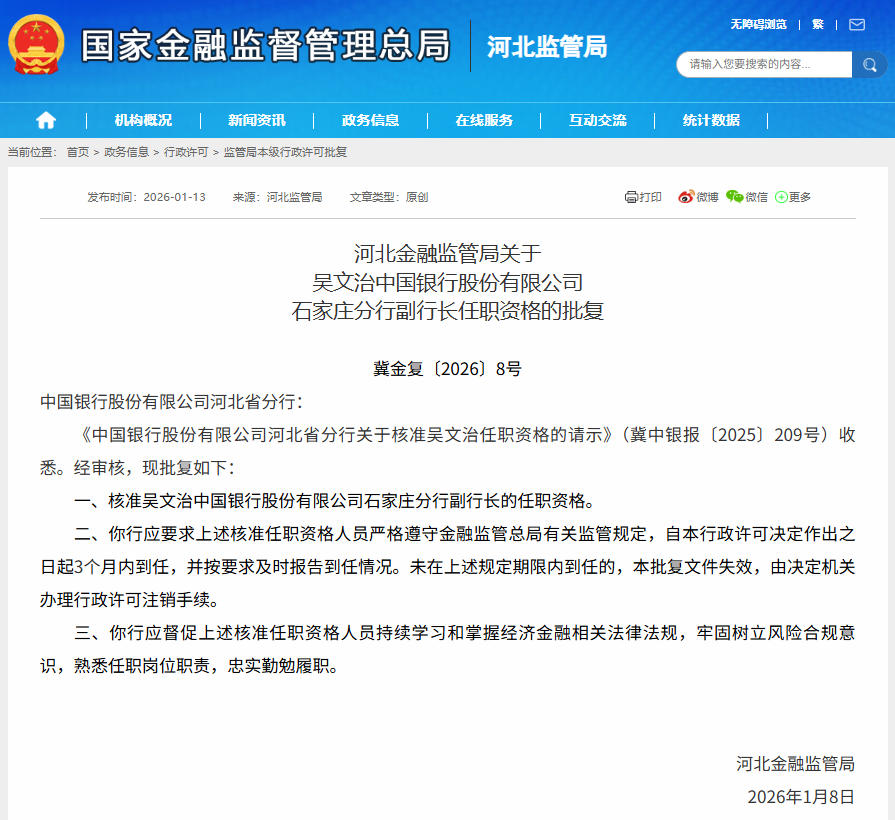
吴文治获准出任中国银行石家庄分行副行长
Xin Lang Cai Jing· 2026-01-14 02:24
据国家金融监督管理总局的批复文件显示,河北金融监管局同意吴文治出任中国银行石家庄分行副行长。 图源:国家金融监督管理总局网站 ...


中国银行协助德国汉高集团发行15亿元熊猫债
Jin Rong Shi Bao· 2026-01-14 01:01
Core Viewpoint - China Bank has successfully assisted Henkel Group in issuing 1.5 billion yuan panda bonds in the Chinese interbank bond market, marking Henkel's debut in the RMB bond market and the first foreign panda bond issuance of 2026, which enhances the international influence of the panda bond market [1] Group 1 - China Bank is the only Chinese underwriter for this issuance and has been a key player in the panda bond market, facilitating the entry of over 20 international giants since 2014, including companies like Veolia, BMW, Volkswagen, BASF, and Henkel [1] - The bank has participated in over 80% of the panda bond issuances by multinational companies, showcasing its strong professional capabilities and commitment to supporting foreign enterprises in China [1] - China Bank aims to continue its role as a primary channel for cross-border financial services and leverage its expertise in foreign exchange and trade to help global companies seize opportunities in China [1]
智通ADR统计 | 1月14日
智通财经网· 2026-01-13 22:43
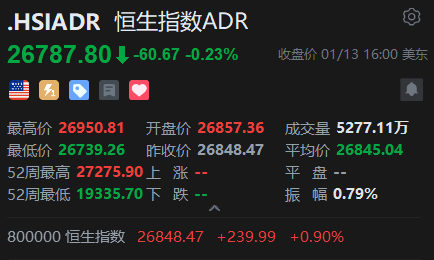
Core Viewpoint - The Hang Seng Index (HSI) experienced a slight decline, closing at 26,787.80, down 0.23% from the previous close, indicating a mixed performance in the Hong Kong stock market [1]. Group 1: Market Performance - The Hang Seng Index closed at 26,787.80, down 60.67 points or 0.23% [1]. - The index reached a high of 26,950.81 and a low of 26,739.26 during the trading session, with a trading volume of 52.77 million shares [1]. - The average price for the session was 26,845.04, with a 52-week high of 27,275.90 and a low of 19,335.70 [1]. Group 2: Major Blue-Chip Stocks - HSBC Holdings closed at HKD 127.188, up 0.62% compared to the previous close [2]. - Tencent Holdings closed at HKD 624.864, down 0.42% from the previous close [2]. - Alibaba Group saw a price increase of 3.63%, closing at HKD 159.900 [3]. - Other notable performances include AIA Group up 0.84% at HKD 84.400 and China Construction Bank up 1.17% at HKD 7.810 [3].




金价再创新高!工行、中行等多家银行密集公告!
Jin Rong Shi Bao· 2026-01-13 11:04
Core Viewpoint - Gold prices have continued to rise since the beginning of 2026, reaching a historical high of $4601.38 per ounce on January 12, prompting banks to adjust their gold accumulation business and issue risk warnings to investors [1] Group 1: Bank Adjustments - Industrial and Commercial Bank of China (ICBC) announced an increase in the minimum investment amount for its gold accumulation business from 1000 yuan to 1100 yuan, effective January 8, 2026 [1] - ICBC has adjusted its gold accumulation business minimum investment amount five times since 2025, with a total increase of 450 yuan, or nearly 70%, from the initial amount of 650 yuan [1] - Other banks, including Bank of Communications, Industrial Bank, and China CITIC Bank, have also raised their gold accumulation thresholds, with minimum investment amounts now generally exceeding 1000 yuan [2] Group 2: Market Trends - The gold investment and consumption market in China is experiencing increased activity, as evidenced by sales data from key trading markets like Shenzhen's Shui Bei, where gold prices reached a record high of 1178 yuan per gram on January 12 [2] - Some banks have implemented a "floating mechanism" for gold accumulation thresholds, adjusting the minimum investment based on real-time gold prices [2] Group 3: Investment Risks - The rise in market enthusiasm has led to an increase in illegal gold trading schemes, significantly raising investment risks [3] - The Shenzhen Gold and Jewelry Association has warned about companies engaging in illegal "non-physical gold betting" activities, which have been linked to criminal charges [3] - China Bank's Shenzhen branch has issued warnings about fraudulent platforms that lure investors with promises of low thresholds and high returns, emphasizing the importance of using licensed financial institutions for gold investments [3] Group 4: Investment Advice - Experts recommend that investors should base their investment decisions on personal experience, capability, and risk tolerance, avoiding impulsive trading behaviors [4] - Investors are advised to choose investment methods and products they understand, rather than following market trends blindly [4]




港股13日涨0.9% 收报26848.47点
Xin Hua She· 2026-01-13 10:17
Market Performance - The Hang Seng Index increased by 239.99 points, a rise of 0.9%, closing at 26,848.47 points [1] - The total turnover for the day on the main board was HKD 315.92 billion [1] - The National Enterprises Index rose by 65.33 points, closing at 9,285.41 points, with a gain of 0.71% [1] - The Hang Seng Tech Index saw a slight increase of 6.59 points, closing at 5,869.79 points, reflecting a gain of 0.11% [1] Blue-Chip Stocks - Tencent Holdings rose by 0.72%, closing at HKD 627.5 [1] - Hong Kong Exchanges and Clearing increased by 1.31%, closing at HKD 431.8 [1] - China Mobile decreased by 0.25%, closing at HKD 80.95 [1] - HSBC Holdings rose by 1.85%, closing at HKD 126.4 [1] Local Hong Kong Stocks - Cheung Kong Holdings fell by 0.19%, closing at HKD 42.56 [1] - Sun Hung Kai Properties increased by 1.22%, closing at HKD 107.9 [1] - Henderson Land Development rose by 2.99%, closing at HKD 31.72 [1] Chinese Financial Stocks - Bank of China increased by 0.9%, closing at HKD 4.48 [1] - China Construction Bank rose by 1.17%, closing at HKD 7.81 [1] - Industrial and Commercial Bank of China increased by 0.96%, closing at HKD 6.3 [1] - Ping An Insurance rose by 2.19%, closing at HKD 70 [1] - China Life Insurance increased by 3.51%, closing at HKD 33 [1] Oil and Petrochemical Stocks - Sinopec increased by 0.65%, closing at HKD 4.65 [1] - PetroChina rose by 1.36%, closing at HKD 8.22 [1] - CNOOC increased by 2.58%, closing at HKD 21.48 [1]





中国银行常州分行与常州市南通商会签署战略合作备忘录
Yang Zi Wan Bao Wang· 2026-01-13 08:34
Core Viewpoint - The strategic cooperation memorandum signed between Changzhou Bank and the Nantong Chamber of Commerce aims to enhance long-term financial support and collaboration for member enterprises, promoting high-quality development [1] Group 1: Strategic Cooperation - Changzhou Bank and the Nantong Chamber of Commerce signed a strategic cooperation memorandum during the second first member meeting [1] - The agreement includes comprehensive financial services such as exclusive credit support, settlement and wealth management, and cross-border finance for over 300 member units [1] - This partnership marks a new chapter in building a stable financial-business cooperation mechanism [1] Group 2: Financial Support and Collaboration - Changzhou Bank has already collaborated with over 40 member units, providing more than 1 billion yuan in financial support [1] - The bank plans to deepen its strategic cooperation with the Nantong Chamber of Commerce by integrating resources and complementing advantages [1] - The initiative aims to create a "finance + industry" collaborative service system, enhancing the connection between finance and real economy [1]
中国银行取得提取方法、装置、设备及存储介质专利
Sou Hu Cai Jing· 2026-01-13 07:39
Group 1 - The core point of the article is that the Bank of China has obtained a patent for a method, device, equipment, and storage medium related to extraction, with the authorization announcement number CN115311669B and an application date of August 2022 [1] Group 2 - The Bank of China, established in 1983 and located in Beijing, primarily engages in monetary financial services, with a registered capital of approximately 29.44 billion RMB [1] - According to data analysis from Tianyancha, the Bank of China has invested in 16 enterprises, participated in 5,000 bidding projects, and holds 1,474 trademark records and 5,000 patent records, in addition to possessing 255 administrative licenses [1]
中行新加坡分行落地境外柜台债并参与数字人民币试点
Ren Min Wang· 2026-01-13 05:40
Group 1 - The Bank of China Singapore Branch has successfully conducted offshore counter RMB bond transactions, marking a significant step in financial cooperation under the framework of the 2025 China-Singapore Joint Council for Bilateral Cooperation (JCBC) [1] - This initiative allows local qualified institutional investors to directly participate in the Chinese bond market through the bank's counter bond channel, enhancing the connectivity between the Chinese and Singaporean financial markets [1] - As the first Chinese financial institution to independently operate offshore counter bond business, the Bank of China Singapore Branch provides a one-stop service for institutional investors, facilitating RMB bond investment transactions in Singapore [1] Group 2 - The Bank of China Singapore Branch will support the digital RMB pilot program for Singapore tourists visiting China, set to launch by the end of 2025, allowing Singapore residents to register digital RMB wallets using local mobile numbers [2] - This initiative aims to enhance the offline payment experience for Singapore residents in China and promote the convenience of payments, further deepening digital financial cooperation between China and Singapore [2] - Over its 90 years of service, the Bank of China Singapore Branch has continuously supported bilateral economic and cultural exchanges, launching various innovative financial products and services [2]

中国银行取得数据迁移方法专利
Sou Hu Cai Jing· 2026-01-13 04:33
Core Insights - China Bank Co., Ltd. has obtained a patent for "Data Migration Method, Device, Equipment, and Storage Medium," with the authorization announcement number CN117194378B, and the application date is September 2023 [1] Company Overview - China Bank Co., Ltd. was established in 1983 and is located in Beijing, primarily engaged in monetary financial services [1] - The registered capital of China Bank Co., Ltd. is approximately 29,438.78 million RMB [1] Investment and Intellectual Property - The company has invested in 16 enterprises and participated in 5,000 bidding projects [1] - In terms of intellectual property, China Bank Co., Ltd. holds 1,474 trademark registrations and 5,000 patent records, along with 255 administrative licenses [1]
为外贸企业“走出去”架桥铺路
Jin Rong Shi Bao· 2026-01-13 04:28
Core Viewpoint - The Bank of China Xuzhou Branch is leveraging its global network and comprehensive services to support foreign trade enterprises in the Huaihai Economic Zone, providing customized solutions and technological empowerment to facilitate their international operations [1] Group 1: Emergency Financial Support - The Xuzhou Branch approved a $5.394 million export order financing within three days, setting a record for single financing for the enterprise and enabling it to secure long-term cooperation orders [2] - The branch initiated an "Emergency Service Mechanism" for foreign trade enterprises, forming a specialized service team to assess business data and market risks, and introduced a local first "foreign currency trade financing + exchange rate derivatives" combination plan [2] - The branch has provided over 4 billion yuan in working capital loans and more than 2 billion yuan in trade financing and foreign-related guarantee services to over 200 foreign trade enterprises [2] Group 2: Accelerated Service for Trade Facilitation - The introduction of the "Cross-border E-Line" service has reduced the time for cross-border settlement processes by over 50%, allowing enterprises to complete transactions in less than half a day [3] - The Xuzhou Branch has recommended 79 enterprises for high-level cross-border trade facilitation pilot programs and has included 134 enterprises in the cross-border RMB trusted list, enhancing the overall trade facilitation level in the region [3] - The branch has processed cross-border settlements totaling $3.7 billion and 7.2 billion yuan through online channels, with over 85% coverage of online exchange clients [3] Group 3: Cross-border Guarantee Services - The Xuzhou Branch utilized its global network to assist a local enterprise in securing a $9 million guarantee for customs requirements in North America, completing the process within 48 hours [4] - The branch has launched a "One Order System" financing service for the first "One Order" export train, providing comprehensive financial support and facilitating global fund management for leading enterprises [4] Group 4: Exchange Rate Hedging Services - The Xuzhou Branch has implemented a "Foreign Exchange Hedging Inclusive Action," promoting an electronic trading platform that allows small and micro enterprises to complete forward exchange transactions in 20 seconds without transaction fees [5][6] - The branch has established dedicated service groups for over 70 enterprises, providing real-time market analysis and policy interpretation to help them manage exchange rate risks effectively [6] - The introduction of a "credit granting + margin recycling" model has lowered the barriers for enterprises to engage in hedging, while also responding to cost reduction policies by waiving fees for small enterprises [6]