
HEARTCARE(06609)

Search documents
港股异动|心玮医疗-B大涨超12%,机构指脑机接口近百亿美元蓝海市场加速开启
Ge Long Hui· 2025-12-29 02:22
Core Insights - Heartway Medical-B (6609.HK) surged over 12%, reaching a peak of HKD 54.05 [1] Industry Overview - Brain-computer interface (BCI) is at the forefront of the convergence between life sciences and information technology, currently experiencing enhanced policy support, rapid technological iteration, and accelerated commercialization [1] - The global market for BCI is approaching a nearly USD 10 billion opportunity, indicating significant growth potential [1] Technological Advancements - Invasive, semi-invasive, and interventional technologies possess irreplaceable advantages in signal quality and control precision, serving as core solutions for complex application scenarios [1] - Domestic companies have achieved technological breakthroughs in flexible electrodes and real-time Chinese language decoding, accelerating the process of domestic substitution [1] Policy Developments - On December 18, the National Medical Products Administration held a meeting in Beijing to advance BCI medical device initiatives, emphasizing safety and effectiveness as primary considerations [1] - The meeting called for innovative regulatory methods, the establishment of standard systems, and enhanced technical guidance services [1] - There is a focus on cross-departmental collaboration among industry, academia, and medical sectors to address key technological challenges and improve the supply chain [1] - Companies are urged to take responsibility, adopt a problem-oriented approach, and enhance product reliability and overall competitiveness to better serve clinical needs and benefit patients [1]
心玮医疗20251225
2025-12-26 02:12
Summary of New Wei Medical Conference Call Company Overview - **Company**: New Wei Medical - **Industry**: Medical Devices, specifically focusing on brain-computer interface (BCI) technology and drug balloon stents Key Points and Arguments Brain-Computer Interface (BCI) Development - New Wei Medical plans to obtain the inspection report for its BCI product in Q1 2026 and will communicate clinical plans with hospitals in Q2 2026, aiming for the first patient to undergo implantation in the same year, targeting conditions like ALS and stroke-related limb dysfunction [2][3] - The company is facing regulatory challenges with its BCI product and is engaging with review agencies through a project to ensure smooth approval processes, referencing similar companies' experiences [2][6] - Stroke is the leading cause of disability and death in China, with approximately 3 million new cases annually and over 20 million existing patients, many of whom suffer from limb dysfunction post-treatment [9] Clinical Development Plans - New Wei Medical aims to finalize clinical plans with top hospitals by June 2026, with ethical approvals expected within three months and patient recruitment starting in Q4 2026 [5] - The clinical trial will involve 20 to 30 patients, with follow-up periods of 6 to 12 months to assess safety and efficacy [5][6] Financial Projections - The company expects a revenue growth of 30% to 35% in 2026, projecting total revenue between 520 million to 530 million yuan [4][21] - Mid-term goals include achieving over 1 billion yuan in revenue by 2028, with an operating profit margin exceeding 20% [4][22] Product Pricing and Market Strategy - The invasive implantation cost is approximately 6,000 yuan, with the final product price expected to be between 200,000 to 300,000 yuan, referencing DBS products for pricing strategy [10][17] - New Wei Medical plans to gradually reduce prices to increase market penetration, targeting a significant population of stroke and ALS patients [17] Regulatory and Technical Challenges - The BCI product faces high regulatory scrutiny due to its innovative nature, with ongoing discussions with regulatory bodies to ensure compliance [6][10] - The company has validated the safety and signal transmission stability of its technology through animal trials, with plans for human trials in 2026 [3] Research and Development - The BCI product consists of a domestically produced electrode stent and an internationally sourced signal processing unit, with ongoing collaborations with domestic chip design companies [11][12] - The company has invested several million yuan annually since 2021 into the BCI project, with a dedicated team of over 10 people established for its development [18] Future Investment Directions - New Wei Medical will continue to focus on the neuro-intervention sector, exploring partnerships and acquisitions to enhance its product offerings [19][20] - The company plans to apply for A-share listing in 2026 to improve liquidity and support growth [25] Competitive Positioning - New Wei Medical's drug balloon stent is expected to receive approval by Q4 2026, positioning it as a significant growth driver [24] - The company aims to maintain a competitive edge in the BCI market by leveraging government support and focusing on product innovation [24] Additional Important Information - The company anticipates that the new BCI business will gradually contribute to revenue, although the exact impact will depend on market promotion efforts [21] - New Wei Medical's operational strategy includes maintaining stable management and R&D expenses to support growth [23]
格隆汇“科技赋能·资本破局”线上分享会暨“金格奖”——“年度卓越医疗健康企业”奖项揭晓:阿里健康(00241.HK)、佰泽医疗(02609.HK)、固生堂(02273.HK)等10家企业上榜
Ge Long Hui· 2025-12-22 08:53
Group 1 - The "Annual Outstanding Healthcare Enterprises" award recognizes companies in the Chinese healthcare industry that excel in innovation, technological leadership, market influence, social value, and sustainable development [4] - The award winners include Alibaba Health (00241.HK), Anxuyuan, Baize Medical (02609.HK), Gushengtang (02273.HK), Haijia Medical (06078.HK), Jinhua Medical Group (01110.HK), Kangchen Pharmaceutical (01681.HK), Ping An Good Doctor (01833.HK), Weitai Medical-B (02235.HK), and Xinwei Medical-B (06609.HK) [1] - The selection process involved quantitative data analysis and an expert review panel to determine the final results [4] Group 2 - The "Jin Ge Award" aims to create a reference for the investment community by highlighting the most valuable listed companies and unicorns in China [4] - The evaluation covers all listed companies and unicorns on the Hong Kong Stock Exchange, Shanghai Stock Exchange, Shenzhen Stock Exchange, New York Stock Exchange, American Stock Exchange, and NASDAQ [4]



前景研判!2026年中国脑血管介入器械行业市场发展概况分析及投资前景预测(智研咨询)
Sou Hu Cai Jing· 2025-12-19 02:15
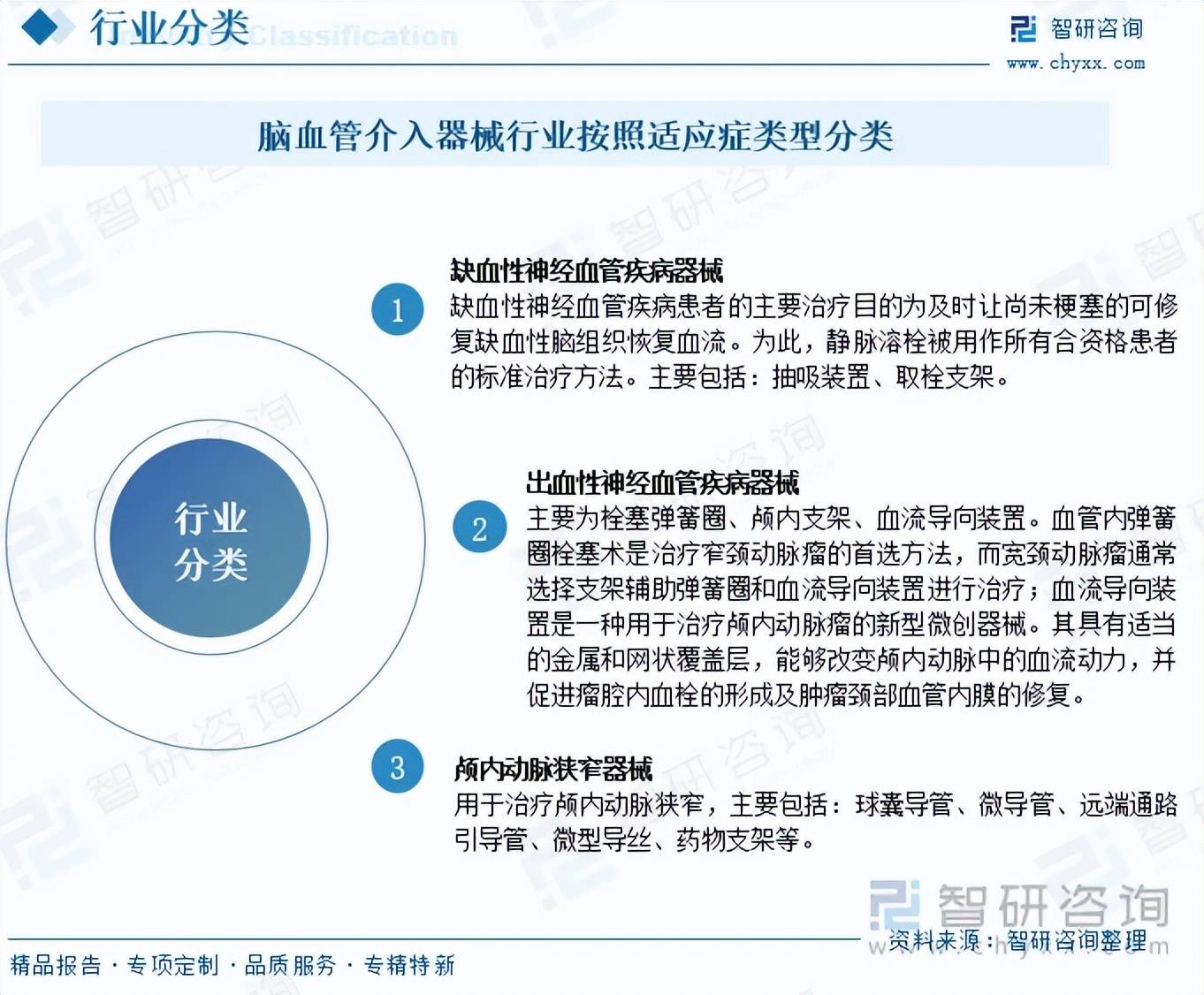
Core Viewpoint - The demand for cerebrovascular interventional devices in China is increasing due to the rising incidence of cerebrovascular diseases, which are among the top three causes of death in the country, with stroke being the leading cause [1][10]. Industry Definition and Classification - Cerebrovascular diseases are conditions affecting blood vessels in the brain, primarily including ischemic and hemorrhagic strokes. Cerebrovascular interventional surgery involves minimally invasive techniques for diagnosing and treating these conditions [2]. - Cerebrovascular interventional devices include medical consumables required for these surgeries, such as embolization coils, thrombectomy stents, and aspiration catheters [2]. Industry Characteristics - The cerebrovascular interventional device industry is characterized by high technical barriers, continuous technological innovation, and favorable industry policies [4]. Current Industry Status Global Market - The global market for cerebrovascular interventional devices is projected to reach USD 3.292 billion in 2024, with North America accounting for 43.04% of the market, Europe 26.56%, and Asia-Pacific 25.27%. The market is expected to grow to USD 3.974 billion by 2025 [7]. Chinese Market - In China, the market for cerebrovascular interventional devices is expected to reach CNY 3.504 billion in 2024, with specific segments such as intracranial thrombectomy stents at CNY 1.584 billion and aspiration catheters at CNY 0.272 billion. By 2025, the market is projected to grow to CNY 4.879 billion [10][13]. Industry Supply Chain - The upstream of the cerebrovascular interventional device industry consists of raw material suppliers, including tubing and alloy materials. The midstream includes manufacturers like Medtronic and Johnson & Johnson, while the downstream consists of distribution channels and end customers, primarily medical institutions [15].

心玮医疗-B(06609.HK)公司公告变更股份激励计划股份来源,12月16日股价下跌1.66%
Sou Hu Cai Jing· 2025-12-16 10:05
《变更股份激励的股份来源(注销现有股份奖励及授出新股份奖励)》 以上内容为证券之星据公开信息整理,由AI算法生成(网信算备310104345710301240019号),不构成 投资建议。 最新公告列表 截至2025年12月16日收盘,心玮医疗-B(06609)报收于49.66元,较前一交易日下跌1.66%。该股当日 开盘价为52.45元,盘中最高触及52.6元,最低下探至48.74元,全天成交额为296.11万元。近52周内,该 股最高报71.25元,最低为20.1元。 近日,上海心玮医疗科技股份有限公司发布公告称,董事会已决议变更股份激励计划的股份来源。公司 将注销根据2021年H股激励计划授出的430,500股奖励股份,该等股份原授予集团四名管理层及高级管理 层雇员。同日,公司依据2025年5月26日采纳的2025年H股激励计划,向相同承授人授出合计430,500股 H股作为新股份奖励,发行价为零。此次授出的新奖励股份占公司已发行H股总数约1.39%,占已发行 股本总额约1.12%。新奖励将于2027年6月30日归属,须满足个人表现目标(年度评估达"B"级以上)及 董事会厘定的财务、运营或市值目标。若出 ...
心玮医疗-B(06609.HK)注销现有股份奖励及授出新股份奖励
Ge Long Hui· 2025-12-15 12:11
Core Viewpoint - The company, 心玮医疗-B (06609.HK), has decided to cancel 430,500 shares of previously granted incentive stock under the 2021 H-share incentive plan, aiming to motivate management and reduce costs associated with the existing incentive program [1] Group 1 - The board believes that canceling the previously granted shares and reissuing new stock awards will encourage recipients to contribute to the company's success and reward their ongoing efforts [1] - The cancellation of the previous awards is contingent upon obtaining consent from the recipients [1] - The company plans to grant 430,500 shares under the new 2025 H-share incentive plan on December 15, 2025, to replace the previously granted awards [1]
心玮医疗(06609) - 变更股份激励的股份来源(註销现有股份奖励及授出新股份奖励)
2025-12-15 12:05
香港交易及結算所有限公司及香港聯合交易所有限公司對本公告的內容概不負責,對其準確 性或完整性亦不發表任何聲明,並明確表示,概不就因本公告全部或任何部分內容所產生或 因依賴該等內容而引致的任何損失承擔任何責任。 Shanghai HeartCare Medical Technology Corporation Limited 上 海 心 瑋 醫 療 科 技 股 份 有 限 公 司 ( 於 中 華 人 民 共 和 國 註 冊 成 立 的 股 份 有 限 公 司 ) (股份代號:6609) 變更股份激勵的股份來源 (註銷現有股份獎勵及授出新股份獎勵) 本公告由上海心瑋醫療科技股份有限公司(「本公司」,連同其附屬公司統稱「本 集團」)根據香港聯合交易所有限公司(「聯交所」)證券上市規則(「上市規則」) 第17.06A條刊發。 變更股份激勵的股份來源 茲提述本公司於2021年11月1日採納的2021年H股激勵計劃(隨後經修訂「2021年 H股激勵計劃」)。 本公司董事(「董事」)會(「董事會」)欣然宣佈,其建議通過實施以下步驟變更 其股份激勵計劃的股份來源。董事會認為,註銷先前授出獎勵(定義見下文)及 重新授出新股份獎 ...
心玮医疗-B(06609.HK):取消监事会
Ge Long Hui· 2025-12-12 14:55
Core Viewpoint - The company Xinwei Medical-B (06609.HK) announced changes in its governance structure in response to the new Company Law of the People's Republic of China, which will take effect on July 1, 2024 [1] Group 1: Governance Changes - According to the new Company Law, joint-stock companies can establish an audit committee composed of directors to exercise the powers previously held by the supervisory board, eliminating the need for a supervisory board [1] - On December 12, 2025, the board of directors will propose the cancellation of the supervisory board, with its powers being transferred to the audit committee [1]
心玮医疗-B(06609.HK)拟折价1.10%向张涵配售100万股内资股 净筹4325万港元
Ge Long Hui· 2025-12-12 14:49
认购事项所得款项总额为4500万港元。经扣除公司就认购事项应付的专业费用及其他费用后,认购事项 的全部所得款项净额约为4325万港元(相当于约人民币3926万元),即每股认购股份净价约为43.25港元。 该等所得款项净额拟分配作医疗器械行业的投资及并购机会,目前预计将于2028年12月31日前悉数动 用。 格隆汇12月12日丨心玮医疗-B(06609.HK)宣布,为进一步提升公司的整体竞争力、为集团经营活动筹集 额外资金及促进集团业务稳定发展,于2025年12月12日,董事会决议建议根据特别授权发行认购股份, 且公司与认购方(公司副总裁、首席财务官、首席运营官兼联席公司秘书张涵)订立认购协议,据此,公 司有条件同意配发及发行,而认购方有条件同意认购合共100万股内资股,认购价为45.00港元,较紧接 认购协议日期前的交易日联交所所报每股H股收市价(即45.50港元)折让约1.10%。 ...
心玮医疗(06609) - 建议取消监事会;及建议修订组织章程细则
2025-12-12 14:41
香港交易及結算所有限公司及香港聯合交易所有限公司對本公告的內容概不負責,對其準確 性或完整性亦不發表任何聲明,並明確表示,概不就因本公告全部或任何部分內容所產生或 因依賴該等內容而引致的任何損失承擔任何責任。 Shanghai HeartCare Medical Technology Corporation Limited 上 海 心 瑋 醫 療 科 技 股 份 有 限 公 司 ( 於 中 華 人 民 共 和 國 註 冊 成 立 的 股 份 有 限 公 司 ) (股份代號:6609) 建議取消監事會;及 建議修訂組織章程細則 本公告由上海心瑋醫療科技股份有限公司(「本公司」)根據香港聯合交易所有 限公司(「聯交所」)證券上市規則(「上市規則」)第13.51(1)及第13.51(2)條而刊發。 本公司董事(「董事」)會(「董事會」)宣佈,本公司擬向本公司股東(「股東」)提 案,以取消本公司監事會(「監事會」)及修訂本公司現行組織章程細則(「細則」)。 建議取消監事會 根據於 2024 年 7 月 1 日 起 施 行 的《中 華 人 民 共 和 國 公 司 法》修 正 案(「新《公 司 法》」),股份有限公司可以 ...