
Cinda Real Estate(600657)

Search documents
A股部分地产股拉升,招商蛇口涨超4%
Ge Long Hui A P P· 2025-11-20 03:32
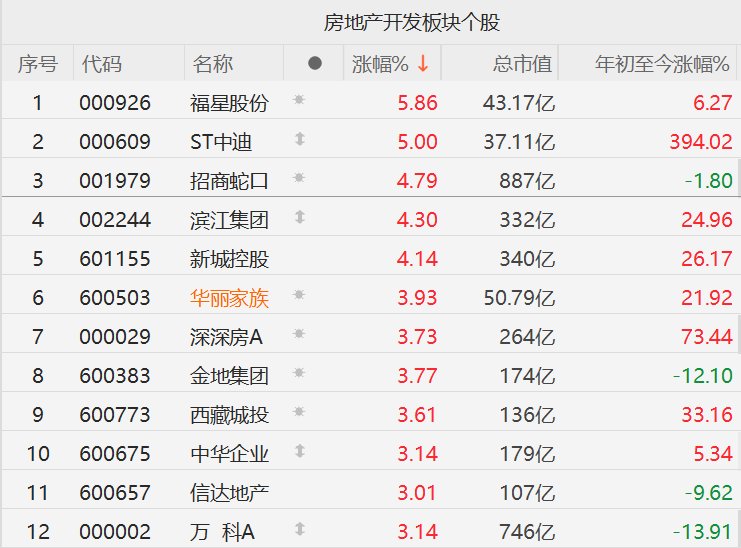
Group 1 - A-share market saw a rise in certain real estate stocks influenced by related rumors, with notable increases in stocks such as China Merchants Shekou, Binjiang Group, and New Town Holdings, which rose over 4% [1] - Other companies like Huayi Family, Shenzhen Housing A, Jindi Group, Tibet City Investment, China Enterprises, Xinda Real Estate, and Vanke A experienced increases of over 3% [1] Group 2 - The real estate development sector showed significant stock performance, with 福星股份 (Fuxing Co.) leading with a rise of 5.86% and a total market value of 4.317 billion [2] - ST中油 (ST Zhongyou) followed with a 5.00% increase and a market value of 3.711 billion, while 招商蛇口 (China Merchants Shekou) rose by 4.79% with a market cap of 88.7 billion [2] - Other notable performers included 滨江集团 (Binjiang Group) with a 4.30% increase and a market value of 3.32 billion, and 新城控股 (New Town Holdings) with a 4.14% rise and a market cap of 3.4 billion [2]



信达地产涨2.19%,成交额4197.30万元,主力资金净流入132.80万元
Xin Lang Zheng Quan· 2025-11-20 03:15
Core Viewpoint - Xinda Real Estate's stock price has shown a decline of 10.34% year-to-date, with recent trading activity indicating a slight recovery, as the stock rose by 2.19% on November 20, 2023 [1] Company Overview - Xinda Real Estate Co., Ltd. is located in Haidian District, Beijing, and was established on July 20, 1984. The company was listed on May 24, 1993, and its main business involves real estate development and property management [1] - The revenue composition of Xinda Real Estate includes: Residential 68.38%, Other (supplementary) 18.41%, Parking and other real estate products 5.01%, Commercial 4.48%, Leasing and others 3.72% [1] Financial Performance - For the period from January to September 2025, Xinda Real Estate reported operating revenue of 2.692 billion yuan, a year-on-year decrease of 23.06%. The net profit attributable to the parent company was -5.309 billion yuan, a significant year-on-year decrease of 6021.43% [2] - Since its A-share listing, Xinda Real Estate has distributed a total of 1.984 billion yuan in dividends, with 114 million yuan distributed over the past three years [3] Shareholder Information - As of September 30, 2025, the number of shareholders of Xinda Real Estate was 38,500, a decrease of 8.82% from the previous period. The average number of circulating shares per person increased by 9.67% to 74,026 shares [2] - Among the top ten circulating shareholders, Hong Kong Central Clearing Limited holds 14.149 million shares, an increase of 2.886 million shares compared to the previous period. South China CSI Real Estate ETF has reduced its holdings by 106,300 shares [3]

信达地产跌2.13%,成交额1698.05万元,主力资金净流出209.93万元
Xin Lang Cai Jing· 2025-11-19 02:06
Core Viewpoint - Xinda Real Estate's stock price has experienced a significant decline this year, with a year-to-date drop of 11.54% and a recent 60-day decline of 10.68% [2] Financial Performance - For the period from January to September 2025, Xinda Real Estate reported a revenue of 2.692 billion yuan, representing a year-on-year decrease of 23.06% [2] - The company recorded a net profit attributable to shareholders of -5.309 billion yuan, a substantial year-on-year decrease of 6021.43% [2] Stock Market Activity - On November 19, Xinda Real Estate's stock fell by 2.13%, trading at 3.68 yuan per share with a total market capitalization of 10.495 billion yuan [1] - The stock has seen a net outflow of 2.0993 million yuan in principal funds, with a selling proportion of 12.36% [1] Shareholder Information - As of September 30, 2025, the number of shareholders for Xinda Real Estate was 38,500, a decrease of 8.82% from the previous period [2] - The average circulating shares per person increased by 9.67% to 74,026 shares [2] Dividend Distribution - Since its A-share listing, Xinda Real Estate has distributed a total of 1.984 billion yuan in dividends, with 114 million yuan distributed over the past three years [3] Institutional Holdings - As of September 30, 2025, Hong Kong Central Clearing Limited was the sixth-largest circulating shareholder, holding 14.149 million shares, an increase of 2.886 million shares from the previous period [3] - Southern CSI Real Estate ETF and Southern CSI 1000 ETF were among the top ten circulating shareholders, with slight reductions in their holdings [3]
信达地产(600657) - 信达地产第一百零七次(2025年第一次临时)股东大会会议文件
2025-11-14 12:45
信达地产股份有限公司第一百零七次 (2025 年第一次临时) 股东大会会议文件 会议方式:现场方式+网络投票 二〇二五年十一月二十四日·北京 1 信达地产股份有限公司 第一百零七次(2025 年第一次临时)股东大会 会议文件 目 录 公司第一百零七次(2025 年第一次临时)股东大会会议议程...........3 关于取消监事会、修订《信达地产股份有限公司章程》的议案........6 2 公司第一百零七次(2025 年第一次临时) 股东大会会议议程 《关于取消监事会、修订<信达地产股份有限公司章程>的议案》 (二)与会股东发言 现场会议开始时间:2025 年 11 月 24 日上午 9:30 网络投票起止时间:自 2025 年 11 月 24 日至 2025 年 11 月 24 日,采用上海证券交易所网络投票系统,通过交易系统投票平台的投 票时间为股东大会召开当日的交易时间段,即 9:15-9:25,9:30-11:30, 13:00-15:00;通过互联网投票平台的投票时间为股东大会召开当日的 9:15-15:00。 会议地点:北京市海淀区中关村南大街甲 18 号北京国际大厦 A 座 10 楼会议室 会 ...
信达地产(600657) - 信达地产第一百零七次(2025年第一次临时)股东大会会议文件
2025-11-14 08:15
信达地产股份有限公司第一百零七次 (2025 年第一次临时) 股东大会会议文件 二〇二五年十一月二十四日·北京 1 信达地产股份有限公司 第一百零七次(2025 年第一次临时)股东大会 会议文件 目 录 公司第一百零七次(2025 年第一次临时)股东大会会议议程...........3 关于取消监事会、修订《信达地产股份有限公司章程》的议案........6 2 公司第一百零七次(2025 年第一次临时) 股东大会会议议程 会议方式:现场方式+网络投票 现场会议开始时间:2025 年 11 月 24 日上午 9:30 网络投票起止时间:自 2025 年 11 月 24 日至 2025 年 11 月 24 日, 采用上海证券交易所网络投票系统,通过交易系统投票平台的投票时 间为股东大会召开当日的交易时间段,即 9:15-9:25,9:30-11:30, 13:00-15:00;通过互联网投票平台的投票时间为股东大会召开当日的 9:15-15:00。 会议地点:北京市海淀区中关村南大街甲 18 号北京国际大厦 A 座 10 楼会议室 会议召集人:公司董事会 主要议程: 会议主持人:邓立新董事长 一、会议主持人宣布 ...
信达地产股份有限公司第十三届监事会第九次(临时)会议决议公告
Zhong Guo Zheng Quan Bao - Zhong Zheng Wang· 2025-11-08 00:23
Core Points - The company has decided to abolish the supervisory board and amend its articles of association accordingly [2][62] - The decision requires approval from the shareholders' meeting [3][10] - The supervisory board's responsibilities will be transferred to the audit committee of the board of directors [62] Group 1: Supervisory Board Cancellation - The supervisory board has been canceled, and the articles of association have been revised [2][62] - The resolution was passed unanimously with 4 votes in favor and no opposition [4] - The relevant supervisory board regulations will also be abolished [5][6] Group 2: Board of Directors Meeting - The board of directors held a meeting on November 7, 2025, to discuss the cancellation of the supervisory board [9][62] - The board approved multiple amendments to various internal regulations, including the audit committee's implementation rules [12][19][22] - All resolutions passed with unanimous support from the board members [11][13][21] Group 3: Shareholders' Meeting - The 107th shareholders' meeting is scheduled for November 24, 2025 [48] - Voting will be conducted through both on-site and online systems [48][49] - Shareholders must register to attend the meeting, with specific procedures outlined for both individual and corporate shareholders [56][57]
信达地产(600657) - 信达地产股份有限公司信息披露管理办法
2025-11-07 10:01
信达地产股份有限公司信息披露管理办法 第一章 总 则 第一条 为规范信达地产股份有限公司(以下简称"公司")信 息披露行为,做好信息归集、披露及保密工作,做到及时、公平、真 实、准确、完整地披露公司信息,维护股东和公司的合法权益,根据 《中华人民共和国证券法》(以下简称"《证券法》")《上市公司信息 披露管理办法》《上海证券交易所股票上市规则》(以下简称"《股票 上市规则》")《上海证券交易所上市公司自律监管指引第 2 号——信 息披露事务管理》等法律法规、规章、规范性文件、监管规则的规定 及《信达地产股份有限公司章程》(以下简称"《公司章程》"),制定 本办法。 第二条 公司股票及其衍生品种的信息披露及相关工作(以下简 称"信息披露工作")适用本办法的规定。 信息披露文件包括定期报告、临时报告、招股说明书、募集说明 书、上市公告书、收购报告书等。定期报告为年度报告、半年度报告、 季度报告,其他报告为临时报告。 第三条 本办法由公司董事会负责实施,由公司董事长作为实施 本办法的第一责任人,由董事会秘书负责具体协调。 第四条 董事会秘书为公司信息披露事务负责人。董事会办公室 为公司信息披露的常设机构,即信息披露 ...
信达地产(600657) - 信达地产股份有限公司投资者关系管理办法
2025-11-07 10:01
信达地产股份有限公司投资者关系管理办法 第一条 为了加强信达地产股份有限公司(以下简称"公司") 与投资者之间的信息沟通,促进投资者对公司的了解和认同,在公司 与投资者之间建立相互信任、利益一致的关系,实现公司价值最大化 和股东利益最大化,根据《中华人民共和国公司法》《中华人民共和 国证券法》《上市公司投资者关系管理工作指引》《上海证券交易所股 票上市规则》《上海证券交易所上市公司自律监管指引第 1 号——规 范运作》等有关法律、法规及规范性文件以及《信达地产股份有限公 司章程》,结合公司实际情况,制定本办法。 第二条 投资者关系管理是指公司通过便利股东权利行使、信息 披露、互动交流和诉求处理等工作,加强与投资者及潜在投资者之间 的沟通,增进投资者对公司的了解和认同,以提升公司治理水平和企 业整体价值,实现尊重投资者、回报投资者、保护投资者目的的相关 活动。 第三条 投资者关系管理的基本原则: (一)合规性原则。公司投资者关系管理应当在依法履行信息披 露义务的基础上开展,符合法律、法规、规章及规范性文件、行业规 范和自律规则、公司内部规章制度,以及行业普遍遵守的道德规范和 行为准则; (二)平等性原则。公司开 ...
信达地产(600657) - 信达地产股份有限公司董事、高级管理人员所持本公司股份及其变动管理办法
2025-11-07 10:01
信达地产股份有限公司 第五条 公司董事和高级管理人员在买卖本公司股份前,应当将 其买卖计划以书面方式通知董事会秘书,董事会秘书应当核查公司信 息披露及重大事项等进展情况,如该买卖行为可能违反法律法规、上 交所相关规定、《公司章程》和其所作承诺的,董事会秘书应当及时 通知相关董事和高级管理人员。 第二条 本办法适用于公司的董事和高级管理人员所持本公司 A 股股份及其变动的管理。 第三条 公司董事和高级管理人员所持本公司股份,是指登记在 其名下和利用他人账户持有的所有本公司股份。 公司董事和高级管理人员从事融资融券交易的,还包括记载在其 信用账户内的本公司股份。 第四条 公司董事和高级管理人员所持股份变动行为应当遵守 法律法规、上海证券交易所(以下简称"上交所")相关规定以及《公 司章程》等规定。 1 公司董事和高级管理人员对持有股份比例、持有期限、变动方式、 变动数量、变动价格等作出承诺的,应当严格履行所作出的承诺。 第二章 股份变动管理 董事、高级管理人员所持本公司股份及其变动管理办法 第一章 总 则 第一条 为加强对信达地产股份有限公司(以下简称"公司")董 事、高级管理人员所持本公司股份及其变动的管理,维 ...
信达地产(600657) - 信达地产股份有限公司募集资金管理办法
2025-11-07 10:01
信达地产股份有限公司募集资金管理办法 第一章 总 则 本办法所称超募资金是指实际募集资金净额超过计划募集资金 金额的部分。 第三条 公司募集资金应当专款专用。公司使用募集资金应当符 合国家产业政策和相关法律法规,践行可持续发展理念,履行社会责 任,原则上应当用于主营业务,有利于增强公司竞争能力和创新能力。 中国证监会及上海证券交易所相关规则对公司发行股份、可转换 公司债券购买资产并募集配套资金用途另有规定的,从其规定。 第四条 公司董事会应当持续关注募集资金存放、管理和使用情 况,有效防范投资风险,提高募集资金使用效益。公司董事和高级管 1 理人员应当勤勉尽责,督促公司规范使用募集资金,确保公司募集资 金安全,不得操控公司擅自或变相改变募集资金用途。 第五条 募集资金限定用于公司对外披露的募集资金投向,公司 董事会应当制订详细的资金使用计划,做到资金使用规范、公开、透 明。 第一条 为规范信达地产股份有限公司(以下简称"公司")募集 资金的存放、使用与管理,提高募集资金使用效益,切实保护投资者 利益,根据《中华人民共和国公司法》《中华人民共和国证券法》《上 市公司证券发行注册管理办法》《上市公司募集资金监管规 ...