
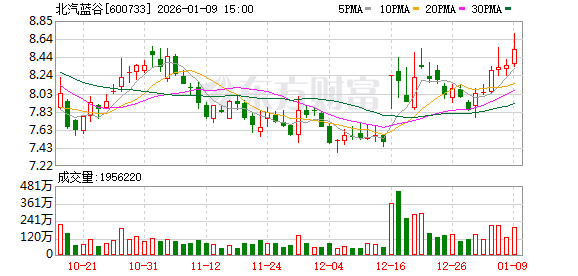
BAIC BluePark(600733)

Search documents
北汽新能源与小马智行全面深化战略合作
Xin Hua Cai Jing· 2026-01-12 01:48
Group 1 - The core viewpoint of the article is that BAIC New Energy and Pony.ai have officially established a comprehensive strategic cooperation to promote the "Chinese solution" of the Arcfox Alpha T5 Robotaxi globally, focusing on markets in the Middle East and Europe [1] - The partnership aims to develop a benchmark system that includes technology standards, efficient and replicable operational models, and a collaborative business ecosystem [1] - Since the strategic signing at the first Technology Day in November 2024, the two companies have completed the mass production of 600 Arcfox Alpha T5 Robotaxis and have initiated full operations in Beijing and Shenzhen [1]

小马智行与北汽新能源全面深化战略合作
Zheng Quan Shi Bao Wang· 2026-01-12 01:40
Core Viewpoint - The autonomous driving company Pony.ai and BAIC New Energy have officially established a comprehensive deepening strategic cooperation, marking the beginning of Cooperation 2.0 phase focused on the mass production and commercialization of L4 level Robotaxi [1] Group 1 - The partnership aims to expand the breadth and depth of collaboration based on the successful experience of large-scale production and operation of L4 level Robotaxi [1] - The focus areas of the collaboration include the mass production, commercialization, and globalization of autonomous driving technology [1]
“终于上路了”!北汽、长安等车企竞逐L3
Xin Lang Cai Jing· 2026-01-11 11:44
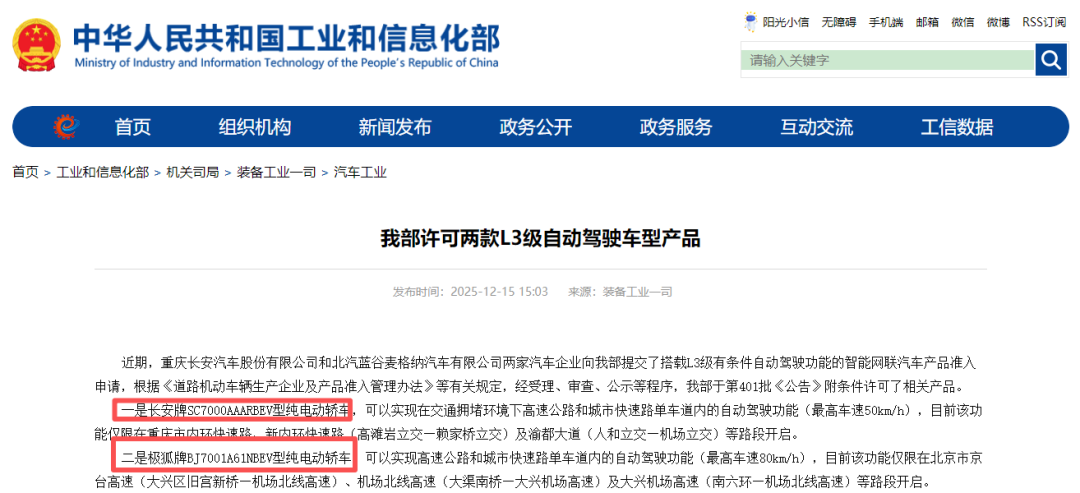
Core Insights - The approval of L3 conditional autonomous driving vehicles by the Ministry of Industry and Information Technology marks a significant step towards commercial application in China [4][18] - Companies like BAIC and Changan are leading the charge in the L3 autonomous driving sector, with their models set to begin trial operations [1][2] Group 1: L3 Autonomous Driving Approval - The first batch of L3 conditional autonomous driving vehicles approved includes the BAIC Arcfox Alpha S (L3 version) and Changan SC7000AAARBEV [1][2] - These vehicles are designed for specific urban and highway scenarios, with the Arcfox model capable of operating at speeds up to 80 km/h on designated routes in Beijing [2][3] - The approval process involves a phased approach, with commercial operations expected to gradually open to individual users by Q2 2026 [3][12] Group 2: Competitive Landscape - Multiple automakers, including BYD, NIO, and Geely, are vying for entry into the L3 autonomous driving market, with some obtaining local government permits for testing [2][14] - The distinction between permits from the Ministry of Industry and Information Technology and local governments lies in their nature; the former allows for commercial pilot projects, while the latter focuses on research and development [15][17] - Geely's Zeekr 9X has received a testing permit covering over 9,224 square kilometers in Hangzhou, indicating the scale of testing efforts [14] Group 3: Future Developments - The industry anticipates 2026 to be a pivotal year for the mass production of L3 autonomous driving technology, with potential breakthroughs in L4 technology as well [6][18] - BAIC is committed to expanding its lineup of vehicles equipped with L3 technology, indicating a long-term strategy in the autonomous driving space [18] - The partnership between BAIC and Pony.ai aims to develop a comprehensive operational model for Robotaxi services, showcasing the industry's focus on commercializing autonomous driving [19]

“终于上路了”!车企竞逐L3
Zhong Guo Ji Jin Bao· 2026-01-11 11:19
Core Insights - The article discusses the approval of L3 conditional autonomous driving vehicles by the Ministry of Industry and Information Technology in China, highlighting the competitive landscape among various automotive companies to secure entry into this advanced driving technology market [2][11]. Group 1: Approval and Launch of L3 Vehicles - BAIC's Arcfox Alpha S (L3 version) has officially started trial operations for L3 conditional autonomous driving [2][6]. - The first batch of approved L3 vehicles includes the Arcfox BJ7001A61NBEV and Changan SC7000AAARBEV, which are set to operate in designated areas in Beijing and Chongqing [6][11]. - The L3 vehicles are designed for specific scenarios, such as urban congestion and highway driving, with a maximum speed of 80 km/h [7][8]. Group 2: Competitive Landscape - Multiple companies, including BYD, NIO, and Geely, are vying for L3 conditional autonomous driving permits, with some obtaining local government approvals for testing [5][9]. - The distinction between the approvals from the Ministry and local governments lies in their nature; the former allows for commercial trial operations, while the latter is focused on research and testing [10][12]. Group 3: Future Developments and Collaborations - The industry is moving towards mass production of L3 technology, with 2026 anticipated as a pivotal year for its commercial launch [13]. - BAIC is collaborating with Pony.ai to enhance its Robotaxi services, aiming to expand its autonomous driving capabilities across various urban and highway scenarios [14]. - The development of Robotaxi services is seen as a significant opportunity for commercializing autonomous driving technology [14].
“终于上路了”!车企竞逐L3
中国基金报· 2026-01-11 11:13
Core Viewpoint - The article discusses the recent approval of L3 level conditional autonomous driving vehicles by the Ministry of Industry and Information Technology in China, highlighting the competitive landscape among various automotive companies to secure entry into this advanced driving technology market [2][4][12]. Group 1: Approval and Launch of L3 Vehicles - BAIC and Changan have received approval for their L3 level conditional autonomous driving vehicles, marking a significant step in the commercialization of autonomous driving technology in China [4][12]. - The first batch of approved L3 vehicles includes the BAIC Arcfox Alpha S and Changan SC7000AAARBEV, which are set to operate in designated areas in Beijing and Chongqing [4][12]. - The BAIC Arcfox Alpha S can achieve autonomous driving at speeds up to 80 km/h on specific highways and urban expressways, with plans to gradually open access to individual users by Q2 2026 [12][13]. Group 2: Competitive Landscape and Testing - Multiple automotive companies, including BYD, NIO, and Geely, are competing for L3 level conditional autonomous driving licenses, with some obtaining local government permits for road testing [7][15]. - The distinction between the licenses issued by the Ministry of Industry and local governments is significant; the former allows for commercial pilot operations, while the latter is primarily for research and testing purposes [16]. - Geely's vehicles have received road testing permits in Hangzhou, covering an area of 9,224 square kilometers, which will help in accumulating real-world data for optimizing autonomous driving technologies [15][16]. Group 3: Future Developments and Collaborations - The approval of L3 vehicles is seen as a pivotal moment for the autonomous driving industry, with expectations that 2026 will mark the beginning of mass production for L3 technology [18]. - BAIC is planning to introduce more high-end models equipped with L3 technology and is focusing on the development of Robotaxi services as a key application for commercializing autonomous driving [18][19]. - A strategic partnership between BAIC and Pony.ai aims to promote the deployment of the Arcfox T5 Robotaxi, with plans to establish a comprehensive operational model and technical standards for global markets [19][21].
从L3规模运营到L4全球输出,北汽新能源自动驾驶商业化版图已明
Bei Jing Shang Bao· 2026-01-11 11:10
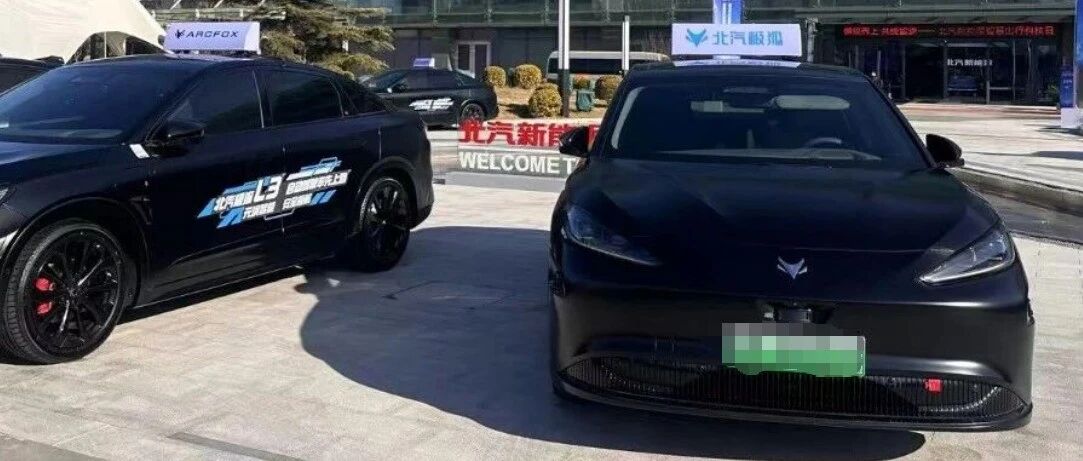
Core Insights - The article discusses the launch of the large-scale trial operation of the BAIC Arcfox Alpha S (L3 version) on January 10, marking a significant step in the commercialization of autonomous driving in China [1][3] - The collaboration between BAIC New Energy and Pony.ai aims to promote the global rollout of the Arcfox Alpha T5 Robotaxi, with 600 units already produced [4][5] Group 1: Trial Operation and Technology - The trial operation of the Arcfox Alpha S (L3 version) will initially focus on B-end users, with plans to gradually open to individual users by Q2 2026 as supporting policies mature [3][5] - The vehicle features a robust safety design with 34 high-performance sensors, including three LiDARs, enabling 360-degree environmental perception [3][6] - BAIC's "Yuanjing Intelligent" technology system, set to launch in 2025, aims to enhance safety through a comprehensive three-tier protection system [3][6] Group 2: Strategic Collaboration and Global Expansion - The partnership between BAIC New Energy and Pony.ai is described as a "five-in-one" strategic collaboration, focusing on the global deployment of the Arcfox Alpha T5 Robotaxi [4][5] - The goal is to achieve 3,000 Robotaxi operations by the end of the year, supported by the recent production of 600 units [5][6] - The collaboration will also target international markets, particularly in the Middle East and Europe, to establish a comprehensive ecosystem for autonomous driving [5][6] Group 3: Financial Challenges and Profitability - Despite advancements, the autonomous driving industry faces profitability challenges, as evidenced by significant losses reported by competitors like WeRide and Pony.ai [7][8] - The focus on cost reduction through supply chain optimization and scaling production is essential for improving profitability [8] - The long-term vision includes achieving breakeven by 2030, with expectations of a fleet size exceeding 100,000 Robotaxis [7][8]
北汽新能源L3车型开启规模化上路通行试点运营
Zhong Guo Qing Nian Bao· 2026-01-11 08:34
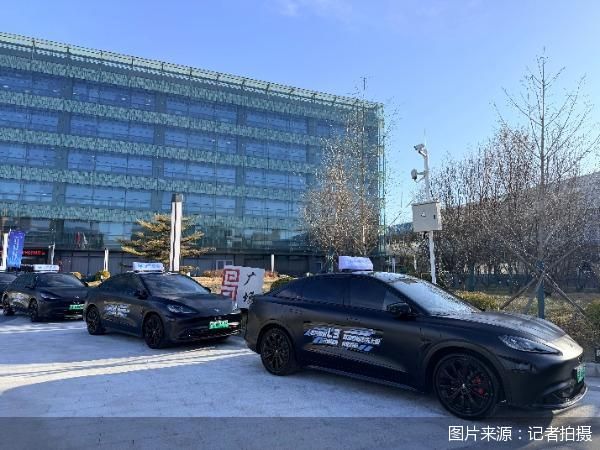
Group 1 - The core viewpoint of the article highlights that Beijing Automotive Group's New Energy division is one of the earliest companies in China to develop autonomous driving technology, achieving full coverage from L2 to L4 levels [2] - The launch of the Baic Jihe Alpha S (L3 version) marks the beginning of large-scale pilot operations for autonomous driving in designated areas such as the Beijing-Taiwan Expressway and Daxing Airport Expressway [2] - The company has developed a high-end intelligent connected technology system called "Yuanjing Intelligent," which includes a comprehensive safety assurance system to ensure vehicle safety during operations [2] Group 2 - The pilot operation strategy is to initially focus on B-end users and gradually open up to individual users starting from the second quarter of 2026, pending the maturation of relevant supporting policies [2] - Future plans include the introduction of more high-end models equipped with L3 autonomous driving technology [2]
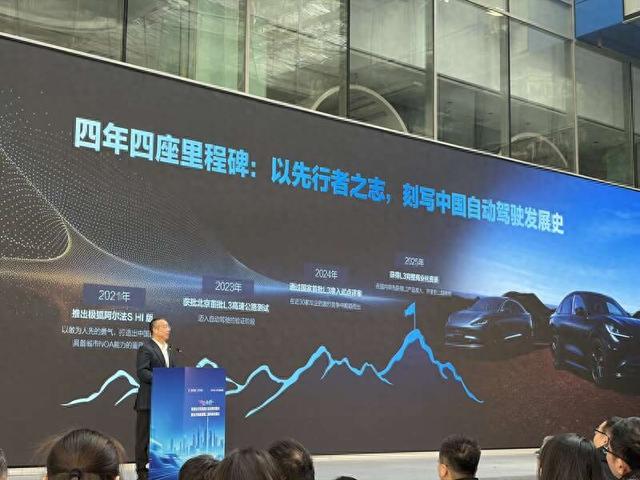
北汽新能源与北京出行启动L3车型规模化上路通行试点运营
Cai Jing Wang· 2026-01-11 02:08
Group 1 - The core viewpoint of the article is that Beijing Automotive Group (BAIC) and Beijing Mobility have launched a pilot operation for the BAIC Arcfox Alpha S (L3 version) on January 10, with plans for gradual rollout to individual users in the second quarter of this year [1] Group 2 - The first batch of vehicles will be deployed in designated areas along the Jing-Tai Expressway, Airport North Line Expressway, and Daxing Airport Expressway [1]
又一批L3上路!二季度将向个人用户开放
Zhong Guo Zheng Quan Bao· 2026-01-10 13:44
Core Viewpoint - The launch of the L3 version of the Arcfox Alpha S by BAIC New Energy marks a significant step in the commercialization of autonomous driving in China, with plans for trial operations beginning in designated areas [2][5][7]. Group 1: Launch and Operations - BAIC New Energy announced the initiation of trial operations for the Arcfox Alpha S (L3 version) in collaboration with Beijing Mobility, with a focus on safety and a phased approach to opening up to individual users by Q2 2026 [2][6]. - The first batch of 30 L3 autonomous vehicles is set to operate in specific areas of major highways, including the Beijing-Taipei and Daxing Airport highways [3][5]. - The L3 vehicles will initially operate under limited conditions, including specific scenarios, road segments, and speed limits, as part of the regulatory framework for autonomous driving [5][6]. Group 2: Industry Implications - The approval of the L3 autonomous vehicles signifies a transition from technology validation to mass application in the autonomous driving sector, highlighting BAIC New Energy's role as a key player in this evolution [7]. - The collaboration with Pony.ai aims to expand the Robotaxi service globally, with significant progress already made in mass production and operational deployment of the Arcfox Alpha T5 Robotaxi [8]. - The shared mobility market in China is shifting towards high-quality growth, with Robotaxi technology expected to fundamentally optimize the cost structure of the industry and drive the next growth curve [9].
加速推动自动驾驶商业化落地 北汽新能源L3车型开启规模化上路通行试点运营
Bei Jing Ri Bao Ke Hu Duan· 2026-01-10 12:42
Core Viewpoint - The launch of the BAIC Arcfox Alpha S (L3 version) marks a significant step towards the commercialization of autonomous driving in China, with pilot operations beginning on designated highways [1] Group 1: Company Developments - BAIC New Energy is one of the earliest companies in China to invest in autonomous driving technology, achieving coverage from L2 to L4 levels [1] - The company plans to introduce a high-end intelligent connected technology system called "Yuanjing Intelligent" by 2025, which includes a comprehensive safety assurance system [1] - The pilot operation will initially adopt a "B-end first, gradually open" strategy, with plans to open to individual users by the second quarter of 2026 [1] Group 2: Industry Trends - The pilot operation signifies that the autonomous driving industry in China is accelerating towards large-scale commercial implementation [1] - Future models equipped with L3 autonomous driving technology are expected to be launched by BAIC New Energy [1]