PICC(601319)

Search documents
上市险企权益资产配置 一手抓股息一手抓成长
Zhong Guo Zheng Quan Bao· 2025-08-29 20:14
Core Viewpoint - The five major listed insurance companies in A-shares have all released their semi-annual performance reports, showing a significant impact from the investment side, particularly in the context of a low interest rate environment, which has pressured fixed-income asset returns and led to a strategic shift towards equity investments, especially high-dividend assets [1][2][4]. Investment Asset Growth - All five major insurance companies reported growth in investment assets compared to the beginning of the year, with increases ranging from 5.1% to 8.2%. A significant portion of this growth came from A-share investments, with China Pacific Insurance reporting a 26.1% increase in A-share investment assets [2][3]. Impact of Low Interest Rates - The pressure on fixed-income asset returns has accelerated the search for alternative assets among insurance companies. For instance, China Pacific Insurance reported a total investment yield of 2.3%, down 0.4 percentage points year-on-year, primarily due to declines in the fair value of fixed-income assets [3][4]. Diversification into Equity Assets - In response to the low interest rate environment, insurance companies are increasingly diversifying their asset allocations to include more equity assets, particularly high-dividend stocks, which are seen as stabilizing factors for overall investment returns [4][5]. Focus on Growth Stocks - The insurance companies are not only focusing on stable cash flows from their investments but are also looking to capture excess returns by identifying growth-oriented targets. This dual approach aims to balance stability and growth potential in their investment strategies [6][7]. Strategic Investment Areas - Companies like China Life and China Insurance are emphasizing the optimization of their equity allocation structures, focusing on sectors such as technology innovation, advanced manufacturing, and new consumption, which align with national strategic directions [7].





上半年新增超6400亿险资入市 重仓股浮出水面
Zhong Guo Jing Ying Bao· 2025-08-29 18:27
Core Viewpoint - The A-share market is experiencing a "slow bull" trend, with significant inflows from various funds, particularly insurance capital, leading to a new high in the Shanghai Composite Index and total market capitalization [1][2]. Insurance Capital Investment Trends - As of the end of Q2 2025, the balance of insurance company funds reached 36.23 trillion yuan, a year-on-year increase of 17.4% [1]. - Insurance capital's stock investment balance exceeded 3 trillion yuan, with a net increase of 640.6 billion yuan in the first half of the year, marking a significant rise [1][2]. - In 2024, insurance capital saw a substantial increase in stock investments, totaling 485.5 billion yuan, reversing a cautious trend from previous years [2]. Investment Structure and Strategy - The proportion of insurance capital allocated to stocks has been increasing for five consecutive quarters, with a notable 8.9% growth from Q1 to Q2 2025 [2]. - The investment strategy is shifting towards equities due to low long-term bond yields and the need to enhance returns amid declining net investment income [2][3]. - Regulatory changes have created a more favorable environment for insurance capital to enter the stock market, including increased investment limits for equity assets [3]. Sector Preferences and Stock Characteristics - Insurance capital has shown a preference for high-dividend and high-growth potential stocks, particularly in sectors like banking, chemicals, machinery, and new energy [6][8]. - The banking sector has been particularly favored, with 14 instances of insurance capital increasing stakes in seven banks, attributed to their stable dividends and solid performance [7]. - Notable companies attracting insurance capital include Yuntianhua, Dongmu Co., and Zhongjian Technology, which are seen as benefiting from economic recovery and industry upgrades [8]. Future Investment Outlook - Insurance institutions are optimistic about sectors such as pharmaceuticals, electronics, banking, and new energy, with a focus on high-dividend and innovative companies [9][10]. - The investment approach is expected to evolve towards a "dumbbell" strategy, balancing traditional stable investments with growth opportunities in new sectors [9][10]. - Major insurance companies like China Life and China Ping An are committed to enhancing their equity allocations, focusing on high-quality stocks and sectors aligned with national strategies [10][11].
中国人保:适时加大投资力度 增加OCI股票配置
2 1 Shi Ji Jing Ji Bao Dao· 2025-08-29 14:34
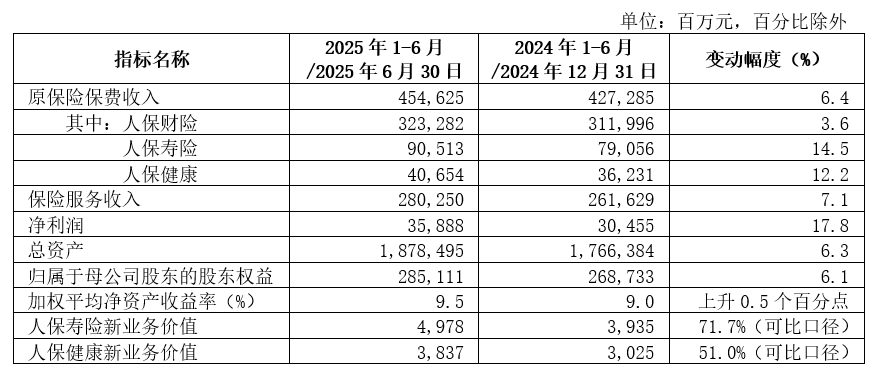
Core Viewpoint - China People's Insurance Group Co., Ltd. (China PICC) reported strong financial performance for the first half of 2025, with significant growth in premium income and net profit, indicating a positive outlook for the insurance sector in China [1][2][10]. Financial Performance - In H1 2025, China PICC achieved original insurance premium income of CNY 454.625 billion, a year-on-year increase of 6.4% [1]. - Net profit reached CNY 35.888 billion, reflecting a year-on-year growth of 17.8% [1]. - Total assets amounted to CNY 1.87 trillion, up 6.3% from the beginning of the year [1]. - Investment assets exceeded CNY 1.7 trillion, growing by 7.2% year-to-date, with total investment income of CNY 41.478 billion, a 42.7% increase year-on-year [1][10]. Strategic Focus - The company emphasized three strategic areas: enhancing insurance protection functions, improving development quality, and deepening reforms [2][3]. - Insurance liability amounts reached CNY 178 trillion, with claims payments of CNY 233.5 billion, marking increases of 6.9% and 14% respectively [2]. Business Segments - Non-auto insurance "reporting and execution" policy is expected to be implemented by Q4 2025, which aims to stabilize the market and improve underwriting capabilities [5]. - In the life insurance segment, premium income was CNY 90.513 billion, up 14.5%, with new business value increasing by 71.7% [6]. - Health insurance is projected to grow, driven by rising demand for long-term care and disability insurance due to an aging population [7]. Market Position and Stock Performance - China PICC's stock prices reached record highs, with A-shares at their highest in nearly six years and H-shares at their highest in 13 years [8]. - The company attributes stock price increases to favorable economic conditions, improved development environments, and strong fundamentals [9]. Investment Strategy - The company plans to increase its allocation to high-dividend stocks, particularly in a declining interest rate environment [10]. - Future investments will focus on high-potential targets aligned with national strategic directions, utilizing methods such as private placements and strategic investments [11].
中国人保(601319):COR显著改善,NBV延续高增
HUAXI Securities· 2025-08-29 13:38
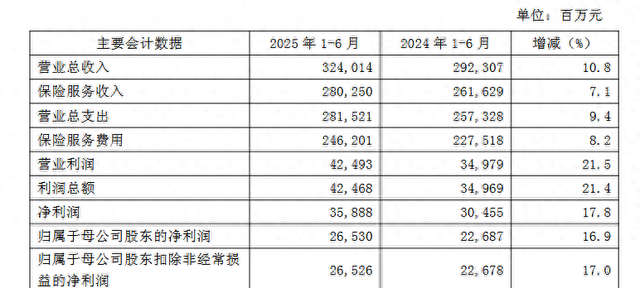
Investment Rating - The investment rating for the company is "Buy" [1][7] Core Views - The company reported a significant improvement in its combined operating ratio (COR) and continued high growth in new business value (NBV) [2][3] - The company achieved a revenue of 324.01 billion yuan in H1 2025, representing a year-on-year increase of 10.8%, and a net profit attributable to shareholders of 26.53 billion yuan, up 16.9% year-on-year [2] - The company plans to distribute an interim cash dividend of 0.075 yuan per share, an increase of 19.0% year-on-year [2] Summary by Sections Premium Growth and Underwriting Improvement - In H1 2025, the company achieved original premium income of 323.28 billion yuan, a year-on-year increase of 3.6%, with insurance service income of 249.04 billion yuan, up 5.6% [3] - The underwriting profit reached 11.70 billion yuan, a year-on-year increase of 53.5%, with a COR of 95.3%, improving by 1.5 percentage points year-on-year [3] - The combined loss ratio increased by 1.6 percentage points to 72.3%, while the combined expense ratio improved by 3.1 percentage points to 23.0% [3] Life and Health Insurance NBV Growth - The NBV for life insurance increased by 71.1% year-on-year to 4.978 billion yuan, with the bank insurance channel contributing significantly with a 108% increase [4] - The NBV for health insurance grew by 51% year-on-year to 3.837 billion yuan, driven by improved payment structures and reduced channel commissions [4] - The life insurance service income was 14.018 billion yuan, up 32.5% year-on-year, while original premium income increased by 14.5% [4] Investment Income and Asset Allocation - As of mid-2025, the company's investment assets reached 1,760.67 billion yuan, a year-on-year increase of 7.24% [5] - Total investment income for H1 2025 was 41.478 billion yuan, up 42.7% year-on-year, with net investment income of 30.324 billion yuan, an increase of 13.2% [5] - The annualized total investment return rate was 5.1%, up 1.0 percentage points year-on-year [5] Profit Forecast and Valuation - The company maintains its profit forecast, expecting revenues of 659.5 billion yuan, 712.6 billion yuan, and 736.8 billion yuan for 2025-2027 [6] - The expected net profit attributable to shareholders for the same period is 45.5 billion yuan, 49.1 billion yuan, and 52.9 billion yuan respectively [6] - The projected earnings per share (EPS) for 2025-2027 are 1.03 yuan, 1.11 yuan, and 1.20 yuan [6]
一周保险速览(8.22—8.29)
Cai Jing Wang· 2025-08-29 12:26
Regulatory Developments - The Financial Regulatory Bureau supports insurance institutions in Fujian to develop innovative insurance products covering both sides of the Taiwan Strait [1] - Three departments, including the People's Bank of China, issued a notice to explore a forest insurance product system, including index insurance, yield insurance, income insurance, and liability insurance [2] Industry Performance - In the first half of 2025, the five major listed insurance companies in A-shares achieved a total net profit of 178.19 billion yuan, a year-on-year increase of 3.7%, with New China Life Insurance showing the highest profit growth rate of 33.5% [3] - Insurance capital has increasingly invested in equity assets, with two new equity investment funds established, totaling nearly 27 billion yuan, driven by declining fixed-income asset yields and improved market conditions [4] Company Updates - China Ping An reported a net profit of 68.05 billion yuan for the first half of 2025, with a new business value growth of 39.8% [5] - China Pacific Insurance achieved a net profit of 26.53 billion yuan in the first half of 2025, a year-on-year increase of 16.9% [6] - China Life Insurance reported a net profit of 40.93 billion yuan, a year-on-year increase of 6.9%, with total assets exceeding 7 trillion yuan [7] - New China Life Insurance reported a net profit of 14.8 billion yuan, a year-on-year increase of 33.5%, with a new business value growth of 58% [9] - China Taiping achieved an insurance service performance of 11.35 billion yuan, with a significant transformation in its participating insurance business [10]
中国人保上半年业绩创多个“新高”,财险一哥如何“反内卷”
Nan Fang Du Shi Bao· 2025-08-29 11:44
"2025年上半年,集团合并资产达到3895亿元、集团合并利润为359亿元、总投资收益达415亿元、人身 险新业务价值为88亿元,均创历史同期新高;财产险综合成本率达95.30%,创近10年同期最好水平。" 此外,中国人保(601319)A股、H股股价分别在上半年迎来近6年和上市13年来的最高价,在港交所上 市的财险主体部分中国财险迎来了上市22年来的最高价。 8月28日,在中国人民保险集团有限公司(下称"中国人保")的中期业绩发布会上,中国人保总裁赵鹏 以8个"新高"描述公司业绩。 在良好业绩的支撑下,8月29日,中国人保A股股价开盘走高,一度涨超6%,截至下午收盘,收于8.98 元/股,涨幅3.10%。 未来将加大投资力度 对于股价创新高的逻辑,赵鹏解释称,核心源于三大支撑:一是我国经济社会高质量发展,为保险业带 来了历史性发展机遇;二是监管政策持续引导行业回归保障本源,车险综合改革、预定利率动态调整、 银保渠道"报行合一"等举措优化了行业发展环境;三是公司自身基本面扎实,价值创造能力显著增强, 为资本市场信心注入"强心剂"。 记者留意到,在一系列重要政策陆续出台的背景下,2025年资本市场回暖,推升了险 ...
中国人保2025年中报:净利润增16.9%,多项指标创新高
Hua Er Jie Jian Wen· 2025-08-29 10:23
Core Viewpoint - The company has demonstrated significant achievements in high-quality development, with record-breaking performance metrics in various sectors, indicating a strong upward trend in its operations and financial health [2][3][4]. Business Performance Overview - The company achieved a total premium income of 454.6 billion yuan, representing a year-on-year growth of 6.4%, with property insurance premiums at 323.3 billion yuan (up 3.6%) and life insurance premiums at 131.2 billion yuan (up 13.8%) [3]. - The comprehensive cost ratio for property insurance was 95.3%, the best level in nearly a decade, while the new business value for life insurance reached 8.8 billion yuan, a historical high [2]. - The total investment income was 41.5 billion yuan, also a record for the same period [2]. Investment and Asset Growth - As of June 30, 2025, the company's investment asset scale exceeded 1.7 trillion yuan, reflecting a growth of 7.2% since the beginning of the year [4]. Business Structure Optimization - The proportion of life insurance premiums in total premium income increased by 1.9 percentage points, with personal non-auto insurance premiums growing at a rate of 16.6%, significantly outpacing overall premium growth [5]. - The first-year premium income for life insurance reached 87 billion yuan, marking a year-on-year increase of 17.2% [5]. Profitability and Capital Strength - The group reported a net profit of 35.9 billion yuan, a historical high for the same period, with insurance service performance at 27.7 billion yuan and investment performance at 17.5 billion yuan, up 78.3% year-on-year [6]. - The group's net assets reached 389.5 billion yuan, a 6.1% increase from the beginning of the year, with core solvency ratios at 219% [6]. Risk Management and Control - The company maintained a stable risk appetite with no major risk events reported, and its risk ratings improved across various segments [7]. - The net cash flow from operating activities increased by 6.9% year-on-year, indicating effective cash management [7]. Social Responsibility and Economic Impact - The company served 317 million individual clients and 7.94 million institutional clients, with risk coverage amounts reaching 178 trillion yuan and claims payments of 233.5 billion yuan, both leading the industry [8]. - The company actively participated in disaster relief efforts, providing comprehensive insurance coverage for major disasters [9]. Strategic Initiatives and Future Focus - The company plans to enhance its functional capabilities to support economic and social development, focusing on high-quality growth and risk prevention [11][12]. - Key areas of focus include improving service quality in property and life insurance, driving innovation in health insurance products, and enhancing investment capabilities [12][13].

中国人保:适时加大投资力度 增加OCI股票配置|直击业绩会
2 1 Shi Ji Jing Ji Bao Dao· 2025-08-29 10:04
Core Viewpoint - China People's Insurance Group Co., Ltd. (China PIC) reported strong financial performance for the first half of 2025, with significant growth in premium income and net profit, indicating a positive outlook for the insurance sector in China [1][10]. Financial Performance - In the first half of 2025, China PIC achieved original insurance premium income of CNY 454.625 billion, a year-on-year increase of 6.4% [1]. - The net profit for the same period was CNY 35.888 billion, reflecting a year-on-year growth of 17.8% [1]. - As of June 30, 2025, total assets reached CNY 1.87 trillion, up 6.3% from the beginning of the year [1]. - Investment assets exceeded CNY 1.7 trillion, growing by 7.2% year-to-date, with total investment income of CNY 41.478 billion, a 42.7% increase year-on-year [1][11]. Strategic Focus - The company emphasized three strategic areas for enhancing its operations: strengthening insurance coverage, improving development quality, and deepening reforms [2][3]. - Insurance liability amounts reached CNY 178 trillion, with claims payments of CNY 233.5 billion, marking increases of 6.9% and 14% respectively [2]. Non-Motor Insurance Developments - The non-motor insurance sector is expected to see the implementation of the "reporting and operation integration" policy by the fourth quarter of 2025, which aims to stabilize market order and improve underwriting capabilities [5][6]. - The company anticipates that this policy will positively impact non-motor insurance performance in 2025 and significantly improve results in 2026 [6]. Life and Health Insurance Growth - In the life insurance segment, premium income reached CNY 90.513 billion, a 14.5% increase, with new business value rising by 71.7% to CNY 4.978 billion [7]. - Health insurance premiums totaled CNY 40.654 billion, up 12.2%, indicating strong growth potential in the health insurance market driven by aging population and increasing demand for long-term care [8]. Investment Strategy - The company has increased its investment in high-dividend stocks, which are expected to provide stable returns amid declining yields from traditional fixed-income assets [11][12]. - China PIC plans to enhance its equity investment strategies and focus on high-potential investment targets that align with national strategic directions [12].
保险板块8月29日涨1.95%,新华保险领涨,主力资金净流入9413.95万元
Zheng Xing Xing Ye Ri Bao· 2025-08-29 08:48
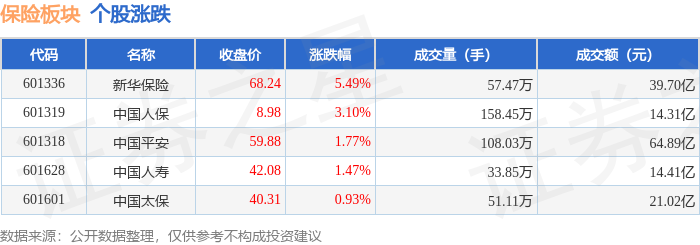
从资金流向上来看,当日保险板块主力资金净流入9413.95万元,游资资金净流出5.07亿元,散户资金净 流入4.13亿元。保险板块个股资金流向见下表: | 代码 | 名称 | 收盘价 | 涨跌幅 | 成交量(手) | 成交额(元) | | --- | --- | --- | --- | --- | --- | | 601336 | 新华保险 | 68.24 | 5.49% | 57.47万 | 39.70 Z | | 601319 | 中国人保 | 8.98 | 3.10% | 158.45万 | 14.31亿 | | 601318 | 中国平安 | 59.88 | 1.77% | 108.03万 | 64.89 Z | | 601628 | 中国人寿 | 42.08 | 1.47% | 33.85万 | 14.41亿 | | 601601 | 中国太保 | 40.31 | 0.93% | 51.11万 | 21.02亿 | 证券之星消息,8月29日保险板块较上一交易日上涨1.95%,新华保险领涨。当日上证指数报收于 3857.93,上涨0.37%。深证成指报收于12696.15,上涨0.99%。保险板块个股 ...
中国人保半年报公布,A股股价今年以来涨超30%
Guan Cha Zhe Wang· 2025-08-29 08:32
| 主要会计数据 | 2025年6月30 | 2024年12月31日 | 增减(%) | | --- | --- | --- | --- | | | 日 | | | | 总资产 | 1, 878, 495 | 1, 766, 384 | 6. 3 | | 总负债 | 1, 489, 039 | 1. 399. 158 | 6.4 | | 净资产 | 389, 456 | 367, 226 | 6.1 | | 归属于母公司股东的股东权益 | 285, 111 | 268, 733 | 6.1 | | 总股本 | 44, 224 | 44, 224 | | | 每股净资产(元/股) | 6.4 | 6.1 | 6.1 | 8月27日,中国人民保险集团股份有限公司(以下简称为中国人保)发布2025年半年度报告。 报告显示,中国人保上半年实现净利润359亿元,同比增长17.8%;归属于母公司股东净利润265亿元, 同比增长16.9%。2025年上半年实现保险服务收入2803亿元,同比增长7.1%;原保险保费收入4546亿 元,同比增长6.4%。总投资收益415亿元,增长42.7%。 | | | | 主要会计数据 | ...