
保险服务

Search documents
上市险企2025年年报综述:资负联动是经营关键,保险加服务成重点
GUOTAI HAITONG SECURITIES· 2026-04-01 03:40
Investment Rating - The report maintains an "Overweight" rating for the insurance industry [4]. Core Insights - The insurance sector is experiencing significant growth in profitability and net assets, driven by improvements in asset-liability management and a favorable equity market [2][4]. - The report highlights three key themes: the rise of bancassurance, the linkage between assets and liabilities, and the integration of insurance with services [4][6]. Summary by Sections 1. Performance and Shareholder Returns - The overall performance of listed insurance companies in 2025 met expectations, with net profit increasing by 22.4% year-on-year, driven by improved investment performance [7]. - Cash dividends for listed insurance companies reached 125.17 billion yuan, reflecting a 13.5% increase, indicating a focus on shareholder returns [9][11]. 2. Bancassurance and Asset Changes - Bancassurance has emerged as a highlight on the liability side, contributing significantly to the growth of new business value (NBV), which increased by 30.9% year-on-year [13][14]. - The net assets of listed insurance companies grew by over 10% year-on-year, primarily due to profit growth offsetting negative impacts from interest rate fluctuations [25][26]. 3. Key Themes in the Industry - The rise of bancassurance is identified as a new growth driver for listed insurance companies [4][6]. - The report emphasizes the importance of asset-liability management, particularly in the context of fluctuating interest rates and the need for improved matching strategies [4][6]. - The integration of insurance products with services is seen as a critical strategy for enhancing customer loyalty and competitive advantage [4][6]. 4. Investment Recommendations - The report recommends increasing holdings in specific companies, including China Ping An, China Taiping, New China Life, China Pacific Insurance, China Life, and China People's Insurance Group [4][6].



复星国际2025年度业绩发布会:每股NAV达18.1港元,管理层对未来充满信心
Jin Rong Jie· 2026-04-01 02:51
Core Insights - Fosun International reported a total revenue of RMB 173.43 billion for the fiscal year 2025, with an adjusted operating profit of RMB 4 billion and a net asset value (NAV) of RMB 133.5 billion, translating to a per-share NAV of HKD 18.1 [1] - The company recorded a significant non-cash impairment loss of RMB 23.4 billion, primarily due to real estate and non-core business assets, with real estate impairments accounting for approximately 55% of the total [1] - The chairman emphasized a strategic shift towards divesting underperforming assets and focusing on high-growth core sectors, indicating a commitment to sustainable and healthier growth [2] Financial Performance - The four core subsidiaries generated RMB 128.2 billion in revenue, representing 74% of the total group revenue [1] - Fosun Pharma achieved a net profit of RMB 3.371 billion, reflecting a year-on-year growth of 21.69%, while the Portuguese insurance segment reported a net profit of EUR 201 million, up 15.8% [1] - The company has successfully improved its debt structure, increasing the proportion of medium to long-term debt from 48.7% in 2024 to 53.5% [5] Strategic Focus - The company plans to concentrate on innovation and globalization, aiming for long-term value creation [4] - The insurance segment is expected to be a key driver for profit and cash flow growth, while the travel and leisure sector is also projected to achieve high efficiency through light asset operations [4] - Management is committed to optimizing the asset portfolio by divesting heavy and non-core assets, with a mid-term target of achieving a net profit of over RMB 10 billion [5] Market Outlook - The company expressed confidence in its future financing capabilities, noting improvements in the domestic and international financing environment [3] - Management believes there is no further impairment pressure anticipated, having conducted thorough assessments of asset valuations [3] - The company is exploring opportunities for non-listed assets to connect with capital markets, aiming for greater transparency and valuation recovery [5]

新华保险(601336):NBV维持高增,银保渠道价值贡献水平继续提升
Guolian Minsheng Securities· 2026-03-30 09:08
Investment Rating - The report maintains a "Buy" rating for both A-shares and H-shares of the company [3] Core Insights - The company achieved a net profit attributable to shareholders of 36.284 billion yuan in 2025, representing a year-on-year increase of 38.3% [8] - The New Business Value (NBV) reached 9.842 billion yuan, up 57.4% year-on-year, driven by growth in new single premiums and an increase in NBV Margin [8] - The NBV Margin improved to 16.2%, an increase of 1.5 percentage points year-on-year [8] - The contribution of the bancassurance channel to NBV increased significantly, with its share rising to 52.6%, up 13.5 percentage points year-on-year [8] - The company plans to distribute a dividend of 2.73 yuan per share, a 7.9% increase from the previous year [8] Financial Forecasts - Projected operating revenue for 2025 is 155.551 billion yuan, with a growth rate of 17.8% [2] - The estimated net profit for 2026 is 31.151 billion yuan, reflecting a decline of 14.1% [2] - The expected Earnings Per Share (EPS) for 2025 is 11.6 yuan [2] - The company's estimated Embedded Value Per Share (EVPS) for 2025 is 92.3 yuan [2] - The A-share price-to-embedded value (PEV) ratio is projected to be 0.7 for 2025 [2] Additional Insights - The number of agents as of the end of 2025 was 133,400, showing a slight stabilization compared to previous periods [8] - The average monthly productivity per agent increased by 43% year-on-year to 11,200 yuan [8] - The company's total Embedded Value (EV) reached 287.84 billion yuan, an increase of 11.4% from the previous year [8]

国泰海通晨报-20260327
GUOTAI HAITONG SECURITIES· 2026-03-27 01:52
Group 1: Aerospace Electrical Connectors and Micro Motors - The report covers Aerospace Electric (航天电器), a leading company in military connectors and micro motors, which is expected to benefit from the acceleration of aerospace equipment construction in China [2][3] - The company is projected to see a steady growth in demand for military connectors and micro motors due to increasing requirements for performance in new generation equipment [3] - The estimated EPS for the company from 2025 to 2027 is expected to be 0.67, 0.96, and 1.23 yuan respectively, with a target price set at 73.49 yuan, indicating a "buy" rating [2][3] Group 2: Gold Retail - Laopu Gold - Laopu Gold (老铺黄金) is positioned as a high-end brand with significant brand equity, expected to maintain growth in single-store sales [5][6] - The company forecasts net profits of 90.14, 107.33, and 126.54 billion yuan for 2026 to 2028, reflecting strong growth potential [5] - In 2025, the company achieved a revenue of 313.75 billion yuan, a year-on-year increase of 220.3%, with a net profit of 48.68 billion yuan, up 230.5% [6][7] Group 3: Pharmaceutical Glass Packaging - Lino Pharmaceutical Packaging - Lino Pharmaceutical Packaging (力诺药包) is a leading company in the pharmaceutical glass industry, transitioning from an OEM to an ODM model, focusing on product design and channel development [17][19] - The market for pharmaceutical glass is expected to grow, with a projected CAGR of 8.51% from 2023 to 2026, driven by increasing health awareness and aging population [18] - The company has established long-term partnerships with major pharmaceutical manufacturers, enhancing its competitive advantage [19] Group 4: Heavy-Duty Trailers - CIMC Vehicles - CIMC Vehicles (中集车辆) is benefiting from the growth of new energy heavy trucks, with significant growth potential in both domestic and North American markets [20][22] - The company expects revenues of 209.6, 230.3, and 255.6 billion yuan for 2026 to 2028, with a net profit forecast of 12.6, 14.5, and 16.4 billion yuan respectively [20] - The company has maintained a leading market share in the semi-trailer sector, with a focus on expanding its presence in Southeast Asia and enhancing profitability through strategic initiatives [22] Group 5: Dairy Products - Miaokelando - Miaokelando (妙可蓝多) is focusing on growth in its cheese business, with a revenue increase of 22.84% in 2025 [24][26] - The company is expected to continue its growth trajectory, driven by both consumer and B2B channels, with a focus on product innovation and market expansion [27] - The overall revenue for 2025 was 56.33 billion yuan, reflecting a year-on-year increase of 16.29% [25] Group 6: Life Insurance - China Life - China Life (中国人寿) reported a significant increase in net profit by 44.1% in 2025, driven by strong performance in both insurance and investment services [28][29] - The company is expected to maintain a positive outlook with a target price of 53.41 yuan, reflecting a P/EV of 0.95 times [28] - The investment asset scale reached 7.4 trillion yuan by the end of 2025, with a notable increase in equity investments [29] Group 7: Financial Technology - Changliang Technology - Changliang Technology (长亮科技) is a leader in the banking IT sector, focusing on digital transformation and international expansion [36][37] - The company has established a strong presence in Southeast Asia, with a growing number of clients and contracts [37] - Despite a slight revenue decline in 2024, the company maintains a robust order backlog, indicating future growth potential [37]



中国人民保险集团(01339.HK)2025年度归母净利润增长9.6%至462.07亿元 拟10派1.45元
Ge Long Hui· 2026-03-26 10:44
Core Insights - China People's Insurance Group (01339.HK) reported a net profit of 62.451 billion yuan for 2025, representing a year-on-year growth of 10.0% [1] - The net profit attributable to shareholders reached 46.207 billion yuan, with a year-on-year increase of 9.6% [1] - The company declared a mid-year dividend of 0.75 yuan per 10 shares and proposed a final dividend of 1.45 yuan per 10 shares, totaling a cash dividend of 2.20 yuan per 10 shares for the year, which is a 22.2% increase compared to the previous year [1] Business Performance - The company achieved original insurance premium income of 738.333 billion yuan, reflecting a year-on-year growth of 6.5%, which is a favorable growth rate among major listed insurance groups [1] - Insurance service income amounted to 570.717 billion yuan, with a year-on-year increase of 6.1% [1] - Total investment income improved significantly, reaching 92.987 billion yuan, a year-on-year growth of 13.2% [1] - The investment asset scale surpassed 1.90 trillion yuan by December 31, 2025, marking a 15.8% increase from the beginning of the year [1] Financial Strength - As of December 31, 2025, the total assets of the group were 2,027.592 billion yuan, a 14.8% increase from the previous year [2] - The net assets stood at 420.466 billion yuan, reflecting a year-on-year growth of 14.4% [2] - The comprehensive solvency adequacy ratio was 249.9%, while the core solvency adequacy ratio was 201.3%, indicating strong capital strength [2] - The company remains committed to high-quality development, with continuous optimization of operational efficiency indicators [2]
中国太平:拟派发2025年末期股息每股1.23港元,较去年增长251.4%
Xin Lang Cai Jing· 2026-03-25 12:20
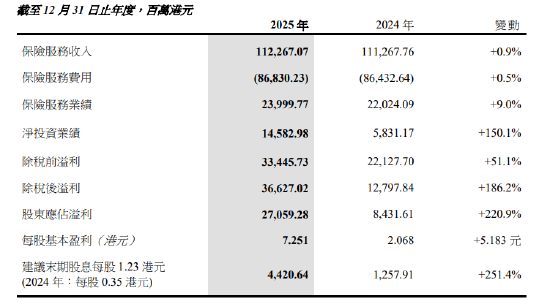
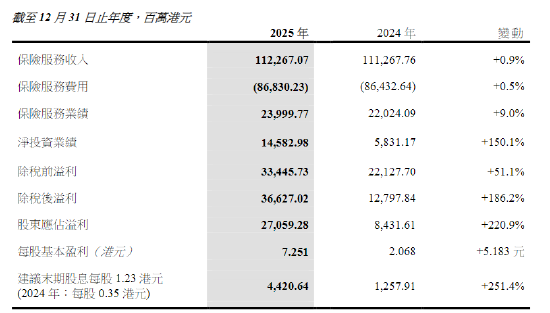
Core Viewpoint - China Taiping Insurance Holdings Company Limited announced its full-year results for 2025, proposing a final dividend of HKD 1.23 per share, representing a 251.4% increase compared to the previous year [1][3]. Financial Performance Summary - Insurance service revenue for 2025 reached HKD 112,267.07 million, a slight increase of 0.9% from HKD 111,267.76 million in 2024 [2][4]. - Insurance service expenses amounted to HKD (86,830.23) million, reflecting a 0.5% increase from HKD (86,432.64) million in 2024 [2][4]. - The insurance service performance showed a growth of 9.0%, totaling HKD 23,999.77 million compared to HKD 22,024.09 million in 2024 [2][4]. - Investment income surged by 150.1%, reaching HKD 14,582.98 million, up from HKD 5,831.17 million in 2024 [2][4]. - Profit before tax increased by 51.1% to HKD 33,445.73 million from HKD 22,127.70 million in 2024 [2][4]. - Profit after tax rose significantly by 186.2%, totaling HKD 36,627.02 million compared to HKD 12,797.84 million in 2024 [2][4]. - Shareholders' profit increased by 220.9%, reaching HKD 27,059.28 million, up from HKD 8,431.61 million in 2024 [2][4]. - Basic earnings per share were HKD 7.251, an increase of HKD 5.183 from HKD 2.068 in 2024 [2][4]. - The proposed final dividend of HKD 1.23 per share is a significant increase from HKD 0.35 per share in 2024, marking a growth of 251.4% [2][4].


中国太平:2025年股东应占溢利270.59亿港元 同比增长220.9%
Xin Lang Cai Jing· 2026-03-25 12:15
Core Viewpoint - China Taiping Insurance Holdings Company Limited reported a significant increase in net profit attributable to shareholders for the year 2025, reaching HKD 27.059 billion, a year-on-year growth of 220.9%, driven by improved performance in insurance services and net investment income, along with a one-time benefit from new corporate income tax policies in the Chinese insurance industry [1][3]. Financial Performance Summary - Insurance service revenue for 2025 was HKD 112.267 billion, a slight increase of 0.9% from HKD 111.268 billion in 2024 [2][4]. - Insurance service expenses rose to HKD 86.830 billion, reflecting a 0.5% increase from HKD 86.433 billion in the previous year [2][4]. - The performance from insurance services improved to HKD 23.999 billion, marking a 9.0% increase compared to HKD 22.024 billion in 2024 [2][4]. - Net investment income surged to HKD 14.583 billion, a remarkable increase of 150.1% from HKD 5.831 billion in 2024 [2][4]. - Profit before tax reached HKD 33.446 billion, up 51.1% from HKD 22.128 billion in the prior year [2][4]. - Profit after tax was HKD 36.627 billion, showing a substantial increase of 186.2% from HKD 12.798 billion in 2024 [2][4]. - Basic earnings per share were HKD 7.251, compared to HKD 2.068 in 2024, reflecting an increase of HKD 5.183 [2][4]. - The proposed final dividend per share is HKD 1.23, significantly higher than HKD 0.35 per share in 2024, representing a 251.4% increase [2][4].
Mizuho Upgrades AON after Sector Selloff, Highlights Resilience to AI
Yahoo Finance· 2026-03-18 22:18
Group 1 - Aon plc (NYSE:AON) is recognized as one of the 14 High Growth Dividend Paying Stocks to invest in currently [1] - Mizuho analyst Yaron Kinar upgraded Aon to Outperform from Neutral, setting a price target of $397, slightly down from $398, following a sector selloff in the insurance property and casualty group [2] - The analyst noted a "low disruption threat" from AI for insurance brokers focusing on middle-market and larger clients, while disintermediation risk is more relevant to mass market personal lines and smaller SMEs [2] Group 2 - On March 9, Aon completed the first known stablecoin insurance premium payment among major global brokers, utilizing US dollar-backed stablecoins, indicating a modernization effort in the insurance value chain [2][3] - This initiative allows Aon to evaluate the potential use of regulated stablecoin settlements in insurance services while maintaining governance standards [3] - Aon operates as a global professional services firm, with its business divided into Risk Capital and Human Capital, where the Risk Capital segment includes insurance brokerage and risk consulting [3]

Arch Capital (ACGL) Down 1.7% Since Last Earnings Report: Can It Rebound?
ZACKS· 2026-03-11 16:31
Core Viewpoint - Arch Capital Group Ltd. reported strong fourth-quarter earnings, exceeding estimates, driven by solid underwriting performance and increased premiums, despite facing higher taxes and some challenges in net premiums written [3][4][5]. Financial Performance - The company reported fourth-quarter operating income of $2.98 per share, beating the Zacks Consensus Estimate by 19.7% and increasing 31.9% year over year [3]. - Gross premiums written rose 1.1% year over year to $4.8 billion, while net premiums earned increased 2.7% to $4.3 billion, slightly missing estimates [4]. - Operating revenues reached $4.7 billion, a 4.4% increase year over year, surpassing the Zacks Consensus Estimate by 2% [5]. - Underwriting income surged 32.3% year over year to $827 million, with the combined ratio improving to 80.6, better than estimates [6]. Segmental Results - **Insurance Segment**: Gross premiums written increased 2.3% to $2.5 billion, but net premiums written fell 4% to $1.9 billion, with underwriting income of $119 million [7]. - **Reinsurance Segment**: Gross premiums written rose 0.2% to $1.9 billion, while net premiums written decreased 5.2% to $1.5 billion, with underwriting income of $458 million [8]. - **Mortgage Segment**: Gross premiums written declined 1.5% to $326 million, and net premiums written decreased 3.6% to $267 million, with underwriting income of $250 million [9]. Financial Update - As of December 31, 2025, cash and cash equivalents stood at $993 million, total debt was $2.7 billion, and book value per share increased 22.6% to $65.11 [10][11]. - Annualized operating return on average common equity expanded to 18.9%, while net cash provided by operating activities was $1.4 billion, down 10.7% year over year [11]. Full-Year Highlights - For 2025, operating income was reported at $9.84 per share, beating estimates by 5% and improving 6% year over year, with total revenues of $18.8 billion, a 12.9% increase [12]. Market Position and Outlook - Arch Capital holds a Zacks Rank 3 (Hold), indicating an expectation of an in-line return in the coming months [15]. - The company has a subpar Growth Score of D and a Momentum Score of F, but a value score of B, placing it in the top 40% for this investment strategy [14].


保险行业研究“红宝书”系列之一:如何理解保险行业新会计准则的变化?
Shenwan Hongyuan Securities· 2026-03-09 14:06
Investment Rating - The report maintains a positive outlook on the insurance sector, indicating a mid-term value reassessment opportunity, particularly recommending companies such as China Ping An, New China Life, China Life (H), China Pacific Insurance, China Property & Casualty Insurance, and China Reinsurance, while suggesting to pay attention to ZhongAn Online [3][6]. Core Insights - The new accounting standards (IFRS 9 and IFRS 17) significantly impact the insurance industry by enhancing performance comparability and profitability transparency. The implementation of these standards is expected to reshape the accounting practices, operational management, and valuation logic of insurance companies [3][9]. - IFRS 9 introduces a new classification system for financial assets, reducing the categories from four to three, which increases the proportion of assets measured at fair value. This change aims to reflect the true value of financial assets more accurately [3][16]. - IFRS 17 redefines the logic of financial statements, focusing on the clarity of income sources. It shifts the premium recognition principle from cash-based to accrual-based, ensuring that only income corresponding to services provided in the current period is recognized [3][39]. Summary by Sections Implementation Background - The new accounting standards were introduced to enhance the comparability and transparency of financial statements for insurance companies, with listed companies implementing IFRS 9 and IFRS 17 from January 1, 2023, and non-listed companies expected to follow by January 1, 2026 [5][9]. IFRS 9: Financial Asset Classification - The classification of financial assets under IFRS 9 has transitioned from a subjective four-category system to an objective three-category system based on the business model and cash flow characteristics of the financial assets. The new categories include: - Amortized Cost (AC) - Fair Value through Other Comprehensive Income (FVOCI) - Fair Value through Profit or Loss (FVTPL) [3][16][21]. - The impairment loss recognition has shifted from an "incurred loss model" to an "expected loss model," allowing for a more timely reflection of the true value of financial assets [3][34]. IFRS 17: Redefining Financial Statement Logic - IFRS 17 introduces a more refined and transparent measurement model for insurance contracts, categorizing them into three models: General Measurement Model (GMM), Variable Fee Approach (VFA), and Premium Allocation Approach (PAA). This aims to ensure that the measurement results reflect the economic substance of insurance contracts [3][43][60]. - The recognition of premium income has shifted to an accrual basis, excluding investment components, which may lead to a significant decrease in recognized insurance service income compared to previous standards [3][39][40].
