
CNECC(601611)

Search documents
多家A股公司披露可控核聚变业务进展
Xin Lang Cai Jing· 2026-01-23 03:42
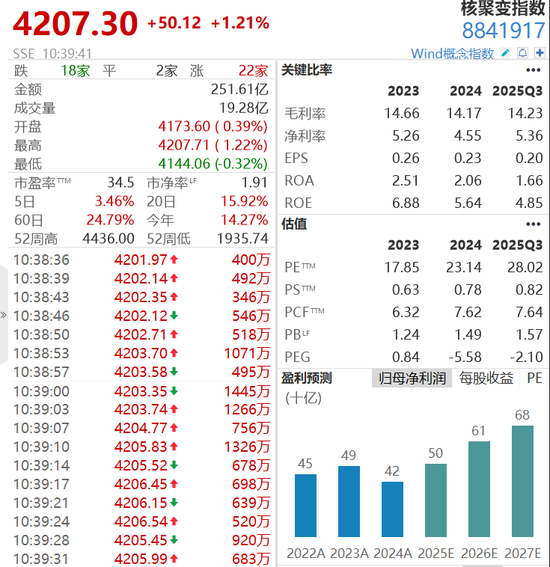
Core Viewpoint - The A-share market is experiencing significant investment interest in the controllable nuclear fusion sector, with the Wind nuclear fusion index rising by 20.5% at its peak in January and currently up by 15.92%, with monthly trading volume exceeding 780 billion yuan [1][2]. Industry Developments - Several companies, including Zhongji HuanKe, Antai Technology, Tiangong International, and Xuguang Electronics, have disclosed their involvement in controllable nuclear fusion, while others have clarified their limited business scale to manage market expectations [2][13]. - The compact fusion energy experimental device (BEST) in Hefei has made significant progress, with key components successfully delivered, and it is expected to be completed by 2027, potentially becoming the first device to achieve fusion power generation [4][15]. - The controllable nuclear fusion industry is advancing rapidly in China, with a notable increase in commercialization efforts since 2022, and a significant number of startups emerging in the past five years, attracting around $6.5 billion in investments [6][16]. Market Performance - As of January 23, 2026, many nuclear fusion concept stocks have seen substantial gains, with companies like Zinc Industry Co., Yuguang Gold Lead, and Western Materials hitting their daily price limits [2][14]. - The stock prices of companies involved in nuclear fusion have shown significant increases, with Zhongji HuanKe's stock rising by 18.31% since the beginning of January [18]. Regulatory Environment - The implementation of the Atomic Energy Law on January 15, 2023, encourages and supports controllable nuclear fusion, providing a foundational framework for the industry's development [5][16]. Company Initiatives - Companies like Antai Technology and Tiangong International are actively participating in nuclear fusion projects, with Antai signing agreements for advanced filter projects and Tiangong achieving breakthroughs in neutron shielding materials [19][20]. - Star Ring Fusion announced a record-breaking 1 billion yuan A-round financing, with plans to complete engineering validation by 2028 and start construction of a commercial demonstration reactor by around 2032 [17][18].


中国核建董事长调整
中国能源报· 2026-01-23 02:43
Core Viewpoint - The announcement details the election of Yin Weiping as the Chairman of China Nuclear Engineering Construction Corporation (CNEC) and the subsequent adjustments to the board's specialized committees [1][2]. Group 1: Election of Chairman - On January 22, 2026, CNEC held its sixth meeting of the fifth board of directors, where the proposal to elect Yin Weiping as the Chairman was approved [2][4]. - Yin Weiping's term as Chairman will last until the end of the current board's term [2][3]. Group 2: Adjustments to Board Committees - Following the change in Chairman, adjustments were made to the members of the Strategic and Investment Committee and the Nomination Committee [3]. - The new composition of the Strategic and Investment Committee includes Yin Weiping (Convener), Dai Xiong Biao, Chen Xue Ying, Zhang Lu, and Wu Wan Liang [3]. - The Nomination Committee now consists of Yin Weiping (Convener), Wu Wan Liang, and Chen Li [3]. Group 3: Background of Yin Weiping - Yin Weiping, born in 1970, is a senior engineer and a member of the Communist Party, with extensive experience in various roles within the nuclear industry [5].

中国核工业建设股份有限公司 2026年第一次临时股东会决议公告
Zhong Guo Zheng Quan Bao - Zhong Zheng Wang· 2026-01-22 23:41
Group 1 - The first extraordinary general meeting of shareholders for China Nuclear Engineering Corporation was held on January 22, 2026, in Shanghai [2] - The meeting was convened by the board of directors and chaired by Director Dai Xiong Biao, with all procedures complying with relevant laws and regulations [2][6] - There were no rejected resolutions during the meeting, and the voting process was conducted in accordance with the company’s articles of association [2][4] Group 2 - The sixth meeting of the fifth board of directors was also held on January 22, 2026, with all eight directors present [8] - The meeting resulted in the unanimous election of Yin Wei Ping as the chairman of the board, with all votes in favor and none against [9] - The board committees were adjusted following the chairman's election, with Yin Wei Ping appointed as the convener of both the Strategy and Investment Committee and the Nomination Committee [12]
中国核工业建设股份有限公司关于选举董事长、调整董事会专门委员会委员的公告
Shang Hai Zheng Quan Bao· 2026-01-22 19:22
Group 1 - The company elected Yin Weiping as the chairman of the fifth board of directors, with a term starting from the date of the board's approval until the end of the current board's term [1][5][6] - The board meeting was held on January 22, 2026, with all 8 directors present, and the election of the chairman was unanimously approved with 8 votes in favor [4][6] - The company adjusted the members of the Strategic and Investment Committee and the Nomination Committee following the change in the chairman, with Yin Weiping as the convener of both committees [2]
尹卫平任中国核建董事长
Bei Jing Ri Bao Ke Hu Duan· 2026-01-22 10:37
Core Viewpoint - The company announced the election of Yin Weiping as the chairman of the board, effective from January 22, 2026, following the sixth meeting of the fifth board of directors [1] Group 1: Board Election - The fifth board of directors elected Yin Weiping as the chairman, with his term lasting until the end of the current board's tenure [1] - Yin Weiping has also been appointed as the secretary of the party committee of China Nuclear Engineering [1] Group 2: Committee Adjustments - Due to the change in the chairman, adjustments were made to the members of the Strategic and Investment Committee and the Nomination Committee [1] - The Strategic and Investment Committee will now be led by Yin Weiping, with members including Dai Xiongbao, Chen Xueying, Zhang Lu, and Wu Wanliang [1] - The Nomination Committee will also be chaired by Yin Weiping, with members Wu Wanliang and Chen Li [1]
中国核建(601611) - 中国核建关于选举董事长、调整董事会专门委员会委员的公告
2026-01-22 09:45
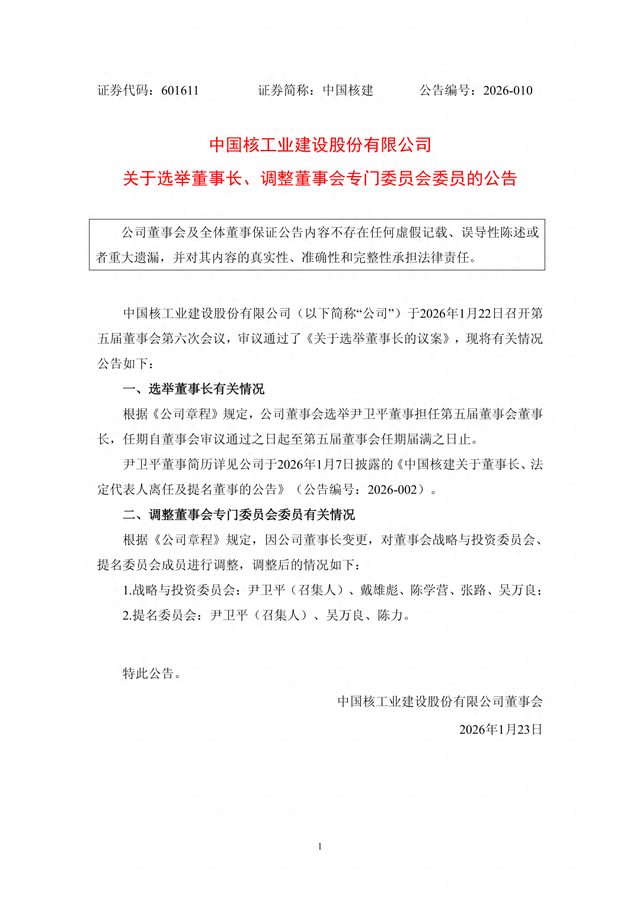
证券代码:601611 证券简称:中国核建 公告编号:2026-010 中国核工业建设股份有限公司 关于选举董事长、调整董事会专门委员会委员的公告 中国核工业建设股份有限公司(以下简称"公司")于2026年1月22日召开第 五届董事会第六次会议,审议通过了《关于选举董事长的议案》,现将有关情况 公告如下: 一、选举董事长有关情况 根据《公司章程》规定,公司董事会选举尹卫平董事担任第五届董事会董事 长,任期自董事会审议通过之日起至第五届董事会任期届满之日止。 尹卫平董事简历详见公司于2026年1月7日披露的《中国核建关于董事长、法 定代表人离任及提名董事的公告》(公告编号:2026-002)。 二、调整董事会专门委员会委员有关情况 根据《公司章程》规定,因公司董事长变更,对董事会战略与投资委员会、 提名委员会成员进行调整,调整后的情况如下: 1.战略与投资委员会:尹卫平(召集人)、戴雄彪、陈学营、张路、吴万良; 2.提名委员会:尹卫平(召集人)、吴万良、陈力。 特此公告。 中国核工业建设股份有限公司董事会 2026年1月23日 公司董事会及全体董事保证公告内容不存在任何虚假记载、误导性陈述或 者重大遗漏,并对其 ...
中国核建(601611) - 北京国枫律师事务所关于中国核建2026年第一次临时股东会的法律意见书
2026-01-22 09:45
北京市东城区建国门内大街 26 号新闻大厦 7 层、8 层 电话:010-88004488/66090088 传真:010-66090016 邮编:100005 北京国枫律师事务所 关于中国核工业建设股份有限公司 2026 年第一次临时股东会的 法律意见书 国枫律股字[2026]A0020 号 致:中国核工业建设股份有限公司(贵公司) 3.本所及经办律师依据《证券法》《证券法律业务管理办法》《证券法律业务执业 规则》等规定及本法律意见书出具日以前已经发生或者存在的事实,严格履行了法定职 责,遵循了勤勉尽责和诚实信用原则,进行了充分的核查验证,保证本法律意见所认定 的事实真实、准确、完整,所发表的结论性意见合法、准确,不存在虚假记载、误导性 陈述或者重大遗漏,并承担相应法律责任; 4.本法律意见书仅供贵公司本次会议之目的使用,不得用作任何其他用途。本所 律师同意将本法律意见书随贵公司本次会议决议一起予以公告。 本所律师根据《公司法》《证券法》《股东会规则》《证券法律业务管理办法》《证 券法律业务执业规则》等相关法律、行政法规、规章、规范性文件的要求,按照律师行 业公认的业务标准、道德规范和勤勉尽责精神,对贵公司 ...
中国核建(601611) - 中国核建2026年第一次临时股东会决议公告
2026-01-22 09:45
证券代码:601611 证券简称:中国核建 公告编号:2026-008 中国核工业建设股份有限公司 2026年第一次临时股东会决议公告 本公司董事会及全体董事保证本公告内容不存在任何虚假记载、误导性陈述 或者重大遗漏,并对其内容的真实性、准确性和完整性承担法律责任。 重要内容提示: 本次会议是否有否决议案:无 一、 会议召开和出席情况 (一)股东会召开的时间:2026 年 1 月 22 日 (二)股东会召开的地点:上海市青浦区蟠龙路 500 号中核科创园 A1 办公楼 公司 2026 年第一次临时股东会由董事会召集,经与会董事推举,由戴雄彪 董事主持。会议的召集、召开及表决方式符合《公司法》《公司章程》等相关规 定。 (三)出席会议的普通股股东和恢复表决权的优先股股东及其持有股份情况: | 1、出席会议的股东和代理人人数 | 2,701 | | --- | --- | | 2、出席会议的股东所持有表决权的股份总数(股) | 2,073,847,870 | | 3、出席会议的股东所持有表决权股份数占公司有表决权股 | 68.8109 | | 份总数的比例(%) | | (四)表决方式是否符合《公司法》及《公司章 ...
中国核建(601611) - 中国核建第五届董事会第六次会议决议公告
2026-01-22 09:45
证券代码:601611 证券简称:中国核建 公告编号:2026-009 表决结果:同意票数 8 票;反对票数 0 票;弃权票数 0 票。 相关内容详见与本公告同时刊登的《中国核建关于选举董事长、调整董事会 专门委员会委员的公告》(2026-010)。 特此公告。 中国核工业建设股份有限公司董事会 中国核工业建设股份有限公司 第五届董事会第六次会议决议公告 公司董事会及全体董事保证公告内容不存在任何虚假记载、误导性陈述或 者重大遗漏,并对其内容的真实性、准确性和完整性承担法律责任。 中国核工业建设股份有限公司(以下简称"公司")第五届董事会第六次会议 于2026年1月22日以现场方式召开,会议通知于2026年1月15日送达。本次会议应 参会表决董事8人,实际参会董事8人(其中委托出席1人),董事张路委托职工 董事王伟潮出席并表决。经与会董事推举,会议由尹卫平董事主持。会议的召集、 召开程序合法有效。 经与会董事审议,形成决议如下: 一、通过了《关于选举董事长的议案》 2026年1月23日 1 ...
中国核建:选举尹卫平担任董事长
Ge Long Hui· 2026-01-22 09:31
Group 1 - The core point of the article is the election of Yin Weiping as the chairman of the fifth board of directors of China Nuclear Engineering Corporation (601611.SH) [1] Group 2 - The term of the newly elected chairman will last from the date of the board's approval until the end of the fifth board's term [1]