CHINA SATCOM(601698)

Search documents
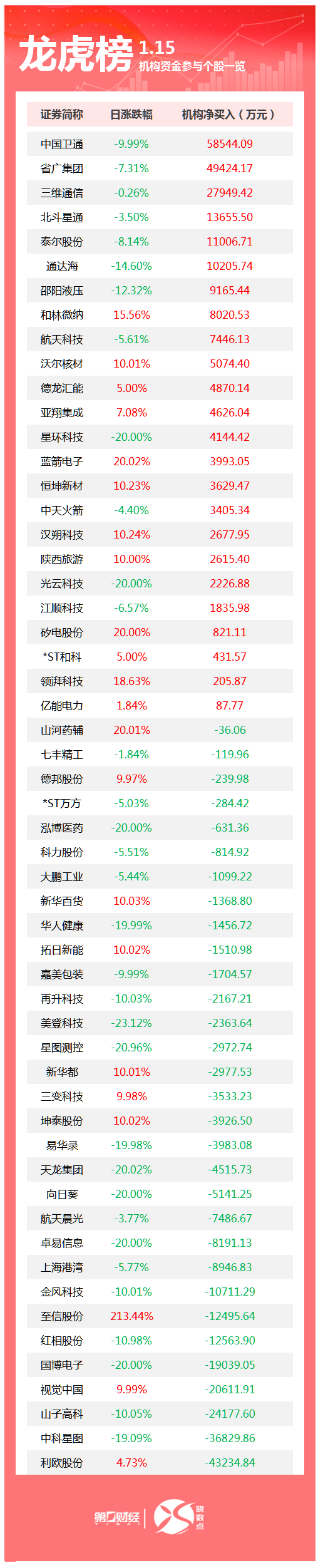
龙虎榜丨机构今日买入这24股,卖出利欧股份4.32亿元


Di Yi Cai Jing· 2026-01-15 10:16
Summary of Key Points Core Viewpoint - On January 15, a total of 55 stocks were involved with institutional investors, with 24 stocks showing net buying and 31 stocks showing net selling [1]. Institutional Net Buying - The top three stocks with the highest net buying by institutions were China Satellite Communications, Province Advertising Group, and Sanwei Communication, with net buying amounts of 585 million, 494 million, and 279 million respectively [1]. - Other notable stocks with institutional net buying include Beidou Star, with a net buying of 1,365 million, and Tai'er Co., with 110 million [2]. Institutional Net Selling - The top three stocks with the highest net selling by institutions were Liou Co., Zhongke Star Map, and Shanzi Gaoke, with net selling amounts of 432 million, 368 million, and 242 million respectively [1]. - Additional stocks with significant net selling include Huaxin Technology, with a net selling of 12,495 million, and Visual China, with 20,611 million [4].

中国卫通(601698) - 中国卫通股票交易异常波动公告
2026-01-15 09:32
重要内容提示: 中国卫通集团股份有限公司(简称"公司")股票 于 2026 年 1 月 13 日、1 月 14 日、1 月 15 日连续三个交易 日内收盘价格跌幅偏离值累计超过 20%,根据《上海证券交 易所交易规则》的有关规定,属于股票交易异常波动。 经公司自查并书面问询控股股东及实际控制人,截 至本公告披露日,不存在应披露而未披露的重大信息。 敬请广大投资者注意投资风险。 一、股票交易异常波动的具体情况 证券代码:601698 证券简称:中国卫通 公告编号:2026-005 中国卫通集团股份有限公司 股票交易异常波动公告 本公司董事会及全体董事保证本公告内容不存在任何虚假记载、误导性陈述 或者重大遗漏,并对其内容的真实性、准确性和完整性承担法律责任。 公司股票于 2026 年 1 月 13 日、1 月 14 日、1 月 15 日 连续三个交易日内收盘价格跌幅偏离值累计超过 20%,根据 《上海证券交易所交易规则》的有关规定,属于股票交易异 常波动 二、公司关注并核实的相关情况 (一)生产经营情况 经自查,公司目前生产经营情况正常,近期市场环境和 行业政策没有发生重大变化。 (二)重大事项情况 针对公司股票 ...
国防军工行业资金流出榜:航天电子等28股净流出资金超亿元
Zheng Quan Shi Bao Wang· 2026-01-15 09:08
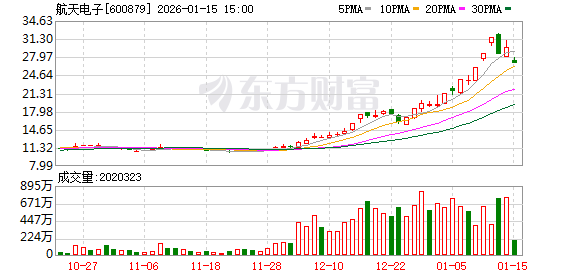
Market Overview - The Shanghai Composite Index fell by 0.33% on January 15, with 11 sectors experiencing gains, led by the electronics and basic chemicals sectors, which rose by 1.67% and 1.40% respectively. The defense and military industry had the second-largest decline at 2.80% [2] - The net outflow of capital from the two markets was 62.864 billion yuan, with six sectors seeing net inflows. The electronics sector had the highest net inflow of 12.083 billion yuan, followed by the non-ferrous metals sector with a net inflow of 1.936 billion yuan [2] Defense and Military Industry - The defense and military industry experienced a decline of 2.80%, with a total net capital outflow of 9.695 billion yuan. Out of 138 stocks in this sector, 32 rose, including one that hit the daily limit, while 103 fell, with 10 hitting the lower limit [3] - Among the stocks with net inflows, 40 saw capital inflow, with nine exceeding 100 million yuan. The top inflow was for Shenglu Communication, with a net inflow of 438 million yuan, followed by Feilihua and AVIC Shenyang Aircraft Corporation with inflows of 426 million yuan and 340 million yuan respectively [3] - The stocks with the highest net outflows included Aerospace Electronic, China Satellite, and Shanghai Hanxun, with outflows of 1.455 billion yuan, 1.092 billion yuan, and 796 million yuan respectively [3] Capital Flow in Defense and Military Stocks - The top stocks with capital inflow in the defense and military sector included: - Shenglu Communication: +9.97%, 438.2 million yuan - Feilihua: +3.78%, 426.1 million yuan - AVIC Shenyang Aircraft Corporation: +2.34%, 339.5 million yuan [4] - The stocks with the highest capital outflow included: - Aerospace Electronic: -9.98%, -1.4547 billion yuan - China Satellite: -10.00%, -1.0918 billion yuan - Shanghai Hanxun: -11.54%, -796.3 million yuan [5]





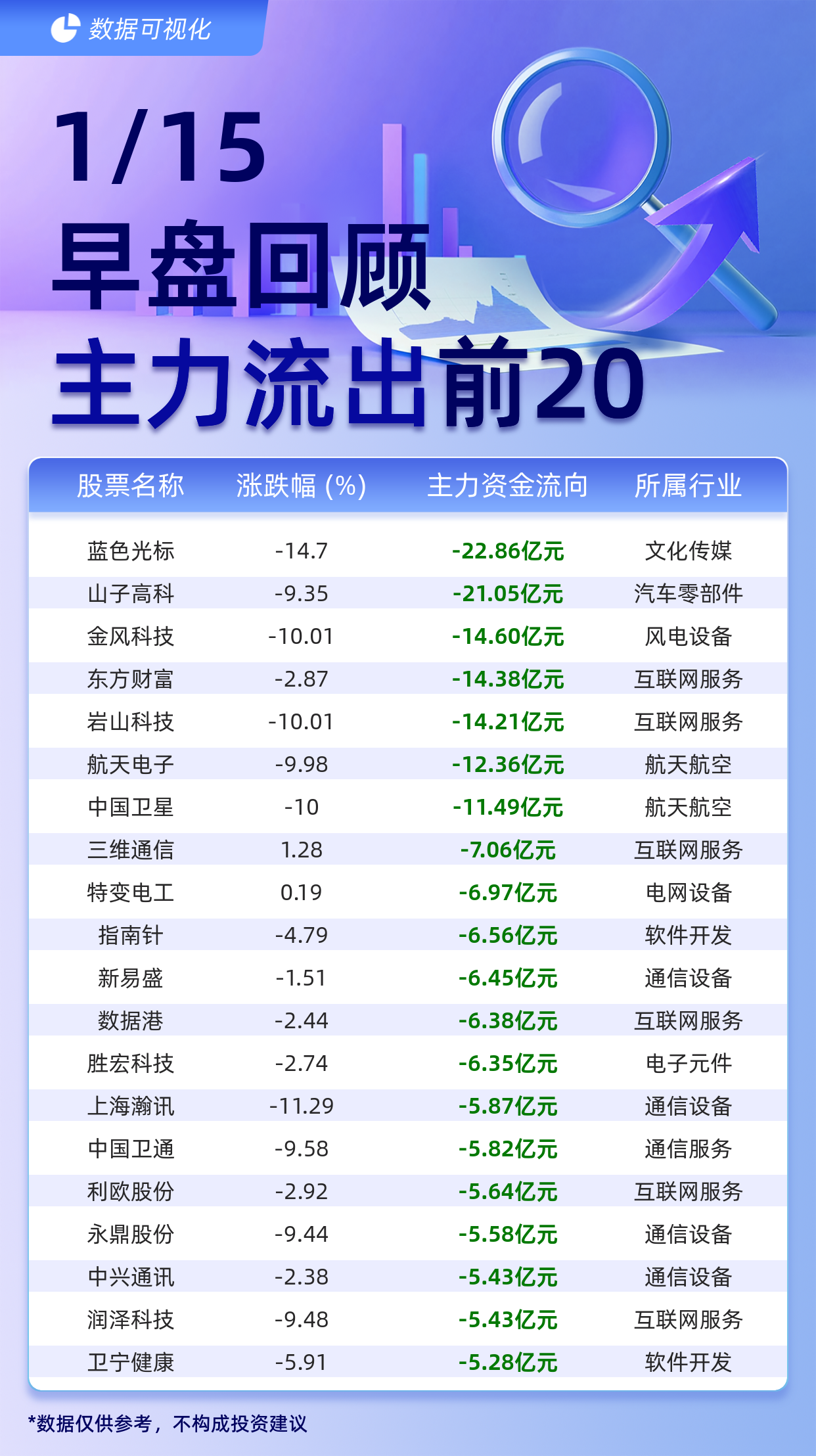
主力个股资金流出前20:蓝色光标流出22.86亿元、山子高科流出21.05亿元
Jin Rong Jie· 2026-01-15 03:50
Core Viewpoint - The data indicates significant outflows of main funds from various stocks, with notable declines in share prices across multiple sectors, particularly in cultural media, automotive parts, and wind power equipment [1][2][3] Group 1: Stock Performance and Fund Flow - Blue Cursor experienced a decline of 14.7% with a fund outflow of 2.286 billion [2] - Shanzi Gaoke saw a decrease of 9.35% with a fund outflow of 2.105 billion [2] - Goldwind Technology had a drop of 10.01% with a fund outflow of 1.460 billion [2] - Dongfang Fortune's stock fell by 2.87% with a fund outflow of 1.438 billion [2] - Yanshan Technology declined by 10.01% with a fund outflow of 1.421 billion [2] - Aerospace Electronics dropped by 9.98% with a fund outflow of 1.236 billion [2] - China Satellite's stock decreased by 10% with a fund outflow of 1.149 billion [2] - Sanwei Communication had a slight increase of 1.28% but still faced a fund outflow of 0.706 billion [2] - Tebian Electric experienced a minor increase of 0.19% with a fund outflow of 0.697 billion [2] - Compass saw a decline of 4.79% with a fund outflow of 0.656 billion [2] Group 2: Additional Stock Data - Xinyisheng's stock fell by 1.51% with a fund outflow of 0.645 billion [3] - Dataport experienced a decline of 2.44% with a fund outflow of 0.638 billion [3] - Shenghong Technology's stock decreased by 2.74% with a fund outflow of 0.635 billion [3] - Shanghai Huanxun saw a significant drop of 11.29% with a fund outflow of 0.587 billion [3] - China Satellite Communications experienced a decline of 9.58% with a fund outflow of 0.582 billion [3] - Leo Holdings' stock fell by 2.92% with a fund outflow of 0.564 billion [3] - Yongding's stock decreased by 9.44% with a fund outflow of 0.558 billion [3] - ZTE Corporation saw a decline of 2.38% with a fund outflow of 0.543 billion [3] - Runze Technology experienced a drop of 9.48% with a fund outflow of 0.543 billion [3] - Weining Health's stock fell by 5.91% with a fund outflow of 0.528 billion [3]


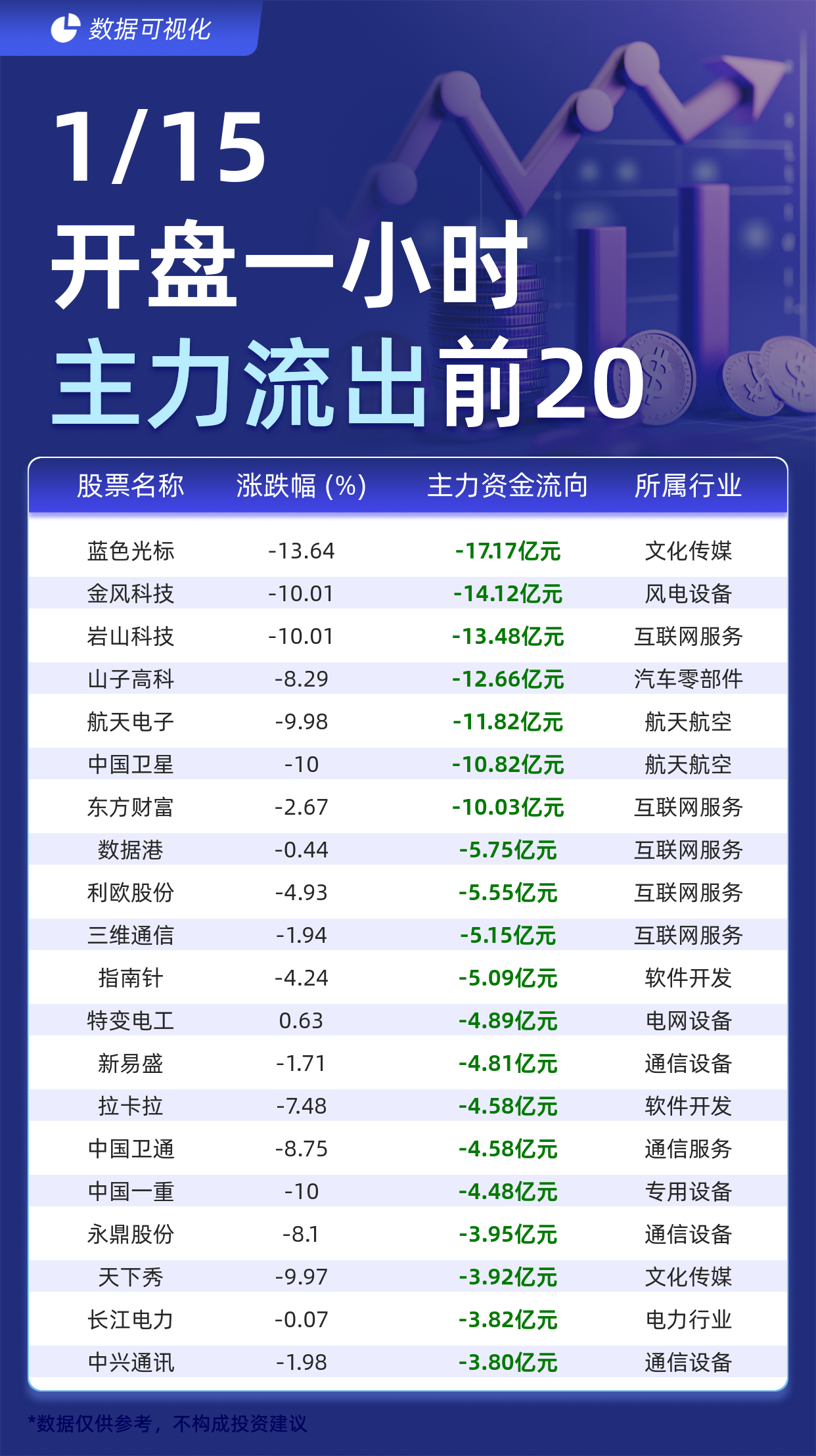
主力个股资金流出前20:蓝色光标流出17.17亿元、金风科技流出14.12亿元


Jin Rong Jie· 2026-01-15 02:47
Group 1 - The main stocks with significant capital outflows include BlueFocus (-1.717 billion), Goldwind (-1.412 billion), and Yanshan Technology (-1.348 billion) [1] - The sectors affected by the capital outflows include cultural transmission, wind power equipment, and internet services [2][3] - The largest percentage drop in stock prices was observed in BlueFocus (-13.64%) and Goldwind (-10.01%) [2] Group 2 - Other notable stocks with capital outflows include Aerospace Electronics (-1.182 billion), China Satellite (-1.082 billion), and Dongfang Fortune (-1.003 billion) [1] - The telecommunications sector also saw significant outflows, with companies like ZTE (-0.380 billion) and China Satcom (-0.458 billion) experiencing declines [3] - The overall trend indicates a bearish sentiment in the market, particularly affecting technology and aerospace sectors [2][3]
通用航空概念股走弱,相关ETF跌超3%
Sou Hu Cai Jing· 2026-01-15 02:11
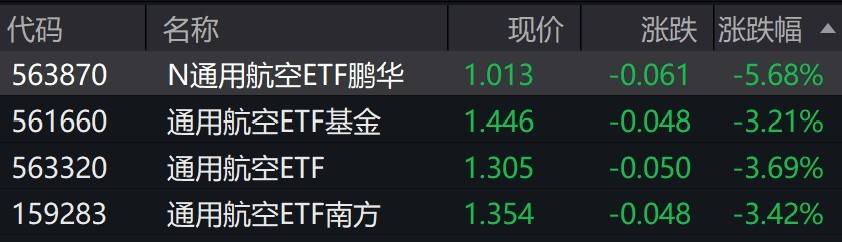
Group 1 - General aviation concept stocks weakened, with Zhongke Xingtou falling over 11%, Aerospace Electronics and Haige Communication hitting the daily limit down, and China Satellite Communications dropping over 5% [1] - The general aviation-related ETFs declined by more than 3% due to market influences [1] Group 2 - Specific ETF performance includes: - N General Aviation ETF Penghua at 1.013, down 0.061 (-5.68%) - General Aviation ETF Fund at 1.446, down 0.048 (-3.21%) - General Aviation ETF at 1.305, down 0.050 (-3.69%) - General Aviation ETF Southern at 1.354, down 0.048 (-3.42%) [2] Group 3 - Brokerages indicate that the low-altitude economy is a strategic emerging industry included in the government work report, and is an important component of China's transportation network planning, with numerous supportive policies from various government levels [2] - The market space for the low-altitude economy is accelerating, with projections indicating that by 2035, China's drone low-altitude market could exceed 3.1 trillion yuan, and the manned eVTOL market could exceed 500 billion yuan [2]

商业航天,送了股民开年第一辆过山车
吴晓波频道· 2026-01-15 00:48
Core Viewpoint - The article discusses the rapid rise and subsequent volatility of the commercial aerospace sector in the A-share market, highlighting significant stock price movements and the underlying factors driving these changes [4][9][11]. Group 1: Market Performance - From December 24, 2025, to January 12, 2026, the aerospace equipment sector achieved a 12-day consecutive rise, with a cumulative increase of 79% [9]. - On January 12, 2026, the A-share market recorded a historic trading volume of 3.64 trillion yuan, with many aerospace stocks hitting the daily limit [9][11]. - Following the peak, many companies in the sector issued risk warnings, leading to a sharp decline in stock prices, with over 60 stocks experiencing significant drops [11]. Group 2: Industry Dynamics - The commercial aerospace sector is experiencing a surge in demand, driven by China's recent application to the International Telecommunication Union (ITU) for an additional 203,000 satellites, marking one of the largest resource declarations in recent years [16][19]. - The cost of satellite launches is high, with estimates ranging from 50,000 to 100,000 yuan per kilogram, necessitating the development of reusable rockets to reduce costs significantly [21][22]. - The successful launch of the reusable rocket "Zhuque-3" by Blue Arrow Aerospace represents a significant milestone in the industry, despite its recovery failure [24][26]. Group 3: Future Prospects - The commercial aerospace industry is positioned as a critical infrastructure for future communication technologies, with low Earth orbit satellites expected to enhance connectivity in underserved areas [29][30]. - The competition in the global aerospace market is intensifying, with various countries, including the U.S., Europe, and India, investing heavily in their commercial space sectors [34][36][37]. - China's commercial aerospace strategy involves both state-owned and private enterprises, aiming to deploy thousands of satellites to create a comprehensive satellite internet network [38][41].


中国卫通1月14日龙虎榜数据
Zheng Quan Shi Bao Wang· 2026-01-14 14:17
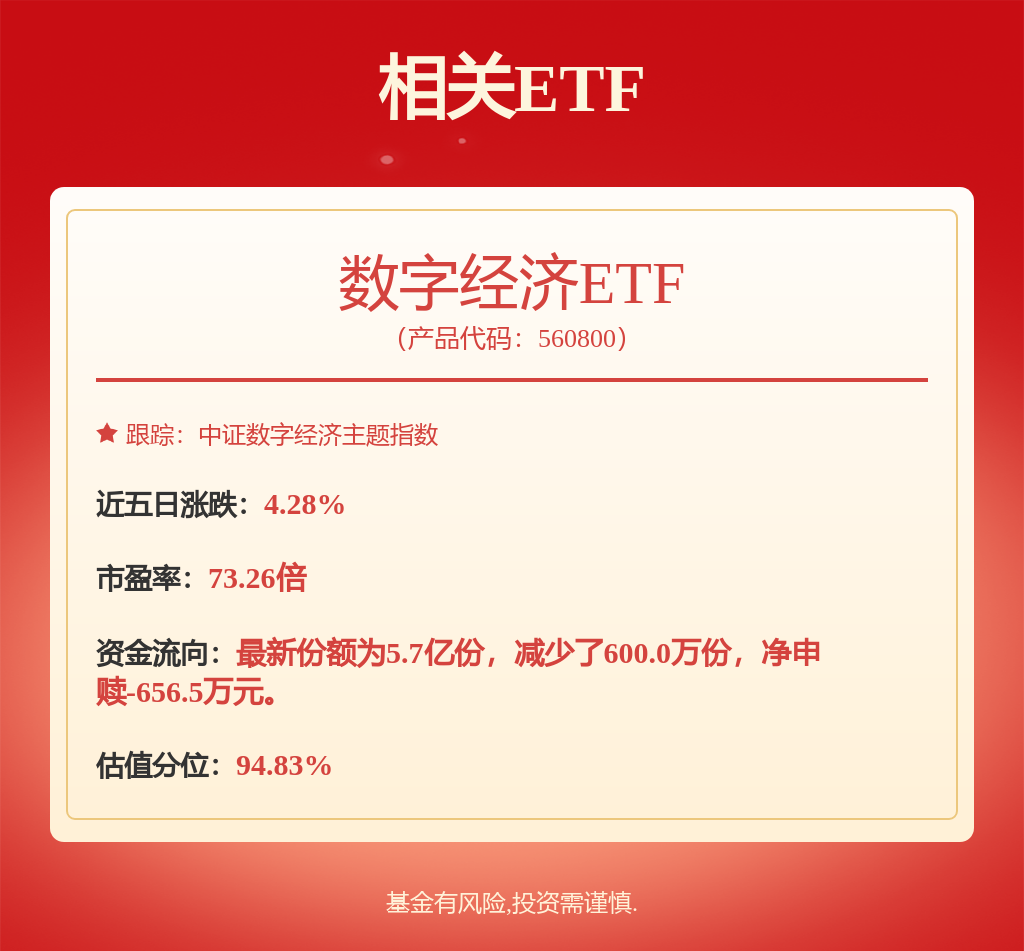
(原标题:中国卫通1月14日龙虎榜数据) 中国卫通(601698)今日跌停,全天换手率6.32%,成交额120.22亿元,振幅9.99%。龙虎榜数据显示,机构净买入3.46亿元,沪股通净卖出1.15亿 元,营业部席位合计净卖出1.16亿元。 上交所公开信息显示,当日该股因日跌幅偏离值达-9.70%上榜,机构专用席位净买入3.46亿元,沪股通净卖出1.15亿元。 证券时报•数据宝统计显示,上榜的前五大买卖营业部合计成交11.21亿元,其中,买入成交额为6.18亿元,卖出成交额为5.03亿元,合计净买入 1.15亿元。 具体来看,今日上榜的营业部中,共有2家机构专用席位现身,即买一、买二,合计净买入3.46亿元,沪股通为第二大卖出营业部,卖出金额为 1.15亿元,合计净卖出1.15亿元。 注:本文系新闻报道,不构成投资建议,股市有风险,投资需谨慎。 相关ETF 数字经济ETF (产品代码: 560800) ★ 跟踪:中证数字经济主题指数 近五日涨跌:4.28% 资金流向方面,今日该股主力资金净流出9.04亿元,其中,特大单净流出8.75亿元,大单资金净流出2860.00万元。近5日主力资金净流出33.24亿 元。 ...
低轨卫星互联网加速落地 中国卫通能否守住卫星通信“C位”?
Mei Ri Jing Ji Xin Wen· 2026-01-14 13:06
Core Viewpoint - The rise of commercial aerospace is disrupting the capital market landscape traditionally dominated by basic telecom operators, with China Satcom's stock price surging past China Unicom's, making it the third-largest operator by market capitalization in A-shares [1] Group 1: Company Overview - China Satcom's main business involves satellite space segment operations and related application services, primarily in satellite communication broadcasting [1] - As of June 30, 2025, China Satcom operates 18 commercial communication broadcasting satellites, all of which are high-orbit satellites [2] - The company has initiated work on low-orbit satellite constellations, recognizing the trend of combining high and low-orbit communication satellites for future development [2] Group 2: Market Dynamics - The satellite communication market is becoming increasingly competitive, with China Satcom's revenue and net profit showing a declining trend from 2022 to 2024 [4] - The company faces challenges in new business development due to market cultivation periods, economic downturns, and intensified competition from international markets [4] - The construction and operation of low-orbit satellite internet present both opportunities and challenges for China Satcom, with the market still in its initial development phase [5][6] Group 3: Regulatory Environment - The Ministry of Industry and Information Technology issued guidelines in August 2025 to promote the development of the satellite communication industry, encouraging telecom operators to expand services based on low-orbit satellite internet [6] - Major telecom operators, including China Telecom, China Mobile, and China Unicom, have all obtained licenses for satellite mobile communication services, indicating a broad industry shift towards satellite internet [6]
龙虎榜 | 深南东路、宁波桑田路会师利欧股份,消闲派3.71亿打板山子高科
Sou Hu Cai Jing· 2026-01-14 11:19
Group 1 - A-shares trading volume reached a record high of 3.99 trillion yuan, with over 2,700 stocks rising, particularly in the medical services, AI applications, computing hardware, and semiconductor sectors [2] - Key stocks include Jia Mei Packaging with 14 consecutive trading limits, Youbang Ceiling with 8 limits in 10 days, and Galaxy Electronics with 7 limits in 8 days [2] - The market saw significant activity in stocks related to AI and computing, indicating strong investor interest in these sectors [2] Group 2 - Stock performance highlights include Hongxiang Co. with a 20.03% increase, LaKala with a 20.02% rise, and Qida Chemical with a 20.01% gain, all showing strong trading activity [1][3] - The top net buying stocks on the day included Shanzikao Technology, Guangxun Technology, and Huasheng Tiancai, with net purchases of 9.97 billion yuan, 8.35 billion yuan, and 7.70 billion yuan respectively [4][6] - Conversely, the top net selling stocks included Yanshan Technology, Haige Communication, and Leike Defense, with net sales of 6.27 billion yuan, 5.78 billion yuan, and 5.41 billion yuan respectively [5][7] Group 3 - Shanzikao Technology is actively involved in the restructuring of Nezha Automobile and has reported a net profit of 437 million yuan for the first three quarters, indicating a turnaround [11] - Guangxun Technology is focusing on next-generation optical modules and has seen significant growth in its product shipments, positioning itself as a leader in the optical device market [15] - Huasheng Tiancai is advancing its AI and computing strategy, with a notable increase in revenue from AI-related products, reflecting strong market demand [20]