
Nanhua Futures(603093)

Search documents
南华期货锡风险管理日报-20250904
Nan Hua Qi Huo· 2025-09-04 02:50
Report Overview - Report Name: Nanhua Futures Tin Risk Management Daily Report - Date: September 4, 2025 - Research Team: Nanhua Non - ferrous Metals Research Team [1] Investment Rating - Not provided in the report Core Viewpoints - The recent strength of tin prices is mainly due to tight supply. Yunnan Tin plans to shut down for maintenance from August 30 for 45 days. In August 2025, China's refined tin production decreased both month - on - month and year - on - year, affected by enterprise maintenance and lower tin concentrate imports in July. In the short term, with a stable macro - environment, tin prices may rise slightly further, with the upper target set at 276,000 yuan per ton [3] Summary by Directory 1. Tin Price Volatility and Risk Management - **Price Volatility**: The latest closing price is 273,120 yuan, the monthly price range forecast is 245,000 - 263,000 yuan, the current volatility is 12.99%, and the historical percentile of the current volatility is 22.4% [2] - **Risk Management Suggestions**: - **Inventory Management**: For high finished - product inventory and fear of price drops, sell 75% of the Shanghai Tin main futures contract at around 275,000 yuan and sell 25% of the SN2511C275000 call option when volatility is appropriate [2] - **Raw Material Management**: For low raw - material inventory and fear of price increases, buy 50% of the Shanghai Tin main futures contract at around 230,000 yuan and sell 25% of the SN2511P260000 put option when volatility is appropriate [2] 2. Factors Affecting Tin Prices - **Likely Positive Factors**: Sino - US tariff policy easing, the semiconductor sector being in an expansion cycle, and Myanmar's production resumption falling short of expectations [4][5] - **Likely Negative Factors**: Tariff policy reversals, the inflow of Burmese tin ore into China, and the semiconductor sector's expansion slowing down and moving towards a contraction cycle [5] 3. Tin Futures and Spot Market Data - **Futures Data (Daily)**: - Shanghai Tin main contract: 273,120 yuan/ton, unchanged [6] - Shanghai Tin continuous - one contract: 273,120 yuan/ton, unchanged [6] - Shanghai Tin continuous - three contract: 273,260 yuan/ton, unchanged [6] - LME Tin 3M: 34,620 dollars/ton, down 115 dollars (- 0.33%) [6] - Shanghai - London ratio: 7.85, up 0.08 (1.03%) [6] - **Spot Data (Weekly)**: - Shanghai Non - ferrous tin ingot: 273,100 yuan/ton, up 1,100 yuan (0.4%) [10] - 1 tin premium: 0 yuan/ton, down 200 yuan (- 100%) [10] - 40% tin concentrate: 261,100 yuan/ton, up 1,100 yuan (0.42%) [10] - 60% tin concentrate: 265,100 yuan/ton, up 1,100 yuan (0.42%) [10] - Other tin - related products also showed varying degrees of price changes [10] 4. Tin Import and Inventory Data - **Import and Processing Data (Daily)**: - Tin import profit and loss: - 20,238.59 yuan/ton, up 143.67 yuan (- 0.7%) [12] - 40% tin ore processing fee: 12,200 yuan/ton, unchanged [12] - 60% tin ore processing fee: 10,050 yuan/ton, unchanged [12] - **Inventory Data (Daily)**: - Shanghai Futures Exchange tin warehouse receipts: 7,407 tons, up 144 tons (1.98%) [14] - LME tin inventory: 2,175 tons, up 20 tons (0.93%) [14]

南华期货铜风险管理日报-20250904
Nan Hua Qi Huo· 2025-09-04 02:49
Report Summary 1. Report Industry Investment Rating No information provided. 2. Core View of the Report - Copper prices' rise and fall on Wednesday were closely related to the US economy. The unusual simultaneous rise of copper, gold, the US dollar index, and crude oil at night, along with a significant drop in US stocks and a sharp increase in European and American long - term bond yields, led to an over - rise, and the price fell during the daytime. Considering tight supply and the US economic pressure on the Fed's interest - rate cut expectations, copper prices may remain strong in the short term [3]. 3. Summary by Relevant Categories Copper Price and Volatility - The latest copper price is 80,110 yuan/ton, with a monthly price range forecast of 73,000 - 80,000 yuan/ton. The current volatility is 7.39%, and the historical percentile of the current volatility is 3.3% [2]. Copper Risk Management Suggestions - **Inventory Management**: For high finished - product inventory and fear of price drops, sell 75% of the Shanghai Copper main - contract futures at around 82,000 yuan/ton and sell 25% of the CU2511C82000 call options when volatility is relatively stable [2]. - **Raw Material Management**: For low raw - material inventory and fear of price increases, buy 75% of the Shanghai Copper main - contract futures at around 78,000 yuan/ton [2]. Factors Affecting Copper Prices - **Likely Positive Factors**: Agreement on tariff policies, increased interest - rate cut expectations leading to a lower US dollar index and higher non - ferrous metal valuations, and a rising lower support level [4]. - **Likely Negative Factors**: Uncertain tariff policies, reduced global demand due to tariffs, and extremely high COMEX inventory caused by US copper tariff policy adjustments [5]. Copper Futures and Spot Data - **Futures Data**: The latest price of the Shanghai Copper main contract is 80,110 yuan/ton with no daily change; the Shanghai Copper continuous - one contract rose 0.56% to 80,110 yuan/ton; the Shanghai Copper continuous - three contract was at 80,010 yuan/ton with no change; the LME Copper 3M was at 9,974 dollars/ton, down 0.39% [4]. - **Spot Data**: The latest prices of Shanghai Non - ferrous 1 copper, Shanghai Wumaotrade, Guangdong Nanchu, and Yangtze Non - ferrous were 80,520 yuan/ton, 80,435 yuan/ton, 80,280 yuan/ton, and 80,580 yuan/ton respectively, with daily increases of 0.45%, 0.41%, 0.39%, and 0.44% [7]. Copper Scrap and Refined Copper Spread - The current含税 refined - scrap spread is 1,762.98 yuan/ton, down 4.81%; the reasonable含税 refined - scrap spread is 1,503.8 yuan/ton, up 0.15% [11]. Copper Warehouse Receipts and Inventory - **Warehouse Receipts**: The total Shanghai Copper warehouse receipts are 19,471 tons, down 0.15%; the total International Copper warehouse receipts are 5,422 tons, down 3.13% [14]. - **Inventory**: The LME copper inventory is 158,575 tons, down 0.13%; the COMEX copper inventory is 284,400 tons, up 4.52% [16][17]. Copper Import Profit and Processing - The copper import profit is - 53.18 yuan/ton, down 116.83%; the copper concentrate TC is - 40.6 dollars/ton, down 1.62% [18].
竞争格局生变 上市期货公司营收“三跌一升”
Zhong Guo Jin Rong Xin Xi Wang· 2025-09-03 23:01
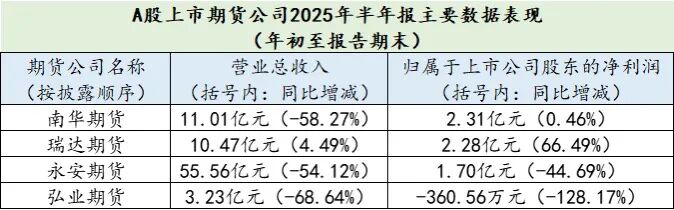
Core Viewpoint - The performance of A-share listed futures companies in the first half of 2025 shows significant divergence, with total revenue of 8.027 billion yuan and net profit of 625 million yuan, indicating a shift from the "channel dividend" era to a "service and capital dividend" era in the futures industry [1][2][6]. Revenue Summary - A-share listed futures companies reported a total revenue of 8.027 billion yuan in the first half of 2025, a decrease of 8.752 billion yuan compared to the same period last year [2][3]. - Among the four companies, only Ruida Futures achieved revenue growth, while Nanhua Futures, Yong'an Futures, and Hongye Futures experienced revenue declines exceeding 50% [3][4]. - Yong'an Futures led in revenue with 5.556 billion yuan, followed by Nanhua Futures at 1.101 billion yuan, Ruida Futures at 1.047 billion yuan, and Hongye Futures at 0.323 billion yuan [3]. Net Profit Summary - Nanhua Futures and Ruida Futures reported positive growth in net profit, with Ruida Futures leading at a 66.49% increase [4]. - Yong'an Futures saw a decline of 44.69% in net profit, while Hongye Futures experienced a dramatic drop of 128.17%, resulting in a loss of 3.6056 million yuan [4][5]. - The total net profit for the four companies was 625 million yuan, reflecting a decrease of 6.3 million yuan from the previous year [2][4]. Industry Context - The overall futures industry showed a positive trend, with a total net profit of 5.074 billion yuan, a year-on-year increase of 32%, and total revenue of 18.676 billion yuan, up 3.89% [5][6]. - The disparity in performance between A-share listed companies and the overall industry is attributed to changes in accounting policies, business structure differences, and evolving market competition [6]. - The implementation of the "net method" for revenue recognition has significantly impacted the revenue reporting of A-share listed companies, while other firms with lower trade business ratios maintained revenue growth [6]. Future Outlook - The futures industry is transitioning towards a focus on specialization, technology, and internationalization, with companies needing to excel in at least one of these areas to succeed in the competitive landscape [6][7]. - Future strategies for medium-sized and regional firms include focusing on differentiated development and enhancing local market penetration [7]. - New regulations are expected to foster a more rational competitive environment, shifting the focus from fee competition to improved financial services and product innovation [7].




竞争格局生变上市期货公司营收三跌一升
Sou Hu Cai Jing· 2025-09-03 16:27
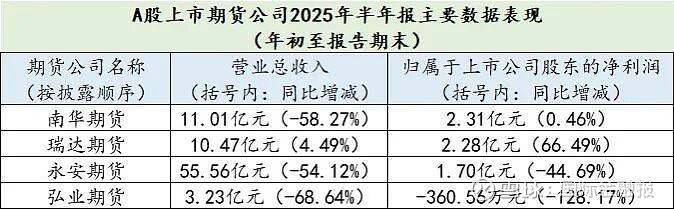
Core Viewpoint - The performance of A-share listed futures companies in the first half of 2025 shows significant divergence, with overall revenue declining and only one company, Ruida Futures, achieving growth in both revenue and net profit [1][2][4]. Group 1: Financial Performance - A-share listed futures companies (Nanhua Futures, Hongye Futures, Ruida Futures, Yong'an Futures) reported a total revenue of 8.027 billion yuan, a decrease of 8.752 billion yuan compared to the same period last year [2][3]. - The total net profit attributable to shareholders was 625 million yuan, down by 6.3 million yuan year-on-year [2][3]. - Ruida Futures achieved a revenue increase of 4.49% to 1.047 billion yuan and a net profit increase of 66.49% to 228 million yuan [3][4]. - Nanhua Futures reported a revenue of 1.101 billion yuan, down 58.27%, with a slight net profit increase of 0.46% to 231 million yuan [3][4]. - Yong'an Futures had a revenue of 5.556 billion yuan, down 54.12%, and a net profit decrease of 44.69% to 170 million yuan [3][4]. - Hongye Futures reported a revenue of 323 million yuan, down 68.64%, and a net loss of 3.6056 million yuan, a decline of 128.17% [3][4]. Group 2: Industry Trends - The futures industry is transitioning from a "channel dividend" era to a "service and capital dividend" era, requiring companies to focus on specialization, technology, or internationalization to succeed [1][6][7]. - The overall futures industry showed a positive trend, with net profits increasing by 32% to 5.074 billion yuan and total revenue rising by 3.89% to 18.676 billion yuan in the first half of 2025 [5][6]. - The decline in A-share listed companies' performance is attributed to changes in accounting policies, specifically the adoption of the "net method" for revenue recognition, which affected revenue reporting without impacting profitability [4][6]. - The competitive landscape is evolving, with smaller firms capturing market share through regional services and niche markets, while larger firms face challenges from increased compliance costs and strategic adjustments [6][7].
供需的矛盾尚未解决 纸浆盘面有止跌企稳的迹象
Jin Tou Wang· 2025-09-03 06:19
News Summary Core Viewpoint - The pulp market is experiencing a downward adjustment in prices, with a notable decline in inventory levels in China, while the demand remains weak, leading to a cautious outlook for the industry. Group 1: Market Pricing and Inventory - Arauco's August price adjustment for Asian markets is set at $720 per ton, unchanged from the previous month [1] - As of August 28, 2025, the inventory of pulp at major Chinese ports is 2.084 million tons, a decrease of 48,000 tons or 2.3% from the previous period, indicating a trend of inventory reduction [1] - On September 2, the Shanghai Futures Exchange reported a decrease of 60 tons in pulp warehouse receipts to 229,027 tons, while factory warehouse receipts remained stable at 18,240 tons [1] Group 2: Industry Profitability and Demand - In July, the profit of the paper and paper products industry decreased by 21.9% year-on-year, with the decline slightly widening [2] - The supply remains ample, and there is an expectation for demand to pick up during the peak season, although pulp prices are currently experiencing low-level fluctuations [2] Group 3: Supply and Demand Dynamics - The price of hardwood pulp has strengthened, while the price spread between softwood and hardwood pulp continues to narrow [3] - Despite positive factors such as expectations of interest rate cuts and rising hardwood pulp prices abroad, the weak fundamentals are prevailing due to high port inventories and lackluster downstream demand [3] - Global pulp shipment volumes are at historical highs, with shipments to Western Europe and North America at lower levels compared to the same period last year, while shipments to China are significantly higher than last year [3] - The production of major paper types shows that while the output of white cardboard and coated paper is on par with last year, the production of household paper is higher, and the output of newsprint is slightly above last year's levels [3] - Overall, the consumption of paper types, excluding household paper, is below last year's levels, indicating unresolved supply-demand contradictions [3]
纯苯基本面较弱 短期内预计在5900-6100附近运行
Jin Tou Wang· 2025-09-03 06:19
Core Viewpoint - The main focus of the articles is on the current state and future outlook of the pure benzene futures market, indicating a weak fundamental backdrop with expectations of price fluctuations in the near term [2][3]. Group 1: Market Performance - On September 3, pure benzene futures showed a slight increase, with the main contract reaching a peak of 6024.0 yuan and closing at 6003.0 yuan, reflecting a rise of 0.62% [1]. - The short-term trading range for the BZ2603 contract is projected to be between 5900 and 6100 yuan [2]. Group 2: Supply and Demand Dynamics - Supply side: Domestic petroleum benzene production remained stable, with a capacity utilization rate increasing by 0.19% to 79.18%. However, the utilization rate for hydrogenated benzene decreased by 1.57% to 56.12% due to some units reducing output or shutting down [2]. - Demand side: The operating rate of downstream pure benzene users fell by 1.46% to 76.96%, indicating a decline in demand [2]. - Inventory levels: The inventory at East China ports decreased by 4.17% to 138,000 tons, but overall inventory at the main port increased to 149,000 tons due to weak demand [3]. Group 3: Future Outlook - The overall market sentiment is cautious, with no clear signals of demand improvement as the traditional peak season approaches. The expectation is for continued weak price fluctuations due to a combination of increased supply pressure from overseas and reduced demand from downstream sectors [2][3]. - The upcoming maintenance schedules for downstream styrene and aniline plants are likely to further constrain demand, leading to challenges in inventory reduction [3].
南华豆一产业风险管理日报-20250903
Nan Hua Qi Huo· 2025-09-03 01:57
Report Summary 1. Report Industry Investment Rating No relevant content provided. 2. Core Viewpoints - The old - season market is ending, and the new - season soybeans are gradually coming onto the market. There is a strong wait - and - see attitude, resulting in light spot trading. The double - festival stocking - driven consumption recovery will face pressure from the new - season supply, and prices are mainly under pressure. The short - term trend in the futures market remains unchanged [3]. - There are both positive and negative factors. Positively, the bottoming - out of grass - roots grain reserves, the expected recovery of edible consumption demand, and the reduction of short - side positions drive the futures price rebound. Negatively, the expected increase in the quality and yield of new - season soybeans, the decline in the auction transaction rate, and the continuous double - auctions per week will put pressure on prices [3][4][6]. 3. Summary by Related Catalogs 3.1 Bean One Risk Strategy - **Inventory Management for Sellers**: For those with long spot positions, such as planting entities with high demand for selling new beans in autumn but facing large short - term selling pressure, it is recommended to short the A2511 bean one futures contract at an entry range of 4000 - 4050 with a hedging ratio of 30% to lock in planting profits. Also, when the seller's bargaining power weakens during the centralized listing period, selling the A2511 - C - 4050 call option at an entry range of 50 - 60 with a hedging ratio of 30% can increase the grain - selling price [2]. - **Procurement Management for Buyers**: For those with short spot positions worried about rising raw material prices and increased procurement costs, it is recommended to mainly wait to purchase spot goods in the medium - term and focus on forward procurement management. Wait for the autumn price guidance to go long on A2603 and A2605 [2]. 3.2 Core Contradictions and Interpretations - **Core Contradictions**: The old - season market is closing, the new - season is starting, and there is a wait - and - see attitude. The auction maintains a double - auction rhythm per week, and the transaction rate has declined. The consumption recovery for double - festival stocking will face new - season supply pressure, and the futures market shows a short - term trend [3]. - **Positive Factors**: The bottoming - out of grass - roots grain reserves restricts price drops. The expected recovery of edible consumption demand in September and the reduction of short - side positions drive the futures price rebound [6]. - **Negative Factors**: The expected increase in the quality and yield of new - season soybeans will lead to a concentrated supply, putting continuous pressure on prices. The decline in the auction transaction rate and the continued double - auctions per week will impact the old - season price system, and the technical short - term trend of the 11 - contract remains unchanged [4]. 3.3 Bean One Futures Price | Contract | 2025 - 09 - 01 | 2025 - 09 - 02 | Daily Change | Change Rate | | --- | --- | --- | --- | --- | | Bean One 11 Closing Price | 3965 | 3970 | 5 | 0.13% | | Bean One 01 Closing Price | 3964 | 3963 | - 1 | - 0.03% | | Bean One 03 Closing Price | 3963 | 3966 | 3 | 0.08% | | Bean One 05 Closing Price | 4008 | 4012 | 4 | 0.10% | | Bean One 07 Closing Price | 4010 | 4013 | 3 | 0.07% | | Bean One 09 Closing Price | 4111 | 4109 | - 2 | - 0.05% | [4]
传统业务增长乏力 上市期货公司发力资管与海外业务
Zheng Quan Shi Bao· 2025-09-02 18:06
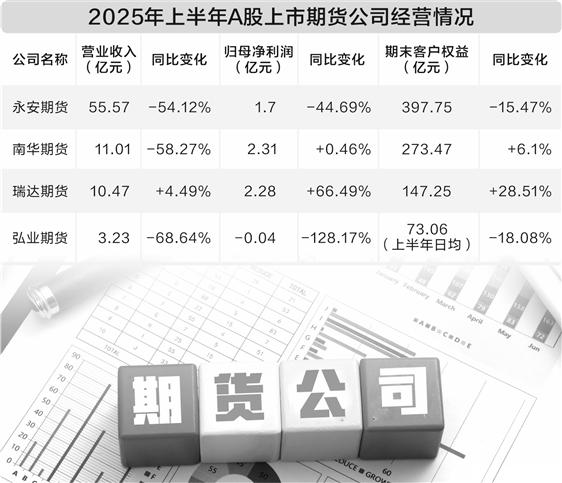
Core Viewpoint - The performance of A-share listed futures companies has been significantly impacted by changes in revenue recognition methods for trade-related businesses, leading to a notable decline in operating income for several firms [1][2]. Group 1: Financial Performance - As of the first half of this year, the operating revenues for Yong'an Futures, Nanhua Futures, and Hongye Futures were 5.557 billion, 1.101 billion, and 323 million yuan respectively, showing declines of 54.12%, 58.27%, and 68.64% year-on-year [2]. - In contrast, Ruida Futures achieved an operating revenue of 1.047 billion yuan, representing a year-on-year increase of 4.49% [2]. - Profitability varied significantly among the four companies, with Ruida Futures reporting a net profit of 228 million yuan, up 66.49% year-on-year, while Hongye Futures incurred a loss of 3.61 million yuan, a decline of 128.17% [2]. Group 2: Market Activity - The Chinese futures market saw increased activity in the first half of the year, with a total trading volume of 4.076 billion contracts and a total transaction value of 339.73 trillion yuan, reflecting year-on-year growth of 17.82% and 20.68% respectively [4]. - Despite the overall market growth, many futures companies did not see a corresponding increase in net income from fees and commissions, indicating intense competition within the industry [4]. Group 3: Revenue Sources - Interest income, a major component of futures brokerage revenue, has declined due to lower interest rates, with Hongye Futures experiencing the largest drop at 45.68% year-on-year [5]. - By the end of the first half, client equity for Yong'an Futures was 39.775 billion yuan, down 15.47% year-on-year, while Ruida Futures saw a 28.51% increase to 14.725 billion yuan [5]. Group 4: Business Transformation - In light of stagnant growth in traditional businesses, new business initiatives are becoming critical for futures companies. For instance, Ruida Futures reported a significant increase in asset management revenue, which grew by 223.83% year-on-year [6]. - Nanhua Futures is focusing on international business, with its overseas brokerage client equity reaching 17.768 billion HKD, a year-on-year increase of 32.25% [6]. Group 5: Industry Trends - The futures industry is facing severe competition characterized by homogenization of traditional services, prompting companies to seek innovative business models for growth [7]. - The China Futures Association has recently proposed new regulations to address unfair competition in the brokerage sector, which is expected to improve the competitive landscape and enhance service quality [7].
南华商品指数:贵金属板块领涨,有色板块下跌
Nan Hua Qi Huo· 2025-09-02 11:22
Group 1: Market Performance Summary - The Nanhua Composite Index rose 0.35% based on the closing prices of adjacent trading days [1]. - Among the sector indices, only the Nanhua Non - Ferrous Metals Index fell by 0.21%, while the rest rose. The Nanhua Precious Metals Index had the largest increase of 0.49%, and the Nanhua Metals Index had the smallest increase of 0.02% [1][3]. - In the theme indices, the Energy Index had the largest increase of 1.17%, the Economic Crops Index had the smallest increase of 0.07%, the Coal - Chemical Index had the largest decrease of 0.59%, and the Oilseeds and Oils Index had the smallest decrease of 0.02% [1]. - Among the single - variety commodity futures indices, the Low - Sulfur Fuel Oil index had the largest increase [1]. Group 2: Sector - Specific Performance Energy and Chemical Sector - In the energy and chemical sector, crude oil rose 1.61%, LPG rose 0.79%, while methanol fell 0.55%, styrene fell 1.05%, etc. [2] Black Sector - In the black sector, some varieties had their respective single - variety index daily changes as shown in the black - sector part of the document, with some falling, e.g., a certain variety fell 0.69% [2]. Agricultural Products Sector - In the agricultural products sector, palm oil rose 0.40%, corn rose 0.32%, while rapeseed meal fell 0.92%, etc. [8]
南华干散货运输市场日报-20250902
Nan Hua Qi Huo· 2025-09-02 09:02
1. Report Industry Investment Rating No relevant content provided. 2. Core View of the Report - The BDI shipping market's upward trend started to reverse this week. The sharp week-on-week decline in the BCI freight index and the narrowing increase or decline in the BPI and BSI freight indices contributed to this change. The BCI freight index dropped by over 2%. In terms of shipping demand, most agricultural product shipments slowed down, but there was still significant demand for shipping Brazilian soybeans. Among industrial products, iron ore and coal shipments remained high, and the shipment of Guinea bauxite accelerated. Overall, the demand for Capesize vessels increased, while the demand for Panamax and Handymax vessels decreased marginally [1]. 3. Summary by Relevant Catalogs 3.1 Spot Index Review 3.1.1 BDI Freight Index Analysis - Compared to August 26th data, the BDI composite freight index decreased on September 1st. The BCI freight index dropped by over 2.71%, which was the main factor dragging down the BDI. The BPI freight index declined slightly week-on-week, and the increase in the BSI freight index narrowed. Specifically, the BDI composite freight index closed at 2024 points, down 0.83% week-on-week; the BCI freight index was at 2949 points, down 2.71% week-on-week; the BPI freight index was at 1813 points, down 0.28% week-on-week; the BSI freight index was at 1467 points, up 2.09% week-on-week; and the BHSI freight index was at 779 points, up 5.99% week-on-week [4]. 3.1.2 FDI Far East Dry Bulk Freight Index - Compared to August 29th, on September 1st, the FDI composite index and the Capesize vessel charter freight increased, while the charter freight for Panamax and Handymax vessels decreased. The FDI composite freight index closed at 1348.64 points, up 0.29% month-on-month; the FDI charter index was at 1660.2 points, up 0.3% month-on-month. Among them, the Capesize vessel charter index was at 1714.5 points, up 1.15% month-on-month; the Panamax vessel charter index was at 1574.42 points, down 0.68% month-on-month [8]. 3.2 Dry Bulk Shipment Tracking 3.2.1 Number of Vessels Used for Shipment by Sending Countries - On September 2nd, among the main agricultural product sending countries, Brazil used 43 vessels, Russia used 9 vessels, Argentina used 16 vessels, Ukraine used 2 vessels, and Australia used 0 vessels. Among the main industrial product sending countries, Australia used 55 vessels, Guinea used 30 vessels, Indonesia used 34 vessels, Russia used 23 vessels, South Africa used 21 vessels, Brazil used 10 vessels, and the United States used 12 vessels [14][15]. 3.2.2 Shipment Volume and Vessel Usage Analysis - In terms of agricultural product shipments, 17 vessels were used for corn, 12 for wheat, 24 for soybeans, 11 for soybean meal, and 8 for sugar. For industrial product shipments, 104 vessels were used for coal, 64 for iron ore, and 19 for other dry goods. By vessel type, agricultural product shipments required the most Post-Panamax vessels (37), followed by Supramax vessels (18), and then Handysize vessels (10). Industrial product shipments required the most Large Capesize vessels (79), followed by Post-Panamax vessels (67), and then Supramax vessels (63) [16]. 3.3 Tracking of the Number of Vessels at Major Ports - Current week data showed a week-on-week decrease in the number of vessels at Chinese ports and an increase at other ports. Early September data indicated that the number of dry bulk vessels at Chinese ports was expected to increase by 6 week-on-week, while the number at six Australian ports decreased by 3 week-on-week, and the number at other ports remained unchanged [16][17]. 3.4 Relationship between Freight and Commodity Prices - On September 1st, Brazilian soybeans were priced at $39 per ton, and the near-term shipping quote was 3992.81 yuan per ton. On August 29th, the latest quote for the BCI C10_14 route freight was $26,105 per day, and on September 1st, the latest CIF price for iron ore was $120.45 per thousand tons. On August 29th, the latest quote for the BPI P3A_03 route freight was $14,170 per day, and on September 1st, the latest CIF price for thermal coal was 543.75 yuan per ton. On September 1st, the Handysize vessel freight index was quoted at 755.8 points, and on August 29th, the 4-meter medium ACFR radiata pine was quoted at $116 per cubic meter [21].