
Nanhua Futures(603093)

Search documents
南华期货硅产业链企业风险管理日报-20250905
Nan Hua Qi Huo· 2025-09-05 01:52
Report Summary 1. Industry Investment Rating No industry investment rating is provided in the report. 2. Core Views Industrial Silicon - Supply - The end of the low - electricity - price period in Southwest China during the wet season will slow down and potentially decrease the growth rate of the ore - heating furnace operating rate. The furnace - opening growth rate in Xinjiang is also slower than expected. Overall, the future operating rate of industrial silicon may peak, reducing the risk of inventory accumulation and supply - side pressure [4]. - Demand - The demand from the organic silicon industry is limited, while the demand from the recycled aluminum alloy remains stable. The demand from the polysilicon sector is expected to increase steadily in the next two months as enterprise profits improve and production schedules are raised. If supply decreases and polysilicon demand increases, the oversupply situation may ease, and the industry may reach a price bottom - reversal point [4]. - Factors Affecting Price - Positive factors include the "anti - involution" policy boosting market sentiment, limited downward space for costs, and strong demand. Negative factors include potential weakening of demand due to industrial integration or production cuts in the polysilicon industry [7][8]. Polysilicon - Supply - The production schedule of polysilicon enterprises in September is expected to increase, exacerbating the supply - side surplus. The increasing number of daily warehouse receipts also pressures the futures market [10]. - Demand - The production pace of silicon wafers and battery cells continues to slow. Terminal demand lags, and high inventory restricts the demand for polysilicon [10]. - Long - term Outlook - If major enterprises reach effective integration agreements, the current "over - capacity and price involution" situation may improve, fundamentally repairing the supply - demand pattern [10]. 3. Section Summaries Industrial Silicon - **Risk Management Strategy** - Price Forecast - The strong support level of the industrial silicon main contract is 8200 yuan/ton, with a current 20 - day rolling volatility of 27.6% and a 3 - year historical percentile of 77.6% [2]. - Procurement Management - For products with no price correlation, 60% of the corresponding futures contracts can be bought at 7900 - 8400 yuan/ton, and 40% of put options (SI2511 - P - 8200) can be sold. For products with price correlation, 20% of the main futures contracts can be sold according to the procurement progress, and 40% of put - call option combinations can be bought according to the procurement cost [2]. - Sales Management - 20% of the corresponding futures contracts can be sold according to the production plan, and 40% of put - call option combinations can be bought according to the sales profit [2]. - Inventory Management - 10% - 20% of the main futures contracts can be sold at 9000 - 9500 yuan/ton, and 20% - 40% of call options (SI2511 - C - 9200) can be sold [2]. - **Futures Data** - The closing price of the industrial silicon main contract is 8515 yuan/ton, with a weekly increase of 1.49%. The trading volume is 371805 lots, with a weekly increase of 9.69%. The open interest is 277305 lots, with a weekly decrease of 5.17% [12]. - The number of industrial silicon warehouse receipts is 50072 lots, with a weekly decrease of 1.15% [13]. - **Spot Data** - The prices of 99 and 553 industrial silicon in different regions are mostly stable, while the prices of 421 in some regions have decreased by about 100 yuan/ton in a week [18]. - The price of trichlorosilane is 3375 yuan/kg, the N - type polysilicon price index is 51.13 yuan/kg, the price of DMC is 10650 yuan/ton, and the price of alloy ADC12 is 20750 yuan/ton [18][20]. - **Basis and Warehouse Receipts** - The total number of industrial silicon warehouse receipts is 50072 lots, a decrease of 276 lots from the previous period [35]. - The basis of the main contract of 553 and 421 industrial silicon in different regions shows seasonal characteristics [29][30][31]. Polysilicon - **Futures Data** - The closing price of the polysilicon main contract is 52195 yuan/ton, with a weekly increase of 5.09%. The trading volume is 268080 lots, with a weekly decrease of 28.76%. The open interest is 145950 lots, with a weekly increase of 1.42% [36]. - The number of polysilicon futures warehouse receipts is 6870 lots, with a weekly decrease of 0.15% [36]. - **Spot Data** - The prices of N - type polysilicon products such as N - type re - feedstock, N - type dense material, etc., have increased by about 2 - 2.5 yuan/kg in a week. The prices of silicon wafers, battery cells, and components in the photovoltaic industry have also changed slightly [41]. - **Basis and Warehouse Receipts Data** - The basis of the polysilicon main contract is - 1065 yuan/ton, with a weekly increase of 16.39% [53]. - The total number of polysilicon warehouse receipts is 6870 lots, unchanged from the previous day [53].

传统业务增长乏力,上市期货公司发力资管与海外业务
Zheng Quan Shi Bao· 2025-09-04 12:03
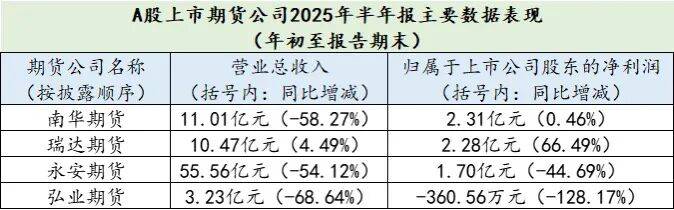
Core Viewpoint - The performance of A-share listed futures companies has been significantly impacted by changes in revenue recognition methods for trade-related businesses, leading to a decline in operating income for several firms [1][2]. Group 1: Revenue Performance - In the first half of the year, the operating revenues of Yong'an Futures, Nanhua Futures, and Hongye Futures were 5.557 billion, 1.101 billion, and 0.323 billion yuan respectively, showing declines of 54.12%, 58.27%, and 68.64% year-on-year [2]. - In contrast, Ruida Futures achieved an operating revenue of 1.047 billion yuan, representing a year-on-year increase of 4.49% [3]. Group 2: Profitability Analysis - Among the four futures companies, Ruida Futures reported a net profit attributable to shareholders of 228 million yuan, a significant increase of 66.49% year-on-year; Nanhua Futures reported a net profit of 231 million yuan, up 0.46%; Yong'an Futures saw a decline in net profit to 170 million yuan, down 44.69%; while Hongye Futures turned to a loss of 3.61 million yuan, a decrease of 128.17% [3]. - The overall profitability of the futures industry has increased, but individual company performances vary significantly, with some firms achieving substantial gains in asset management business [3]. Group 3: Market Activity and Competition - The Chinese futures market saw a notable increase in activity, with a total trading volume of 4.076 billion contracts and a trading value of 339.73 trillion yuan in the first half of the year, reflecting year-on-year growth of 17.82% and 20.68% respectively [4]. - Despite the growth in market size and overall trading volume, many futures companies did not see a corresponding increase in net income from fees and commissions, indicating intense competition within the industry [4]. Group 4: Interest Income Decline - Interest income, a significant component of futures brokerage revenue, has declined due to falling interest rates, with Hongye Futures experiencing the largest drop of 45.68% year-on-year; Nanhua Futures, Yong'an Futures, and Ruida Futures saw declines of 27.8%, 13.46%, and 8.42% respectively [5]. Group 5: Shift to New Business Models - In light of sluggish growth in traditional business, new business areas are becoming focal points for futures companies seeking growth [6]. - Ruida Futures reported a strong performance in asset management, with revenue from this segment reaching 121 million yuan, a year-on-year increase of 223.83% [7]. - Nanhua Futures is focusing on international business, with significant growth in overseas brokerage and asset management, including a total client equity of 177.68 billion HKD and 3.376 billion HKD respectively, both showing year-on-year increases [7]. Group 6: Industry Trends and Regulations - The futures industry faces severe competition characterized by homogenization of traditional business, prompting companies to innovate and seek differentiated competitive advantages [8]. - The China Futures Association has recently proposed new regulations to address issues of unfair competition in the brokerage business, which is expected to improve the competitive environment and enhance service quality in the industry [8].



期货业中报揭晓:上市期货公司业绩分化,行业步入服务资本新时代
Sou Hu Cai Jing· 2025-09-04 10:40
Core Viewpoint - The performance of A-share listed futures companies in the first half of 2025 shows significant divergence, with only Ruida Futures achieving growth in both revenue and net profit, while others like Nanhua Futures, Yong'an Futures, and Hongye Futures faced declines or losses [1][2]. Group 1: Company Performance - The four listed futures companies collectively achieved a revenue of 8.027 billion yuan and a net profit of 625 million yuan in the first half of 2025 [1]. - Ruida Futures reported a revenue increase of 4.49% to 1.047 billion yuan and a net profit surge of 66.49% to 228 million yuan [2][4]. - Nanhua Futures experienced a revenue drop of 58.27% to 1.101 billion yuan, but a slight net profit increase of 0.46% to 231 million yuan [4]. - Yong'an Futures had the largest revenue of 5.556 billion yuan, but it declined by 54.12%, with a net profit decrease of 44.69% to 170 million yuan [4]. - Hongye Futures faced the most severe challenges, with a revenue drop of 68.64% to 323 million yuan and a net loss of 3.6056 million yuan, reflecting a 128.17% decline in net profit [4]. Group 2: Industry Trends - The futures industry is undergoing a transformation from a "channel dividend" era to a "service and capital dividend" phase, necessitating core competencies in specialization, technology, and internationalization for companies to succeed [1][3]. - Despite the poor performance of A-share listed futures companies, the overall futures industry showed optimism, with a net profit of 5.074 billion yuan and a revenue of 18.676 billion yuan, reflecting a year-on-year growth of 32% and 3.89%, respectively [2][3]. - The decline in revenue for many A-share listed companies is attributed to the impact of the "net amount method" of accounting, which has particularly affected those focused on trade [2][3].

南华干散货运输市场日报:当日,农产品发运需求大幅增加,或为应对关税政策影响而提前补库,小船需求维持高位-20250904
Nan Hua Qi Huo· 2025-09-04 09:49
Report Summary 1. Investment Rating The report does not provide an investment rating for the industry. 2. Core View The decline in the BDI shipping market widened this week. The BCI and BPI freight rate indices continued to fall, with the decline exceeding 7%, and the increase in the BSI freight rate index continued to narrow. Only the BHSI freight rate index maintained a sharp increase. The demand for large ships has reached saturation, but the significant increase in agricultural product shipments, especially from Uruguay, may be an early stockpiling measure in response to US tariff policies, which supports the demand for (large) handy - sized ships [1]. 3. Summary by Directory 2.1 BDI Freight Rate Index Analysis - Compared with August 27th data, on September 3rd, the BDI composite freight rate index continued to weaken with an enlarged decline. The BCI and BPI freight rate indices' declines both exceeded 7%, and the increase in the BSI freight rate index narrowed. Specifically, the BDI composite freight rate index closed at 1940 points, down 5.18% week - on - week; the BCI freight rate index closed at 2773 points, down 7.23% week - on - week; the BPI freight rate index closed at 1719 points, down 8.27% week - on - week; the BSI freight rate index closed at 1467 points, up 1.38% week - on - week; the BHSI freight rate index closed at 788 points, up 5.77% week - on - week [4]. 2.2 FDI Far - East Dry Bulk Freight Rate Index - Compared with September 2nd, on September 3rd, the FDI composite index turned down. The only rising route was the capesize ship rental freight route from Australia to Zhoushan, China, with the freight increasing 0.03% on the day. The FDI composite freight rate index closed at 1329.93 points, down 1.3% month - on - month; the FDI rental index closed at 1622.47 points, down 1.89% month - on - month; the capesize ship rental index closed at 1674.63 points, down 2.55% month - on - month; the panamax ship rental index closed at 1516.52 points, down 2.37% month - on - month; the large handy - sized ship rental index closed at 1658.87 points, down 0.53% month - on - month; the FDI freight rate index closed at 1134.9 points, down 0.74% month - on - month [9]. 3.1当日发运国发运用船数量 - On September 4th, among major agricultural product shipping countries, Brazil used 44 ships, Russia used 11 ships, Argentina used 22 ships, Uruguay used 4 ships, and Australia used 0 ships. Among major industrial product shipping countries, Australia used 59 ships, Guinea used 27 ships, Indonesia used 37 ships, Russia used 21 ships, South Africa used 18 ships, Brazil used 7 ships, and the US used 10 ships [16]. 3.2当日发运量及用船分析 - In terms of agricultural product shipments, 18 ships were used for corn, 25 for wheat, 27 for soybeans, 14 for soybean meal, and 11 for sugar. In terms of industrial product shipments, 109 ships were used for coal, 65 for iron ore, and 13 for other dry goods. For agricultural product shipments, the most required were post - panamax ships (39), followed by super - handy ships (26), and then handy ships (20). For industrial product shipments, the most required were large capesize ships (76), followed by post - panamax ships (63), and then super - handy ships (57) [17]. 4.主要港口船舶数量跟踪 - The weekly data showed that the number of ships docked at all ports increased month - on - month, with the most obvious increase in Australian ports. The early - September data showed that "one port decreased, two ports increased". The number of dry - bulk ships docked at Chinese ports was expected to increase by 7 month - on - month, the number of ships at Australian ports decreased by 1 month - on - month, and the number of ships at Brazilian ports increased by 1 month - on - month [18]. 5.运费与商品价格的关系 - On September 3rd, Brazilian soybeans were at $39/ton, and on September 4th, the near - term shipping quote was 3993.74 yuan/ton. On September 2nd, the latest quote for the BCI C10_14 route freight was $25677/day, and on September 3rd, the latest quote for the iron ore CIF price was $121.6/kiloton. On September 2nd, the latest quote for the BPI P3A_03 route freight was $13519/day, and on September 3rd, the latest quote for the steam coal CIF price was 542.08 yuan/ton. On September 3rd, the handy - sized ship freight rate index was quoted at 774.4 points, and on August 29th, the CFR price of 4 - meter radiata pine ACFR was $116/cubic meter [22].
LPG产业风险管理日报-20250904
Nan Hua Qi Huo· 2025-09-04 08:57
1. Report Industry Investment Rating No relevant content provided. 2. Core Viewpoints of the Report - In the short - term, the LPG market is mainly affected by the crude oil end, with geopolitical and supply - demand issues intertwining to influence the market; the fundamentals have not changed much [4]. - The Houthi armed forces and the US - Venezuela issue have pushed up the risk premium of crude oil [5]. - Against the background of increasing supply and decreasing demand for crude oil, there is still downward pressure in the future; the domestic fundamentals remain loose, with few refinery overhauls and a relatively abundant supply of liquefied gas; there is not much change on the demand side; OPEC+ may increase production at the September meeting [9]. 3. Summaries According to Relevant Catalogs 3.1 LPG Price and Volatility - The monthly price range prediction for LPG is 4200 - 4500, the current 20 - day rolling volatility is 10.91%, and the historical percentage of the current volatility over 3 years is 0.15% [2]. 3.2 LPG Hedging Strategies 3.2.1 Inventory Management - When inventory is high and there are concerns about price drops (long in the spot market), to prevent inventory depreciation losses, companies can short PG2510 futures according to their inventory levels to lock in profits and cover production costs, with a hedging ratio of 50% and a recommended entry range of 4400 - 4500; they can also sell the PG2510C4500 call option to collect premiums and reduce costs, and lock in the selling price if the spot price rises, with a hedging ratio of 25% and a recommended entry range of 60 - 80 [2]. 3.2.2 Procurement Management - When the procurement of regular inventory is low and procurement is based on orders (short in the spot market), to prevent the increase in procurement costs due to rising PG prices, companies can buy PG2510 futures at lower prices on the market to lock in procurement costs, with a hedging ratio of 25% and a recommended entry range of 4200 - 4300; they can also sell the PG2510P4200 put option to collect premiums and reduce procurement costs, and lock in the spot purchase price if the PG price drops, with a hedging ratio of 25% and a recommended entry range of 20 - 30 [2]. 3.3 Industry Data Aggregation - Various price data including Brent, WTI, MOPJ M1, MOPJ spot, NWE NAP M1, NWE NAP spot, etc., show daily and weekly changes. For example, Brent was at 67.39 on September 3, 2025, down 1.68 from the previous day and up 0.19 from the previous week [8]. - There are also data on spreads, such as FEI - MOPJ M1, NWE C3 - NAP, etc., and their corresponding daily and weekly changes [10]. - Information on monthly spreads like LPG08 - 09, LPG09 - 10, etc., and their daily and weekly changes [10]. - Ratio data including MB/WTI, FEI/Brent, etc., along with their daily and weekly changes [10]. - Data on both盘面 and spot profits, such as盘面import profit - FEI, Asian naphtha cracking profit, etc., and their daily and weekly changes [10]. - Freight data including the Middle East to the Far East, the US to Europe, etc., and their daily and weekly changes [10].
丙烯产业风险管理日报-20250904
Nan Hua Qi Huo· 2025-09-04 08:28
1. Report Industry Investment Rating No relevant content provided. 2. Core Viewpoints of the Report - The near - term spot supply and demand of propylene are tightening due to the maintenance of some external devices, while the long - term devices will gradually resume production, and new devices from Jilin Petrochemical, Guangxi Petrochemical, and Yulong Petrochemical are to be put into operation. Currently, the 01 contract is still relatively far away, and market participation is low [3]. - Bullish factors include the rising crude oil risk premium caused by the Houthi armed forces and the US - Venezuela issue, providing cost support, and the strong operation of overseas propane prices. In the Shandong market, the maintenance of Zhenhua's 750,000 - ton PDH, Wanhua Penglai's 900,000 - ton PDH, and Jinneng's 900,000 - ton PDH has reduced the overall external supply, and the supply - demand situation is more tense than in August [4]. - Bearish factors include the addition of PP maintenance devices in Jinneng and Yulong this week, which will lead to some propylene external supply and narrow the supply - demand gap. The PP supply is at a high level, while downstream demand is limited, causing some enterprises to stop PP production and release propylene. The price difference between PP powder and propylene has shrunk to 165 yuan/ton, lower than the processing cost. There are rumors that OPEC+ may increase production at the September meeting [8]. 3. Summary by Related Catalogs 3.1 Propylene Price Range Forecast - The monthly price range forecast for propylene is 6,250 - 6,600 yuan/ton. The current 20 - day rolling volatility is 0.0646, and the historical percentage of the current volatility in the past 3 years is 0.0625 [2]. 3.2 Propylene Hedging Strategy 3.2.1 Inventory Management - For enterprises with high finished - product inventory worried about propylene price decline (long spot exposure), they can short - allocate propylene futures (PL2601) on rallies according to their inventory to lock in profits, with a hedging ratio of 50% and a recommended entry range of 6,500 - 6,600 yuan/ton. They can also sell call options (PL2601C6700) to collect premiums and reduce costs, and lock in the selling price if the spot price rises, with a hedging ratio of 50% and a recommended entry range of 100 - 120 [2]. 3.2.2 Procurement Management - For enterprises with low regular inventory for procurement and hoping to purchase based on orders (short spot exposure), they can buy propylene futures (PL2601) on dips to lock in procurement costs through on - disk procurement, with a hedging ratio of 25% and a recommended entry range of 6,300 - 6,400 yuan/ton. They can also sell put options (PL2601P6000) to collect premiums and reduce procurement costs, and lock in the spot purchase price if the propylene price drops, with a hedging ratio of 25% and a recommended entry range of 30 - 40 [2]. 3.3 Industrial Data Summary - **Upstream Prices**: On September 3, 2025, Brent crude oil was at $67.39/barrel, down $1.68 from the previous day and up $0.19 from the previous week; WTI crude oil was at $63.77/barrel, down $1.85 from the previous day and down $0.09 from the previous week. Other upstream prices also showed different degrees of changes [6]. - **Mid - stream Prices**: The mid - stream propylene prices in different regions and related price differences are presented. For example, the price in the Shandong market on September 3, 2025, was 6,630 yuan/ton, down 5 yuan from the previous day and up 70 yuan from the previous week [8]. - **Downstream Prices**: The downstream product prices such as polypropylene powder, polypropylene granules, and epoxy propane also had corresponding price changes. For example, the price of polypropylene powder was 6,780 yuan/ton on September 3, 2025, unchanged from the previous day and down 50 yuan from the previous week [8]. - **Profits**: The profits of different production processes and products in the mid - upstream and downstream showed different trends. For example, the main refinery profit was 795.66 yuan/ton, down 30.27 yuan from August 27 [8]. - **Price Spreads**: The price spreads between upstream and downstream products and different contracts are also provided. For example, the spread between PP01 and PL01 was 539 yuan/ton on September 3, 2025, up 1 yuan from the previous day and down 38 yuan from the previous week [8].
整体“上紧下松”格局维持不变 PTA期货大幅走低
Jin Tou Wang· 2025-09-04 07:11
Group 1 - PTA futures have significantly declined, with the main contract reported at 4656.00 CNY/ton, a decrease of 2.06% [1] - As of September 3, 2025, the average processing range for PTA in China is 189.82 CNY/ton, reflecting a month-on-month decrease of 21.32% and a year-on-year decrease of 40.68% [2] - The current PTA production capacity utilization rate is 70.86%, down 5.36% from the previous week, with domestic PTA output at 1.3129 million tons, a decrease of 100,000 tons from the previous week [3] Group 2 - According to Nanhua Futures, the overall sentiment in commodities is weak, with high oil prices retreating and PX-TA prices following suit. The structural contradictions between PX and TA are expected to dominate the market, maintaining a "tight up and loose down" pattern [4] - Hualian Futures notes that supply pressure has eased due to significant maintenance at large facilities in South and East China, while polyester operating rates remain stable. However, the replenishment of polyester filament shows moderate performance, focusing on consuming existing raw material inventories [4]
传统业务增长乏力!上市期货公司发力资管与海外业务
券商中国· 2025-09-04 04:16
Core Viewpoint - The performance of A-share listed futures companies in the first half of the year shows significant divergence, with traditional brokerage business facing intense competition and innovative business becoming a key determinant of profitability [2][5][11]. Group 1: Revenue Performance - Four A-share listed futures companies have disclosed their semi-annual reports, revealing a notable decline in revenue for some due to changes in revenue recognition methods for trade-related businesses [1][2]. - Specifically, Yong'an Futures, Nanhua Futures, and Hongye Futures reported revenues of 5.557 billion, 1.101 billion, and 323 million yuan respectively, with year-on-year declines of 54.12%, 58.27%, and 68.64% [3]. - In contrast, Ruida Futures achieved a revenue of 1.047 billion yuan, marking a year-on-year increase of 4.49% [4]. Group 2: Profitability Analysis - Profitability among the four futures companies varied significantly, with Ruida Futures reporting a net profit of 228 million yuan, up 66.49% year-on-year; Nanhua Futures reported a net profit of 231 million yuan, up 0.46%; Yong'an Futures saw a decline in net profit to 170 million yuan, down 44.69%; while Hongye Futures turned to a loss of 3.61 million yuan, a decline of 128.17% [5]. - Overall, the futures industry experienced an increase in profitability, but individual company performances varied, with some achieving substantial gains in asset management business [5]. Group 3: Market Activity and Competition - The Chinese futures market saw a significant increase in activity in the first half of the year, with a total trading volume of 4.076 billion contracts and a total trading value of 339.73 trillion yuan, representing year-on-year growth of 17.82% and 20.68% respectively [6]. - Despite the growth in market size and overall trading volume, many futures companies did not see a corresponding increase in net income from fees and commissions, highlighting the intense competition in the industry [7]. Group 4: Interest Income and Client Equity - Interest income, a major component of brokerage business revenue, declined due to falling interest rates, with Hongye Futures experiencing the largest drop of 45.68% year-on-year, followed by Nanhua Futures, Yong'an Futures, and Ruida Futures with declines of 27.8%, 13.46%, and 8.42% respectively [8]. - Client equity sizes varied among the four listed futures companies, with Yong'an Futures reporting a decline of 15.47% to 39.775 billion yuan, while Nanhua Futures saw a growth of 6.1% to 27.347 billion yuan, and Ruida Futures reported a growth of 28.51% to 14.725 billion yuan [8]. Group 5: Business Transformation and Innovation - In light of sluggish growth in traditional business, futures companies are increasingly focusing on new business areas for growth, with Ruida Futures reporting significant profit growth driven by its asset management business, which generated 121 million yuan in revenue, up 223.83% year-on-year [10]. - Nanhua Futures is also focusing on international business, with its overseas brokerage client equity totaling 17.768 billion HKD, and its overseas asset management business reaching 3.376 billion HKD, both showing year-on-year growth [10]. - The industry is facing challenges from intense competition and the need for transformation, prompting some companies to seek differentiation and innovation to enhance competitiveness [11].

金融期货早评-20250904
Nan Hua Qi Huo· 2025-09-04 03:28
Industry Investment Rating - No investment rating information is provided in the report. Core Views - **Domestic Economy**: Supportive policies are gradually taking effect. Policies to boost service consumption in September are in focus, and real - estate policies are advancing. However, the impact on the overall market may be limited. The improvement in economic sentiment in July was marginal, and industrial profit repair will take time [2]. - **Overseas Economy**: The US manufacturing PMI shows marginal improvement, indicating a "soft landing." The low JOLTS job openings in July have increased the expectation of interest - rate cuts. Attention should be paid to employment and inflation data this week. The long - term government bond yields in the UK, Germany, and France have reached new highs, and the potential "credit crisis" in the global market should be monitored [2]. - **RMB Exchange Rate**: The key issue of the USD/CNY spot exchange rate is the rhythm control. The spot exchange rate is likely to gradually repair towards a reasonable equilibrium level, and it is less likely to return to the "6 era" in the short term [4]. - **Stock Index**: The external pressure on the A - share market has weakened. With the support of domestic policies and loose liquidity, the downside space of the stock index is expected to be limited [5]. - **Treasury Bonds**: The bond market's bottom may be further consolidated, but caution is needed regarding the upward space [6]. - **Container Shipping**: The futures price of the container shipping index (European line) is expected to continue to fluctuate or decline slightly [8]. - **Precious Metals**: The medium - to long - term trend of precious metals may be bullish. Short - term prices are strong, and investors can maintain a strategy of buying on dips [12]. - **Copper**: Copper prices may remain strong in the short term due to tight supply and the expectation of interest - rate cuts in the US [14]. - **Aluminum and Related Products**: Aluminum prices may fluctuate strongly in the short term but face resistance above. Alumina supply is expected to be in surplus, and casting aluminum alloy prices may be supported [16][17][18]. - **Zinc**: Zinc prices are expected to fluctuate strongly at the bottom in the short term, and an internal - external reverse arbitrage strategy can be considered [20]. - **Nickel and Stainless Steel**: Nickel and stainless - steel prices have corrected recently. The medium - term trend depends on demand recovery, and the impact of Indonesia's riots is limited [21][22]. - **Tin**: Tin prices may rise slightly in the short term due to tight supply [23]. - **Lithium Carbonate**: The market is in a weak - oscillating phase, and the key is to observe the downstream's actual purchasing demand [24]. - **Industrial Silicon and Polysilicon**: Industrial silicon is expected to maintain an oscillating trend, and polysilicon is in a wide - range oscillating pattern [27]. - **Lead**: Lead prices are expected to oscillate in the short term, with sufficient support at the bottom [28]. - **Black Metals**: The fundamentals of steel products remain weak, and the price trend is bearish. Iron ore prices are supported after the resumption of steel mills, and the coke and coking coal markets are looking for support downward [32][33][34]. - **Energy and Chemicals**: Crude oil prices are under pressure due to the possibility of OPEC+ increasing production. The LPG market is affected by overseas factors, and the PTA - PX market is weakening with the overall commodity sentiment and oil prices. Other energy - chemical products also show different trends based on their supply - demand fundamentals [38][40][42][44] Summary by Directory Financial Futures - **Macro**: The US JOLTS job openings data is weak, and the Fed's officials have different views on interest - rate cuts. The global bond market is experiencing a sell - off, and the eurozone's PMI has been slightly revised down [1]. - **RMB Exchange Rate**: The on - shore RMB against the US dollar closed higher in the previous trading day. The US job openings in July dropped to a 10 - month low, increasing the expectation of interest - rate cuts [3]. - **Stock Index**: The stock index declined with shrinking volume yesterday. The weak JOLTS data in the US has strengthened the expectation of interest - rate cuts, reducing the external pressure on the A - share market [5]. - **Treasury Bonds**: The bond market closed higher yesterday. The decline in the stock market has led to an increase in the bond market's gains at the end of the session [6]. - **Container Shipping**: The futures price of the container shipping index (European line) declined with the drop in the spot price. It is expected to continue to fluctuate or decline slightly [7][8]. Commodities Precious Metals - **Gold & Silver**: The precious metals market continued to rise on Wednesday. The low JOLTS data in the US has increased the expectation of interest - rate cuts. The market is focusing on economic data and events this week. The medium - to long - term trend may be bullish [9][10][11][12]. - **Copper**: The copper price rose and then fell on Wednesday, mainly due to the US economic situation. It may remain strong in the short term due to tight supply and the expectation of interest - rate cuts [13][14]. - **Aluminum Industry Chain** - **Aluminum**: The price may fluctuate strongly in the short term but face resistance above. The supply and demand situation is affected by production capacity and seasonal factors [16]. - **Alumina**: The supply is expected to be in surplus, and the price is under pressure. The impact of environmental protection restrictions is short - term [17]. - **Cast Aluminum Alloy**: The price is supported by the tight supply of scrap aluminum and the cancellation of tax - return policies [18]. - **Zinc**: The zinc price opened low and lacked upward momentum. The supply is in surplus, and the demand is stable. The inventory shows an external - strong and internal - weak pattern [19][20]. - **Nickel, Stainless Steel**: The prices of nickel and stainless steel corrected on the day. The market is affected by factors such as the Indonesian benchmark price and the EU's stainless - steel tariff policy [20][21][22]. - **Tin**: The tin price has been rising recently due to tight supply. The production has decreased due to maintenance and reduced imports of tin concentrates [23]. - **Lithium Carbonate**: The futures price of lithium carbonate declined on Wednesday. The downstream replenishment pace has slowed down, and the market is in a weak - oscillating phase [24]. - **Industrial Silicon & Polysilicon**: The industrial silicon futures price is oscillating, and the polysilicon futures price is in a wide - range oscillating pattern. Their prices are affected by supply - demand fundamentals and seasonal factors [25][26][27]. - **Lead**: The lead price opened low and closed high, maintaining a narrow - range oscillation. The supply is weak, and the demand is in a "not - prosperous in the peak season" situation [28]. Black Metals - **Rebar and Hot - Rolled Coil**: The prices of rebar and hot - rolled coil have reached new lows recently. The supply exceeds the demand, and the inventory is accumulating seasonally. The market is bearish [30][31][32]. - **Iron Ore**: The iron ore price has rebounded, and the term structure is in a positive - spread arbitrage. The resumption of steel mills after the parade has supported the price, but the upside space is limited [33]. - **Coking Coal and Coke**: The coking coal and coke prices are looking for support downward. The supply - demand gap of coke is expected to narrow, and the coking coal inventory structure has deteriorated [34]. - **Silicon Iron and Silicon Manganese**: The supply of silicon iron and silicon manganese is loose, and the prices are oscillating at the bottom. The profit has declined, and there is a possibility of production reduction [36]. Energy and Chemicals - **Crude Oil**: The crude oil price dropped significantly due to the possible production increase by OPEC+. The uncertainty of OPEC+'s production decision will be an important factor affecting the price next week [38][39][40]. - **LPG**: The LPG price fluctuates with the crude oil price. The supply is relatively loose, and the demand has little change. The market is affected by overseas factors [42]. - **PTA - PX**: The prices of PX and PTA have weakened with the overall commodity sentiment and the decline in the crude oil price. The supply - demand situation is complex, and the profit is under pressure [44][45][46]. - **MEG - Bottle Chip**: The ethylene glycol price is oscillating at a low level. The supply and demand are in a state of change, and the inventory is expected to decline slightly. The bottle - chip demand is not good [48][49]. - **Methanol**: The methanol market is mainly affected by the high - volume shipments from Iran and the port inventory pressure. It is recommended to hold a small number of long positions and short put options [51][52]. - **PP**: The supply of polypropylene is increasing, and the demand is uncertain. The future trend depends on whether the downstream demand can maintain a high growth rate [54][55]. - **PE**: The polyethylene market is in a pattern of decreasing supply and increasing demand, but the demand recovery is not strong enough to drive the price up significantly. It is expected to oscillate [56][57][58]. - **PVC**: The PVC price has returned to the industrial fundamentals. The supply is relatively stable, the demand is weak, and the inventory is accumulating [59][60]. - **Pure Benzene and Styrene**: The prices of pure benzene and styrene have stopped falling. The supply and demand of pure benzene are weak, and the supply of styrene will change in different periods. Short - term short - selling is not recommended [61][62][64]. - **Fuel Oil**: The fuel oil market is waiting for the guidance of the OPEC meeting. The supply is expected to increase slowly, and the demand is stable. The price is under pressure from the spot market [65]. - **Asphalt**: The asphalt supply is stable, but the demand is affected by rainfall and capital shortage. It is mainly following the cost fluctuation in the short term [67][68]. - **Rubber and 20 - Number Rubber**: The rubber market is in a multi - empty stalemate. The price is affected by factors such as the crude oil price, supply - demand fundamentals, and macro - economic data. It is expected to oscillate widely [69][70][71]. - **Urea**: The domestic urea market is in a weak supply - demand situation. The market is waiting for the Indian tender news. It is recommended to pay attention to the 1 - 5 reverse arbitrage [72][73]. - **Glass, Soda Ash, and Caustic Soda**: The soda ash inventory has decreased slightly. The market situation is relatively weak [74].
南华期货锡风险管理日报-20250904
Nan Hua Qi Huo· 2025-09-04 02:50
Report Overview - Report Name: Nanhua Futures Tin Risk Management Daily Report - Date: September 4, 2025 - Research Team: Nanhua Non - ferrous Metals Research Team [1] Investment Rating - Not provided in the report Core Viewpoints - The recent strength of tin prices is mainly due to tight supply. Yunnan Tin plans to shut down for maintenance from August 30 for 45 days. In August 2025, China's refined tin production decreased both month - on - month and year - on - year, affected by enterprise maintenance and lower tin concentrate imports in July. In the short term, with a stable macro - environment, tin prices may rise slightly further, with the upper target set at 276,000 yuan per ton [3] Summary by Directory 1. Tin Price Volatility and Risk Management - **Price Volatility**: The latest closing price is 273,120 yuan, the monthly price range forecast is 245,000 - 263,000 yuan, the current volatility is 12.99%, and the historical percentile of the current volatility is 22.4% [2] - **Risk Management Suggestions**: - **Inventory Management**: For high finished - product inventory and fear of price drops, sell 75% of the Shanghai Tin main futures contract at around 275,000 yuan and sell 25% of the SN2511C275000 call option when volatility is appropriate [2] - **Raw Material Management**: For low raw - material inventory and fear of price increases, buy 50% of the Shanghai Tin main futures contract at around 230,000 yuan and sell 25% of the SN2511P260000 put option when volatility is appropriate [2] 2. Factors Affecting Tin Prices - **Likely Positive Factors**: Sino - US tariff policy easing, the semiconductor sector being in an expansion cycle, and Myanmar's production resumption falling short of expectations [4][5] - **Likely Negative Factors**: Tariff policy reversals, the inflow of Burmese tin ore into China, and the semiconductor sector's expansion slowing down and moving towards a contraction cycle [5] 3. Tin Futures and Spot Market Data - **Futures Data (Daily)**: - Shanghai Tin main contract: 273,120 yuan/ton, unchanged [6] - Shanghai Tin continuous - one contract: 273,120 yuan/ton, unchanged [6] - Shanghai Tin continuous - three contract: 273,260 yuan/ton, unchanged [6] - LME Tin 3M: 34,620 dollars/ton, down 115 dollars (- 0.33%) [6] - Shanghai - London ratio: 7.85, up 0.08 (1.03%) [6] - **Spot Data (Weekly)**: - Shanghai Non - ferrous tin ingot: 273,100 yuan/ton, up 1,100 yuan (0.4%) [10] - 1 tin premium: 0 yuan/ton, down 200 yuan (- 100%) [10] - 40% tin concentrate: 261,100 yuan/ton, up 1,100 yuan (0.42%) [10] - 60% tin concentrate: 265,100 yuan/ton, up 1,100 yuan (0.42%) [10] - Other tin - related products also showed varying degrees of price changes [10] 4. Tin Import and Inventory Data - **Import and Processing Data (Daily)**: - Tin import profit and loss: - 20,238.59 yuan/ton, up 143.67 yuan (- 0.7%) [12] - 40% tin ore processing fee: 12,200 yuan/ton, unchanged [12] - 60% tin ore processing fee: 10,050 yuan/ton, unchanged [12] - **Inventory Data (Daily)**: - Shanghai Futures Exchange tin warehouse receipts: 7,407 tons, up 144 tons (1.98%) [14] - LME tin inventory: 2,175 tons, up 20 tons (0.93%) [14]