
Nanhua Futures(603093)

Search documents
南华期货光伏产业周报:供需双弱,宽幅震荡-20260208
Nan Hua Qi Huo· 2026-02-08 14:36
1. Report Industry Investment Rating The document does not provide the industry investment rating. 2. Core Viewpoints of the Report - The polysilicon futures price fluctuated widely this week. The core logic driving the price trend focuses on factors such as supply - side production suspension and resumption, downstream demand - side production scheduling, photovoltaic export rush, and anti - involution. The industry presents a "weak supply and weak demand" characteristic, with supply expansion slowing and downstream production under pressure. Due to the export tax - refund window in April, there may be an export rush for photovoltaic modules, but the overall market is mainly focused on inventory consumption [3]. - The polysilicon futures price is expected to be in a wide - range oscillation. The current 20 - day rolling volatility is 28.63%, and the historical percentile of the current volatility in the past 3 years is 83.6% [9]. 3. Summary According to Relevant Catalogs 3.1 Core Contradictions and Strategy Recommendations 3.1.1 Core Contradictions - The current polysilicon market is affected by supply - side production changes, downstream demand, export rush, and anti - involution. The industry shows a "weak supply and weak demand" situation, with supply - side production declining and downstream production also under pressure. The market is mainly consuming inventory, and attention should be paid to the anti - involution progress [3]. 3.1.2 Industry Operation Suggestions - **Polysilicon Futures Price Range**: The polysilicon futures price is expected to have a wide - range oscillation, with a 20 - day rolling volatility of 28.63% and a historical percentile of 83.6% in the past 3 years [9]. - **Photovoltaic Industry Risk Management Strategy Suggestions**: Different hedging strategies are provided for polysilicon sales, procurement, and inventory management, including using futures contracts and option combinations, with recommended hedging ratios [9]. 3.2 Market Information - On January 31 (Saturday), some leading polysilicon companies held a meeting to discuss polysilicon market - related matters. On February 5, a photovoltaic industry - related meeting was held to focus on capacity optimization and price order rectification [11]. 3.3 Market Analysis 3.3.1 Price, Volume, and Capital Interpretation - **Market Review and Technical Analysis**: The polysilicon weighted index closed at 49,536 yuan/ton this week, with a week - on - week increase of 5.06%. The trading volume was 12,451 lots, a week - on - week decrease of 47.72%, and the open interest was 65,885 lots, a week - on - week decrease of 10,229 lots. The PS2605 - PS2606 spread was in a contango structure, with a week - on - week decrease of 470 yuan/ton. The number of warehouse receipts was 8,610 lots, a week - on - week increase of 190 lots. The futures price is expected to face resistance at 52,000 yuan/ton [15]. - **Option Situation**: The 20 - day historical volatility and the implied volatility of at - the - money options of polysilicon fluctuated widely in the past week. The option open - interest PCR showed a weakening trend [17][18]. - **Capital Trends**: The long - position scale of key profitable seats in polysilicon showed a stable trend in the past week [20]. - **Spread Structure**: The polysilicon futures term structure is in a contango structure [22]. - **Basis Structure**: The basis of the main contract showed a slightly stronger oscillation this week, and it is recommended to pay attention to the opportunity of taking goods from the futures market periodically [26]. 3.3.2 Futures and Price Data - The prices of various types of polysilicon, silicon wafers, battery cells, and photovoltaic modules are provided, showing different price changes [29]. 3.4 Valuation and Profit Analysis - The overall profit margin of polysilicon enterprises is weakening. From the spot market, the spot profit of polysilicon is declining. In terms of production technology, the profit of the silane method is higher than that of the improved Siemens method. The gross profit margin of polysilicon futures is about 26.99% [30]. 3.5 Fundamental Data 3.5.1 Polysilicon Supply - **Domestic Production**: The domestic polysilicon weekly production decreased, with the SMM - weekly production at 20,100 tons, a week - on - week decrease of 0.50% and a month - on - week decrease of 15.55%. The Baichuan - weekly production was 19,220 tons, a week - on - week decrease of 5.78% and a month - on - week decrease of 27.14%. The Baichuan - weekly utilization rate was 31%, a week - on - week decrease of 0.0313 and a month - on - week decrease of 26.19% [38]. - **Overseas Production**: The overseas polysilicon monthly production and utilization rate data are provided [40]. - **Inventory**: The domestic polysilicon weekly inventory increased. The total weekly inventory was 589,000 tons, a week - on - week increase of 1.63% and a month - on - week increase of 10.22% [43]. 3.5.2 Silicon Wafer Supply - **Production**: The weekly silicon wafer production was 10.38 GW, a week - on - week decrease of 11.66% and a month - on - week decrease of 1.33% [46]. - **Inventory**: The weekly silicon wafer inventory was 28.32 GW, a week - on - week increase of 3.77% and a month - on - week increase of 7.97% [46]. 3.5.3 Battery Cell Supply - **Production**: The monthly production and utilization rate data of battery cells are provided, including different types of battery cells such as Topcon, BC, and HJT [53]. - **Inventory**: The weekly battery cell inventory was 9.17 GW, a week - on - week increase of 2.80% and a month - on - week increase of 2.80% [56]. 3.5.4 Photovoltaic Module Supply - **Production**: The monthly production and utilization rate data of photovoltaic modules are provided, including N - type and P - type modules [59]. - **Inventory**: The weekly photovoltaic module inventory was 24.7 GW, a week - on - week decrease of 5.36% and a month - on - week decrease of 17.67% [62]. 3.5.5 Bidding - The weekly data of photovoltaic module winning bids show that the winning bid capacity was 137.33 MW, a week - on - week decrease of 46.84% and a month - on - week decrease of 95.83%. The average winning bid price was 0.78 yuan/watt, a week - on - week increase of 1.30% and a month - on - week increase of 6.85% [64]. 3.5.6 Installation and Application - The monthly new - installed capacity of Chinese photovoltaics and the data of green power generation (including wind and solar power) are provided [68][70].

南华期货苹果产业周报:节前备货尾声,成交氛围偏弱-20260208
Nan Hua Qi Huo· 2026-02-08 14:28
南华期货苹果产业周报 ——节前备货尾声,成交氛围偏弱 杨歆悦 投资咨询证书:Z0022518 联系邮箱:yangxy@nawaa.com 投资咨询业务资格:证监许可【2011】1290号 2026年2月8日 source: 上海钢联,南华研究 万吨 22/23 23/24 24/25 25/26 01/01 03/01 05/01 07/01 09/01 0 250 500 750 1000 source: 同花顺,南华研究 元/吨 2023 2024 2025 2026 12/01 12/15 12/29 01/12 01/26 02/09 02/23 -1000 -500 0 500 ∗ 近端交易逻辑 AP2603合约还有不到一个月的时间进行交割,市场当前重点关注春节旺季消费情况,上周产区节前备货 步入尾声,去库加速,但现货价格弱稳,果农降价促销心理显现,整体需求仍受到高价压制。从盘面看, AP2605强于AP2603,03合约减仓下跌,需要关注交割品短期问题是否得到改善。上周全国苹果去库环比加 . 第一章 核心矛盾及策略建议 1.1 核心矛盾 当前影响苹果价格走势的核心矛盾有以下几点: 1、当前产区春节 ...
2月6日郑州白糖持仓排行表
Xin Lang Cai Jing· 2026-02-07 11:26
来源:沐甜科技 品种:白糖SR 日期:2026-02-06名次会员简称交易量(手)增减量会员简称持买仓量增减量会员简称 持卖仓量增减量1东证期货(代客)74,794-438中粮期货(代客)67,9611,553中粮期货(代客) 100,1394,7192中信期货(代客)58,9805,673银河期货(代客)54,914409中信期货(代客)68,5571,7583 国泰君安(代客)39,3854,691东证期货(代客)49,173-861乾坤期货(代客)49,2742,1044广发期货 (代客)32,3971,636中信期货(代客)37,917260东证期货(代客)34,1241,3935南华期货(代客) 28,5403,999国泰君安(代客)28,1821,326浙商期货(代客)32,538-496五矿期货(代客)26,8794,682华 泰期货(代客)23,027-225华泰期货(代客)26,653-1,3007海证期货(代客)23,8153,506永安期货(代 客)18,7412,086永安期货(代客)24,7051,0818银河期货(代客)19,3703,228中信建投(代客)15,917- 1,07 ...

涉黄金、白银、铜等!上海期货交易所最新通知
Sou Hu Cai Jing· 2026-02-06 00:49
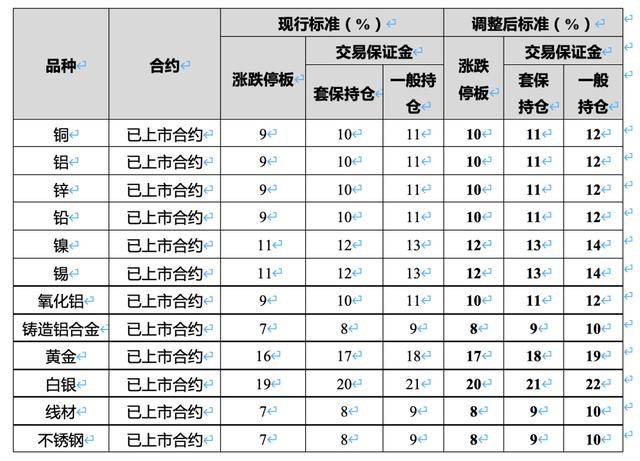
上期所再次对黄金、白银等期货品种提保扩板。 2月5日晚间,上海期货交易所(以下简称"上期所")发布通知,自2026年2月9日(星期一)收盘结算时起,对铜、铝、铅、锌、氧化铝、铸造铝合金、线 材、不锈钢、镍、锡、黄金、白银等期货已上市合约的涨跌停板幅度及交易保证金比例进行调整。 沪银期货涨跌停板扩大至20% 具体来看,黄金期货已上市合约的涨跌停板幅度调整为17%,套保持仓交易保证金比例调整为18%,一般持仓交易保证金比例调整为19%;白银期货已上 市合约的涨跌停板幅度调整为20%,套保持仓交易保证金比例调整为21%,一般持仓交易保证金比例调整为22%。 在有色金属方面,铜、铝、铅、锌、氧化铝期货已上市合约的涨跌停板幅度调整为10%,套保持仓交易保证金比例调整为11%,一般持仓交易保证金比例 调整为12%;铸造铝合金、线材、不锈钢期货已上市合约的涨跌停板幅度调整为8%,套保持仓交易保证金比例调整为9%,一般持仓交易保证金比例调整 为10%;镍、锡期货已上市合约的涨跌停板幅度调整为12%,套保持仓交易保证金比例调整为13%,一般持仓交易保证金比例调整为14%。 | | | | 现行标准(%)e | | | 调整后标 ...

南华期货(603093) - 南华期货H股公告
2026-02-04 09:45
FF301 | 2. 股份分類 | 普通股 | | 股份類別 | A | | 於香港聯交所上市 (註1) | | 否 | | | --- | --- | --- | --- | --- | --- | --- | --- | --- | --- | | 證券代號 (如上市) | 603093 | 說明 | | A 股 (於上海證券交易所上市) | | | | | | | | | | 法定/註冊股份數目 | | 面值 | | | 法定/註冊股本 | | | 上月底結存 | | | | 610,065,893 RMB | | | 1 RMB | | 610,065,893 | | 增加 / 減少 (-) | | | | 0 | | | RMB | | 0 | | 本月底結存 | | | | 610,065,893 RMB | | | 1 RMB | | 610,065,893 | | I. 法定/註冊股本變動 | | | | | | | | | --- | --- | --- | --- | --- | --- | --- | --- | | 1. 股份分類 | 普通股 | 股份類別 | H | | 於香港聯交所 ...
南华期货股份有限公司关于变更签字注册会计师的公告
Xin Lang Cai Jing· 2026-02-03 18:43
本公司董事会及全体董事保证本公告内容不存在任何虚假记载、误导性陈述或者重大遗漏,并对其内容 的真实性、准确性和完整性承担法律责任。 南华期货股份有限公司(以下简称"公司")于2025年3月7日、3月31日分别召开第四届董事会第十九次 会议和2024年年度股东大会,审议通过了《关于续聘会计师事务所的议案》,同意续聘天健会计师事务 所(特殊普通合伙)(以下简称"天健会计师事务所")为公司境内2025年度财务及内部控制审计机构。 续聘审计机构的具体内容详见公司于2025年3月11日披露的《南华期货股份有限公司续聘会计师事务所 公告》(公告编号:2025-014)。 近日,公司收到天健会计师事务所出具的《关于变更签字注册会计师的函》。现将相关情况公告如下: 一、本次变更签字会计师的情况 天健会计师事务所作为公司2025年度财务报表和2025年末财务报告内部控制审计机构,原委派卢娅萍和 吕蔡霞作为公司2025年度财务报表审计报告和2025年末财务报告内部控制审计报告的签字注册会计师。 由于内部工作调整,现委派唐彬彬、兰笑接替卢娅萍、吕蔡霞作为签字注册会计师。变更后的签字注册 会计师为唐彬彬和兰笑。 二、本次新任签字会计 ...
南华期货:变更签字注册会计师为唐彬彬、兰笑
Zheng Quan Ri Bao Wang· 2026-02-03 12:41
证券日报网讯2月3日,南华期货(603093)发布公告称,公司2025年度财务报表及内控审计签字注册会 计师由卢娅萍、吕蔡霞变更为唐彬彬、兰笑,天健会计师事务所已出具变更函,交接有序不影响审计工 作。 ...
南华商品指数日报-20260203
Nan Hua Qi Huo· 2026-02-03 11:59
1. Report Industry Investment Rating - There is no information about the report industry investment rating in the provided content. 2. Core Viewpoints of the Report - Calculated based on the closing prices of adjacent trading days, the Nanhua Composite Index rose 0.93% today [1][3]. - Among the sector indices, only the Nanhua Precious Metals Index fell by -0.36%, while the rest of the sectors rose. The sector with the largest increase was the Nanhua Non - ferrous Metals Index, up 4.38%, and the sector with the smallest increase was the Nanhua Agricultural Products Index, up 0.08% [1][3]. - Among the theme indices, only the Oilseeds and Oils Index fell by -0.01%, while the rest of the theme indices rose. The theme index with the largest increase was the Mini Composite Index, up 1.43%, and the theme index with the smallest increase was the Black Raw Materials Index, up 0.27% [1][3]. - Among the single - variety indices of commodity futures, the single - variety index with the largest increase was Lithium Carbonate, up 11.82%, and the single - variety index with the largest decrease was Silver, down - 13.64% [3]. 3. Summary According to Relevant Contents 3.1 Nanhua Commodity Index Market Data | Index Name | Today Close | Pre. Close | Points | Daily Change | Annualized Return | Annualized Volatility | Sharpe Ratio | | --- | --- | --- | --- | --- | --- | --- | --- | | Composite Index NHCI | 2758.41 | 2733.02 | 25.38 | 0.93% | 7.28% | 13.21% | 0.55 | | Precious Metals Index NHPMI | 2174.24 | 2182.21 | - 7.96 | - 0.36% | 27.71% | 3.82% | | | Industrial Goods Index MHII | 3644.59 | 3594.36 | 50.23 | 1.40% | - 6.21% | 14.59% | - 0.43 | | Metal Index MHMI | 7150.53 | 6982.18 | 168.35 | 2.41% | 12.06% | 14.01% | 0.86 | | Non - ferrous Metals Index NHNF | 1972.76 | | | | | | | | Black Index NHFI | 2519.61 | 2512.72 | 6.89 | 0.27% | - 5.51% | 16.31% | - 0.34 | | Agricultural Products Index NHAI | 1057.60 | 1056.80 | 0.81 | 0.08% | | | | | Mini Composite Index NHCIMi | 1204.34 | 1187.38 | 16.97 | 1.43% | 14.64% | | 0.07 | | Oil and Chemical Industry Index NHEI | 1004.87 | 996.23 | 8.64 | 0.87% | 0.68% | 22.15% | 0.03 | | Petrochemical Index NHPCI | 940.37 | 932.44 | 7.93 | 0.85% | 2.77% | 15.61% | 0.18 | | Fuel and Chemical Industry Index NHCCI | 956.65 | 951.80 | 4.85 | 0.51% | 1.78% | 14.93% | 0.12 | | Black Raw Materials Index NHFM | 1056.06 | 1053.23 | 2.83 | 0.27% | 0.02% | 17.28% | 0.00 | | Building Materials Index NHBMI | 694.45 | 690.97 | 3.48 | 0.50% | - 0.22% | 12.98% | - 0.02 | | Oilseeds and Oils Index NHOOI | 1234.61 | 1234.79 | - 0.18 | - 0.01% | 0.14% | 10.58% | 0.01 | | Economic Crops Index NHAECI | 927.58 | 924.28 | 3.31 | 0.36% | 3.31% | 9.85% | 0.05 | [3] 3.2 Contribution of Each Variety's Daily Change to Index Change - For different indices such as Nanhua Mini Composite Index, Nanhua Composite Index, Nanhua Industrial Goods Index, etc., various varieties have different positive or negative contributions to their changes. For example, for the Nanhua Composite Index, Gold has a positive contribution of 22.26%, while some varieties like Ethylene Glycol have a negative contribution [3]. 3.3 Industry Chain Diagrams and Single - Variety Index Daily Changes - There are industry chain diagrams for energy and chemical, black, and agricultural product sectors, along with the daily changes of single - variety indices in these sectors. For example, in the energy and chemical sector, Glass rose 0.179 (1.52%) and Urea rose 0.95%; in the agricultural product sector, Palm Oil rose 0.89%, and Rapeseed Meal fell - 1.19% [3][5][6]
南华期货(603093) - 南华期货股份有限公司关于变更签字注册会计师的公告
2026-02-03 09:15
证券代码:603093 证券简称:南华期货 公告编号:2026-003 南华期货股份有限公司 关于变更签字注册会计师的公告 本公司董事会及全体董事保证本公告内容不存在任何虚假记载、误导性陈述 或者重大遗漏,并对其内容的真实性、准确性和完整性承担法律责任。 南华期货股份有限公司(以下简称"公司")于 2025 年 3 月 7 日、3 月 31 日分别召开第四届董事会第十九次会议和 2024 年年度股东大会,审议通过了《关 于续聘会计师事务所的议案》,同意续聘天健会计师事务所(特殊普通合伙)(以 下简称"天健会计师事务所")为公司境内 2025 年度财务及内部控制审计机构。 续聘审计机构的具体内容详见公司于 2025 年 3 月 11 日披露的《南华期货股份有 限公司续聘会计师事务所公告》(公告编号:2025-014)。 近日,公司收到天健会计师事务所出具的《关于变更签字注册会计师的函》。 现将相关情况公告如下: 一、本次变更签字会计师的情况 天健会计师事务所作为公司2025年度财务报表和2025年末财务报告内部控 制审计机构,原委派卢娅萍和吕蔡霞作为公司 2025 年度财务报表审计报告和 2025 年末财务报告 ...
市场缺乏持续性驱动 纯碱仍反弹试空思路对待
Jin Tou Wang· 2026-02-03 07:58
库存方面,据首创期货介绍,上周纯碱厂家库存154.42万吨,环比增加2.30万吨,涨幅1.52%。 展望后市,正信期货表示,下游总体库存相对高位,节前补货意向减弱,受物流影响春节期间上游面临 累库压力,市场缺乏持续性驱动。不过整体纯碱估值不高,可暂时观望或尝试反套。在供大于求格局未 有明显改善下,等待市场情绪转弱,仍以反弹试空思路对待。 2月3日,国内期市能化板块大面积飘绿。其中,纯碱期货主力合约报收于1201.00元/吨,小幅下跌 1.15%。 基本面看,南华期货(603093)分析称,随着新产能逐步释放产量,纯碱日产高位,过剩预期也在加 剧。当下纯碱中长期供应维持高位的预期不变,光伏玻璃继续累库,堵窑开始增加,重碱平衡继续保持 过剩。 需求方面,五矿期货指出,随着春节临近,下游加工厂逐步进入收尾阶段,市场需求趋于平淡,整体交 易活跃度有所下降,采购以刚需为主,备货已接近尾声。 ...