
Kingmed Diagnostics(603882)

Search documents
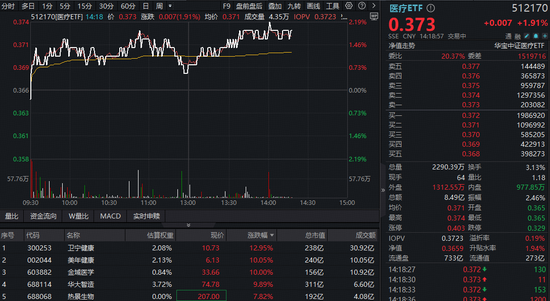
OpenAI押注万亿AI医疗市场!规模最大医疗ETF(512170)冲涨2%!卫宁健康飙升13%,美年健康、金域医学涨停
Xin Lang Ji Jin· 2026-01-09 06:30
Group 1 - The AI healthcare sector is experiencing significant growth, with the largest healthcare ETF (512170) rising over 2% in the first week of the year, indicating strong market interest [1][3] - AI healthcare stocks are leading the gains, with notable increases such as Weining Health soaring by 13%, and other companies like Meinian Health and Kingmed Diagnostics hitting the daily limit [1][3] - The global AI healthcare market is projected to grow from approximately $26.65 billion in 2024 to about $505.59 billion by 2033, reflecting a compound annual growth rate (CAGR) of 38.8% [3] Group 2 - The investment opportunity in AI healthcare can be captured through the healthcare ETF (512170) and its associated fund (012323), which includes 12 AI healthcare and brain-computer interface stocks with a combined weight of over 36% [3] - The current price-to-earnings ratio of the CSI Healthcare Index is 34.74, which is below the 39.22% percentile of the past 10 years, suggesting a favorable investment valuation [3]


【盘中播报】160只个股突破年线
Zheng Quan Shi Bao Wang· 2026-01-08 06:35
Market Overview - The Shanghai Composite Index is at 4086.67 points, slightly above the annual line, with a change of 0.02% [1] - The total trading volume of A-shares today is 22,700.94 billion yuan [1] Stocks Above Annual Line - A total of 160 A-shares have surpassed the annual line today, with notable stocks showing significant deviation rates [1] - The stocks with the highest deviation rates include: - Haiyou New Materials (11.09%) - Tianjian Technology (9.75%) - Hongdu Aviation (7.47%) [1] Notable Stocks Performance - Haiyou New Materials (688680) has a price increase of 15.15% with a turnover rate of 7.95% [1] - Tianjian Technology (002977) has increased by 10.00% with a turnover rate of 24.70% [1] - Hongdu Aviation (600316) has risen by 7.96% with a turnover rate of 4.76% [1] Additional Stocks with Significant Movement - Other notable stocks include: - Fengli Intelligent (301368) with a 14.08% increase and a 19.87% turnover rate [1] - KOTAI Power (300153) with an 8.64% increase and an 18.94% turnover rate [1] - Hongbo Pharmaceutical (301230) with a 7.38% increase and a 9.58% turnover rate [1] Stocks with Smaller Deviation Rates - Stocks with smaller deviation rates that have just crossed the annual line include: - *ST Haiyuan (002529) with a 4.98% increase [1] - Xunjiexing (688655) with a 6.10% increase [1] - Donghu Gaoxin (600133) with a 5.33% increase [1]




今日124只个股跨越牛熊分界线
Zheng Quan Shi Bao Wang· 2026-01-08 04:06
Market Overview - The Shanghai Composite Index closed at 4089.45 points, above the annual line, with a slight increase of 0.09% [1] - The total trading volume of A-shares reached 17815.48 billion yuan [1] Stocks Breaking Annual Line - A total of 124 A-shares have surpassed the annual line today, with notable stocks showing significant deviation rates [1] - The stocks with the highest deviation rates include: - Keta Power (300153) with a deviation rate of 11.05% and a daily increase of 12.50% [1] - Tianjian Technology (002977) with a deviation rate of 9.75% and a daily increase of 10.00% [1] - Hongbo Pharmaceutical (301230) with a deviation rate of 9.27% and a daily increase of 10.27% [1] Additional Stocks with Notable Performance - Other stocks with significant performance include: - Hongdu Aviation (600316) with a daily increase of 8.58% and a deviation rate of 8.08% [1] - Jiuliang Co. (300808) with a daily increase of 5.79% and a deviation rate of 5.21% [1] - Zhongcheng Technology (920207) with a daily increase of 22.67% and a deviation rate of 4.84% [1] Summary of Stocks with Smaller Deviation Rates - Stocks that have just crossed the annual line with smaller deviation rates include: - Dongfang Guoxin (东方国信) and Fuchun Environmental (富春环保) with minimal deviation rates [1] - The table lists various stocks along with their daily performance metrics, including turnover rates and latest prices [1]


多家公司发布2025年前三季度利润分配预案
Zheng Quan Ri Bao Zhi Sheng· 2026-01-07 17:08
Group 1 - The A-share market is experiencing a wave of "dividend warmth" at the beginning of 2026, with multiple companies announcing profit distribution plans for the first three quarters of 2025, reflecting a trend towards institutionalized, normalized, and frequent dividends [1][2] - Companies like Guangzhou Kingmed Diagnostics Group Co., Ltd. and Shaanxi Srey New Materials Co., Ltd. have proposed cash dividends of 8.8 yuan and 0.40 yuan per 10 shares respectively, indicating a commitment to enhancing investor returns [1] - The total dividend amount for A-share listed companies in 2025 is expected to exceed 2.6 trillion yuan, showcasing a significant increase in cash returns to investors [2] Group 2 - The timing of dividend announcements before the Spring Festival is intended to enhance investor sentiment and demonstrate companies' cash flow stability and commitment to returns [2] - The overall performance of dividends in 2025 is characterized by large scale, high frequency, and broad coverage, with traditional sectors like banking and energy continuing to lead in dividend payouts, while technology companies show impressive growth in dividend increases [3] - The increase in dividends is supported by the recovery of companies' profitability, reflecting a shift from passive compliance to proactive shareholder returns, driven by policy guidance and improved corporate governance [3]



金域医学跌2.01%,成交额9459.96万元,主力资金净流出1643.23万元
Xin Lang Cai Jing· 2026-01-07 02:49
截至9月30日,金域医学股东户数4.17万,较上期减少1.60%;人均流通股11042股,较上期增加1.62%。 2025年1月-9月,金域医学实现营业收入45.38亿元,同比减少19.23%;归母净利润-7960.95万元,同比 减少184.84%。 金域医学今年以来股价涨4.83%,近5个交易日涨6.52%,近20日涨4.17%,近60日涨2.41%。 资料显示,广州金域医学检验集团股份有限公司位于广东省广州市国际生物岛螺旋三路10号,成立日期 2006年5月26日,上市日期2017年9月8日,公司主营业务涉及为全国超过23,000家各类医疗机构提供包 括理化质谱检验、基因组检验、病理诊断、生化发光检验、免疫学检验、其他综合检验等六大类合计近 80类检验技术,近3,200项检验项目的外包及科研技术服务。主营业务收入构成为:医学诊断服务 91.20%,销售诊断6.45%,其他1.47%,冷链物流服务0.62%,健康体检业务0.27%。 分红方面,金域医学A股上市后累计派现25.45亿元。近三年,累计派现16.47亿元。 资金流向方面,主力资金净流出1643.23万元,特大单买入0.00元,占比0.00%,卖 ...
1月6日晚间重要公告一览
Xi Niu Cai Jing· 2026-01-06 02:49
Group 1 - Lichong Group expects a net profit of 830 million to 870 million yuan for 2025, representing a year-on-year growth of 17.38% to 23.04% [1] - Shandong Zhanggu anticipates a net profit of 72 million to 80 million yuan for 2025, with a year-on-year increase of 0.65% to 11.83% [2] - Yinglian Co. forecasts a net profit of 32 million to 42 million yuan for 2025, marking a turnaround from a loss of 39.67 million yuan in the previous year [3] Group 2 - Hangya Technology announces plans for shareholders to reduce their holdings by up to 2.76% of the company's shares [4] - Guizhou Tire plans to invest in a project in Morocco to produce 6 million semi-steel radial tires annually, with a total investment of 299 million USD [5] - Laisentongling's shareholder plans to reduce their stake by no more than 1% [6] Group 3 - ST Yifei's shareholder intends to reduce their holdings by up to 1.53% [7] - Hengyi Petrochemical has fully launched the second phase of its Brunei refining project, aiming for a production capacity of 12 million tons per year [8] - Zai Sheng Technology's controlling shareholder has terminated an agreement to transfer part of the company's shares [9] Group 4 - Sry New Materials proposes a cash dividend of 0.4 yuan per 10 shares for the first three quarters of 2025 [10] - Quanyin High-Tech announces that the offer period for China Seed Group's acquisition has expired, leading to a temporary suspension of its stock [11] - Zhonggang Luonai's shareholder plans to reduce their stake by up to 1% [12] Group 5 - Nanmo Bio expects to receive a government subsidy of 5.8 million yuan for its subsidiary [13] - Beite Technology has received approval from the China Securities Regulatory Commission for a stock issuance to specific investors [14] - Qianyuan Pharmaceutical's subsidiary has obtained drug registration certificates for a new medication [15] Group 6 - Boto Integrated plans to reduce its holdings by no more than 1% [16] - Wanze Co. intends to reduce its stake by up to 1.66% [17] - Tianci Materials will halt production for maintenance on its lithium hexafluorophosphate production line starting March 1, 2026 [18] Group 7 - Haopeng Technology plans to raise up to 800 million yuan through a private placement [20] - Yisheng Co. reports a 43.32% year-on-year increase in sales revenue for its white feather broiler chicks in December 2025 [21] - Jinyu Medical proposes a cash dividend of 8.8 yuan per 10 shares for the first three quarters of 2025 [22] Group 8 - Caesar Travel's subsidiary has won a management service project for the Qingdao International Cruise Port [23] - Kelun Pharmaceutical plans to repurchase shares worth 50 million to 100 million yuan [24] - Jiangling Motors reports a 10.56% year-on-year increase in cumulative sales for 2025 [25] Group 9 - Yilian Technology plans to issue convertible bonds to raise up to 1.2 billion yuan [26] - Shaanxi Guotou A intends to participate in a capital increase for Chang'an Bank, with an amount not exceeding 800 million yuan [27] - Oupokang Vision has obtained a production license for eye drops [28] Group 10 - Shanghai Electric plans to provide management services for overseas assets of China Electric International [30] - Yingfang Micro is planning a major asset restructuring, leading to a temporary suspension of its stock [31] - Victory Energy's stock will resume trading after completing a verification process [32] Group 11 - China Merchants Industry has signed a shipbuilding agreement with Dalian Shipbuilding [33] - Kunyu Group has appointed a new chairman following a board meeting [34] - Microchip Bio's clinical trial application for a new diabetes treatment has been accepted [35] Group 12 - Hanshuo Technology has signed a sales intention agreement for smart shopping carts with Woolworths in Australia [36] - Zhongmin Energy's three photovoltaic power station projects have been included in the Fujian Province development list [37] - Penghui Energy plans to issue H-shares and apply for listing on the Hong Kong Stock Exchange [38] Group 13 - Victory Energy reports that the acquirer has deposited a guarantee for the acquisition [39] - Fangsheng Pharmaceutical proposes a special dividend of 0.15 yuan per share for 2025 [40] - Nanning Department Store has received approximately 14.28 million yuan in government subsidies since January 2025 [41] Group 14 - Jushen Co. has signed a bauxite transfer agreement with a company in Guinea [42] - ST Huluwawa has received a drug registration certificate for a new inhalation solution [43] - Zhongzhi Co. will become the controlling shareholder following a share transfer agreement [44] Group 15 - Chuangli Group has signed a strategic cooperation framework agreement with Chuanjiu Construction [45]


金域医学2025年前三季度利润分配方案:拟每10股派8.8元
Zheng Quan Shi Bao Wang· 2026-01-05 12:20
人民财讯1月5日电,金域医学(603882)1月5日公告,2025年前三季度利润分配方案如下:以实施权益 分派股权登记日登记的总股本为基数,向全体股东每10股派发现金红利8.8元(含税),剩余未分配利润结 转以后年度分配。 ...
金域医学(603882) - 广州金域医学检验集团股份有限公司章程(202601)
2026-01-05 12:01
广州金域医学检验集团股份有限公司 章 程 二○二六年一月 | . | 2 | 17 | | --- | --- | --- | | - | | | | | | 第一条 为维护广州金域医学检验集团股份有限公司(下称"公司")、股东、 职工和债权人的合法权益,规范公司的组织和行为,弘扬企业家精神,根据《中华人 民共和国公司法》(以下简称"《公司法》")、《中华人民共和国证券法》(以下 简称"《证券法》")、《上市公司章程指引》和其他有关规定,制订本章程。 第二条 公司系依照《公司法》有关规定成立的股份有限公司。 公司系由广州市金域投资咨询有限公司整体变更,并由全体发起人采取发起设立 方式设立的股份有限公司。公司在广州市市场监督管理局注册登记,取得《营业执照》, 统一社会信用代码为 9144010178891443XK。 第三条 公司于 2017 年 8 月 18 日经中国证券监督管理委员会批准,首次向社会 公众发行人民币普通股 6,868 万股,于 2017 年 9 月 8 日在上海证券交易所上市。 第四条 公司注册名称: 中文名称:广州金域医学检验集团股份有限公司 英文名称:Guangzhou Kingmed ...
金域医学(603882) - 广州金域医学检验集团股份有限公司关于预计与金墁利2026年度日常关联交易的公告
2026-01-05 12:00
证券代码:603882 证券简称:金域医学 公告编号:2026-004 广州金域医学检验集团股份有限公司 关于预计与金墁利2026年度日常关联交易的公告 本公司董事会及全体董事保证本公告内容不存在任何虚假记载、误导性陈述 或者重大遗漏,并对其内容的真实性、准确性和完整性承担法律责任。 重要内容提示: 本次日常关联交易事项无需经公司股东会审议。 日常关联交易对上市公司的影响:公司及下属企业与关联人金墁利及其 下属企业的日常关联交易为因日常经营活动所需而发生的正常业务往来,遵循公 平、公正、公开的原则,不会对公司的生产经营和财务状况产生重大影响,公司 的主营业务也不会因此而形成依赖。 一、日常关联交易基本情况 (一)日常关联交易履行的审议程序 收入、利润来源不依赖该类关联交易。上述交易不对公司资产及损益情况构成重 大影响,不存在损害公司及全体股东特别是中小股东利益的情形。独立董事同意 将该议案提交董事会审议。 (二)2025 年度日常关联交易的预计和执行情况 单位:万元 | 关联交易类 | | 2025 年预计 | 2025 年 1-11 月累计 | 预计金额与 实际发生金 | | --- | --- | --- ...
金域医学(603882) - 广州金域医学检验集团股份有限公司关于变更经营范围暨修订《公司章程》的公告
2026-01-05 12:00
广州金域医学检验集团股份有限公司 关于变更经营范围暨修订《公司章程》的公告 本公司董事会及全体董事保证本公告内容不存在任何虚假记载、误导性陈述 或者重大遗漏,并对其内容的真实性、准确性和完整性承担法律责任。 广州金域医学检验集团股份有限公司(以下简称"公司")于 2026 年 1 月 5 日召开第四届董事会第九次会议审议通过了《关于变更经营范围暨修订〈公司 章程〉的议案》,现将相关情况公告如下: 一、变更经营范围的情况 证券代码:603882 证券简称:金域医学 公告编号:2026-005 二、修订《公司章程》的情况 鉴于公司拟对经营范围进行变更,对《公司章程》相应条款修订如下: | 原条款 | 修订后条款 | | --- | --- | | 广州金域医学检验集团股份有限公司章程 | 广州金域医学检验集团股份有限公司章程 | | (2025 年 8 月) | (2026 年 1 月) | | 第十五条 公司的主营项目类别:商务服务 | 第十五条 公司的主营项目类别:商务服务业, | | 业,经营范围:投资咨询服务;商品信息咨 | 经营范围:以自有资金从事投资活动;技术服 | | 询服务;生物技术开发服务;生物 ...