基金投资

Search documents
为什么基金一跌就慌?有可能是你没搞懂这个指标!
私募排排网· 2026-03-30 09:11
Core Viewpoint - The article emphasizes the importance of understanding downside risk in investment, distinguishing it from maximum drawdown, and highlights how many investors fail to consider potential future declines, leading to significant losses [4][6][10]. Group 1: Understanding Downside Risk - Downside risk is not the same as maximum drawdown; the former focuses on future potential declines while the latter is based on historical data [6][9]. - Maximum drawdown reflects past performance, indicating the largest drop from peak to trough, serving as a retrospective measure [6][8]. - Downside risk assesses the likelihood and extent of future declines in fund value under adverse market conditions, providing a forward-looking risk profile [6][9]. Group 2: Factors Influencing Downside Risk - The concentration of assets and industries in a fund can elevate downside risk; funds heavily invested in popular growth sectors may lack diversification, increasing vulnerability during market corrections [12]. - The risk management approach of fund managers plays a crucial role; aggressive managers may face larger losses in downturns, while defensive managers can mitigate risks by adjusting positions and avoiding overvalued assets [13]. - Market conditions, such as high valuations and investor euphoria, can raise the downside risk for equity funds, especially if leverage is employed, amplifying potential losses [14]. Group 3: Strategies to Manage Downside Risk - Investors should align their portfolios with their risk tolerance, opting for less volatile assets if they cannot withstand significant drawdowns [19]. - Diversification across different asset types and styles can help hedge against specific risks, reducing the impact of downturns in any single sector [20]. - Distinguishing between normal market fluctuations and significant structural issues is essential; temporary declines may not warrant panic, but persistent underperformance or changes in fund management style should prompt a reassessment of holdings [21]. Conclusion - Understanding and managing downside risk is integral to successful fund investment; it is not about avoiding all volatility but rather controlling risk within acceptable limits to ensure long-term success [23][24].


[3月22日]美股指数估值数据(全球股票、黄金大跌;遇到波动,要卖出吗)
银行螺丝钉· 2026-03-22 14:05
Core Viewpoint - The global stock market continues to experience volatility, with various indices showing declines, and the valuation of gold has changed, affecting its status as a safe-haven asset. The rise in oil prices is contributing to market fluctuations and inflation concerns, which may delay interest rate cuts by the Federal Reserve. Group 1: Global Stock Market Performance - The global stock market has seen a decline, with the global stock index rating returning to 3.2 stars [2] - A-shares experienced significant volatility, with the CSI All Share Index dropping by 4.1%, returning to a rating of 4.1 stars [3] - The Hong Kong stock market showed smaller fluctuations, with the Hang Seng Index down by 0.74% [4] - European markets also faced volatility, with German stocks down by 4.5% and French and British stocks down over 3% [5] - Year-to-date, A-shares have increased by approximately 1% [6] - U.S. stocks have decreased by 4.4%, and the global stock index has fallen by 3.1% [7] Group 2: Gold and Inflation - International gold prices have dropped by 10%, while silver prices have decreased by 15% [9] - Gold is typically considered a safe-haven asset, but its valuation has reached a high level not seen in the last 20 years, leading to increased volatility [10][11] - The current volatility risk of gold is nearly double that of stocks [13] - As gold's valuation increases, it exhibits characteristics of risk assets, and a future decline in valuation may restore its safe-haven status [14] Group 3: Impact of Oil Prices - The surge in oil prices is a key factor contributing to recent market volatility, leading to increased transportation and raw material costs, which may elevate inflation [15] - This situation could force the Federal Reserve to reconsider its interest rate policies, potentially delaying rate cuts or even discussing rate hikes [15] - Different asset classes, including stocks, gold, and bonds, are under pressure due to these developments, with small-cap and growth stocks facing greater stress [17] Group 4: Investment Strategy - Historical market fluctuations, such as those seen in April of the previous year due to tariff crises, suggest that short-term volatility should not prompt immediate selling of funds [19][20] - The market's short-term fluctuations primarily affect valuation changes, while the underlying companies continue to operate normally and generate income [26][28] - If current investments are not overvalued, patience is advised, allowing time for companies to grow earnings and dividends, which will eventually lead to stock price recovery [30] Group 5: Global Index Investment Options - There are global stock index funds available in overseas markets, with significant assets exceeding trillions of dollars, although such funds are not yet available in mainland China [34] - The company has introduced a "Global Index Advisory Portfolio" that diversifies investments across U.S., UK, Hong Kong, and A-share indices to track the global stock market [35] Group 6: New Publication - A new book titled "Personal Pension Investment Guide" has been released, focusing on retirement planning and investment strategies [39] - The book achieved high sales rankings on platforms like JD.com, indicating strong interest in personal pension topics [40]
每日钉一下(指数基金收益=市盈率×盈利+分红)
银行螺丝钉· 2026-03-18 14:01
Group 1 - The article emphasizes that funds are very suitable investment products for ordinary people [2] - It suggests that new investors should consider what type of funds are more appropriate for them and how to approach fund investment [2] - A free course is offered to help new investors understand fund investment from scratch, along with course notes and mind maps for efficient learning [2] Group 2 - The long-term return of index funds can be broken down into three components: price-to-earnings ratio, earnings growth, and dividends [4] - Buying at a low valuation and selling at a high valuation can yield a valuation difference profit, while buying at a high valuation can lead to losses [5] - For broad-based and excellent industry funds, the long-term earnings growth rate is approximately 10%, while excellent industry funds can achieve around 15% [7]

暴涨行情下,联接基金为什么总是“跟不上”ETF?
市值风云· 2026-03-10 10:10
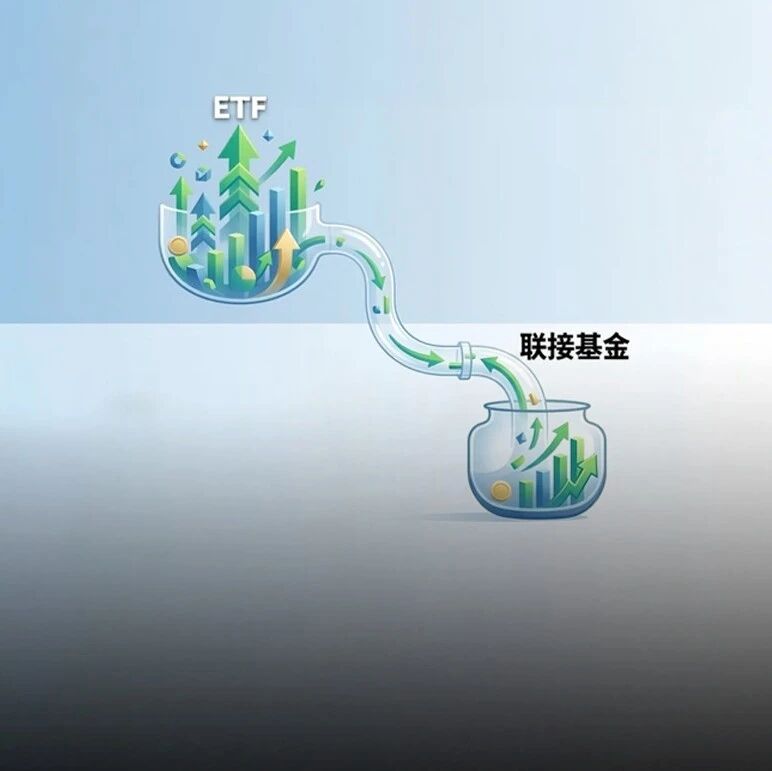
Core Viewpoint - The article discusses the differences between on-market ETFs and off-market linked funds, emphasizing that there is no absolute superiority between the two, as their performance is influenced by their underlying operational mechanisms [1][4]. Group 1: Differences Between ETFs and Linked Funds - On-market ETFs are traded on stock exchanges, allowing real-time transactions and low costs, while off-market linked funds act as intermediaries, enabling investors without brokerage accounts to invest indirectly in ETFs [6][7]. - The operational differences lead to performance discrepancies, particularly in volatile markets, where linked funds may lag behind ETFs due to additional layers in their structure [8]. Group 2: Reasons for Underperformance of Linked Funds - The first reason for the underperformance of linked funds is the inherent cash reserve requirement, which limits their ability to operate close to full investment capacity, resulting in a drag on returns during market upswings [11][12]. - The second reason is the dilution effect caused by large inflows of new capital, which can increase the total number of shares and dilute existing shareholders' returns during rapid market movements [13][15]. - The third reason involves timing discrepancies in the trading mechanism, where funds submitted for linked funds do not immediately convert into ETF shares, potentially causing investors to miss out on gains during market surges [17][18]. Group 3: Performance Comparison - During a specific period in March 2026, the on-market oil ETF saw significant gains of 10.03% and 7.97%, while the corresponding linked fund only increased by 6.97% and 2.94%, highlighting the performance gap [15]. - Conversely, during market downturns, linked funds may exhibit better resilience due to their cash reserves and lower investment levels, as seen when the oil ETF dropped significantly while the linked fund experienced smaller declines [19][20]. Group 4: Investment Considerations - For investors seeking quick trading opportunities, on-market ETFs are recommended as the superior choice, while those focused on long-term value and convenience may find off-market linked funds to be a more suitable option [21].
每日钉一下(为什么说波动是把双刃剑?)
银行螺丝钉· 2026-03-04 14:03
Group 1 - The article emphasizes that funds are a suitable investment option for ordinary people [2] - It suggests that new investors should consider specific types of funds and outlines the importance of psychological preparation for long-term investment [2] - A free course is offered to help new investors understand fund investment from scratch, along with supplementary materials like course notes and mind maps for efficient learning [2] Group 2 - The article discusses the dual nature of market volatility, stating that for experienced investors, high volatility can lead to greater profits by allowing them to buy at extreme lows and sell at extreme highs [6][7] - In contrast, inexperienced investors may suffer losses during high volatility, often buying at market peaks and selling in panic during downturns [8] - The article aims to educate investors to avoid chasing trends and frequent trading, encouraging a long-term investment approach for better returns [9]

我们的基金经理榜单究竟是如何炼成的?
点拾投资· 2026-03-03 11:08
Core Viewpoint - The article emphasizes the importance of creating a fund manager ranking list that not only reflects past performance but also provides guidance for future investment opportunities, aiming to identify managers who can outperform the market [1][11]. Group 1: Purpose of the Ranking List - The increasing number of funds (over 20,000) has made it difficult for investors to select the right ones, and many existing rankings do not provide future performance guidance [2][3]. - Many funds have managers whose performance may not be sustainable due to factors like increased fund size, managerial distractions, or even departures [3][7]. - The article argues that simply selecting past winners does not guarantee future success, and a more systematic approach is needed to identify potential outperformers [9][11]. Group 2: Methodology for Identifying Future Alpha - The methodology consists of four steps: scientific classification, establishing a fund pool, quantitative validation, and qualitative assessment [12][13]. - The first step involves categorizing funds into distinct styles to allow for meaningful comparisons, using a proprietary classification system that includes eight styles and four industries [14][15]. - The second step involves populating these categories with researched fund managers, ensuring a comprehensive pool for analysis [19][20]. - The third step focuses on quantitative metrics to filter out underperformers, while the fourth step involves qualitative assessments to finalize the rankings [23][24]. Group 3: Performance Verification - The performance of the funds listed in the rankings is evaluated against market indices, with the rankings showing a consistent ability to outperform benchmarks over time [26][28]. - From 2022 to 2024, the funds in the equity ranking outperformed the Wind Mixed Equity Index by 9.31% cumulatively [28]. - The rankings also demonstrated that selected funds maintained their performance over multiple years, indicating their sustainability [31]. Group 4: Recognition of Potential Managers - The rankings have successfully identified lesser-known but capable fund managers, leading to significant growth in their fund sizes post-inclusion in the rankings [35][38]. - For instance, a manager from Huazhong Fund saw a size increase of 56.9 billion after being included in the rankings, highlighting the recognition and validation from the market [36][39]. Group 5: Continuous Recognition - The rankings have received consistent support from investors and industry peers over the past five years, reinforcing the value of the lists [42]. - A list of fund managers who have been recognized for five consecutive years is provided, showcasing their sustained performance [44].

建投能源股价涨5.09%,南方基金旗下1只基金位居十大流通股东,持有662.36万股浮盈赚取304.69万元
Xin Lang Cai Jing· 2026-02-27 05:32
Group 1 - The core point of the news is that Jiantou Energy has seen a significant increase in its stock price, rising 5.09% to 9.49 CNY per share, with a total market capitalization of 17.113 billion CNY and a trading volume of 344 million CNY [1] - Jiantou Energy's stock has experienced a cumulative increase of 8.01% over the past three days, indicating positive market sentiment [1] - The company, established in 1994 and listed in 1996, primarily engages in investment, construction, and management of energy projects, with a revenue composition heavily reliant on thermal power generation, accounting for 78.99% of its main business income [1] Group 2 - From the perspective of major shareholders, the Southern Fund's Southern CSI 1000 ETF (512100) has reduced its holdings by 51,300 shares, now holding 6.6236 million shares, which represents 0.61% of the circulating shares [2] - The Southern CSI 1000 ETF has generated a floating profit of approximately 3.0469 million CNY today and 4.4378 million CNY during the three-day increase [2] - The fund, established in September 2016, has a total scale of 78.996 billion CNY, with a year-to-date return of 11.77% and a one-year return of 31.9% [2]

明星电力股价涨5.01%,广发基金旗下1只基金位居十大流通股东,持有171.12万股浮盈赚取90.69万元
Xin Lang Cai Jing· 2026-02-27 04:02
Group 1 - The core point of the news is that Sichuan Mingyang Power Co., Ltd. experienced a stock price increase of 5.01%, reaching 11.10 CNY per share, with a trading volume of 465 million CNY and a turnover rate of 7.81%, resulting in a total market capitalization of 6.081 billion CNY [1] - Sichuan Mingyang Power was established on April 29, 1988, and listed on June 27, 1997. The company's main business includes electricity, tap water, and comprehensive energy services [1] - The revenue composition of the company is as follows: 88.59% from product sales, 9.22% from installation projects, 1.87% from services provided, and 0.32% from other sources [1] Group 2 - From the perspective of the top ten circulating shareholders, GF Fund's ETF, Guangfa CSI All Share Power ETF (159611), increased its holdings by 119,300 shares, totaling 1.7112 million shares, which represents 0.31% of the circulating shares [2] - The Guangfa CSI All Share Power ETF (159611) was established on December 29, 2021, with a current size of 3.69 billion CNY. Year-to-date returns are 6.11%, ranking 2660 out of 5574 in its category; the one-year return is 13.17%, ranking 3334 out of 4326; and since inception, the return is 6.12% [2] - The fund manager of Guangfa CSI All Share Power ETF is Lu Zhiming, who has a cumulative tenure of 14 years and 274 days, managing total assets of 25.098 billion CNY, with the best fund return during his tenure being 119.61% and the worst being -63.28% [2]

上证180指数下跌0.16%,上证180ETF指数基金(530280)备受关注
Xin Lang Cai Jing· 2026-02-27 02:05
Core Viewpoint - The Shanghai 180 Index (000010) experienced a slight decline of 0.16% as of February 26, 2026, with mixed performance among constituent stocks, indicating a volatile market environment [1]. Group 1: Index Performance - As of February 26, 2026, the Shanghai 180 Index saw a decline of 0.16%, with notable gainers including Dongfang Electric up 10.01% and Zhongtian Technology also up 10.01%, while Yutong Bus led the declines at 4.66% [1]. - The Shanghai 180 ETF Index Fund (530280) decreased by 0.95%, with a latest price of 1.26 yuan, but has shown a cumulative increase of 0.80% for the month [1]. Group 2: Liquidity and Trading Volume - The trading volume for the Shanghai 180 ETF Index Fund was 4.40 thousand yuan, with a turnover rate of 0.08% on February 26, 2026 [1]. - Over the past year, the average daily trading volume for the Shanghai 180 ETF Index Fund was 115.50 thousand yuan, indicating consistent trading activity [1]. Group 3: Fund Size and Growth - The Shanghai 180 ETF Index Fund experienced a significant growth in size, increasing by 39.698 million yuan over the past year [1]. Group 4: Drawdown Information - The maximum drawdown for the Shanghai 180 ETF Index Fund year-to-date was 4.28%, with a relative benchmark drawdown of 0.11% [2]. Group 5: Fee Structure - The management fee for the Shanghai 180 ETF Index Fund is set at 0.15%, while the custody fee is 0.05% [3]. - The fund closely tracks the Shanghai 180 Index, which comprises 180 securities selected from the Shanghai market based on market capitalization and liquidity [3]. Group 6: Top Holdings - As of January 30, 2026, the top ten weighted stocks in the Shanghai 180 Index included Zijin Mining, Kweichow Moutai, and China Ping An, collectively accounting for 24.85% of the index [3].
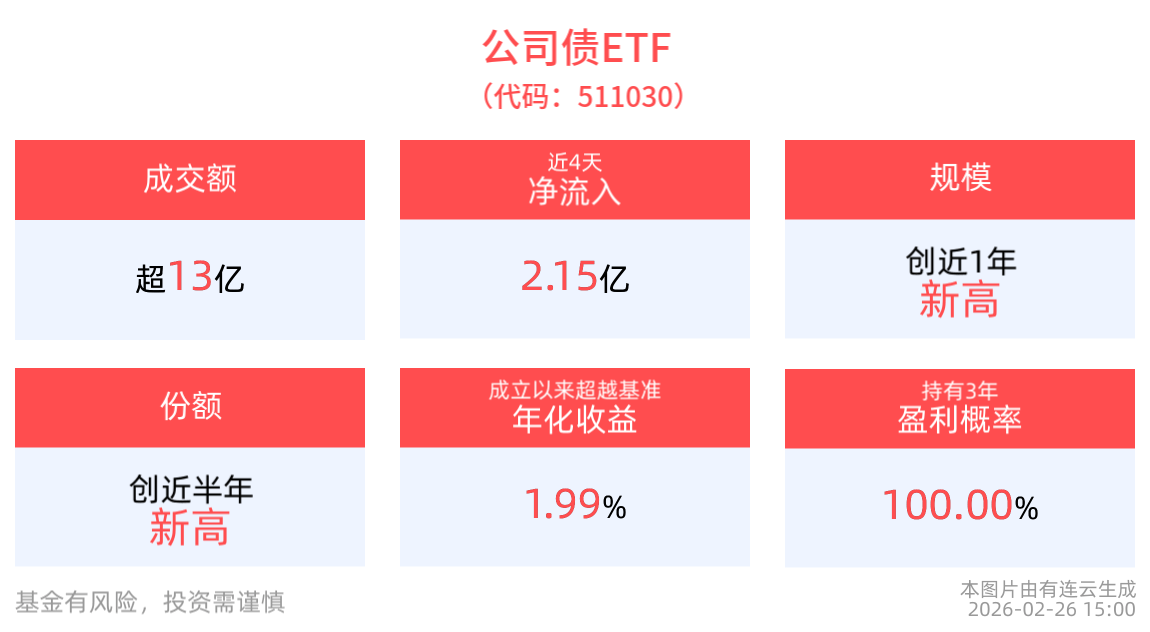
最新规模达358.69亿元,公司债ETF(511030)近4个交易日净流入2.15亿元
Sou Hu Cai Jing· 2026-02-27 02:00
Core Viewpoint - The company bond ETF (511030) is experiencing a stalemate in trading, with a latest quote of 107.03 yuan and a cumulative increase of 1.91% over the past year [3]. Trading Activity - The company bond ETF has a turnover rate of 3.73% during the trading session, with a transaction volume of 1.336 billion yuan. The average daily transaction volume over the past month is 3.027 billion yuan [3]. - The latest scale of the company bond ETF has reached 35.869 billion yuan, marking a new high in nearly a year [3]. - The latest share count of the company bond ETF is 335 million shares, also a new high in the past six months [3]. Fund Flows - The company bond ETF has recorded a net inflow of 53.5117 million yuan. Over the past four trading days, there have been net inflows on three days, totaling 215 million yuan, with an average daily net inflow of 5.38287 million yuan [3]. Performance Metrics - As of February 26, 2026, the maximum drawdown for the company bond ETF this year is 0.03%, compared to a benchmark drawdown of 0.07%. The recovery period after the drawdown is 7 days [3]. Fee Structure - The management fee for the company bond ETF is 0.15%, and the custody fee is 0.05% [4]. Tracking Accuracy - As of February 26, 2026, the tracking error for the company bond ETF over the past month is 0.007%. The ETF closely tracks the China Bond - Medium to High Grade Corporate Bond Spread Factor Index, which reflects the trends in the RMB bond market [5].