PIESAT(688066)

Search documents
航天宏图:2025年营业总收入533910011.43元
Zheng Quan Ri Bao Wang· 2026-02-27 10:16
Group 1 - The company announced a projected total operating revenue of 533,910,011.43 yuan for 2025, representing a year-on-year decline of 66.11% [1] - The net profit attributable to the parent company's owners is expected to be -1,169,192,878.91 yuan [1]

航天宏图(688066.SH):2025年净亏损11.69亿元
Ge Long Hui A P P· 2026-02-27 09:11
Core Viewpoint - Aerospace Hongtu (688066.SH) reported a significant decline in both revenue and net profit for the year 2025, indicating challenges in its operational environment and strategic adjustments made in response to macroeconomic pressures [1] Financial Performance - The company achieved an operating revenue of 534 million yuan, a year-on-year decrease of 66.11% [1] - The net profit attributable to the parent company was -1.169 billion yuan, reflecting a year-on-year decline of 16.06% [1] - The net profit attributable to the parent company after deducting non-recurring gains and losses was -1.215 billion yuan, down 16.40% year-on-year [1] Client Base and Order Trends - The company's client base primarily consists of government entities, large state-owned enterprises, specialized sectors, and overseas clients [1] - New orders signed during the year decreased by approximately 13% compared to the same period last year [1] Strategic Adjustments - Due to pressures from the macroeconomic environment, the company adjusted its strategic planning to only undertake projects with fiscal guarantees, leading to a reduction in orders [1] - The company has been unable to participate in military procurement bids for the past year and a half due to a suspension of qualifications, resulting in a significant drop in revenue from this sector, which fell from 660 million yuan to approximately 50 million yuan [1]
航天宏图:2025年度净利润约-11.69亿元
Mei Ri Jing Ji Xin Wen· 2026-02-27 08:40
Group 1 - The company Aerospace Hongtu reported a significant decline in its 2025 annual performance, with operating revenue approximately 534 million yuan, a year-on-year decrease of 66.11% [1] - The net profit attributable to shareholders of the listed company showed a loss of approximately 1.169 billion yuan, indicating substantial financial challenges [1] - Basic earnings per share reported a loss of 4.47 yuan, reflecting the company's poor financial health [1] Group 2 - In February, China's AI usage surpassed that of the United States for the first time, indicating a rapid growth in domestic demand for AI capabilities [1] - Four major AI models from China ranked among the top five globally, showcasing the competitive strength of Chinese technology in the AI sector [1] - The demand for domestic computing power is experiencing exponential growth, highlighting a significant trend in the industry [1]
航天宏图(688066) - 2025 Q4 - 年度业绩
2026-02-27 08:25
Financial Performance - Total revenue for 2025 was RMB 533,910,011.43, a decrease of 66.11% compared to RMB 1,575,271,317.38 in the previous year[4] - Net profit attributable to shareholders was -RMB 1,169,192,878.91, a decline of 16.06% from -RMB 1,392,889,049.16 year-on-year[6] - Total assets at the end of the reporting period were RMB 3,728,395,931.66, down 21.89% from the beginning of the period[5] - Equity attributable to shareholders decreased by 137.87% to -RMB 331,873,623.28 compared to RMB 876,256,784.54 at the beginning of the period[5] - The weighted average return on equity decreased by 325.43 percentage points to -413.00% compared to -87.57% in the previous year[4] Operational Challenges - The company experienced a 13% decline in new orders compared to the previous year, primarily due to strategic adjustments in response to macroeconomic pressures[6] - The company’s military procurement qualification was suspended, leading to a significant drop in revenue from military contracts, from RMB 660 million to approximately RMB 50 million[6] - The company reported an increase in credit impairment losses due to prolonged accounts receivable aging amid a challenging economic environment[8] Workforce and Cost Management - The company has made structural adjustments to its workforce, resulting in increased employee severance costs compared to the previous year[8] - The company is actively communicating with local government clients to facilitate payment collections[8]
航天宏图:2025年净亏损11.69亿元
Xin Lang Cai Jing· 2026-02-27 08:21
Group 1 - The company announced a projected operating revenue of 534 million yuan for the year 2025, representing a year-on-year decline of 66.11% [1] - The net profit attributable to the parent company is expected to be -1.169 billion yuan, showing a year-on-year decrease of 16.06% [1] - The basic earnings per share are projected to be -4.47 yuan, which is a year-on-year decline of 16.06% [1]
商业航天概念持续走高 航天发展涨停
Xin Lang Cai Jing· 2026-02-25 05:49
Group 1 - The commercial aerospace sector continues to rise, with Aerospace Development hitting the daily limit up [1] - Zai Sheng Technology also reached the daily limit up, indicating strong market interest [1] - Companies such as Keshun Co., Xinghuan Technology, and others saw increases of over 10% [1] Group 2 - Other companies like Shenjian Co., Aerospace Hongtu, Yaguang Technology, and Chaojie Co. also experienced upward movement in their stock prices [1]




航天宏图:关于“宏图转债”预计触发转股价格向下修正的提示性公告
Zheng Quan Ri Bao· 2026-02-13 10:12
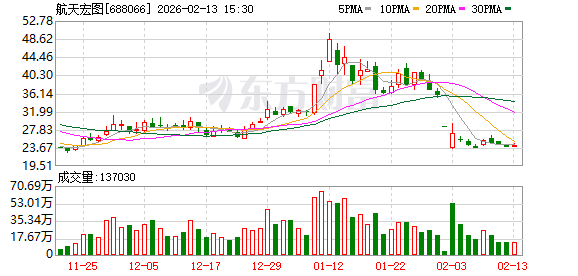
Core Viewpoint - Aerospace Hongtu announced that its stock price has closed below 85% of the current conversion price for 10 trading days, indicating a potential trigger for the downward adjustment of the conversion price as per the bond issuance prospectus [2]. Group 1 - The stock price of Aerospace Hongtu has been below 34.80 yuan per share, which is 85% of the current conversion price [2]. - The company may hold a board meeting to decide on the adjustment of the conversion price if the trigger condition is met [2]. - The company is obligated to fulfill information disclosure requirements promptly following the board's decision [2].

航天宏图(688066) - 关于“宏图转债”预计触发转股价格向下修正的提示性公告
2026-02-13 08:01
| 证券代码:688066 | 证券简称:航天宏图 | 公告编号:2026-008 | | --- | --- | --- | | 债券代码:118027 | 债券简称:宏图转债 | | 航天宏图信息技术股份有限公司 关于"宏图转债"预计触发转股价格向下修正的 提示性公告 本公司董事会及全体董事保证本公告内容不存在任何虚假记载、误导性陈述 或者重大遗漏,并对其内容的真实性、准确性和完整性依法承担法律责任。 重要内容提示: 航天宏图信息技术股份有限公司(以下简称"公司")股票自 2026 年 2 月 2 日至 2026 年 2 月 13 日已有 10 个交易日的收盘价低于当期转股价格的 85% (即 34.80 元/股),存在触发《航天宏图信息技术股份有限公司向不特定对象发 行可转换公司债券募集说明书》(以下简称"募集说明书")中规定的转股价格向 下修正条件的可能性。若触发条件,公司将于触发条件当日召开董事会审议决定 是否修正转股价格,并及时履行信息披露义务。 根据《上海证券交易所上市公司自律监管指引第 12 号——可转换公司债券》 的有关规定,公司可能触发可转换公司债券(以下简称"可转债")转股价格向 下修正 ...
航天宏图信用评级遭下调,股价大幅下跌
Jing Ji Guan Cha Wang· 2026-02-12 03:20
Core Viewpoint - The credit rating of Aerospace Hongtu and its "Hongtu Convertible Bonds" has been downgraded from BBB to BB+ by China Chengxin International, with a negative outlook due to significant weakening of profit indicators for 2025 and expected negative net assets, alongside substantial operational turnover and debt repayment pressures [1] Group 1: Stock Performance - Over the past 7 trading days (February 4 to February 11, 2026), Aerospace Hongtu's stock price has dropped approximately 45.33%, with a price fluctuation range of 46.38% [2] - On February 9, the stock experienced a single-day increase of 7.32%, but on February 4, 5, 6, 10, and 11, it faced declines ranging from 1.58% to 5.45% [2] - On February 6, there was a net outflow of main funds amounting to 47.31 million yuan, accounting for 11.74% of the total trading volume, indicating significant market selling pressure [2] Group 2: Financial Report Analysis - The company released a performance forecast on January 30, 2026, indicating an expected net loss of 1.03 billion yuan for 2025, with an anticipated net asset value of -280 million yuan, which may trigger a delisting risk warning (ST) [3] - The recent downgrade of the credit rating further confirms the risk of financial deterioration, including the suspension of military procurement qualifications until July 2027 and a 13% year-on-year decline in new orders [3]
我国可回收火箭再获关键突破,星云二号发动机密集点火验证,海上回收助力商业航天迈入新阶段
Xin Lang Cai Jing· 2026-02-11 10:16
Group 1 - Hailanxin (300065) is a core enterprise in the field of smart ocean and commercial aerospace measurement and control, with a contract amount of 458 million yuan for a project related to reusable rocket recovery [1][25] - Jieli Suoju (002342) is a leading company in the domestic rigging industry, providing intercept nets and ultra-high molecular weight polyethylene ropes for rocket recovery, with a single set of capture arms valued at 15-20 million yuan [2][26] - Chaojie Co., Ltd. (301005) specializes in precision structural components, supplying key components for rockets, with a single set valued at 25-30 million yuan and securing 30 orders for 2026-2028 [3][27] Group 2 - Taisheng Wind Power (300129) is a leader in wind power towers, providing structural components for rockets and planning to cover 60% of launch tasks by 2025 [4][28] - Zhongheng Design (603017) is a leading engineering design firm, providing design and construction services for rocket recovery bases, supporting industry landing [5][29] - Yitong Century (300310) focuses on communication technology services, providing communication support for rocket recovery processes [6][30] Group 3 - Aerospace Electronics (600879) is a leading company in aerospace electronics, providing landing leg actuators for reusable rockets, with a projected increase in value by 3-5 times after commercialization in 2026 [7][31] - Mengsheng Electronics (688331) specializes in satellite navigation systems, providing core navigation systems for reusable rockets, supporting centimeter-level positioning [8][32] - Sry New Materials (688102) is a leader in high-strength copper alloy materials, supplying core materials for rocket engines, ensuring stable operation for recovery [9][34] Group 4 - AVIC Optoelectronics (002179) is a leading company in aerospace connectors, ensuring reliable signal transmission for rocket recovery processes [10][35] - Guokai Military Industry (688543) provides solid engine power modules for rockets, which are critical components for recovery [11][36] - Parker New Materials (605123) specializes in aerospace forgings, supplying key components for rockets, ensuring structural stability for recovery [12][37] Group 5 - Hanyu Technology (688239) focuses on titanium alloy forgings for rockets, supporting stable engine operation for recovery [13][38] - Race Intelligent (002979) provides specialized motors for rocket engines, crucial for thrust adjustment during recovery [14][39] - Aerospace Universe (688523) specializes in composite materials, supporting lightweight structures for rockets [15][40] Group 6 - Guoguang Electric (688776) provides electrical equipment for rockets, supporting electrical control and signal transmission during recovery [16][41] - Aerospace Hongtu (688066) offers satellite remote sensing services, providing environmental monitoring for rocket recovery [17][42] - Chunzong Technology (603516) provides ground measurement and control equipment for rocket launches and recoveries [18][43] Group 7 - Aerospace Electromechanical (600151) supplies solar panels and power systems for rockets, supporting energy management during recovery [19][44] - Wuzhou Xinchun (603667) supplies bearings for recovery systems, with annual orders valued at 120-180 million yuan [20][45] - Aerospace Morning Light (600501) provides ground support systems for rocket recovery, ensuring efficient execution of recovery operations [21][46] Group 8 - Aerospace Technology (000901) specializes in measurement and control services for rockets, ensuring precise control during recovery [22][47] - Aerospace Power (600343) provides fluid components for rocket engines, ensuring reliable fluid control during recovery [23][48]