NEWLAND(000997)

Search documents
涉“与身份不明客户交易” 新大陆旗下星驿支付被罚没847万
Zhong Guo Jing Ying Bao· 2026-02-26 14:18
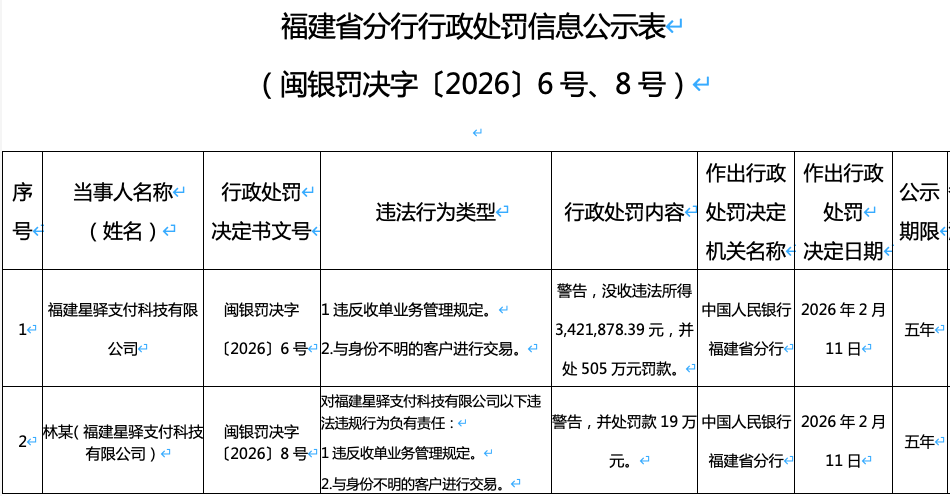
中经记者 许璐 李晖 北京报道 近日,中国人民银行福建省分行公布对福建星驿支付科技有限公司(以下简称"星驿支付")的处罚信 息。 2024年3月,福建国通星驿网络科技有限公司(以下简称"国通星驿")因违反交易信息管理规定,被警 告,并处罚款180万元,时任国通星驿副总经理、总经理同样被警告,并处罚款9万元;2025年6月,国 通星驿辽宁分公司因违反非金融机构支付服务管理规定,被依法没收违法所得43132.91元,并处以6万 元罚款。2025年12月22日,国通星驿正式变更名称为星驿支付。 经营方面,国通星驿2024年实现营收25.03亿元,同比下降23.71%,全年支付交易规模超2万亿元,扫码 交易占比94%;2025年上半年实现营业收入14.12亿元,同比增长9.1%,实现净利润3.18亿元,同比增长 21.4%。 (编辑:李晖 审核:何莎莎 校对:刘军) 因星驿支付违反收单业务管理规定、与身份不明的客户进行交易,对其警告,没收违法所得3421878.39 元,并处505万元罚款,同时因公司相关责任人林某对星驿支付的违法违规行为负有责任,对其警告, 并处罚款19万元。公示期限为五年。 星驿支付成立于2010 ...

新大陆:截至2026年2月10日公司股东人数为60124户
Zheng Quan Ri Bao Wang· 2026-02-26 09:45
证券日报网讯2月26日,新大陆(000997)在互动平台回答投资者提问时表示,截至2026年2月10日,公 司股东人数为60124户。 ...
新大陆:截至2026年1月30日公司股东人数为59473户
Zheng Quan Ri Bao· 2026-02-26 09:39
证券日报网讯 2月26日,新大陆在互动平台回答投资者提问时表示,截至2026年1月30日,公司股东人 数为59473户。 (文章来源:证券日报) ...

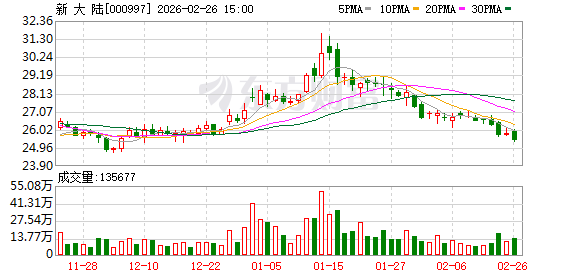
新大陆:公司将秉持开放包容的态度,持续加强与市场的沟通与宣传
Zheng Quan Ri Bao Wang· 2026-02-26 09:13
证券日报网讯2月26日,新大陆(000997)在互动平台回答投资者提问时表示,公司将秉持开放包容的 态度,持续加强与市场的沟通与宣传,以稳健的发展回馈投资者。 ...
又有支付机构吃到黄牌 合计罚没847万元
2 1 Shi Ji Jing Ji Bao Dao· 2026-02-26 01:56
21世纪经济报道记者 叶麦穗 又有第三方支付机构遭监管处罚,被开出大额罚单!近日,中国人民银行 福建省分行披露的一则行政处罚信息显示,福建星驿支付科技有限公司(下称"星驿支付")因涉及违法 违规行为遭到警告,合计被罚没847.19万元。星驿支付已经不是第一家吃到"黄牌"的支付公司,2026年 开年以来,包括银盛支付、开联通支付等10来家公司都收到了大额罚单。 星驿支付再吃大额罚单 2月中旬,人民银行福建省分行行政处罚信息显示,星驿支付违法行为包括:违反收单业务管理规定; 与身份不明的客户进行交易。因此,该公司遭到监管警告,没收违法所得约342.19万元,并处505万元 罚款,合计罚没847.19万元。同时,该公司林某对相关违法违规行为负有责任,遭到监管部门警告,并 处罚款19万元。 109张支付牌照被注销 除了"黄牌"之外,还有公司被"红牌"罚下。今年2月初,河南聚宝支付有限公司(原河南汇银丰信息技 术有限公司,以下简称"聚宝支付")的支付牌照被注销,成为2026年首家退出市场的支付机构。实际 上,自央行2011年签发首批第三方支付牌照以来,已累计发出271张牌照,其中,存续数量缩至162张, 注销数量增至1 ...
新大陆旗下星驿支付因与身份不明客户进行交易等被罚没847.19万元
Xi Niu Cai Jing· 2026-02-24 11:33
值得注意的是,随着第三方支付行业严监管态势持续升级,2026年开年以来,第三方支付行业已迎来多张大额罚单。1月,银盛支付被罚没1584.17万元,开 联通支付被罚没3843.49万元;恒信通、汇付支付、海科融通、新浪支付等机构均被开出百万元以上罚单。据统计,2025年13家支付机构合计被罚没金额超 2.12亿元,其中合利宝以7500万元罚单居首。 公开资料显示,星驿支付成立于2010年6月,前身为福建国通星驿网络科技有限公司,2016年被新大陆以6.86亿元收购100%股权,成为后者布局金融科技领 域的核心支付牌照。作为拥有全国范围展业资质的第三方支付机构,星驿支付主要为商户提供数字支付、场景SaaS及数字营销服务。新大陆财报披露,2024 年星驿支付实现营收25.03亿元,全年支付交易规模超2万亿元,扫码交易占比高达94%,是母公司重要的利润来源。 星驿支付业务高速扩张背后合规风险不断累积,近年来更是多次被罚。2025年6月,星驿支付辽宁分公司因违反非金融机构支付服务管理规定被罚没10万余 元;2024年3月,星驿支付总公司因违反交易信息管理规定被罚180万元;更早的2021年,星驿支付曾因12项违法违规行 ...
与身份不明客户交易!星驿支付被重罚
Shen Zhen Shang Bao· 2026-02-18 09:32
2月13日,中国人民银行福建省分行公布一则行政处罚信息,福建星驿支付科技有限公司(下称"星驿支付")因违反收单业务管理规 定、与身份不明的客户进行交易,被警告、没收违法所得342.19万元,并处505万元罚款。该公司相关责任人林某也被警告,并被处以 罚款19万元。 官网介绍,福建星驿支付科技有限公司成立于2010年6月,是上市公司新大陆的控股子公司,是拥有人民银行颁发的全国范围展业《支 付业务许可证》的第三方支付机构。公司主要为商户提供数字支付、场景SaaS、数字营销、增值业务等数字化服务。 天眼查信息显示,2025年12月22日,福建国通星驿网络科技有限公司正式变更名称为福建星驿支付科技有限公司。 2016年,新大陆以6.86亿元收购国通星驿100%的股权。 读创财经梳理发现,去年国通星驿曾因违法行为被监管处罚。 在黑猫投诉平台,星驿支付涉及的投诉内容主要集中在"乱扣流量费""刷卡资金未及时到账""POS机押金退还难"等方面。 目前,除了支付牌照,新大陆还拥有广州网商融资担保有限公司、广州网商商业保理有限责任公司、广州市网商小额贷款有限责任公 司等牌照。 商报君送新年礼物 来抽百元必胜客礼品卡 1.关注"深 ...
研判2026!中国AI读码器行业政策、产业链、市场规模、竞争格局及发展趋势分析:随着市场规模的扩大,企业竞争更加激烈[图]
Chan Ye Xin Xi Wang· 2026-02-10 01:17
Core Insights - The AI code reader is a crucial tool for information collection, enhancing speed and accuracy while supporting supply chain information management and traceability [1][3] - The global AI code reader market is steadily growing, with projections indicating a market size of approximately 11.78 billion yuan in 2025 and 13.76 billion yuan in 2026 [1][4] - In China, the AI code reader market is expected to reach around 4 billion yuan in 2025 and 4.7 billion yuan in 2026, driven by increasing automation and intelligence in various industries [1][4] Industry Definition and Functionality - AI code readers primarily function to read one-dimensional and two-dimensional codes on products, facilitating information collection through key components such as light sources, imaging, code recognition, and data output [2] Industry Development Status - The integration of advanced technologies like artificial intelligence is significantly boosting the development of key industries, including electronic information manufacturing and consumer goods [3][4] - The demand for production data traceability is increasing, leading to a steady growth in the global AI code reader market [3] Industry Value Chain - The upstream of the AI code reader industry includes components such as image sensors, AI chips, and optical components, while the midstream focuses on production and system integration [6] - The downstream applications span various sectors, including electronics, automotive, and logistics, addressing needs for efficient and precise code reading [6] Industry Development Environment - Related Policies - The government has implemented policies to foster the development of AI code readers, integrating "artificial intelligence+" into traditional industries [8] Industry Competitive Landscape - The AI code reader market is competitive, with major international brands from the US, Germany, and Japan dominating the high-end market [10] - Key domestic players include Shenzhen Simou Information Technology Co., Hikvision Robotics, and Newland Digital Technology [10] Industry Development Trends - The rapid advancement of AI and multimodal models is expected to enhance the adaptability and multitasking capabilities of smart code readers, driving further automation and digital transformation in manufacturing [19]


研判2026!中国金融电子支付设备行业发展历程、产业链、市场规模、重点企业及前景展望:金融电子支付设备智能化升级,行业迈向高质量发展新阶段[图]
Chan Ye Xin Xi Wang· 2026-01-31 02:26
Core Insights - The financial electronic payment equipment industry is undergoing a transformation from traditional to intelligent systems, driven by rapid internet technology development and the popularity of mobile payments [1][7] - The market is expected to grow significantly, with the industry size projected to increase from 61.2 billion yuan in 2020 to approximately 106.3 billion yuan by 2025, reflecting a compound annual growth rate of 12.66% [1][8] Industry Overview - Financial electronic payment equipment includes ATMs, POS machines, and self-service terminals (KIOSK), primarily deployed in banks and retail environments [3][7] - The industry is characterized by a shift towards smart and integrated payment solutions, enhancing user experience and security through advanced technologies like AI and biometric recognition [1][7] Industry Development History - The industry has evolved since the 1980s, transitioning from basic banking terminal equipment to diversified and intelligent payment solutions in the 21st century, influenced by advancements in mobile communication and cloud computing [5][6] Industry Chain - The upstream of the industry includes raw materials and components, while the midstream focuses on manufacturing, and the downstream encompasses various application sectors such as banking, retail, and telecommunications [6][7] Current Industry Status - The industry is at a critical stage of high-quality development driven by technological innovation, with significant government support for policy and market regulation [1][7] - The number of connected POS machines in China is projected to reach approximately 49.05 million by 2024, while the number of ATMs is expected to decline to around 76.09 million by the end of 2025 [8][9] Competitive Landscape - The industry features a mix of international and domestic players, with local companies like GuoDianYunTong and XinDaLu emerging as dominant forces due to their understanding of domestic market needs and competitive service networks [10][12] - The competition has shifted from hardware manufacturing to comprehensive service capabilities, including software platforms and lifecycle services [10] Future Trends - The future of financial electronic payment equipment will see a shift towards integrated service nodes that utilize AI and IoT for personalized user experiences [13] - The service model is evolving towards open platforms that connect various stakeholders, enhancing the value proposition beyond mere hardware sales [15] - Security measures will transition from passive protection to proactive immunity, ensuring data integrity and trust in transactions [16]


2026年度策略:锚定AI未来,共启科技新篇
GOLDEN SUN SECURITIES· 2026-01-30 00:50
Group 1: Financial Technology - In 2026, global liquidity is expected to remain reasonably ample, with the domestic monetary policy maintaining a moderately loose tone[14] - The digital RMB 2.0 will officially implement on January 1, 2026, transitioning from M0 to M1 currency attributes[18] - The CIPS network expansion will be a key focus starting February 1, 2026, as new rules for the RMB cross-border payment system come into effect[20] Group 2: AI Applications - The AI application landscape is shifting towards commercial monetization, with a focus on achieving breakeven after initial explosive growth[24] - C-end applications are dominated by major tech giants, making it difficult for smaller firms to survive in the market[40] - B-end applications are seeing some achieving unit economics (UE) breakeven, particularly in sectors with high product-market fit (PMF) like robotaxi[45] Group 3: AI Computing Power - Global demand for AI computing power is on the rise, with domestic internet companies being the largest consumers of intelligent computing servers[3] - Domestic chip manufacturers are making significant breakthroughs, with companies like Huawei and Cambricon showing strong growth potential[3] - The shift towards scale-up supernode architectures is expected to accelerate, enhancing overall system performance[3] Group 4: AI Energy - The AIDC power supply paradigm is evolving towards 800V HVDC systems, driven by the need for higher power density and efficiency[4] - Nuclear fusion is being explored as a long-term energy solution, with significant advancements expected within the next five years[7]