Workflow
GCLET(002015)
icon
Search documents
RWA,16万亿美元大赛道!
华尔街见闻· 2025-07-18 10:49
Core Insights - The article discusses the emergence of Real World Assets (RWA) through blockchain technology, transforming traditional financial and physical assets into digital tokens, with a projected market size of $16 trillion by 2030 [1][12] - RWA is seen as a new era for asset allocation, providing liquidity to previously illiquid assets and lowering investment barriers for investors [1][5] Definition and Mechanism - RWA refers to the tokenization of real-world assets such as real estate and receivables using blockchain technology, enabling trading, fragmentation, and circulation of these assets [3][4] - The concept allows traditionally illiquid assets to be purchased in small amounts and traded quickly, similar to cryptocurrencies [4] Market Dynamics - The global RWA market is on the verge of significant growth, with a total RWA asset value of $25.5 billion expected by mid-2025, excluding stablecoins [7][6] - The current market is dominated by private credit (58.5%), U.S. Treasury bonds (29.6%), and commodities (6.4%), with BlackRock's BUIDL being the largest single RWA project valued at over $2.8 billion [9] Historical Development - The evolution of RWA can be categorized into four phases: 1. Concept Exploration (2016-2018): Initial ideas and experiments in asset tokenization [17][18] 2. Infrastructure Development (2019-2021): Platforms began offering RWA token issuance and compliance services [20][21] 3. Financial Institutions' Entry (2022-2023): Major banks started pilot projects for tokenizing bonds and private equity [23][24] 4. Application Expansion (2024-present): RWA is moving beyond financial assets into real estate, energy, and other sectors [27][29] Emerging Trends - New sectors such as AI computing power, carbon assets, and agricultural assets are exploring RWA pathways, indicating significant future potential [29] - Stablecoins are highlighted as a successful use case for RWA, serving as a core medium for transactions within the RWA ecosystem [29] Regional Insights - In China, particularly Hong Kong, RWA development is driven by policy and industry applications, with a focus on green assets and computing power [30][31] - Hong Kong's regulatory framework supports RWA projects, with initiatives like the "Financial Technology Regulatory Sandbox" facilitating compliance [30] Challenges and Risks - The article notes several challenges for RWA mainstream adoption, including regulatory complexities, ensuring on-chain and off-chain asset consistency, and the need for improved infrastructure [36][38] - Market liquidity for RWA is currently insufficient, and the pricing mechanisms for non-standard assets remain immature [39]
协鑫能科(002015) - 关于对控股子公司及参股公司提供担保的进展公告
2025-07-18 08:00
关于对控股子公司及参股公司提供担保的进展公告 本公司及董事会全体成员保证信息披露的内容真实、准确、完整,没有虚假 记载、误导性陈述或重大遗漏。 一、担保情况概述 证券代码:002015 证券简称:协鑫能科 公告编号:2025-062 协鑫能源科技股份有限公司 1、协鑫能源科技股份有限公司(以下简称"公司")于 2024 年 4 月 24 日 召开的第八届董事会第二十六次会议,审议通过了《关于 2024 年度对外担保额 度预计的议案》。董事会同意 2024 年度公司(含控股子公司)在下属公司申请 金融机构授信及日常经营需要时为其提供对外担保,担保金额上限为 354.91 亿 元人民币,担保方式包括但不限于保证担保、资产抵押、质押等;如果下属公司 在申请金融机构授信及日常经营需要时引入第三方机构为其提供担保,则公司 (含控股子公司)可为第三方机构提供相应的反担保。公司(含控股子公司)对 合并报表范围内的子公司提供担保额度为 345.11 亿元人民币,其中为资产负债 率低于 70%的子公司提供担保的额度不超过 144.67 亿元人民币,为资产负债率 高于 70%的子公司提供担保的额度不超过 200.44 亿元人民币 ...
公用事业行业资金流入榜:N华新等7股净流入资金超3000万元
Core Viewpoint - The Shanghai Composite Index experienced a slight decline of 0.03% on July 16, with 14 out of 28 sectors showing gains, particularly in social services and automotive sectors, which rose by 1.13% and 1.07% respectively. Conversely, the steel and banking sectors faced declines of 1.28% and 0.74% respectively. The public utilities sector also saw a decrease of 0.20% [1]. Group 1: Public Utilities Sector Performance - The public utilities sector recorded a decline of 0.20% but had a net inflow of 28.23 billion yuan in main funds, with 71 out of 132 stocks in the sector rising, including one hitting the daily limit. A total of 50 stocks in this sector saw net inflows, with N Huaxin leading at 31.72 billion yuan [2]. - The top three stocks in the public utilities sector by net inflow were N Huaxin (125.79% increase), YN Energy (10.02% increase), and Mingxing Electric (3.30% increase) [2]. - The public utilities sector also had stocks with significant net outflows, with the top three being Xiexin Energy (-4.87%), Jingyuntong (-9.69%), and Nanshan Energy (-0.41%) [4]. Group 2: Fund Flow Analysis - The overall market saw a net outflow of 14.265 billion yuan, with 12 sectors experiencing net inflows. The public utilities sector led in net inflow despite its decline, followed by the pharmaceutical and biological sectors, which saw a 0.95% increase and a net inflow of 20.95 billion yuan [1]. - The telecommunications sector had the highest net outflow, totaling 4.019 billion yuan, followed by the electronics sector with a net outflow of 3.559 billion yuan [1].
国信证券晨会纪要-20250716
Guoxin Securities· 2025-07-16 01:31
Macro and Strategy - June financial data shows a significant rebound in credit, with new social financing reaching 4.20 trillion yuan, exceeding expectations of 3.71 trillion yuan, and new RMB loans at 2.24 trillion yuan, surpassing the forecast of 1.84 trillion yuan [8][9][10] - The M2 money supply grew by 8.3% year-on-year, indicating a recovery in domestic economic momentum as private sector balance sheet expansion improves [8][9] - The "seesaw effect" between government financing and corporate loans has weakened, suggesting a shift in credit dynamics as local governments approach their annual debt targets [9][10] Retail Industry - The jewelry market is projected to grow steadily, with the market size reaching 728 billion yuan in 2024, reflecting a compound annual growth rate of 3.6% since 2019 [11][12] - The top five companies in the jewelry sector hold a market share of 41.4%, indicating increasing industry concentration as consumer preferences shift towards quality and design [11][12] - The retail sector is benefiting from the recent Amazon Prime Day, which generated an estimated $24.1 billion in sales, a 30% increase year-on-year, highlighting the growth potential in cross-border e-commerce [13][14] Food and Beverage Industry - The food and beverage sector saw a 0.92% increase, underperforming the Shanghai Composite Index by 0.17 percentage points [14] - The liquor market is stabilizing, with major brands focusing on brand positioning and market health, while the overall demand remains under pressure [15][16] - Recommendations include leading brands like Kweichow Moutai and Wuliangye, which have shown resilience and potential for recovery [15][16] Construction and Building Materials - The construction materials sector is expected to improve due to a shift towards healthy competition and urban renewal initiatives, with a focus on technological innovation [17][18] - Cement prices have stabilized, with a slight decrease of 0.4% week-on-week, while demand remains steady despite seasonal fluctuations [17][18] - Recommendations include companies like Three Trees and China National Building Material, which are well-positioned to benefit from domestic demand [18] Computer Industry - The AI ASIC market is rapidly expanding, with a projected market size growth from $14.8 billion in 2024 to $83.8 billion by 2030, reflecting a compound annual growth rate of 33.5% [19][20] - The price advantage of AI ASIC chips over GPUs is significant, with average prices of $5,236 compared to $8,001 for GPUs, making them more attractive for specific applications [19][20] - Companies like Google and Amazon are accelerating their development of ASIC chips, indicating strong future demand in this sector [21] Home Appliances - The home appliance sector is experiencing stable growth in domestic sales, driven by government subsidies, while exports face challenges due to high bases and tariff impacts [22][23] - White goods are seeing a slight increase in domestic sales, with air conditioning units showing a 9.5% growth in domestic shipments [22][23] - Recommendations include leading brands such as Midea and Gree, which are expected to maintain strong performance [22][23] Pharmaceutical Industry - Merck's acquisition of Verona for $10 billion aims to enhance its portfolio with a new COPD treatment, indicating strong growth potential in respiratory therapies [27][28] - WuXi AppTec is projected to achieve a 102% increase in net profit for the first half of 2025, reflecting robust operational performance [29] - The pharmaceutical sector is showing resilience, with a focus on innovative treatments and strategic acquisitions [27][28] Coal Industry - The coal market is expected to stabilize as domestic production increases and imports decrease, with a projected production of 4.85 billion tons in 2025, a 2% increase year-on-year [31][32] - Demand for coal is anticipated to improve in the second half of the year, particularly for non-electric uses such as chemical production [33] - Recommendations include leading coal companies like China Shenhua and China Coal Energy, which are well-positioned to benefit from market dynamics [34] Electronics Industry - The electronics sector is experiencing positive momentum, with a 0.93% increase in stock performance, driven by strong demand in the optical and semiconductor segments [34] - The industry is expected to see significant catalysts in the coming months, particularly in the context of AI and cloud computing advancements [34] - Companies involved in ASIC development are likely to benefit from the ongoing trends in computing and data processing [34]
协鑫能科(002015):清洁电力运营商,率先探索新能源RWA
Guoxin Securities· 2025-07-15 05:23
Investment Rating - The report assigns no rating to the company [5] Core Viewpoints - The company is a clean energy operator with over 20 years of experience, focusing on combined heat and power generation and energy services. The mid-year performance is expected to increase by 20-35% [1][3] - The company has achieved a total installed capacity of 5.9GW, with significant contributions from various energy sources including gas, coal, solar, wind, and storage [1][3] - The company has initiated the issuance of Real World Assets (RWA) in the renewable energy sector, marking a significant innovation in financing [2][3] - The energy services segment has shown remarkable growth, with revenues increasing by over 337% year-on-year [3][19] Summary by Sections Financial Performance - The company forecasts a revenue of 9.8 billion yuan in 2024, a decrease of 3.4% year-on-year, with a net profit of 489 million yuan, down 46% [1][19] - For the first half of 2025, the expected net profit ranges from 493 to 555 million yuan, reflecting a year-on-year increase of 20-35% [1][18] - The company anticipates achieving net profits of 900 million, 983 million, and 1.05 billion yuan for 2025, 2026, and 2027 respectively, with growth rates of 84%, 9%, and 7% [3][57] Revenue Breakdown - The revenue from gas-fired combined heat and power generation is projected to be 5.24 billion yuan in 2024, accounting for 53.4% of total revenue [1] - The energy services segment is expected to generate 1.19 billion yuan in 2024, contributing 12.2% to total revenue [1][19] - The company’s total revenue is projected to reach 10.9 billion yuan in 2025, with a growth rate of 11.3% [4][51] Market Position and Strategy - The company has established a joint venture with Ant Group to provide RWA issuance services for distributed energy assets, enhancing its market position [3][49] - The company is focusing on expanding its virtual power plant and energy trading businesses, with a demand response capacity of approximately 500MW [3][49] - The company’s energy service revenue is expected to grow significantly, driven by the increasing demand for virtual power plants and energy trading [3][50] Future Outlook - The company is expected to maintain a stable growth trajectory, with projected revenues of 11.5 billion yuan in 2026 and 11.9 billion yuan in 2027 [4][51] - The gross margin is anticipated to stabilize around 27% in the coming years, reflecting operational efficiency [51][52] - The company’s strategic initiatives in RWA and energy services are expected to drive future growth and profitability [2][3][49]
上市公司动态 | 国泰海通上半年净利同比预增205%-218%,三大航司各预亏12亿元-22亿元,主要受价格竞争及环境因素
Sou Hu Cai Jing· 2025-07-14 16:16
Group 1 - Cathay Pacific Haikou expects a net profit increase of 205%-218% for the first half of 2025, with a projected profit of 15.283 billion to 15.957 billion yuan [1] - The main reason for the profit increase is the merger with Haitong Securities, which has led to significant growth in wealth management and trading revenues [1] - Shenyuan Hongyuan anticipates a net profit increase of 92.66%-111.46% for the first half of 2025, with a projected profit of 4.1 billion to 4.5 billion yuan [6][7] Group 2 - Southern Airlines expects a net loss of 1.338 billion to 1.756 billion yuan for the first half of 2025, primarily due to changes in passenger structure and international uncertainties [2] - China Eastern Airlines projects a net loss of 1.2 billion to 1.6 billion yuan for the first half of 2025, influenced by intense domestic market competition [3] - Air China anticipates a net loss of 1.7 billion to 2.2 billion yuan for the first half of 2025, affected by market supply imbalances and international uncertainties [4] Group 3 - HNA Group expects to turn a profit in the first half of 2025, with a projected net profit of 45 million to 65 million yuan, attributed to improved market conditions and operational adjustments [5] - CICC forecasts a net profit increase of 55%-78% for the first half of 2025, with a projected profit of 3.453 billion to 3.966 billion yuan [8] - CITIC Securities anticipates a net profit increase of 55%-60% for the first half of 2025, with a projected profit of 4.43 billion to 4.573 billion yuan [9] Group 4 - Shandong Gold expects a net profit of 2.55 billion to 3.05 billion yuan for the first half of 2025, representing an increase of 84.3%-120.5% [10] - Poly Developments anticipates a net profit decrease of 63.15% for the first half of 2025, with a projected profit of 2.735 billion yuan [11] - Luoyang Molybdenum expects a net profit increase of 51%-68% for the first half of 2025, with a projected profit of 8.2 billion to 9.1 billion yuan [13] Group 5 - Longi Green Energy expects a net loss of 2.4 billion to 2.8 billion yuan for the first half of 2025, but with a significant reduction in losses compared to the previous year [14] - Tongwei Co. anticipates a net loss of 4.9 billion to 5.2 billion yuan for the first half of 2025, influenced by ongoing industry challenges [15] - Ganfeng Lithium expects a net loss of 300 million to 550 million yuan for the first half of 2025, an improvement from the previous year's loss [16] Group 6 - Jianghuai Automobile expects a net loss of approximately 680 million yuan for the first half of 2025, primarily due to increased competition in the international market [21] - Yonghui Supermarket anticipates a net loss of 240 million yuan for the first half of 2025, attributed to ongoing transformation challenges [22] - ST Huatuo expects a net profit increase of 107.2%-159% for the first half of 2025, with a projected profit of 2.4 billion to 3 billion yuan [23] Group 7 - New Hope anticipates a net profit of 680 million to 780 million yuan for the first half of 2025, marking a turnaround from losses [25] - Linyi Intelligent Manufacturing expects a net profit increase of 32%-67% for the first half of 2025, with a projected profit of 900 million to 1.14 billion yuan [27] - Pengding Holdings expects a net profit increase of 52.79%-60.62% for the first half of 2025, with a projected profit of 1.198 billion to 1.26 billion yuan [29] Group 8 - Hengtong Electronics expects a net profit increase of 740.95% for the first half of 2025, with a projected profit of approximately 251 million yuan [30] - Shengyi Technology anticipates a net profit increase of 50%-56% for the first half of 2025, with a projected profit of 1.4 billion to 1.45 billion yuan [31] - Founder Securities expects a net profit increase of 70%-80% for the first half of 2025, with a projected profit of 2.299 billion to 2.43 billion yuan [33]
协鑫能科(002015) - 2025 Q2 - 季度业绩预告
2025-07-14 09:20
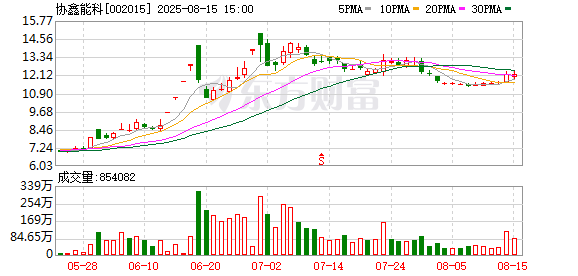
[Performance Forecast](index=1&type=section&id=Item%201.%20Current%20Period%20Performance%20Forecast) The company anticipates a significant year-on-year increase in 2025 first-half net profit, both attributable to shareholders and excluding non-recurring items Key Financial Performance Indicators | Item | Current Period (2025 H1) | Prior Period (2024 H1) | | :--- | :--- | :--- | | **Net Profit Attributable to Shareholders** | **Profit: 493 - 555 million yuan** | Profit: 410.79 million yuan | | Year-on-Year Growth | 20.01% - 35.11% | - | | **Net Profit Excluding Non-Recurring Gains/Losses** | **Profit: 430 - 500 million yuan** | Profit: 276.44 million yuan | | Year-on-Year Growth | 55.55% - 80.87% | - | | **Basic Earnings Per Share** | **Profit: 0.3117 - 0.3509 yuan/share** | Profit: 0.2545 yuan/share | [Communication with Accounting Firm](index=1&type=section&id=Item%202.%20Communication%20with%20Accounting%20Firm) The financial data presented in this performance forecast has not undergone pre-audit by a certified public accountant - The financial data related to this performance forecast has not been pre-audited by a certified public accountant[3](index=3&type=chunk) [Explanation of Performance Change](index=1&type=section&id=Item%203.%20Explanation%20of%20Performance%20Change) The substantial year-on-year performance growth is primarily attributed to increased revenue and profit from energy services and improved performance of existing power plants - Energy service business is the primary driver of performance growth in this period, with both its revenue and profit achieving significant year-on-year increases[4](index=4&type=chunk) - The performance of the company's existing power plants, such as wind power and gas-fired cogeneration, also surpassed that of the prior year period[4](index=4&type=chunk) [Other Explanations](index=1&type=section&id=Item%204.%20Other%20Explanations) The company advises investors that this preliminary performance forecast is subject to uncertainty, with final data to be confirmed in the official 2025 Semi-Annual Report, and cautions regarding investment risks - This performance forecast is a preliminary estimate by the company's financial department, with final data subject to the officially disclosed 2025 Semi-Annual Report[5](index=5&type=chunk)[6](index=6&type=chunk) - The company reminds investors to be aware of investment risks[6](index=6&type=chunk)
协鑫能科:预计2025年上半年净利润同比增长20.01%-35.11%
news flash· 2025-07-14 09:19
协鑫能科(002015)公告,预计2025年1月1日至2025年6月30日归属于上市公司股东的净利润为4.93亿 元-5.55亿元,比上年同期的4.11亿元增长20.01%-35.11%。扣除非经常性损益后的净利润为4.3亿元-5亿 元,比上年同期的2.76亿元增长55.55%-80.87%。基本每股收益为0.3117元/股-0.3509元/股。 ...
公用事业行业资金流入榜:乐山电力、长江电力等净流入资金居前
Market Overview - The Shanghai Composite Index rose by 0.02% on July 7, with 18 out of 28 sectors experiencing gains, led by the comprehensive and public utilities sectors, which increased by 2.57% and 1.87% respectively [1] - The coal and pharmaceutical sectors saw the largest declines, with decreases of 2.04% and 0.97% respectively [1] Capital Flow Analysis - The main capital outflow from the two markets totaled 14.337 billion yuan, with 10 sectors seeing net inflows [1] - The light industry manufacturing sector had the highest net inflow, amounting to 930 million yuan, while the real estate sector followed with a net inflow of 917 million yuan and a daily increase of 1.68% [1] - The electronics sector experienced the largest net outflow, totaling 4.475 billion yuan, followed by the pharmaceutical sector with a net outflow of 3.430 billion yuan [1] Public Utilities Sector Performance - The public utilities sector increased by 1.87% with a net capital inflow of 361 million yuan, where 122 out of 131 stocks in this sector rose, including 11 stocks that hit the daily limit [2] - The top three stocks with the highest net inflow in the public utilities sector were Leshan Electric Power (151 million yuan), Changjiang Electric Power (91.37 million yuan), and Huadian International (84.73 million yuan) [2] - The sector also had five stocks with significant net outflows, led by Huayin Electric Power (-347.25 million yuan), Xiexin Energy (-343.71 million yuan), and Shenzhen Nande A (-138.48 million yuan) [4] Public Utilities Sector Capital Inflow and Outflow - The top inflow stocks in the public utilities sector included: - Leshan Electric Power: +9.99%, 21.36% turnover, 150.57 million yuan inflow - Changjiang Electric Power: +0.33%, 0.21% turnover, 91.37 million yuan inflow - Huadian International: +2.14%, 1.35% turnover, 84.73 million yuan inflow [2] - The top outflow stocks included: - Huayin Electric Power: +10.02%, 11.74% turnover, -347.25 million yuan outflow - Xiexin Energy: +4.28%, 14.39% turnover, -343.71 million yuan outflow - Shenzhen Nande A: +10.00%, 28.53% turnover, -138.48 million yuan outflow [4]
虚拟电厂政策催化市场热潮 协鑫能科以实践领跑行业新赛道
Group 1 - The recent notice from the National Energy Administration emphasizes the pilot projects for virtual power plants, igniting enthusiasm in the capital market and leading to a rise in the virtual power plant concept sector [1] - Virtual power plants are seen as a core vehicle for the digital transformation of energy, presenting a historic development opportunity as the construction of new energy systems accelerates [1] - GCL-Poly Energy (002015.SZ) has established a comprehensive capability in the virtual power plant sector, from resource aggregation to market trading, serving as a benchmark for industry development [1] Group 2 - GCL-Poly Energy has formed a differentiated competitive advantage through a "technology + assets + ecosystem" three-dimensional layout, with a controllable load scale of 550MW in Jiangsu Province, accounting for 30% of the province's actual controllable load [2] - The company’s dual-driven strategy of "energy assets + energy services" has led to the integration of distributed energy, electric vehicle charging stations, user-side energy storage, and industrial loads into its virtual power plant operation platform [2] - GCL-Poly Energy is transitioning from a traditional heavy asset energy production company to a light asset, high-margin energy service company, expanding its virtual power plant business across multiple regions in the country [3]